

High-growth teams face a brutal reality: as lead volume scales, manual qualification becomes impossible. Your sales team drowns in noise while your best prospects slip through the cracks. The solution? Automated lead scoring that separates signal from noise before your team wastes a single minute.
But not all scoring tools are built the same. Some require massive data sets to train effectively. Others lock you into specific CRM ecosystems. The best automated lead scoring tools combine AI-powered intelligence with seamless integration into your existing workflow—whether that means scoring at the point of capture or analyzing behavior across your entire funnel.
We evaluated dozens of platforms based on AI capabilities, integration depth, ease of setup, and scalability for growing teams. Here are the top automated lead scoring tools transforming how high-growth companies prioritize their pipeline in 2026.
1. Orbit AI
Best for: Teams that want to qualify leads at the moment of capture with beautiful, conversion-optimized forms
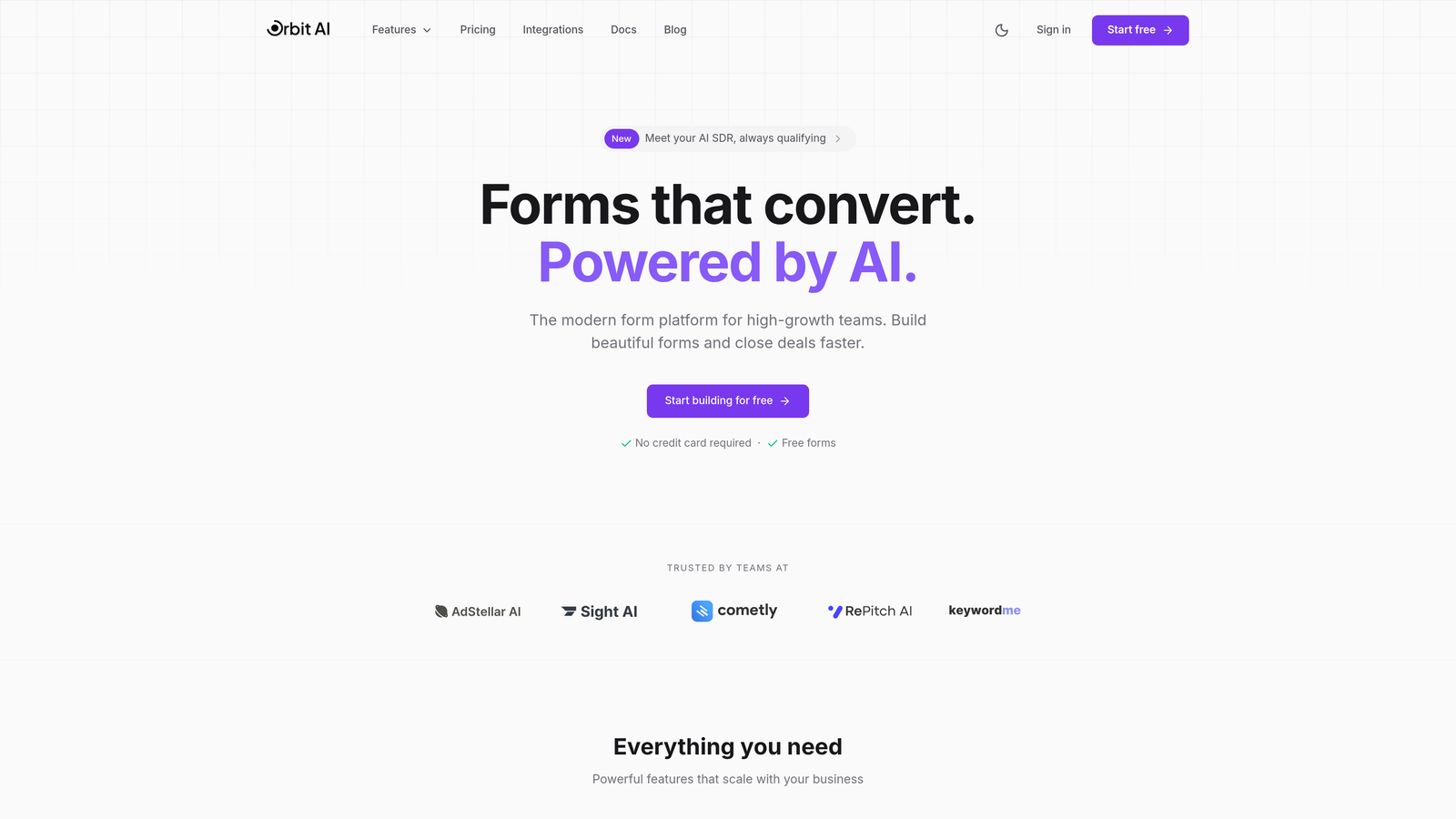
Orbit AI takes a fundamentally different approach to lead scoring by qualifying prospects during form submission—before they ever reach your CRM.
Where This Tool Shines
The breakthrough here is timing. While most scoring tools analyze leads after they're already in your system, Orbit AI scores them at the point of capture. This means your sales team only receives pre-qualified leads, and lower-quality prospects can be routed to nurture sequences automatically.
The platform combines AI-powered qualification with form design that actually converts. You're not choosing between beautiful forms and intelligent scoring—you get both in a single solution built specifically for high-growth teams focused on conversion optimization.
Key Features
AI Lead Qualification: Intelligent scoring analyzes form responses in real-time to determine lead quality instantly.
Automated Routing: High-scoring leads flow directly to sales while lower scores trigger nurture sequences automatically.
Conversion-Optimized Design: Modern, beautiful forms that maintain high completion rates while gathering qualification data.
Native CRM Integrations: Seamless connections with major CRMs ensure scored leads sync instantly with full context.
Form-First Architecture: Purpose-built for teams that want to qualify earlier in the funnel, not after leads are already in the database.
Best For
High-growth B2B teams that generate significant inbound volume through forms and want to qualify leads before they consume sales resources. Particularly powerful for companies where form submissions are the primary lead generation channel and conversion rate optimization matters as much as lead quality.
Pricing
Free tier available for teams getting started. Paid plans begin at $29/month, making it accessible for growing teams that need enterprise-level qualification without enterprise pricing.
2. HubSpot Lead Scoring
Best for: Teams already using HubSpot who need predictive scoring deeply integrated with their marketing automation
HubSpot Lead Scoring combines predictive AI with manual scoring rules inside the HubSpot ecosystem.
Where This Tool Shines
If you're already invested in HubSpot, this is the most natural scoring solution. The predictive scoring engine analyzes your historical conversion data to identify patterns that indicate purchase readiness. It learns which behaviors, properties, and engagement signals actually correlate with closed deals in your specific business.
The real power comes from tight integration with HubSpot's marketing automation. Scores trigger workflows, segment lists, and influence email send logic automatically. Your entire marketing and sales operation can respond to score changes in real-time without custom integration work.
Key Features
Predictive Scoring: Machine learning analyzes your historical data to predict which leads are most likely to convert.
Custom Scoring Properties: Build manual scoring rules based on any contact property, behavior, or engagement metric.
Marketing-Sales Alignment: Scores visible to both teams with shared definitions of what constitutes a qualified lead.
Lifecycle Stage Automation: Automatically advance contacts through lifecycle stages based on score thresholds.
Score Change Triggers: Workflows activate when scores cross specific thresholds, enabling automated responses to engagement shifts.
Best For
Mid-market and enterprise teams already using HubSpot Marketing Hub who want scoring that requires zero integration work. Best when you have at least six months of conversion data to train the predictive model effectively.
Pricing
Included in Marketing Hub Professional at $890/month and above. Predictive scoring requires Enterprise tier. This makes it expensive for scoring alone, but cost-effective if you're already paying for the broader platform.
3. Salesforce Einstein Lead Scoring
Best for: Enterprise sales teams using Salesforce who need AI-powered predictions with full transparency into scoring factors
Salesforce Einstein Lead Scoring brings predictive AI to the world's most popular enterprise CRM.
Where This Tool Shines
Einstein doesn't just give you a score—it explains why. The platform identifies which factors contributed most to each lead's score, giving your sales team context they can actually use in conversations. This transparency builds trust in the scoring system and helps reps prioritize their approach.
The scoring model trains on your Salesforce data automatically, analyzing thousands of data points across leads that converted versus those that didn't. As your business evolves, Einstein adapts its predictions based on new conversion patterns without manual reconfiguration.
Key Features
Predictive Lead Scoring: AI analyzes historical conversion patterns to predict which leads will close.
Conversion Likelihood Predictions: Percentage-based predictions show probability of conversion for each lead.
Score Transparency: View the specific factors that influenced each lead's score for better sales context.
Native Salesforce Integration: Scores live directly in Salesforce with no data syncing or external platforms required.
Automatic Model Retraining: Einstein updates its predictions as new conversion data accumulates in your CRM.
Best For
Enterprise sales organizations with large Salesforce implementations and sufficient historical data (typically 1,000+ leads with known outcomes). Works best when your entire revenue operation lives inside Salesforce and you need scoring that respects your existing workflows.
Pricing
Available as a Sales Cloud Einstein add-on at $50/user/month. Requires Sales Cloud Professional or above as the base subscription, making total cost significant but justified for enterprise teams already committed to Salesforce.
4. MadKudu
Best for: Product-led growth SaaS companies that need scoring based on product usage signals, not just form fills
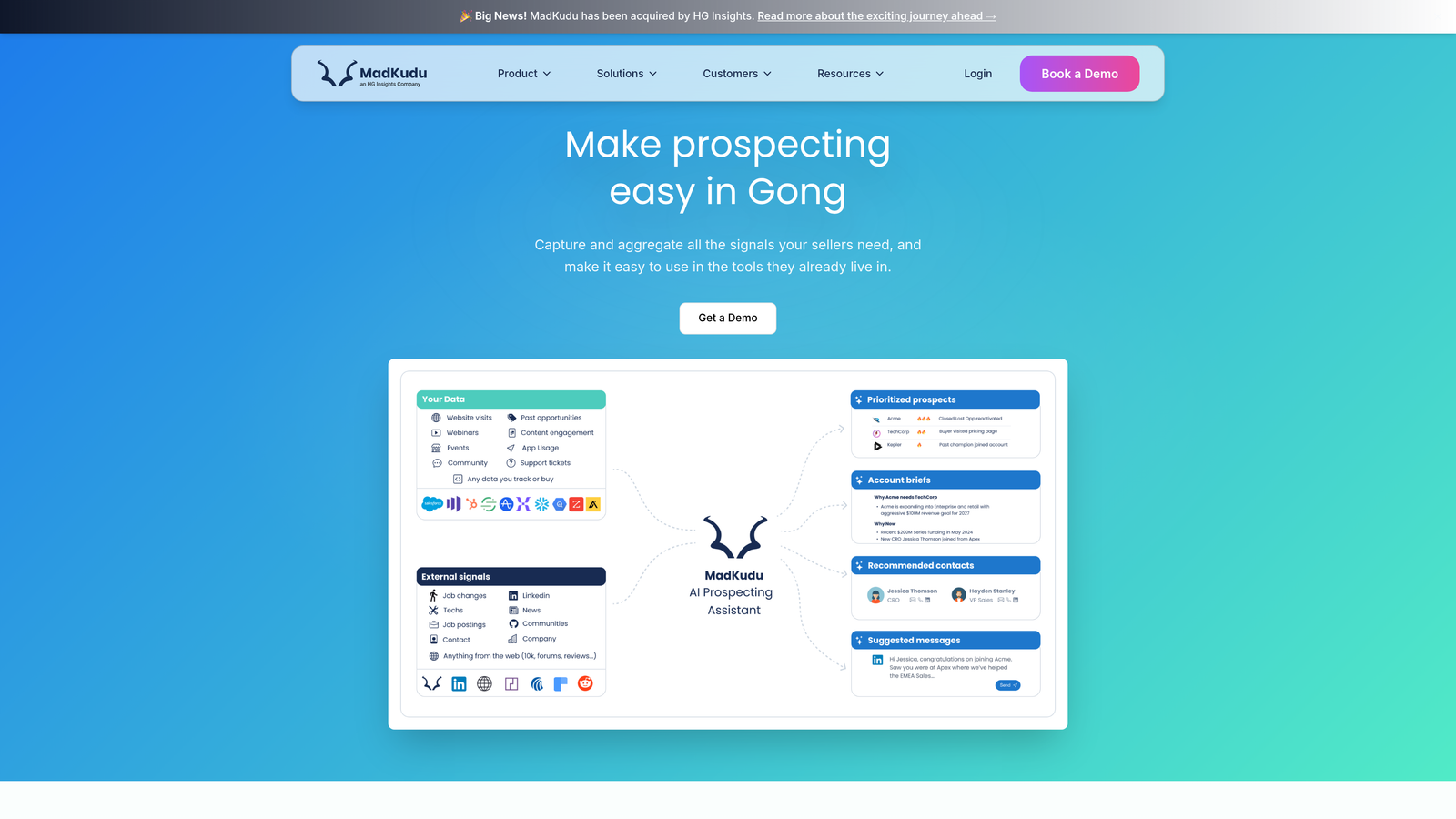
MadKudu specializes in predictive scoring for PLG companies where product engagement is the strongest signal of purchase intent.
Where This Tool Shines
Traditional scoring tools focus on marketing engagement—email opens, website visits, content downloads. MadKudu understands that for PLG companies, product usage is the signal that matters most. The platform analyzes how users actually interact with your product to identify expansion opportunities and purchase readiness.
MadKudu combines product usage data with firmographic and technographic signals to build comprehensive lead profiles. It knows the difference between a solo developer testing your tool and a VP of Engineering evaluating it for their 200-person team. That context transforms how your sales team prioritizes outreach.
Key Features
Product Usage Signals: Scoring incorporates feature adoption, usage frequency, and engagement depth within your product.
Firmographic Enrichment: Automatic data enrichment adds company size, industry, and funding information to every lead.
Real-Time Scoring API: Push scores into any system via API for flexible integration with your entire tech stack.
PLG-Specific Models: Scoring models built specifically for freemium and trial-based business models.
Expansion Opportunity Detection: Identifies existing customers showing signals of upsell or expansion readiness.
Best For
SaaS companies with product-led growth motions, particularly those with freemium models or free trials where product usage is the primary qualification signal. Most effective when you have at least 500 monthly active users generating behavioral data.
Pricing
Custom pricing based on company size and data volume. Typically starts around $20,000/year, positioning it as an enterprise solution for scaling PLG companies with significant ARR.
5. Clearbit Reveal + Scoring
Best for: B2B companies that want to identify and score anonymous website visitors before they fill out a single form
Clearbit Reveal identifies companies visiting your website anonymously and scores them based on fit and intent signals.
Where This Tool Shines
Most scoring tools can only evaluate leads who've identified themselves. Clearbit works earlier in the funnel by identifying companies based on IP address, then enriching that data with firmographic information and behavioral signals. You know who's researching your solution before they ever fill out a form.
The platform scores these anonymous visitors based on how well they match your ideal customer profile and what their on-site behavior reveals about purchase intent. High-scoring accounts can trigger personalized experiences, sales alerts, or targeted advertising—all before the visitor becomes a known lead.
Key Features
Anonymous Visitor Identification: Reveals company information for website visitors who haven't filled out forms yet.
Real-Time Enrichment: Automatically adds firmographic data including company size, industry, and technology stack.
ICP Fit Scoring: Scores accounts based on how closely they match your ideal customer profile criteria.
Intent Signals: Analyzes on-site behavior patterns to gauge purchase intent and research depth.
CRM and MAP Integration: Pushes identified accounts and scores into Salesforce, HubSpot, Marketo, and other platforms.
Best For
B2B companies with significant website traffic from target accounts who want to act on buying signals before prospects formally identify themselves. Most valuable for account-based strategies where knowing who's researching matters as much as who's engaging.
Pricing
Custom pricing based on monthly website traffic volume and data enrichment needs. Enterprise-focused pricing typically requires annual commitments and scales with usage.
6. 6sense Revenue AI
Best for: Enterprise B2B companies running account-based marketing who need intent data and predictive scoring at the account level
6sense Revenue AI combines intent data aggregation with predictive account scoring for complex B2B sales cycles.
Where This Tool Shines
6sense thinks in accounts, not individual leads. The platform aggregates buying signals across an entire organization—tracking who's researching your category, consuming competitor content, and showing signs of active evaluation. This account-level view is essential for B2B companies where purchase decisions involve multiple stakeholders.
The predictive scoring identifies which accounts are in-market right now versus those just beginning research. This timing intelligence helps sales teams strike when accounts are actually ready to engage, rather than wasting effort on organizations still in early education phases.
Key Features
Buyer Intent Data: Aggregates third-party intent signals showing when accounts are actively researching your category.
Account-Level Scoring: Scores entire organizations based on collective buying signals across all contacts and touchpoints.
Buying Stage Predictions: Identifies where accounts sit in the buying journey from awareness through decision.
ABM Orchestration: Coordinates marketing and sales activities based on account scores and buying stage.
Predictive Analytics: AI forecasts which accounts are most likely to convert and when they'll be ready to buy.
Best For
Enterprise B2B organizations with complex sales cycles, multiple decision-makers, and average contract values above $50,000. Most effective for companies already running account-based strategies who need better prioritization of target accounts.
Pricing
Enterprise pricing with annual contracts typically starting at $60,000/year and scaling based on account volume and feature requirements. Significant investment justified by deal sizes and sales cycle efficiency gains.
7. Leadspace
Best for: B2B companies with multiple data sources who need unified lead and account scoring across fragmented systems
Leadspace functions as a customer data platform that unifies first and third-party data for intelligent scoring.
Where This Tool Shines
Most companies struggle with data fragmentation—leads exist in your CRM, marketing automation platform, data warehouse, and third-party tools with no single source of truth. Leadspace solves this by creating unified profiles that combine all available data sources, then scoring those complete profiles rather than partial views.
The platform distinguishes between fit scoring (how well does this lead match our ICP?) and intent scoring (how likely are they to buy right now?). This separation helps teams understand both the quality of the opportunity and the timing of engagement.
Key Features
Data Unification: Combines first-party data from your systems with third-party enrichment for complete lead profiles.
Dual Scoring Models: Separate fit and intent scores provide clarity on both opportunity quality and timing.
TAM Analysis: Identifies total addressable market and prioritizes accounts within your serviceable market.
CRM and MAP Integration: Bi-directional sync with Salesforce, Microsoft Dynamics, Marketo, and other platforms.
Custom Scoring Models: Build scoring logic specific to your business with flexible rule and AI-based approaches.
Best For
Mid-market and enterprise B2B companies dealing with data quality issues and fragmented systems. Most valuable when you have multiple data sources that need consolidation before scoring can be effective.
Pricing
Enterprise pricing with custom quotes based on data volume, number of integrations, and feature requirements. Annual contracts required with pricing typically in the mid-five to six-figure range.
8. Zoho CRM Lead Scoring
Best for: Growing businesses that need affordable scoring with both rule-based and AI options without enterprise complexity
Zoho CRM Lead Scoring offers accessible lead scoring for SMBs and mid-market companies using Zoho's CRM platform.
Where This Tool Shines
Zoho makes lead scoring accessible to companies that can't justify enterprise pricing. You get both rule-based scoring (for teams that understand their qualification criteria) and Zia AI predictions (for teams that want machine learning without the complexity). This flexibility lets you start simple and add sophistication as you grow.
The platform includes negative scoring—a often-overlooked feature that lets you deduct points for disqualifying behaviors or characteristics. If someone downloads a job seeker resource or has a personal email domain, Zoho can automatically reduce their score rather than just failing to increase it.
Key Features
Rule-Based Scoring: Create custom scoring rules based on any lead field, activity, or behavior without AI complexity.
Zia AI Predictions: Machine learning analyzes your data to predict conversion likelihood automatically.
Negative Scoring: Deduct points for disqualifying characteristics or behaviors to filter out poor-fit leads.
Multi-Touch Attribution: Understand which touchpoints contribute most to high-scoring leads over time.
Workflow Integration: Trigger automated actions when leads cross score thresholds.
Best For
Small to mid-sized B2B companies using Zoho CRM who need lead scoring without enterprise pricing or complexity. Best for teams with straightforward qualification criteria that don't require sophisticated intent data or account-level scoring.
Pricing
Included in Zoho CRM Professional plan at $23/user/month and above. This makes it one of the most affordable scoring options for growing teams, particularly when you're already using Zoho for CRM.
9. ActiveCampaign
Best for: Marketing teams focused on email and site engagement who need scoring tied directly to automation workflows
ActiveCampaign integrates lead scoring directly into its marketing automation platform with emphasis on behavioral triggers.
Where This Tool Shines
ActiveCampaign treats scoring as part of automation, not a separate function. Scores change based on email engagement, site visits, and form submissions—then those score changes trigger automations that respond in real-time. A lead who crosses your threshold gets immediately routed to sales or enrolled in a high-intent nurture sequence.
The platform offers both contact scoring (individual lead quality) and deal scoring (opportunity likelihood). This dual approach helps marketing teams qualify leads while sales teams prioritize active opportunities. The scoring logic is visual and intuitive, making it accessible to marketers without technical backgrounds.
Key Features
Contact and Deal Scoring: Score both individual leads and active opportunities with separate logic for each.
Behavioral Trigger Scoring: Adjust scores automatically based on email opens, clicks, site visits, and form submissions.
Email Engagement Tracking: Deep integration with email marketing means engagement signals immediately impact scores.
Automation-Integrated Scoring: Score changes trigger workflow actions without external integration requirements.
Visual Scoring Builder: Intuitive interface for building scoring logic without technical expertise.
Best For
Small to mid-sized businesses where email marketing drives lead generation and qualification. Most effective for companies with active email programs where engagement patterns are strong indicators of purchase readiness.
Pricing
Lead scoring available in Plus plan starting at $49/month for up to 1,000 contacts. Pricing scales with contact volume, making it affordable for smaller teams but potentially expensive as your database grows.
Making the Right Choice
The right automated lead scoring tool depends entirely on where you need to qualify leads and what signals matter most to your business.
For teams that want to qualify leads at the point of capture—before they ever reach your CRM—Orbit AI delivers the earliest possible qualification with forms that actually convert. If you're already committed to a major CRM ecosystem, HubSpot Lead Scoring and Salesforce Einstein provide the deepest native integration without additional platforms to manage.
Product-led growth companies should look at MadKudu, which understands that product usage signals matter more than marketing engagement for freemium and trial-based models. Teams running account-based strategies need account-level scoring from platforms like 6sense or Clearbit that aggregate signals across entire organizations, not just individual contacts.
Budget matters too. Zoho and ActiveCampaign offer capable scoring for growing teams without enterprise pricing, while platforms like 6sense and Leadspace require significant investment justified by complex sales cycles and large deal sizes.
The key is matching your scoring tool to your qualification timing. Do you need to score leads before they reach your CRM, or after they're already in your system? Do you have enough historical conversion data to train predictive models, or should you start with rule-based scoring? Are you qualifying individual leads or entire accounts?
Answer those questions first, then choose the tool that aligns with your existing tech stack, growth stage, and the specific signals that indicate purchase readiness in your market. The best scoring tool is the one that fits naturally into your workflow while surfacing the insights your team actually needs to prioritize effectively.
Transform your lead generation with AI-powered forms that qualify prospects automatically while delivering the modern, conversion-optimized experience your high-growth team needs. Start your free trial today and see how intelligent form design can elevate your conversion strategy.


