

Ever felt like you're just guessing in the morning? Grabbing a sweater, hoping it doesn't wash you out? A "what color suits me quiz" is designed to end that guesswork for good. It's an interactive tool that looks at your natural features—skin undertone, eye color, and hair color—to pinpoint a palette of shades that make you look incredible.
The end result is your own personalized color season—think Winter, Spring, Summer, or Autumn—that gives you a clear roadmap for choosing clothes, accessories, and even makeup with total confidence.
Discover Your Best Colors With Our Interactive Quiz
Stop wondering which colors make you shine and finally get a straight answer. Think of this interactive quiz as your personal color consultant, ready to reveal the shades that help you look and feel your absolute best. We’ll walk you through a few simple, visual questions about your natural look.
You can forget about confusing fashion jargon. We use easy-to-follow guides, like the classic vein test, to help you figure out your skin’s undertones. This is one of the most important pieces of the puzzle in finding your ideal color palette. The goal is to give you an immediate, personalized result that unlocks a new level of confidence in your style.
Find Your Unique Palette
This quiz isn't about following random fashion rules; it's about understanding the science behind your own unique features and making it work for you. Answering that timeless question, "What Colors Look Good On Me?" starts right here, with a tool designed to make color theory simple and personal.
The whole process is straightforward and focuses on three key areas:
- Your Skin's Undertone: We'll figure out if your skin has cool undertones (with hints of pink or blue), warm ones (with yellow or golden hues), or if you fall somewhere in the middle as a neutral.
- Your Natural Hair Color: The quiz takes into account both the shade and tone of your hair, from light ash blonde to deep espresso brown.
- Your Eye Color: Those little flecks of color in your eyes? They hold important clues to which colors will make them pop.
To get started, figuring out your skin's undertone is the most critical step. This quick guide will help you identify it in just a few minutes using simple tests you can do right now.
Quick Guide to Identifying Your Skin's Undertone
Use this table to quickly determine if your skin has cool, warm, or neutral undertones, a key factor in your color analysis.
| Test Method | Cool Undertone Signs | Warm Undertone Signs | Neutral Undertone Signs |
|---|---|---|---|
| The Vein Test | Your wrist veins appear blue or purple. | Your wrist veins look green or olive. | Your veins are a mix of blue and green, or hard to tell. |
| The White Paper Test | Holding a white paper to your face makes your skin look pink or rosy. | Holding a white paper to your face makes your skin look yellow or golden. | Your skin doesn't lean strongly toward pink or yellow. |
| The Jewelry Test | Silver jewelry looks most flattering against your skin. | Gold jewelry brings out the best in your complexion. | Both silver and gold jewelry look great on you. |
| Sun Reaction | You tend to burn easily and turn pink in the sun. | You tan easily and rarely burn. | You might burn at first, but it often develops into a tan. |
Once you have a good sense of your undertone, the rest of the color analysis process becomes much clearer and more accurate.
How It All Comes Together
Answering a few quick questions helps the quiz categorize your features into one of the four seasonal palettes. It's a surprisingly simple system that just works.
For instance, someone with cool undertones, dark hair, and bright, clear eyes often falls into the Winter category. They look absolutely stunning in bold, saturated colors like sapphire blue and true red. On the flip side, a person with warm undertones, golden-blonde hair, and light eyes is likely a Spring, looking their best in vibrant, warm shades like peach and kelly green.
This image shows just how intuitive a tool like this can be. You can see how easy it is to build an interactive experience—much like the quiz you're about to take. Creating engaging tools for customers is simpler than ever, and if you're feeling inspired, you can check out a gallery of ready-to-use quiz and form templates to see how it’s done.
Ultimately, this quiz is here to give you the knowledge to build a wardrobe that truly works for you.
The Simple Science Behind Your Color Results
Ever wonder why a specific color makes you look incredible, while another seems to wash you out completely? It’s not just a matter of luck. There's a simple science at play, a harmony between your natural coloring and the shades you wear. Our "what color suits me quiz" is designed to decode that science for you, analyzing your unique features to pinpoint your most flattering palette.
Think of your skin's undertone as the primer on a painter's canvas. It’s the subtle, underlying color just beneath your skin's surface that dictates how every other color looks when you wear it. This undertone doesn't change when you get a tan or blush; it’s the constant foundation for your entire color story.
Understanding Your Undertones
The first and most critical step is figuring out your skin's undertone. This is the core logic that powers any well-designed color quiz, and there are three main types.
- Cool Undertones: Your skin has subtle hints of pink, red, or blue. Colors like sapphire blue, emerald green, and deep purples look amazing on you because they share that same cool base.
- Warm Undertones: Your skin has underlying shades of yellow, peach, or gold. Rich terracotta, olive green, and creamy whites bring out a natural glow because they vibe with this warmth.
- Neutral Undertones: You have a balanced mix of cool and warm hues. This is the jackpot for versatility, giving you a much wider spectrum of colors to play with.
This concept map breaks down how a quiz systematically looks at your features to deliver a personalized result.
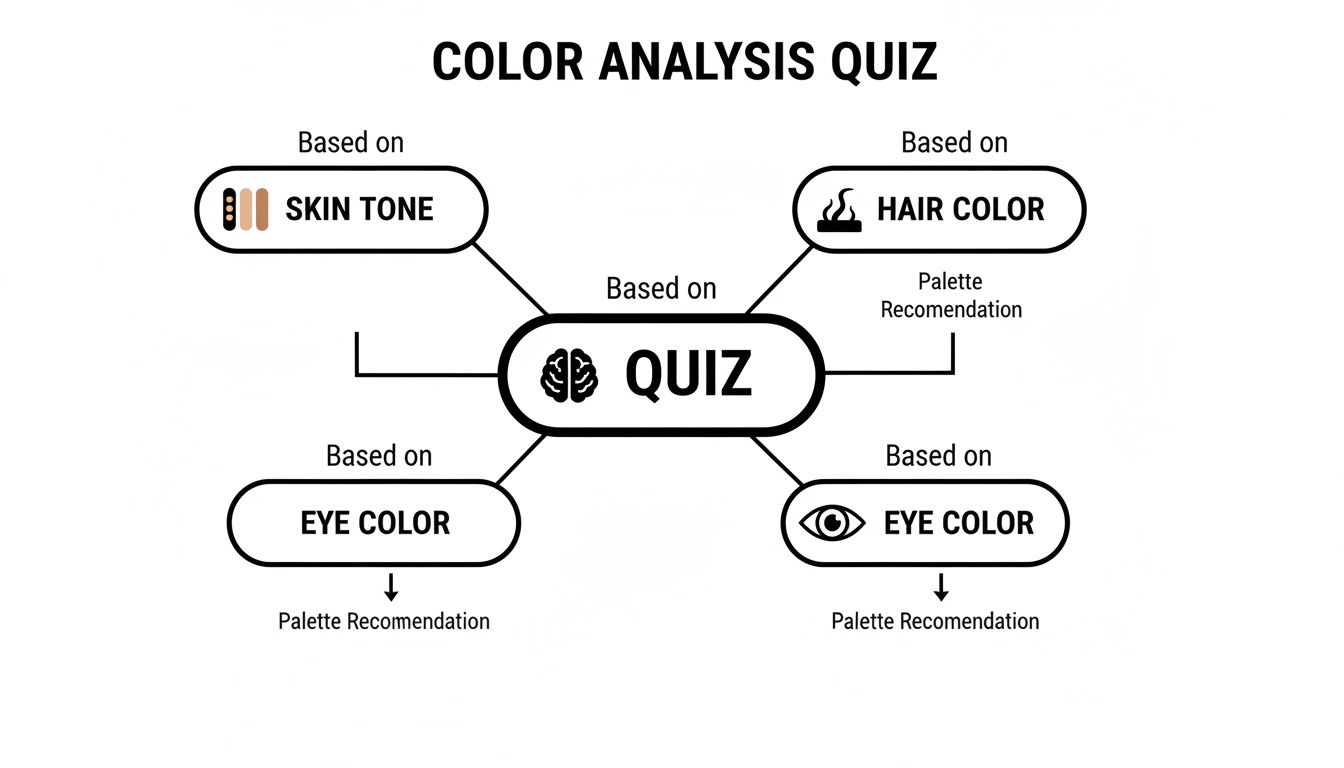
As the visual shows, the quiz doesn't just stop at one factor. It builds a complete picture by combining insights from your skin, hair, and eyes.
More Than Just Skin Deep
While undertone is the foundation, your natural hair and eye colors add crucial layers of detail. The quiz uses the contrast and tone of your hair—from ashy blonde to rich espresso—and even the specific flecks in your eyes to fine-tune your palette.
For example, two people with cool undertones might get totally different recommendations. If one has dark hair and bright blue eyes, she’s likely a "Winter," while another with light hair and soft gray eyes is probably a "Summer."
Key Takeaway: The quiz works by finding the common thread in your coloring. It identifies the dominant temperature (cool or warm) and intensity (bright or muted) across all your features to assign you a seasonal palette where every color just works.
This systematic approach is what makes the results so spot-on. It’s not about following rigid rules, but about giving you a framework that highlights your natural beauty effortlessly.
Building a quiz that makes these complex connections is a powerful way to engage an audience. For those curious about the mechanics, you can learn more about how to build assessment forms that deliver this kind of personalized feedback. The final piece of the puzzle is translating all these inputs into a clear, actionable seasonal palette.
Exploring Your Seasonal Color Palette
So, you've taken the quiz and it's given you a result. But what does "Spring" or "Winter" actually mean? This isn't some random label; it's your key to a time-tested framework that uses your unique features to find the colors that make you shine.
Think of it as a curated collection of shades practically guaranteed to look amazing on you. The quiz didn't just guess. It took your answers about your skin, hair, and eyes and matched them to the palette that creates the most natural harmony. For example, if you noted warm undertones and lighter hair, the system likely pointed you straight to 'Spring'.
Let's unpack what these seasonal palettes really are, so you can see the simple, powerful logic behind your result.
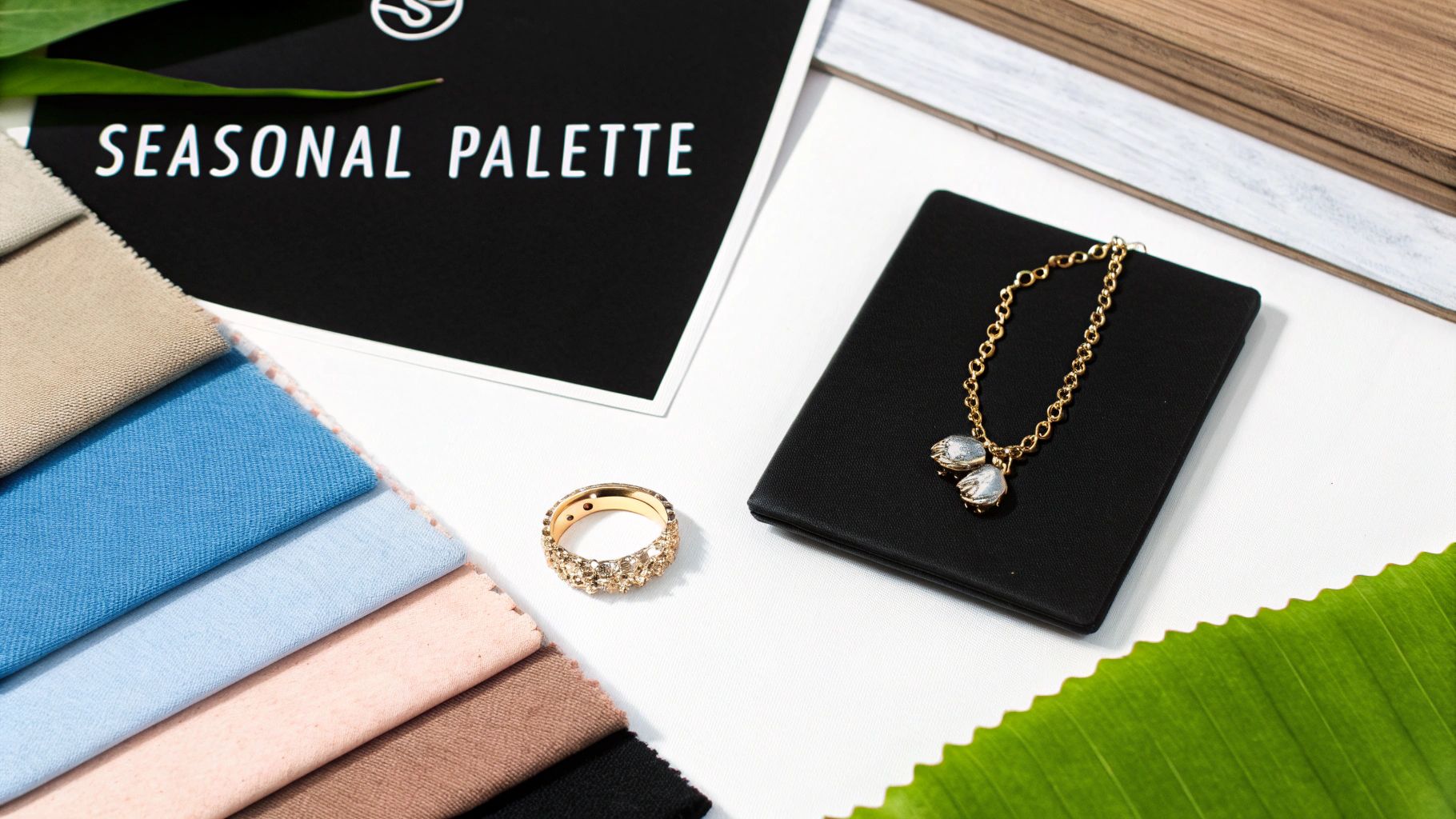
The Four Seasons Explained
Each season represents a unique blend of color properties. We're mainly looking at two things: its underlying temperature (cool or warm) and its intensity (clear and bright, or soft and muted). Finding your season is the secret to unlocking a wardrobe where everything works.
- Winter: This palette is all about cool, deep, and high-contrast colors. Picture a snowy landscape against a brilliant blue sky. Winters look incredible in shades like true black, pure white, bold ruby red, and striking emerald green.
- Spring: Characterized by warm, clear, and bright tones, this palette has all the fresh energy of its namesake. Springs are radiant in colors like warm peach, kelly green, bright aqua, and sunny yellow.
- Summer: This is a cool, soft, and muted palette. Imagine a hazy summer afternoon by the ocean. Summers are flattered by dusty rose, soft lavender, sky blue, and cool mint green.
- Autumn: Full of earthy, rich tones, this palette is warm, deep, and muted. Think of crisp autumn leaves and cozy spices. Autumns absolutely glow in shades like mustard yellow, burnt orange, deep olive, and rich terracotta.
These palettes are your guide, not a set of rigid rules. It's also fascinating how color preferences shift across the globe. Research on how color appeals to target markets shows that blue is the most universally loved color, while our tastes often change as we age—from the bright primary colors kids love to the softer pastels favored by older adults.
Connecting Your Quiz Answers to Your Palette
Let's pull back the curtain and see exactly how the quiz connects the dots. Imagine someone provides these answers:
- Skin Undertone: Warm (their veins appear greenish, and gold jewelry pops).
- Hair Color: Natural golden blonde or a light auburn.
- Eye Color: Light blue, green, or hazel with little gold flecks.
The quiz algorithm takes these inputs and sees a clear pattern. The warmth from the skin and hair, combined with the bright, light quality of the eyes, points directly to the Spring palette. The system knows this person's natural coloring will be amplified by shades that are equally warm and bright.
Key Insight: Your seasonal palette is simply a reflection of your natural harmony. The goal is to wear colors that echo the undertones and intensity already present in your features. This creates a look that's effortlessly cohesive and flattering.
This is exactly why a Winter might feel washed out in Autumn’s muted, earthy tones, or why a Spring can feel totally overpowered by Winter’s deep, high-contrast colors. When you stick to your palette, your clothes and makeup work with your natural beauty instead of fighting against it.
This same personalized logic is a game-changer for e-commerce. You can guide customers to products they'll love by using a similar approach. In our guide, we break down how to create product recommendation quizzes that leverage this kind of analysis to boost sales and keep customers happy.
Bringing Your Best Colors Into Your Daily Life
Alright, you've taken the quiz and discovered your seasonal color palette. Now for the fun part: actually using this knowledge. Think of your palette as your new secret weapon for style—a powerful tool that helps you choose the perfect clothes, makeup, and accessories every single time.
This is your practical guide to weaving these ultra-flattering shades into your everyday life.

Let’s be clear: this isn’t about tossing out your entire wardrobe overnight. The goal here is to make smarter, more confident choices from this point forward. It’s a gradual upgrade, where each new piece you buy works in perfect harmony with your natural coloring.
Practical Styling Tips For Each Season
So, how do you actually apply this? Your seasonal palette gives you a clear roadmap for everything, from a sharp business suit to your weekend casuals. Here’s a quick-start guide to putting these insights into practice.
For the Autumn Palette: You absolutely glow in warm, earthy, and muted shades. Think rich mustard yellows, deep olive greens, and cozy burnt oranges. When it comes to makeup, a warm coral lipstick and shimmering bronze eyeshadow will beautifully highlight your skin's golden undertones.
For the Winter Palette: Your power comes from cool, bold, high-contrast colors. Make a statement in striking jewel tones like emerald green, sapphire blue, and ruby red. A sharp, black power suit or a dress in an electric fuchsia will guarantee all eyes are on you for all the right reasons.
For the Spring Palette: You come alive in warm, bright, and clear colors. Embrace the energy of shades like vibrant peach, light aqua, and sunny yellow. A light, vibrant blouse or a kelly green accessory will bring out your natural radiance without even trying.
For the Summer Palette: You look your best in cool, soft, and muted shades. You'll be stunning in dusty rose, soft lavender, and light sky blue. A flowy dress in a delicate pastel or a simple top in cool mint will perfectly complement your coloring.
Starting Small With Big Impact
Feeling a little overwhelmed by the idea of a complete wardrobe refresh? Don't be. You can make a massive difference by starting small and introducing your colors through accessories. It's an easy, budget-friendly way to experiment and see just how much these shades can do for you.
Pro Tip: Start with items worn closest to your face, because they have the biggest impact. A scarf, a pair of earrings, a necklace, or even the right shade of lipstick can instantly brighten your entire complexion.
Here’s a simple do's and don'ts list to guide you as you start this journey.
| Do's | Don'ts |
|---|---|
| Start with accessories like scarves, hats, or jewelry in your seasonal colors. | Feel pressured to discard clothes you love that aren't in your palette. |
| Trust the process and try shades you may not have considered before. | Ignore your personal style; use your palette to enhance it, not replace it. |
| Choose makeup (blush, lipstick, eyeshadow) that aligns with your undertones. | Buy something just because it's in your palette if you don't genuinely like it. |
At the end of the day, this is all about building a closet that makes you feel incredible every single morning. By slowly weaving in your best colors, you'll create a cohesive, flattering wardrobe that is unapologetically you.
Build Your Own Lead-Generating Quiz With Orbit AI
An interactive "what color suits me quiz" is way more than just a fun distraction for your audience. It’s a seriously powerful lead generation machine. For marketers, this kind of content is a game-changer, letting you attract and qualify potential customers in a way that feels genuinely helpful, not salesy.
This is exactly where Orbit AI comes in. It's the #1 platform for creating beautiful, intelligent quizzes that actually convert. Imagine your e-commerce brand using a quiz to sort users into their seasonal palettes, then sending hyper-personalized product recommendations straight to their inbox. It’s a total win-win: your audience gets valuable style advice, and you get a stream of qualified leads who have told you exactly what they like.
Turn Engagement Into Revenue
With Orbit AI's visual builder, you can whip up a stunning quiz in minutes, and you won't have to write a single line of code. The platform’s AI-powered qualification engine works quietly in the background, helping you turn casual engagement into a predictable revenue stream and a much more efficient sales pipeline.
The appeal here taps into a massive market. This whole "what color suits me quiz" trend mirrors the incredible power of personality tests, which have quietly become multi-billion-dollar tools. Get this: market data shows 80 million people take these kinds of tests every year. That's fueling a sector that was worth $2.3 billion in 2019 and is expected to hit $6.5 billion by 2027. With over 80% of Fortune 500 firms using them, it's clear these tools deliver real business value.
Here's a look at the clean, modern interface you'll use to build your quiz. It makes the whole process feel completely intuitive.
This visual builder gives you total control, so you can make sure your quiz perfectly matches your brand's look and feel.
Advanced Features for Better Leads
Orbit AI goes way beyond just grabbing an email address. It gives you the tools to build a smarter, more effective marketing funnel from the ground up. Here’s how you can take your quiz to the next level:
- Conditional Logic: Show different questions or final results based on how a user answers. This creates a truly dynamic and personal experience for every single person.
- CRM Integration: Automatically send new leads and their quiz results right into your CRM, like Salesforce or HubSpot. No more manual data entry.
- Lead Scoring: Assign points to different answers to pinpoint high-intent leads who are basically raising their hands, ready for a sales conversation.
For an even more advanced approach, you can integrate tools like a ChatGPT Chatbot to create dynamic follow-up conversations right after someone finishes the quiz.
Key Insight: A well-designed quiz doesn't just capture a lead; it gives you a treasure trove of data. By understanding a customer's color preferences from the get-go, you can tailor your email marketing, ad campaigns, and product suggestions for ridiculously higher conversion rates.
By using an advanced tool, you’re moving past simple forms and starting to build interactive experiences that drive real business growth. To see how all these pieces come together, check out our guide on using an AI form builder to create quizzes that not only engage but also qualify leads with precision.
Common Questions About Personal Color Analysis
So you've taken the quiz and discovered your seasonal color palette. That's a huge first step! But finding out you're a "Summer" or an "Autumn" often brings up a whole new set of questions. What if you don't actually like your recommended colors? And can your season change over time?
Don't worry, these questions are completely normal. Let's walk through some of the most common ones so you can start using your new color insights with total confidence.
Can My Colors Change Over Time?
This is probably the number one question people ask, and the short answer is no, your underlying palette doesn't change. Think of it this way: your skin's undertone—that subtle cool, warm, or neutral hue just beneath the surface—is set by your genetics. It’s the foundation of your entire color analysis, and it stays with you for life.
What can change, however, is your surface coloring. Getting a tan, dyeing your hair a dramatic new shade, or even the natural process of going gray can shift the contrast levels between your skin, hair, and eyes. This might mean certain shades within your core seasonal palette suddenly pop more than others, but it won't fundamentally flip you from a warm 'Autumn' to a cool 'Winter'.
What If I Dislike My Recommended Colors?
It can be a little jarring to find out you’re a 'Summer' when you've spent your whole life rocking the bold, high-contrast colors of a 'Winter' wardrobe. But here’s the good news: your seasonal palette isn't a strict rulebook designed to limit you. It’s a guide to help you find the shades that make you look and feel your most vibrant.
You absolutely don’t have to get rid of every piece of clothing you own. Here’s how to ease into a palette you're not immediately in love with:
- Start with accents. If an entire dress in a recommended color feels like too much, try it in a scarf, a piece of jewelry, or a statement handbag first.
- Find variations you actually love. Not a fan of that bright mustard yellow from your 'Autumn' palette? No problem. Maybe a softer gold or a rich camel feels more like you. Every palette has a wide spectrum of shades to explore.
- Keep your flattering colors closest to your face. Wear your old non-palette favorites as pants, skirts, or shoes. For tops, scarves, and necklaces, stick to the colors that make your complexion glow.
How Accurate Are Online Quizzes?
Online quizzes have exploded in popularity for a good reason—they’re fast, accessible, and often surprisingly on-point for most people. Their rise is part of a huge wave in personality testing, a market that hit $2.3 billion in 2019 and is expected to reach $6.5 billion by 2027. This boom is powered by viral digital quizzes, just like the color analysis tools you see everywhere. You can learn more about the boom in personality assessments on leaders.com.
A high-quality online "what color suits me quiz" gives you a strong, reliable starting point by analyzing key visual inputs. While nothing beats an in-person consultation with a trained color analyst using fabric drapes, a well-designed quiz provides a solid foundation to start making smarter style choices right away.
The best quizzes guide you to the right seasonal family by asking clear questions about your natural features. If you want to dive deeper into how these tools work or have other questions, feel free to explore our comprehensive frequently asked questions section. Ultimately, the goal is for you to feel empowered and confident in your style.
Ready to build a quiz that not only engages your audience but also captures high-quality leads? With Orbit AI, you can create beautiful, intelligent forms and quizzes in minutes. Turn website visitors into qualified prospects and streamline your sales pipeline today. Start building for free at Orbit AI.


