

When your team needs more than a drag-and-drop form builder, the conversation shifts quickly to APIs, webhooks, and programmatic control. API-based form solutions let developers embed forms into custom workflows, trigger actions on submission, pipe data directly into CRMs and databases, and maintain full ownership over styling and logic. That's a fundamentally different value proposition from clicking together a form in a visual editor.
The challenge is that this market spans a wide range: full-featured platforms with REST APIs, lightweight webhook endpoints for static sites, specialized flow builders for regulated industries, and AI-enhanced tools that add qualification logic on top of standard form infrastructure. Choosing the wrong one means either over-engineering a simple use case or hitting a ceiling when your needs grow.
The tools below were evaluated on API quality and documentation, integration flexibility, scalability under submission volume, developer experience, and pricing transparency. Whether you're building a lead capture system, a complex onboarding flow, or a simple contact form backend, there's a solution here that fits your stack.
1. Orbit AI
Best for: High-growth teams needing AI-powered lead qualification with full API flexibility
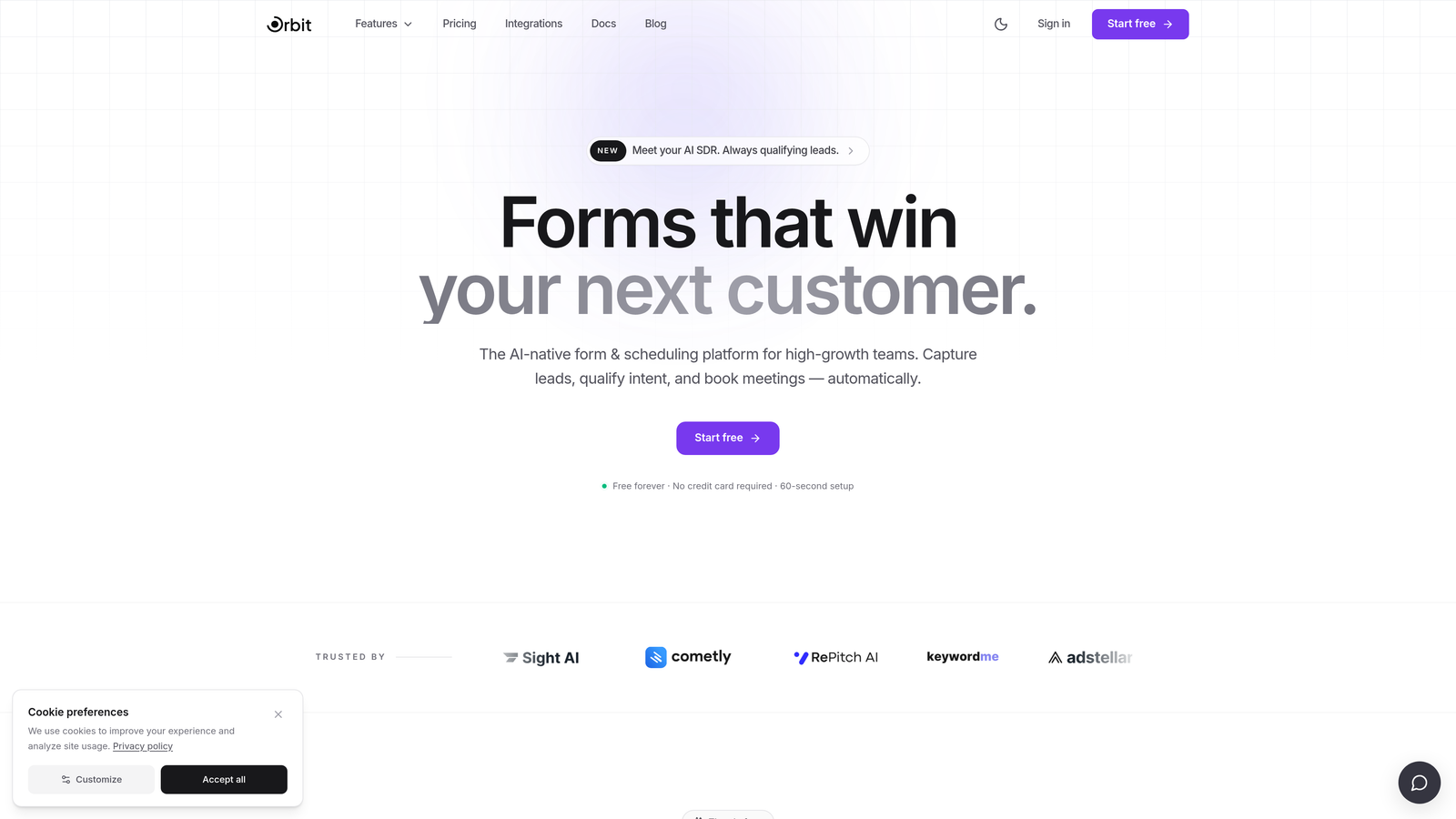
Orbit AI is an AI-powered form builder platform built for teams that want conversion-optimized forms with intelligent lead qualification baked directly into the submission pipeline.
Where This Tool Shines
Most form tools treat submission handling as a passive process: collect data, store it, forward it somewhere. Orbit AI takes a different approach by adding an AI qualification layer that scores and routes leads automatically based on submission data. For high-growth teams running paid acquisition or outbound campaigns, that means your sales team sees prioritized, pre-qualified leads instead of a raw list.
The platform pairs this intelligence with genuinely modern form design. The templates are built for conversion, not just data collection, and the API access lets technical teams embed forms into custom workflows without sacrificing the visual quality that affects completion rates.
Key Features
AI-Powered Lead Qualification: Automatically scores and routes leads based on form submission data, so your team focuses on the highest-value prospects first.
API Access for Programmatic Control: Create forms, retrieve submission data, and manage workflows programmatically through a clean API designed for developer workflows.
Conversion-Optimized Templates: Pre-built form designs engineered for high-growth use cases, from lead capture to demo requests, with completion rates as a core design consideration.
Webhook and CRM Integrations: Automated lead routing to your existing CRM or marketing automation platform on every submission, with no manual data transfer required.
Full Customization Control: Modern, beautiful form design with complete styling flexibility so forms match your brand without compromising on UX quality.
Best For
Growth teams at SaaS companies, agencies running lead generation campaigns, and any team where lead quality matters as much as lead volume. Particularly valuable when you need forms that don't just collect data but actively help prioritize your pipeline.
Pricing
Visit orbitforms.ai for current plans and API access tiers. Free options are available to get started.
2. Typeform
Best for: Teams that want conversational form UX backed by a well-documented REST API
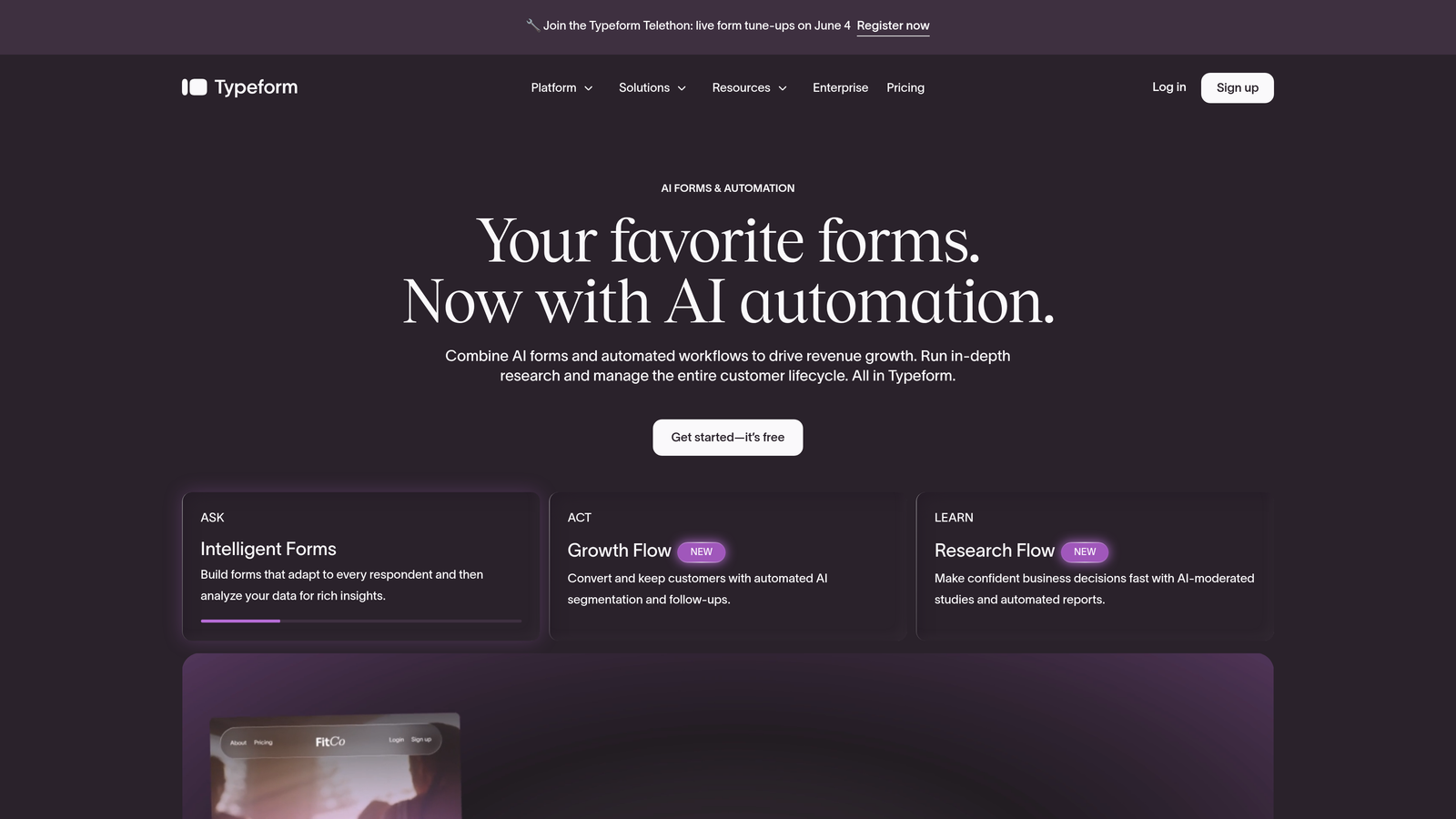
Typeform is a conversational form platform with a mature REST API that supports programmatic form management, response retrieval, and webhook-based integrations.
Where This Tool Shines
Typeform's one-question-at-a-time interface consistently produces higher completion rates for longer forms, and the API lets developers build on top of that UX without reinventing it. You can create and manage forms programmatically, retrieve responses at scale, and trigger downstream actions via webhooks.
The integration ecosystem is extensive, which matters when you need form data flowing into multiple tools simultaneously. The API documentation is thorough and well-maintained, making it a reliable choice for teams with developer resources.
Key Features
Full REST API: Complete CRUD operations for forms, including creation, updates, and deletion, all accessible programmatically.
Webhook System: Real-time submission notifications sent to any endpoint, enabling immediate downstream processing.
Conversational UX: One-question-at-a-time format designed to improve completion rates on longer or more complex forms.
Logic Jumps via API: Conditional branching and skip logic configurable both in the UI and through the API.
Third-Party Integrations: Native connections to HubSpot, Salesforce, Slack, Google Sheets, and hundreds of other tools.
Best For
Marketing teams and product teams that want polished conversational forms with API flexibility. Works well for surveys, lead capture, and multi-step qualification flows where UX quality directly affects completion.
Pricing
Free plan available; paid plans start around $25/month. Full API access is available on higher-tier plans.
3. Formstack
Best for: Enterprise teams needing API-driven form and document workflow automation
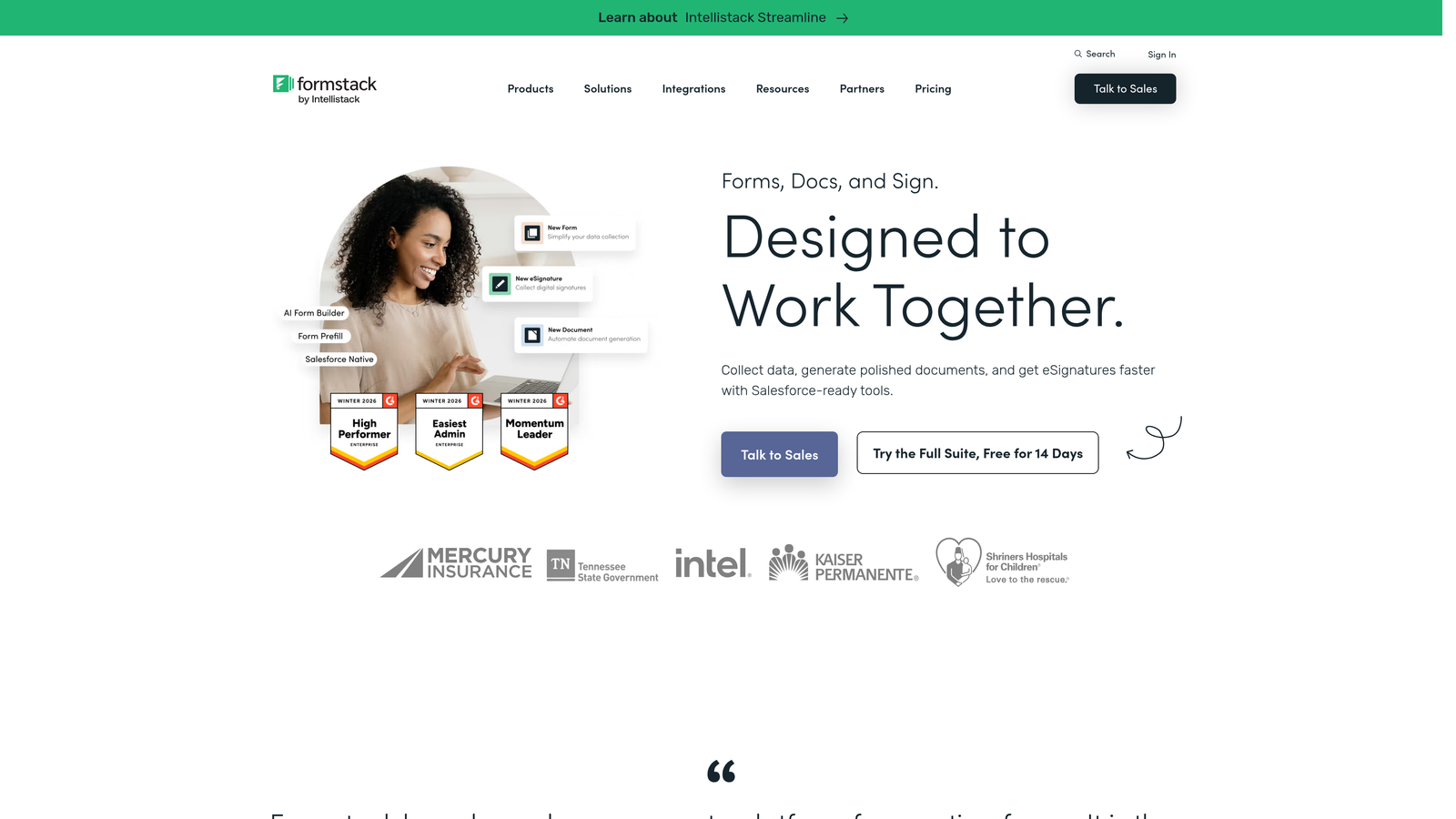
Formstack is an enterprise-grade form and workflow automation platform with a comprehensive API for managing forms, submissions, and document workflows programmatically.
Where This Tool Shines
Formstack goes beyond form collection into full workflow territory. The platform handles document generation, e-signatures, and multi-step approval processes, all accessible via API. For teams in regulated industries or with complex internal processes, that breadth is genuinely useful rather than just a feature checklist item.
The compliance capabilities, including HIPAA-ready configurations, make it one of the few form platforms that enterprise legal and compliance teams will actually approve. Native Salesforce and HubSpot integrations are deep rather than surface-level.
Key Features
Full CRUD REST API: Programmatic management of forms, submissions, and associated data at scale.
Document Generation and E-Signatures: Built-in workflows for generating documents from form data and collecting legally binding signatures.
HIPAA Compliance: Compliance-ready configurations suitable for healthcare, legal, and financial services use cases.
Conditional Logic via API: Complex branching and calculation fields configurable programmatically.
Enterprise Integrations: Native connections to Salesforce, HubSpot, and other enterprise platforms with deep field mapping.
Best For
Enterprise teams and regulated-industry organizations that need form collection as part of a broader workflow automation system. Strong fit for HR, legal, healthcare, and financial services teams.
Pricing
Plans start around $50/month; API access is available on higher-tier plans.
4. JotForm
Best for: Agencies and high-volume operations needing an extensive REST API with generous submission limits
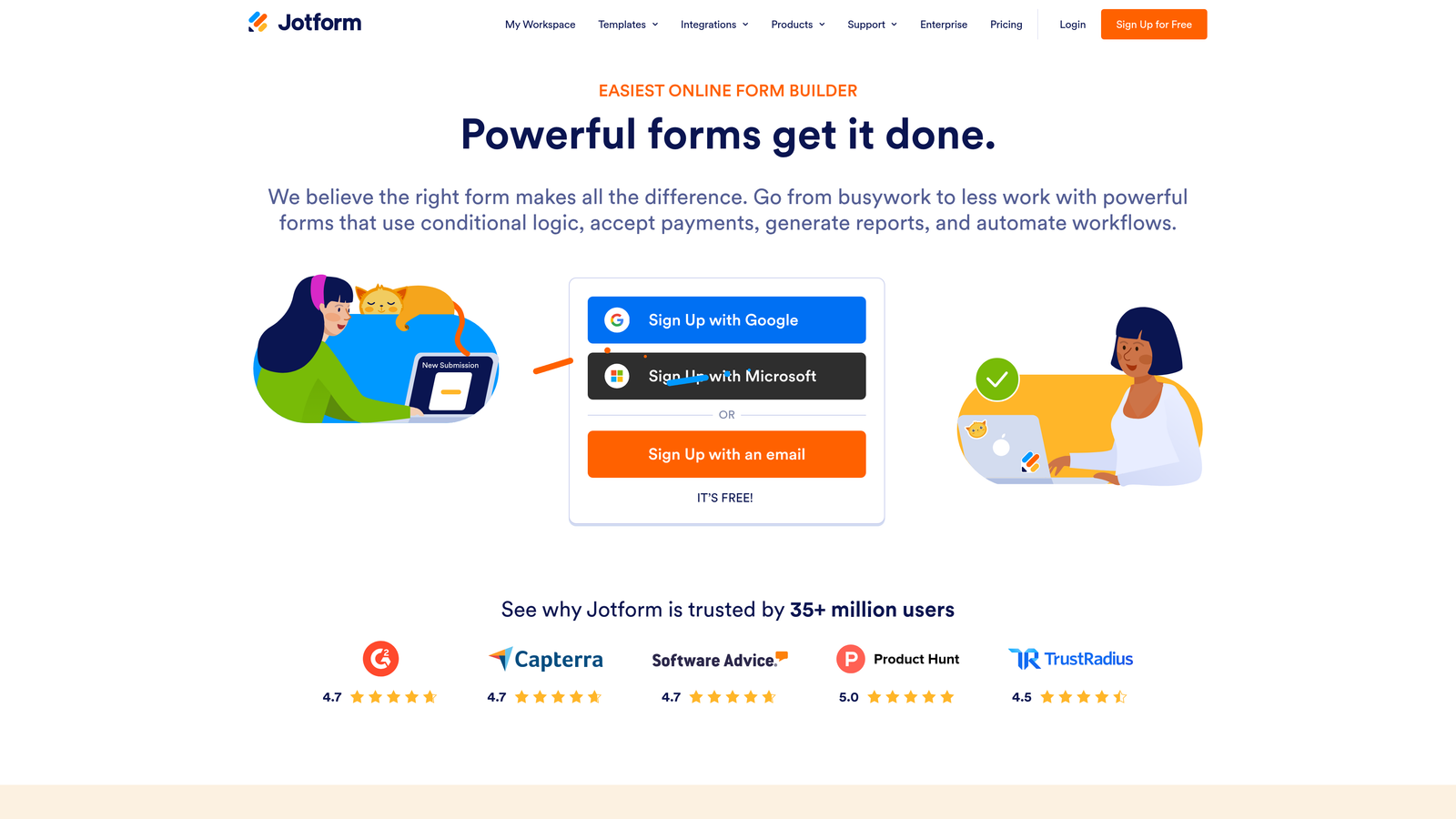
JotForm is a feature-rich form builder with one of the most comprehensive REST APIs in the market, covering form creation, submission management, user administration, and report generation.
Where This Tool Shines
JotForm's API surface area is unusually wide. Beyond basic form and submission management, you can manage users, generate reports, clone forms at scale, and handle payment integrations, all programmatically. For agencies managing forms across multiple client accounts, that depth is genuinely valuable.
The free tier is generous enough for meaningful testing, and the paid plans scale to high submission volumes without requiring enterprise contracts. The template library is extensive, which speeds up form creation when you're managing dozens of forms simultaneously.
Key Features
Extensive REST API: Endpoints covering forms, submissions, reports, users, and folders for comprehensive programmatic management.
High Submission Limits: Paid plans designed to handle agency-scale submission volumes without hitting rate limits constantly.
Payment Form Integrations via API: Programmatic access to payment-enabled forms with Stripe, PayPal, and other processors.
Form Cloning via API: Duplicate and template-manage forms programmatically, useful for multi-client agency workflows.
Generous Free Tier: Five forms and meaningful submission limits for testing and small projects before committing to a paid plan.
Best For
Agencies managing forms across multiple clients, teams with high submission volumes, and developers who need a wide API surface area for complex integrations. Also strong for teams that need payment-enabled forms with programmatic control.
Pricing
Free plan with five forms; paid plans start around $34/month with higher API rate limits and submission volumes.
5. Tally
Best for: Developers wanting a lightweight, webhook-first form tool with a clean free tier
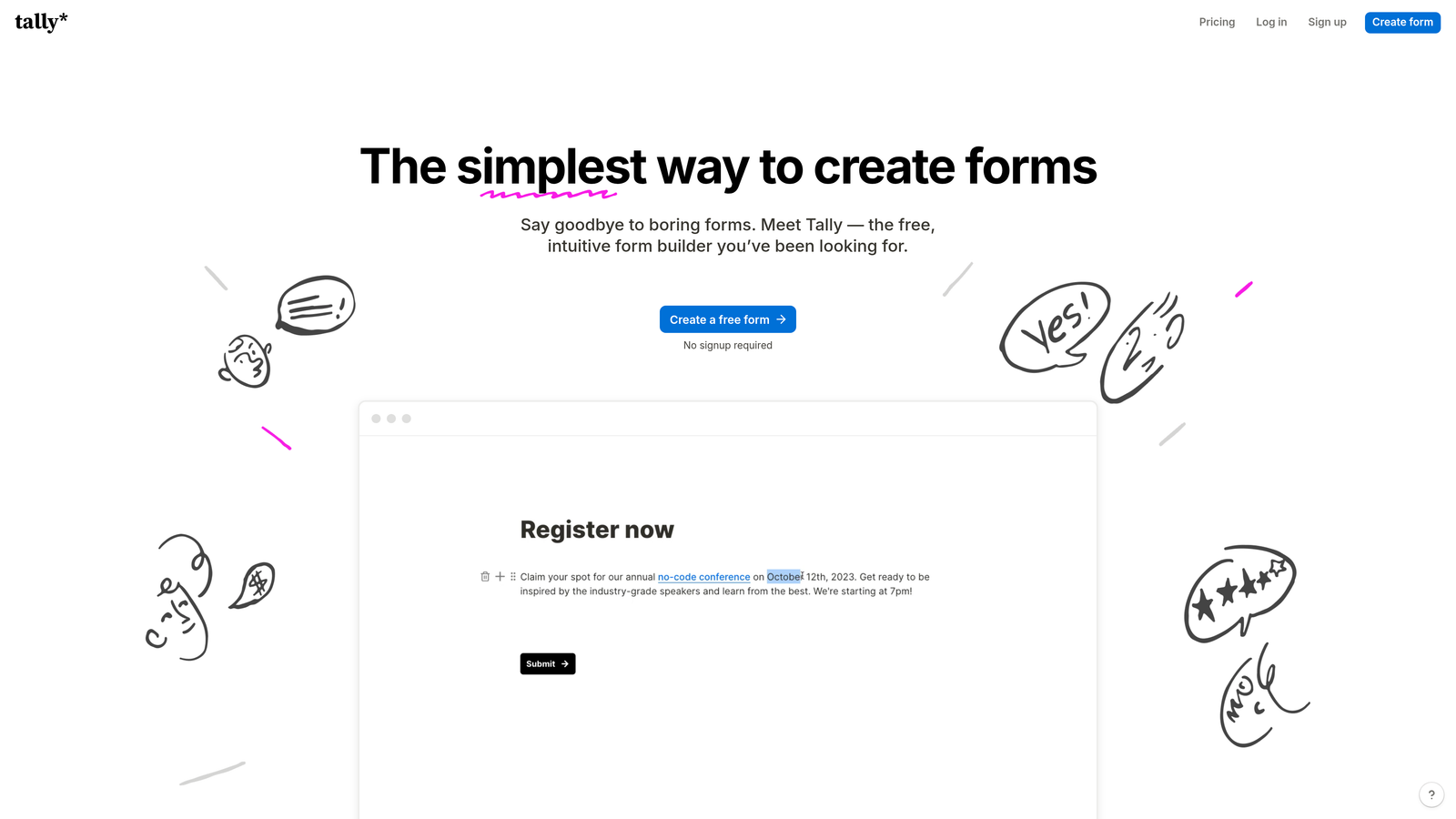
Tally is a minimalist form builder with a webhook-first architecture, designed for developers who want simple form creation with clean data piping to any endpoint.
Where This Tool Shines
Tally's appeal is its simplicity. The form creation experience is Notion-like and fast, and the webhook system sends submission data to any URL without complex configuration. For teams that just need form data flowing into their own backend or a third-party tool, Tally removes a lot of unnecessary friction.
The free plan is genuinely useful, not a stripped-down trial. Unlimited forms and submissions on the free tier make it practical for indie developers, small teams, and anyone who wants to prototype quickly before committing to a paid platform.
Key Features
Webhook-First Architecture: Send submission data to any URL on every form response, enabling clean integration with custom backends and third-party services.
Unlimited Free Forms: No submission or form limits on the free plan, which is genuinely rare in this market.
Clean Form Interface: Notion-inspired creation experience that's fast and intuitive without sacrificing flexibility.
Native Integrations: Direct connections to Notion, Google Sheets, Airtable, and Slack without needing Zapier as middleware.
Embeddable Forms: Customizable embed options for inline, popup, and full-page form implementations.
Best For
Developers, indie makers, and small teams that need reliable webhook-based form handling without paying for features they won't use. Also a strong option for prototyping before migrating to a more complex platform.
Pricing
Free for most features; Tally Pro at $29/month for custom domains, custom branding, and advanced features.
6. Formsort
Best for: Conversion-critical multi-step flows in fintech, healthcare, and regulated industries
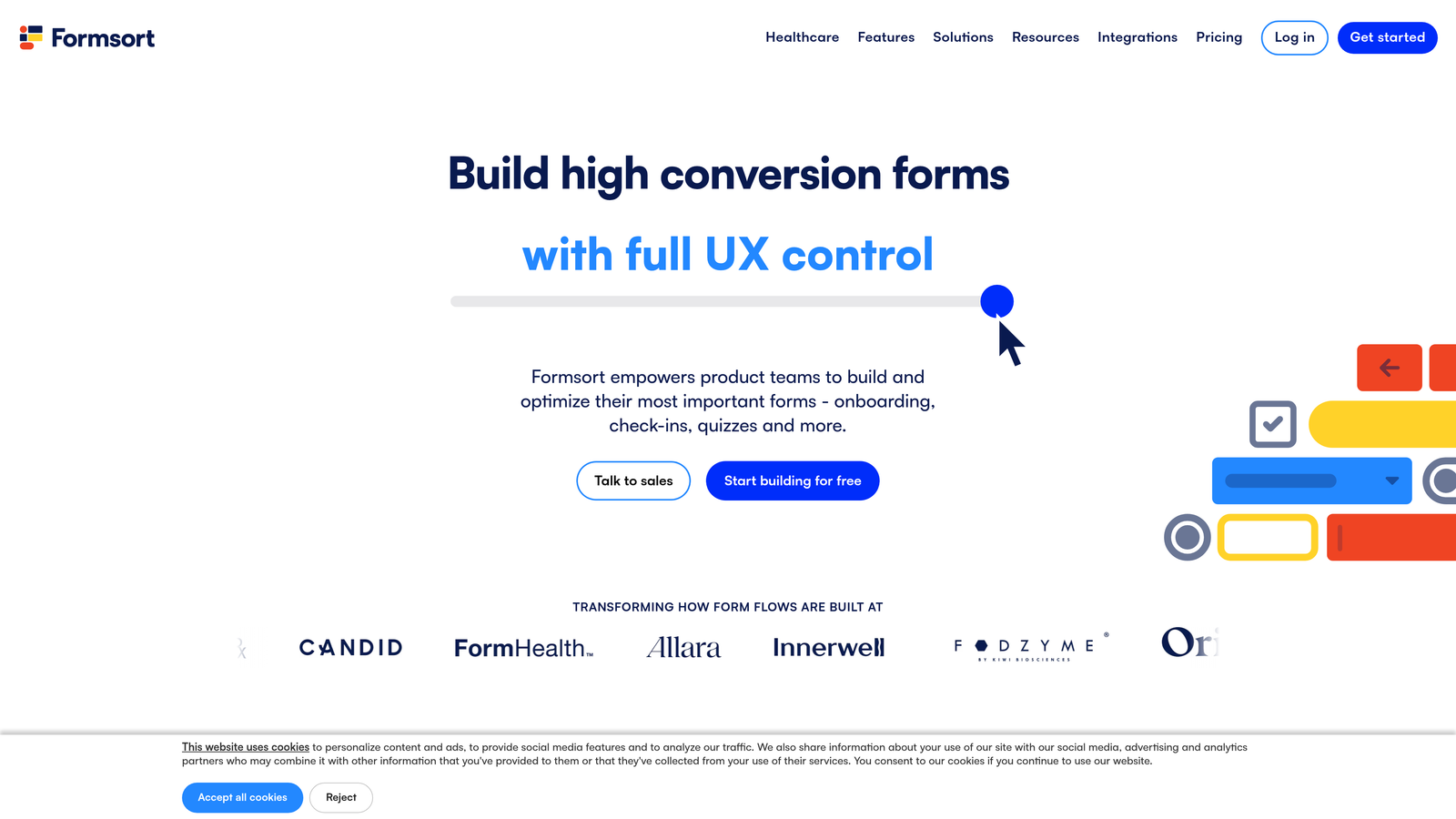
Formsort is a conversion-focused flow builder with deep API and SDK integration, purpose-built for complex multi-step forms where conversion rates directly affect revenue.
Where This Tool Shines
Formsort is designed for the use case where a form isn't just data collection but a critical conversion funnel. The platform supports mid-flow API calls for real-time data validation, built-in A/B testing, and HIPAA-compliant data handling. That combination is rare and genuinely valuable for fintech onboarding, insurance applications, and healthcare intake flows.
The React SDK gives frontend teams full control over the visual implementation while Formsort handles the complex branching logic and data routing underneath. It's a clean separation of concerns that technical teams appreciate.
Key Features
API-Driven Branching Logic: Complex conditional flows configurable via API, handling multi-step logic that would be difficult to manage in simpler tools.
Built-In A/B Testing: Native conversion testing without needing external experimentation tools layered on top.
Mid-Flow API Calls: Real-time data validation and enrichment during form completion, not just at submission.
HIPAA-Compliant Handling: Data handling configurations suitable for healthcare and other regulated industries.
React SDK: Custom frontend implementations with full visual control while leveraging Formsort's backend logic.
Best For
Product and engineering teams at fintech, healthcare, and insurance companies where multi-step forms are conversion-critical and compliance requirements are non-negotiable.
Pricing
Custom pricing based on flow volume; contact Formsort directly for a quote.
7. Basin
Best for: Static sites and JAMstack projects needing a simple form backend with no server-side code
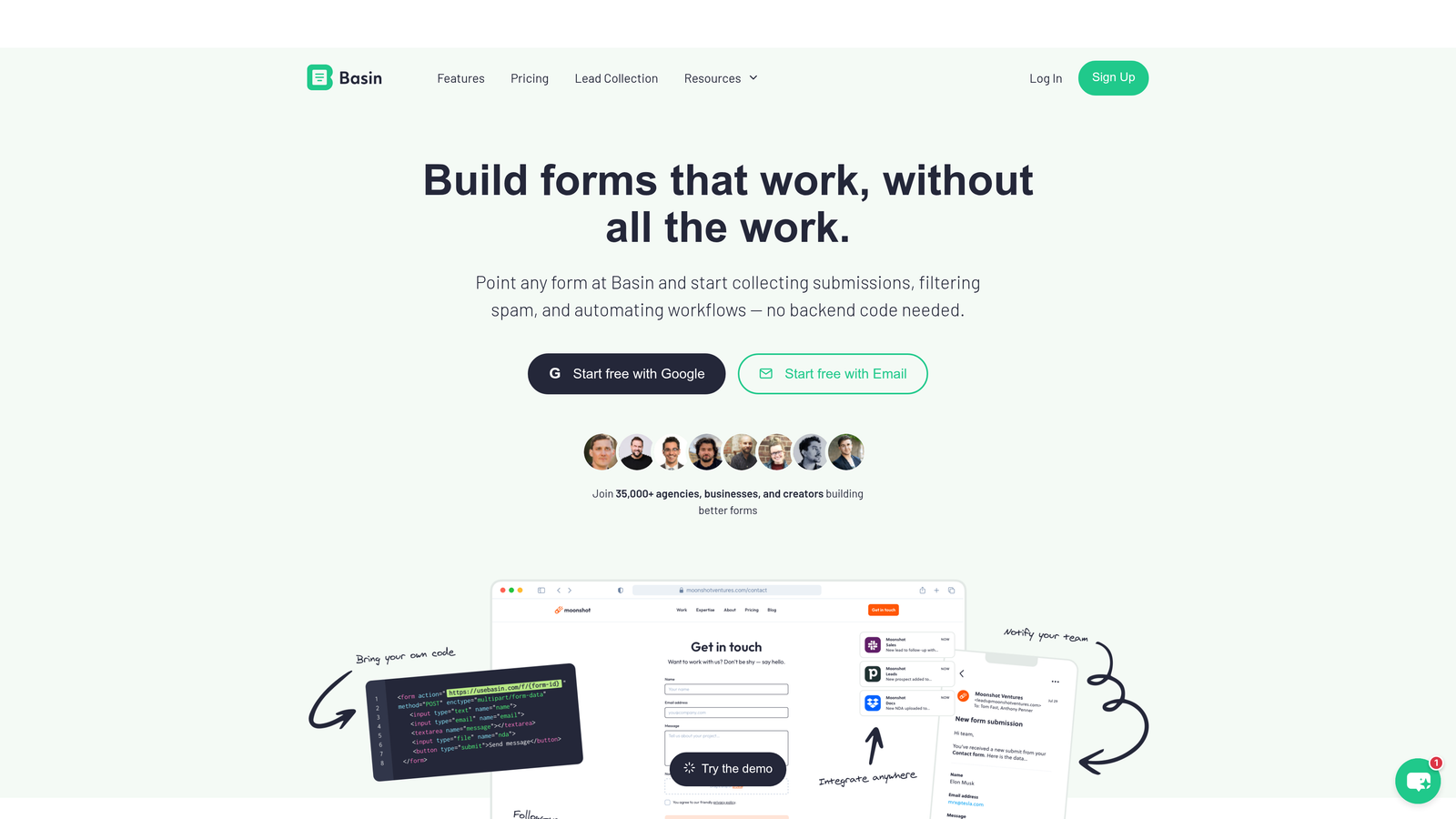
Basin is a form backend service that provides API endpoints for any HTML form, handling submission storage, spam filtering, and webhook forwarding without requiring server-side infrastructure.
Where This Tool Shines
Basin solves a specific problem elegantly: you have an HTML form on a static site, and you need somewhere for the data to go. Point the form's action attribute at a Basin endpoint, and submissions are captured, filtered for spam, and forwarded to your preferred destination. No backend code, no server configuration.
The AJAX submission support makes it practical for single-page applications where a full page reload on form submit would break the user experience. For developers who want form handling without the overhead of building or maintaining a backend service, Basin is a clean solution.
Key Features
Simple Form Endpoints: Point any HTML form's action attribute at Basin to start capturing submissions immediately.
Built-In Spam Filtering: Honeypot fields and reCAPTCHA support to keep submission data clean without manual filtering.
Webhook Forwarding: Forward submissions to external services, enabling integration with your existing notification and data pipeline tools.
File Upload Handling: Accept file attachments through form submissions without building custom upload infrastructure.
AJAX Support: Asynchronous submission handling for single-page applications and custom JavaScript implementations.
Best For
Developers building static sites, JAMstack applications, or any project where adding server-side form handling would be disproportionately complex relative to the need.
Pricing
Free plan with 100 submissions/month; paid plans start at $4.17/month for higher submission volumes.
8. FormKeep
Best for: Developer teams wanting managed form endpoints with team collaboration features
FormKeep is a developer-oriented form endpoint service with managed submission handling, spam filtering, and webhook routing for teams that want a reliable form backend without building one.
Where This Tool Shines
FormKeep sits in similar territory to Basin but adds team collaboration features that make it more suitable for agency and multi-developer environments. Shared form endpoints, a submission management dashboard, and built-in Zapier integration give it slightly more operational depth for teams managing forms across multiple projects.
The zero-backend-code approach is the core value proposition: create an endpoint, wire up your HTML form, and FormKeep handles the rest. The spam filtering and bot detection work quietly in the background without requiring manual configuration for each new form.
Key Features
Managed Form Endpoints: Zero backend code required to start capturing and storing form submissions.
Spam Filtering and Bot Detection: Automated filtering to keep submission data clean across all your form endpoints.
Webhook and Zapier Integration: Route submission data to any downstream tool without custom integration code.
Team Collaboration: Shared form endpoints and submission access for multi-developer or agency team environments.
Submission Dashboard: CSV export and a management interface for reviewing and organizing submission data.
Best For
Development agencies, freelancers managing multiple client projects, and small teams that want a simple, reliable form backend with enough collaboration features to share access across team members.
Pricing
Plans start around $4.99/month per form endpoint.
9. Feathery
Best for: Product-led growth teams building sophisticated signup and onboarding flows
Feathery is an advanced form and onboarding flow builder with a React SDK and REST API, designed for product teams building complex user acquisition and activation experiences.
Where This Tool Shines
Feathery is positioned at the intersection of form builder and onboarding platform. The React SDK lets product engineers embed and customize flows directly inside their web application, while the REST API handles programmatic flow management and data retrieval. Built-in A/B testing and conversion analytics mean teams can optimize flows without adding a separate experimentation tool.
The pre-built integrations with auth providers, payment processors, and CRMs make it particularly useful for product-led growth teams where the signup and onboarding flow is a direct revenue driver. Custom logic rules and API-triggered actions within flows add the kind of flexibility that complex onboarding sequences typically require.
Key Features
React SDK: Embed and fully customize forms and flows directly within your web application's frontend.
REST API: Programmatic flow management, data retrieval, and submission handling for custom backend integrations.
Built-In A/B Testing: Native conversion experimentation without requiring an external testing platform.
Custom Logic and API Actions: Trigger API calls and custom logic rules within flows, enabling dynamic onboarding experiences.
Pre-Built Integrations: Native connections to auth providers, payment processors, and CRM platforms for streamlined product-led growth stacks.
Best For
Product and growth teams at SaaS companies where the signup and onboarding experience directly affects activation rates and revenue. Strong fit for teams that want to iterate quickly on onboarding flows with data-driven optimization.
Pricing
Free plan available; paid plans start around $49/month with full API and SDK access.
Choosing the Right Tool for Your Stack
The right API-based form solution depends almost entirely on what you're trying to build and where you are in your growth stage. There's no single best answer, but there are clear fits for different situations.
For AI-powered lead qualification with API flexibility: Orbit AI is the standout choice for growth teams where lead quality matters as much as volume. The combination of intelligent scoring, conversion-optimized design, and API access is genuinely difficult to replicate by stitching together separate tools.
For conversational UX at scale: Typeform's mature API and polished one-question-at-a-time experience make it the go-to for teams where completion rate is a primary concern.
For enterprise workflows and compliance: Formstack's document generation, e-signature capabilities, and HIPAA-ready configurations make it the right fit for regulated industries and complex internal processes.
For high-volume agency work: JotForm's wide API surface area and generous submission limits serve agencies managing forms across multiple client accounts better than most alternatives.
For lightweight webhook setups: Tally's free tier and clean webhook architecture make it ideal for developers who need reliable form handling without committing to a paid platform.
For conversion-critical regulated flows: Formsort's mid-flow API calls, A/B testing, and HIPAA compliance put it in a category of its own for fintech and healthcare use cases.
For static sites and JAMstack projects: Basin and FormKeep both solve the "where does my HTML form data go" problem cleanly. Basin is slightly simpler; FormKeep adds team collaboration features worth considering for agency environments.
For product-led onboarding: Feathery's React SDK and built-in experimentation tools make it the strongest option for SaaS teams where the signup flow is a direct revenue lever.
The best starting point is to match the tool to your current stack and growth stage, then evaluate the API documentation before committing. Most of these platforms offer free tiers or trials that let you test the developer experience before signing a contract.
If lead generation and conversion optimization are central to your growth strategy, start your free trial today with Orbit AI and see how intelligent form design with built-in lead qualification can transform the quality of your pipeline, not just the volume.


