When your team needs forms that do more than collect data, a drag-and-drop builder with limited export options simply won't cut it. API-driven form solutions give developers and growth teams the programmatic control they need: create forms on the fly, route submissions to any system, trigger real-time workflows, and render forms anywhere in your stack.
But what actually makes a form solution "API-driven"? Look for robust REST or GraphQL APIs with full CRUD operations, webhook support for real-time event triggering, headless or embeddable architecture that decouples form logic from rendering, and the ability to generate and modify forms programmatically. Strong documentation and a healthy integration ecosystem are non-negotiable.
The tools below were evaluated on API completeness, webhook support, headless capability, documentation quality, integration flexibility, and pricing. Whether you're building a conversion-optimized lead capture flow or a complex multi-step onboarding experience, there's a solution here for your stack.
1. Orbit AI
Best for: High-growth teams that need AI-powered lead qualification combined with API-driven form flexibility.
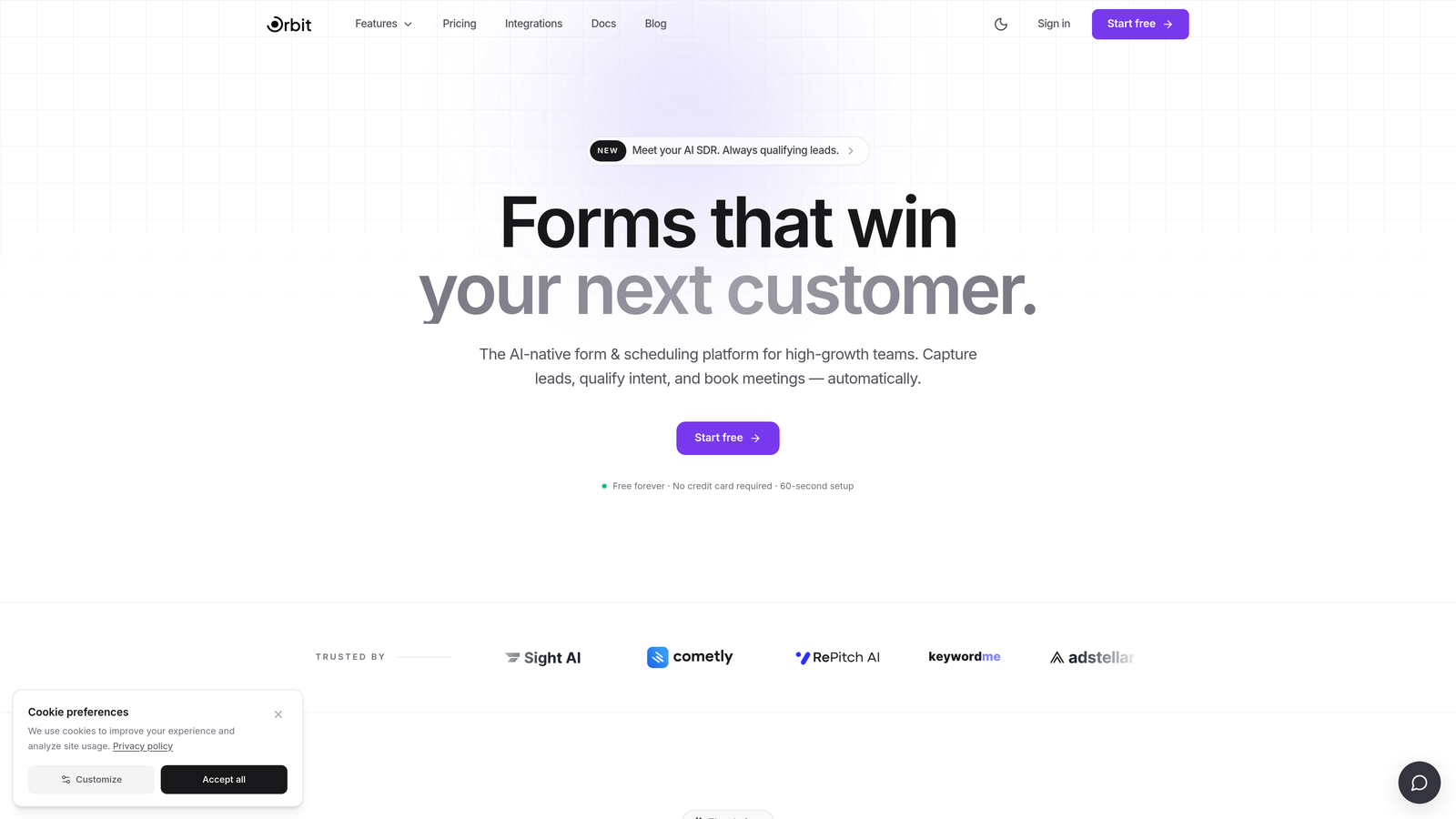
Orbit AI is an AI-powered form builder platform that combines conversion-optimized design with programmatic form management for modern growth teams.
Where This Tool Shines
Most form tools treat qualification as an afterthought, leaving your sales team to manually sort through submissions. Orbit AI bakes lead qualification directly into the form layer, using AI to score and route prospects before they ever hit your CRM. That means your team focuses on the right leads from the start.
The API-driven architecture means forms aren't locked into a visual builder workflow. Developers can create, configure, and manage forms programmatically, while non-technical team members still have access to a clean visual interface. It's a genuinely balanced approach that works for cross-functional teams.
Key Features
AI-Powered Lead Qualification: Intelligent qualification logic built into the form layer automatically scores and routes leads based on response patterns.
Programmatic Form Management: API access for creating, updating, and managing forms and submissions without touching the visual builder.
Conversion-Optimized Templates: Purpose-built templates designed specifically for lead generation flows, not generic data collection.
Dynamic Conditional Logic: Intelligent field routing that adapts the form experience based on user responses in real time.
CRM and Marketing Automation Integrations: Native connectors to the tools your growth stack already depends on, keeping data flowing automatically.
Best For
High-growth SaaS teams, demand generation marketers, and growth engineers who need both the developer flexibility of an API-first platform and the business intelligence of automated lead qualification. Particularly strong for teams where sales and engineering need to collaborate on form strategy.
Pricing
Visit orbitforms.ai for current plans and pricing details. A 7-day free trial gets you started.
2. Typeform
Best for: Teams that want conversational, branded form experiences with mature API coverage for programmatic control.
Typeform is a conversational form platform known for its one-question-at-a-time UX, backed by a well-documented Create API and Responses API.

Where This Tool Shines
Typeform's API maturity sets it apart from most visual-first builders. The Create API lets you generate and modify forms entirely through code, while the Responses API gives you granular access to submission data with filtering and pagination. For teams that need to automate form generation at scale, this is one of the most complete implementations in the market.
The conversational format also tends to drive higher completion rates for longer forms, which matters when you're running qualification flows or research surveys that require multiple fields.
Key Features
Create API: Full programmatic control over form generation, modification, and deletion without touching the visual editor.
Responses API: Retrieve, filter, and paginate submission data directly from your application or data pipeline.
Webhooks: Real-time submission notifications that trigger downstream workflows the moment a form is completed.
Theme Customization via API: Apply and manage branding configurations programmatically across multiple forms.
Integration Ecosystem: Native connectors plus Zapier and Make support for broad automation coverage.
Best For
Marketing and product teams that prioritize user experience in their form design and need robust API access to manage forms at scale. Strong fit for research teams, lead generation flows, and product feedback collection.
Pricing
Free tier available with basic features. Paid plans start around $25/month, with higher tiers unlocking advanced API features and response limits.
3. Formspree
Best for: Developers who want a lightweight form backend without any vendor frontend dependency.
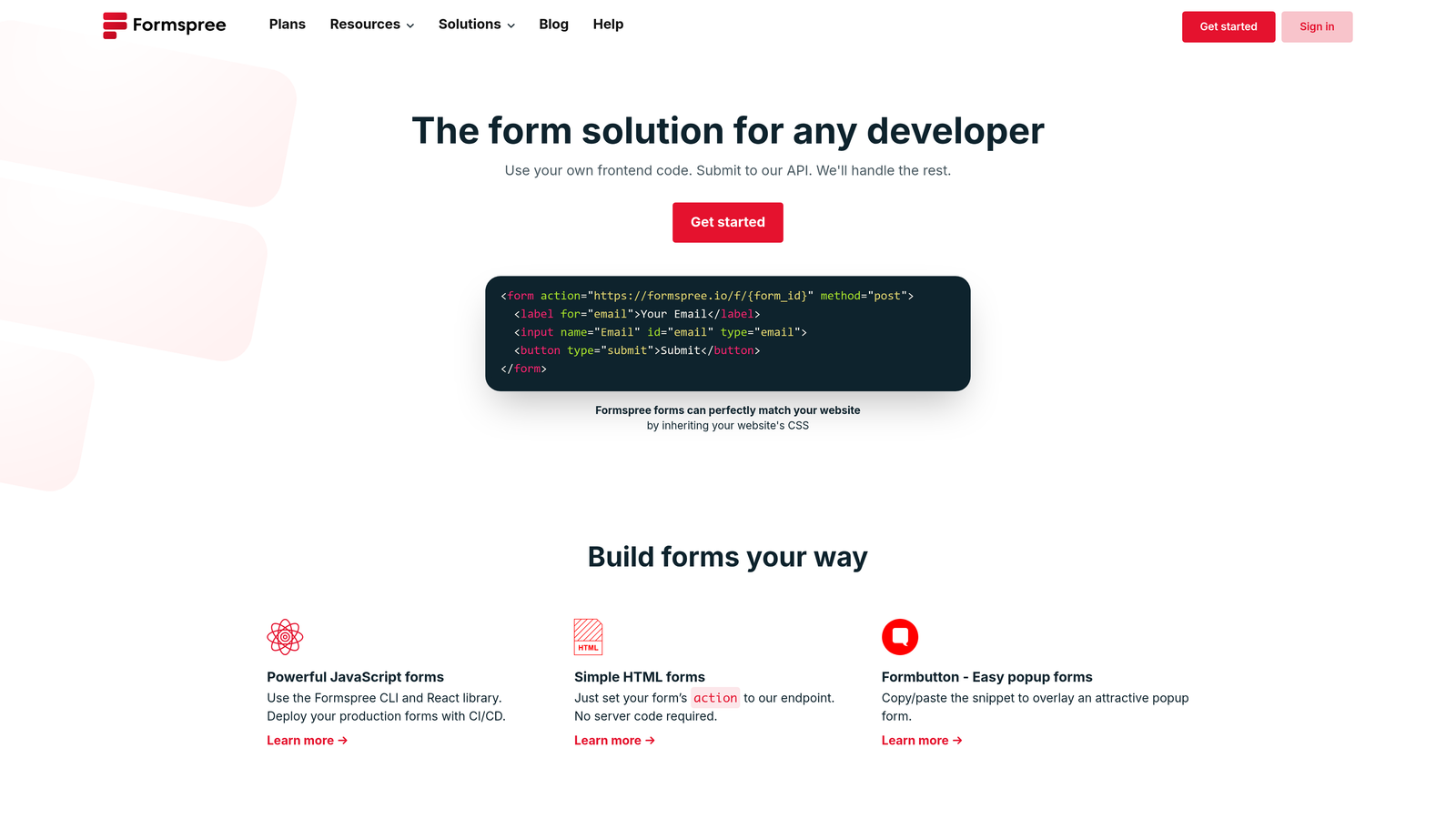
Formspree is a developer-focused form backend that provides API endpoints for any HTML form, completely decoupled from any specific frontend framework.
Where This Tool Shines
Formspree's core value proposition is simplicity without lock-in. Point any HTML form at a Formspree endpoint and submissions are handled, filtered, and forwarded without writing backend code. It works identically whether you're building in React, Vue, Next.js, or plain HTML.
For developers building JAMstack or headless architectures, this is often the fastest path to a reliable form backend. There's no visual builder to navigate, no proprietary embed code to manage. Just a clean REST API and a form that works.
Key Features
Framework-Agnostic Architecture: Works with any frontend stack including React, Vue, plain HTML, and static site generators.
REST API: Manage submissions and form configuration programmatically through a clean API interface.
Built-In Spam Filtering: Akismet and reCAPTCHA support without additional configuration overhead.
File Upload Handling: Accept and manage file attachments through the API with no custom backend required.
Webhook and Zapier Integration: Route submissions to any downstream tool or trigger automation workflows automatically.
Best For
Frontend developers and agencies building static sites, JAMstack applications, or any project where adding a backend solely for form handling isn't justified. Also a strong choice for open-source projects needing a reliable form endpoint.
Pricing
Free tier handles up to 50 submissions per month. Paid plans start at $8/month with higher submission limits and advanced features.
4. Feathery
Best for: Product teams building complex multi-step flows like onboarding, KYC, or application workflows that need headless rendering control.
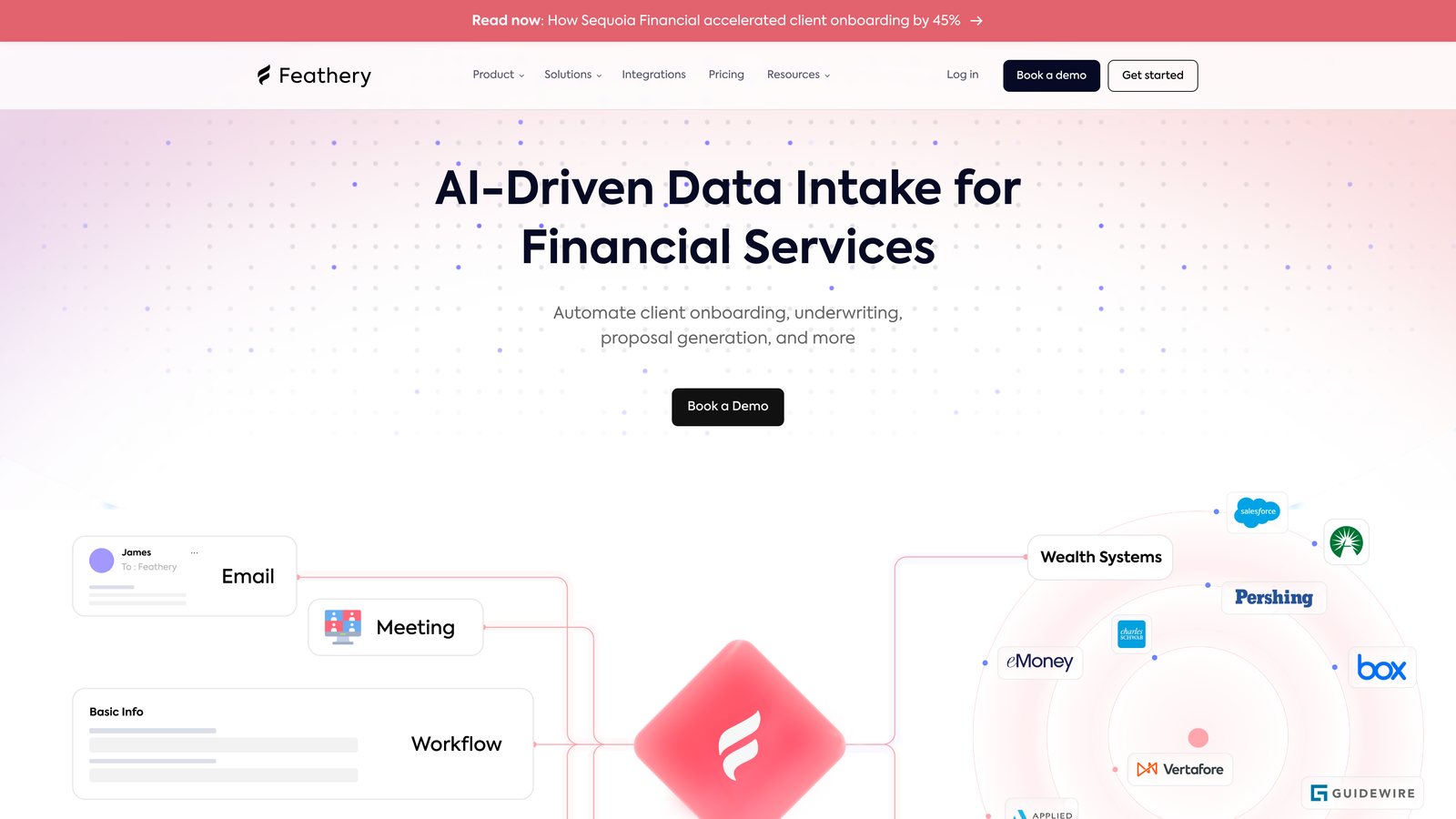
Feathery is an API-first form builder with a dedicated headless mode that separates form logic entirely from the rendering layer.
Where This Tool Shines
Feathery's headless mode is genuinely differentiated. Rather than forcing you to embed a vendor-rendered form, you can consume form logic and structure through the API and render it entirely within your own UI framework. This makes it ideal for product teams that need forms to feel native to their application rather than bolted on.
The visual builder also remains available for non-technical stakeholders, so product managers and designers can collaborate on form structure without requiring engineering involvement for every change.
Key Features
Headless API Mode: Full rendering control by consuming form logic through the API and building your own UI layer.
Visual Builder: Drag-and-drop editor for non-technical team members to configure forms without code.
Advanced Logic Engine: Handles complex multi-step flows including onboarding sequences, KYC verification, and conditional branching.
Native Integrations: Built-in connectors for Stripe, Firebase, Plaid, and other product infrastructure tools.
Custom CSS and JavaScript: Inject custom styling and behavior directly into form components for full design control.
Best For
Product engineers and growth teams at SaaS companies building complex user-facing flows where the form experience needs to feel fully native to the product. Particularly strong for fintech, insurtech, and B2B SaaS onboarding.
Pricing
Free tier available. Paid plans start at $49/month, scaling with team size and feature requirements.
5. Tally
Best for: Teams that want a generous free tier with webhook support and a clean Notion-like editing experience.
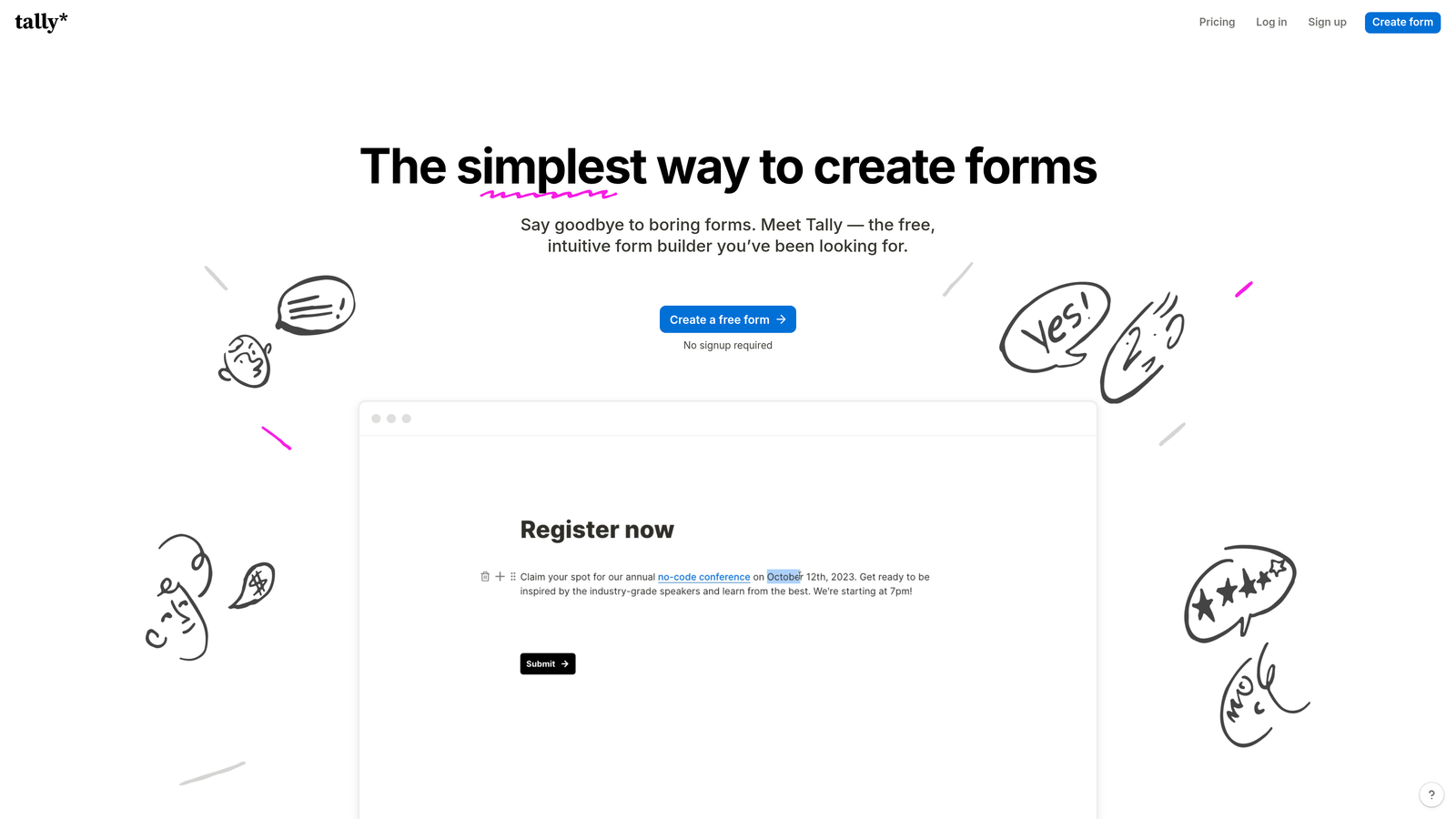
Tally is a minimalist form builder with a block-based editor, offering webhook integrations and API access on one of the most generous free plans in the category.
Where This Tool Shines
Tally's free plan is unusually generous: unlimited forms, unlimited submissions, and webhook support without a credit card. For early-stage teams or developers evaluating options, this removes a lot of friction from the testing process.
The Notion-style editor makes form creation fast and intuitive, which matters when your team needs to iterate quickly on form structure without a steep learning curve. It's not the most API-complete tool on this list, but for teams whose primary need is webhook-driven submission routing, it delivers well above its price point.
Key Features
Block-Based Editor: Notion-style form creation that's fast to learn and easy to iterate on without training.
Webhooks: Real-time submission routing to any endpoint, available even on the free plan.
Unlimited Free Usage: No submission caps or form limits on the free tier, which is rare in this category.
Conditional Logic and Hidden Fields: Dynamic form behavior and pre-population without requiring a paid upgrade.
Automation Integrations: Zapier, Make, and native connectors for connecting submissions to your broader stack.
Best For
Startups, indie developers, and small teams that need reliable webhook-driven form handling without budget constraints. Also a strong fit for internal tools and low-volume lead capture use cases.
Pricing
Free for most features with no submission limits. Tally Pro is available from $29/month for advanced customization and branding options.
6. Jotform
Best for: Enterprise teams that need one of the most comprehensive REST APIs in the form builder market, covering forms, submissions, and user management.
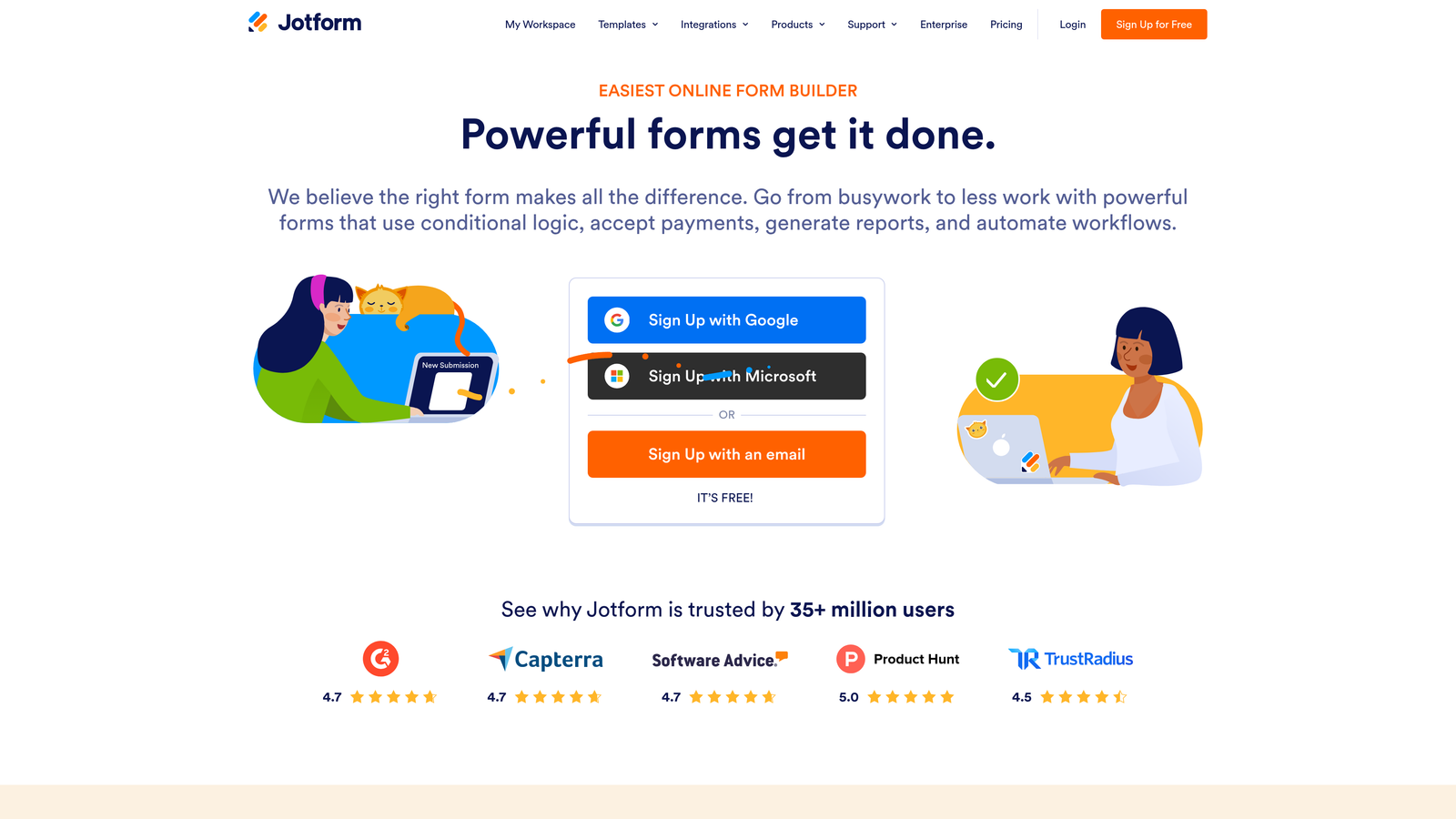
Jotform is an enterprise-grade form platform with extensive REST API coverage across forms, submissions, reports, and account management.
Where This Tool Shines
Jotform's API breadth is hard to match. Beyond basic form and submission management, the API covers user accounts, folders, reports, and payment data, making it viable for teams building internal tooling or reseller platforms on top of the Jotform infrastructure. Full CRUD operations across every major resource type give developers genuine flexibility.
The 10,000+ template library is also accessible via API, which means teams can programmatically deploy pre-configured forms at scale rather than building from scratch each time.
Key Features
Full CRUD REST API: Complete programmatic control over forms, submissions, reports, and user management resources.
Template Library via API: Access and deploy from over 10,000 templates programmatically for rapid form deployment at scale.
Payment Integrations: Native support for PayPal, Stripe, and Square accessible through the API layer.
HIPAA Compliance Option: Available for healthcare teams requiring compliant data handling on form submissions.
User and Folder Management: API support for managing team accounts and organizing forms at the organizational level.
Best For
Enterprise teams, agencies managing multiple client accounts, and organizations in regulated industries like healthcare that need comprehensive API access alongside compliance certifications. Strong for teams building internal platforms or automating form deployment at scale.
Pricing
Free tier supports up to 5 forms. Paid plans start at $34/month with higher form and submission limits plus advanced API features.
7. Paperform
Best for: Teams that need forms with built-in payment processing, appointment scheduling, and lead scoring in a single tool.
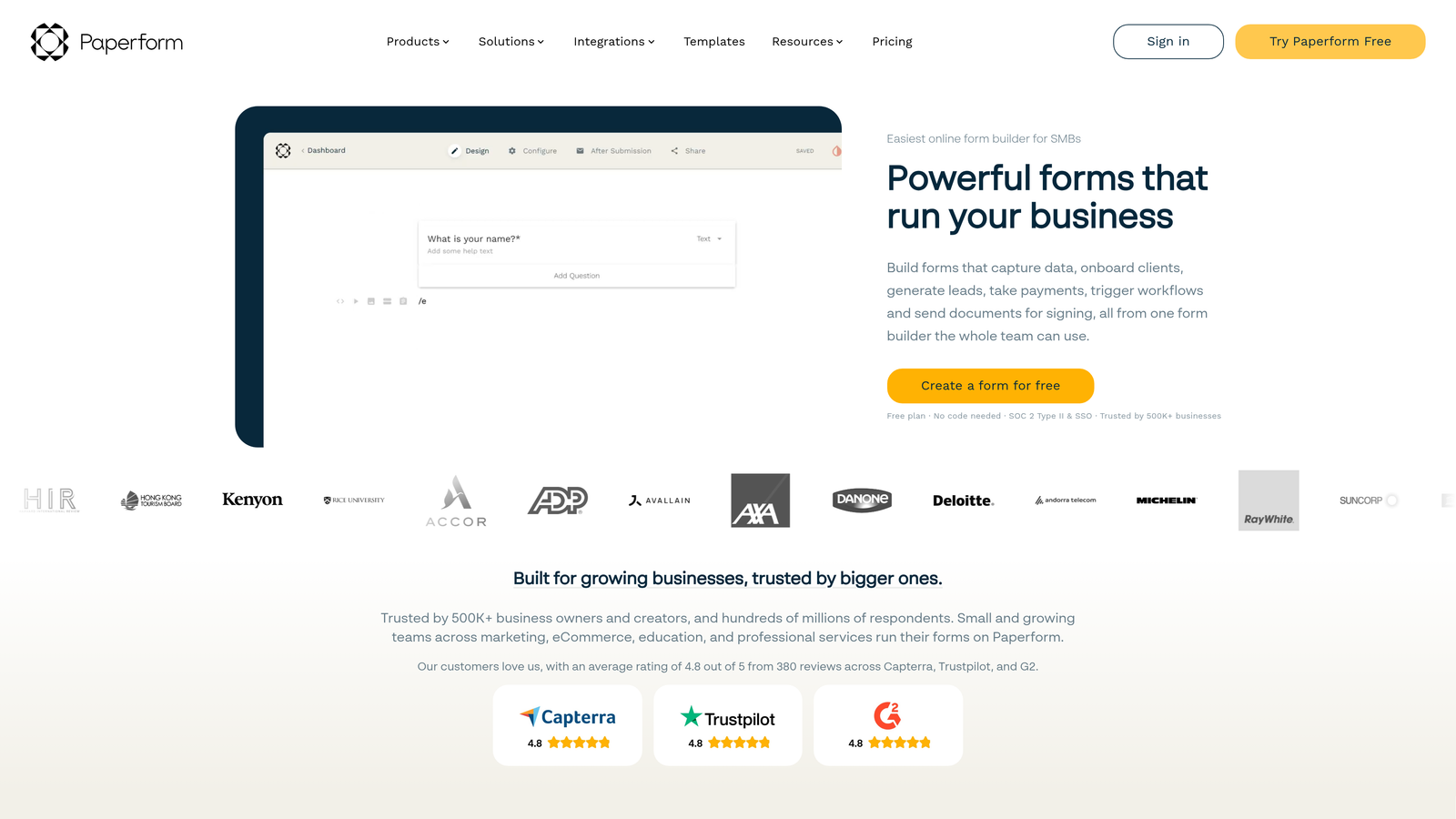
Paperform is a form builder that doubles as a landing page creator, with native payment processing, scheduling, and calculation logic accessible through webhooks and integration layers.
Where This Tool Shines
Paperform occupies an interesting niche: it's more than a form builder but less complex than a full marketing platform. The built-in payment processing and appointment scheduling eliminate the need for separate tools in many use cases, which simplifies the integration surface considerably for smaller teams.
The calculation and scoring features are particularly useful for lead qualification workflows where you want to assign scores based on form responses and route leads accordingly, without building custom scoring logic in your CRM.
Key Features
Built-In Payment Processing: Native Stripe, Square, and Braintree integration for accepting payments directly within form submissions.
Appointment Scheduling: Calendar booking functionality embedded directly within forms without a third-party scheduling tool.
Calculations and Scoring: Formula-based scoring logic for lead qualification and dynamic pricing built into the form layer.
Webhook Support: Real-time submission routing to external systems via webhooks, with Zapier and Make for broader automation.
Landing Page Design: Full-page form layouts with custom branding that function as standalone landing pages.
Best For
Small to mid-size teams in services, consulting, or e-commerce that want to consolidate form collection, payment handling, and scheduling into a single tool. Also useful for lead generation teams that want built-in scoring without CRM configuration overhead.
Pricing
Plans start at $24/month. No free tier, but a free trial is available to evaluate the platform before committing.
8. Basin
Best for: Developers who need the simplest possible form backend with zero JavaScript requirements and a minimal pricing footprint.
Basin is a lightweight form backend service that processes HTML form submissions via API endpoints with built-in spam filtering and file upload support.
Where This Tool Shines
Basin's defining characteristic is its absolute minimalism. There's no JavaScript SDK to install, no embed code to manage, and no visual builder to navigate. You point an HTML form's action attribute at a Basin endpoint and it works. For developers who want form handling that's invisible in their stack, this is about as clean as it gets.
The pricing is also notably accessible for low-to-medium volume use cases, making it a sensible choice for side projects, client sites, or any scenario where form handling volume doesn't justify a more expensive platform.
Key Features
Zero JavaScript Required: Pure HTML form submission via endpoint URL, with no frontend SDK or library dependency.
Built-In Spam Filtering: Honeypot fields and reCAPTCHA support to reduce spam without custom implementation.
File Upload Support: Accept file attachments through the API without building custom upload handling.
Webhook Notifications: Real-time submission forwarding to external endpoints plus Zapier integration for automation.
Custom Redirects: Configure post-submission redirect URLs and thank-you pages without additional code.
Best For
Freelance developers, agencies building client sites, and anyone working on static sites or JAMstack projects where simplicity and cost efficiency are the primary requirements. Not suited for teams needing complex form logic or visual builders.
Pricing
Free tier handles up to 100 submissions per month. Paid plans start at $4.17/month, making it one of the most affordable options in this category.
9. HubSpot Forms
Best for: Teams already in the HubSpot ecosystem that need programmatic form submission tied directly to CRM contact creation.
HubSpot Forms is a form solution deeply embedded in HubSpot's CRM, offering a Forms API for programmatic submission handling and automatic contact lifecycle management.
Where This Tool Shines
If your team runs on HubSpot, the Forms API eliminates a significant integration layer. Programmatic submissions automatically create or update contacts, assign lifecycle stages, and trigger enrollment in workflows and sequences without any middleware. The data fidelity between form submissions and CRM records is as tight as it gets within the HubSpot ecosystem.
Progressive profiling is another standout feature: HubSpot Forms can display different fields to returning visitors based on data already in the CRM, reducing form fatigue without sacrificing data completeness over time.
Key Features
Forms API: Programmatic submission handling that creates and updates HubSpot CRM contacts automatically on every submission.
Automatic Contact Management: Lifecycle stage assignment and contact creation happen natively without additional workflow configuration.
Progressive Profiling: Dynamically swap out fields for returning visitors based on existing CRM data to reduce repeat field friction.
Native Workflow Integration: Form submissions directly trigger HubSpot workflows, sequences, and internal notifications.
Smart and Dependent Fields: Conditional logic that adapts the form based on visitor properties already known to the CRM.
Best For
Marketing and revenue operations teams running HubSpot as their primary CRM. The value compounds significantly the deeper your HubSpot usage is. Less compelling if you're not already invested in the HubSpot ecosystem, since the forms are optimized for that specific data model.
Pricing
Free with any HubSpot CRM account. Advanced features like smart fields and progressive profiling are available in Marketing Hub plans starting at $20/month.
Choosing the Right API-Driven Form Solution for Your Stack
The right choice here depends heavily on where your team sits on the spectrum between developer-first simplicity and full-featured platform capabilities.
If your priority is AI-powered lead qualification combined with API flexibility, Orbit AI is the natural starting point. It's purpose-built for the exact use case high-growth teams face: capturing leads, qualifying them intelligently at the form layer, and routing them into your CRM without manual sorting. The combination of conversion-optimized design and programmatic control is genuinely differentiated.
For teams that need pure backend simplicity without any frontend dependency, Formspree and Basin are the cleanest options. They're both framework-agnostic, minimal in their footprint, and priced accessibly for lower-volume use cases. Basin wins on price; Formspree wins on documentation and developer community.
If you need enterprise-grade API completeness, Jotform's REST API coverage is hard to beat. Full CRUD across forms, submissions, reports, and user management makes it viable for teams building internal platforms or managing forms across multiple client accounts.
For teams already running HubSpot, the Forms API integration is the most direct path to clean CRM data without middleware. And for teams building complex product flows where the form needs to feel fully native, Feathery's headless mode offers the most control over rendering.
The bottom line: API-driven form solutions aren't one-size-fits-all. Match the tool to your stack, your team's technical depth, and the specific workflow you're trying to automate. Then start with a trial or free tier and validate before committing to a paid plan.
Ready to see what AI-powered form qualification looks like in practice? Start your free trial today and experience how intelligent form design can transform your lead generation strategy from passive collection to active qualification.