

Drag-and-drop form builders are great until they're not. The moment you need programmatic form creation, custom validation logic, headless rendering, or deep integration with your existing tech stack, most visual builders hit a wall fast.
For developers building on JAMstack architectures, embedding forms inside SaaS products, or connecting lead capture to complex automation pipelines, what you actually need is an API-first form builder: one with solid documentation, reliable webhooks, flexible SDKs, and submission endpoints that behave predictably at scale.
The tools below were evaluated on API quality and documentation, SDK and language support, customization depth, webhook and integration ecosystems, and pricing structures that make sense for developer use cases. If you're also thinking about how to build effective web forms or need something that holds up under load, check out our guide on form builders for high-traffic websites. Now, let's get into the list.
1. Orbit AI
Best for: High-growth developer teams needing AI-powered lead qualification with full API control
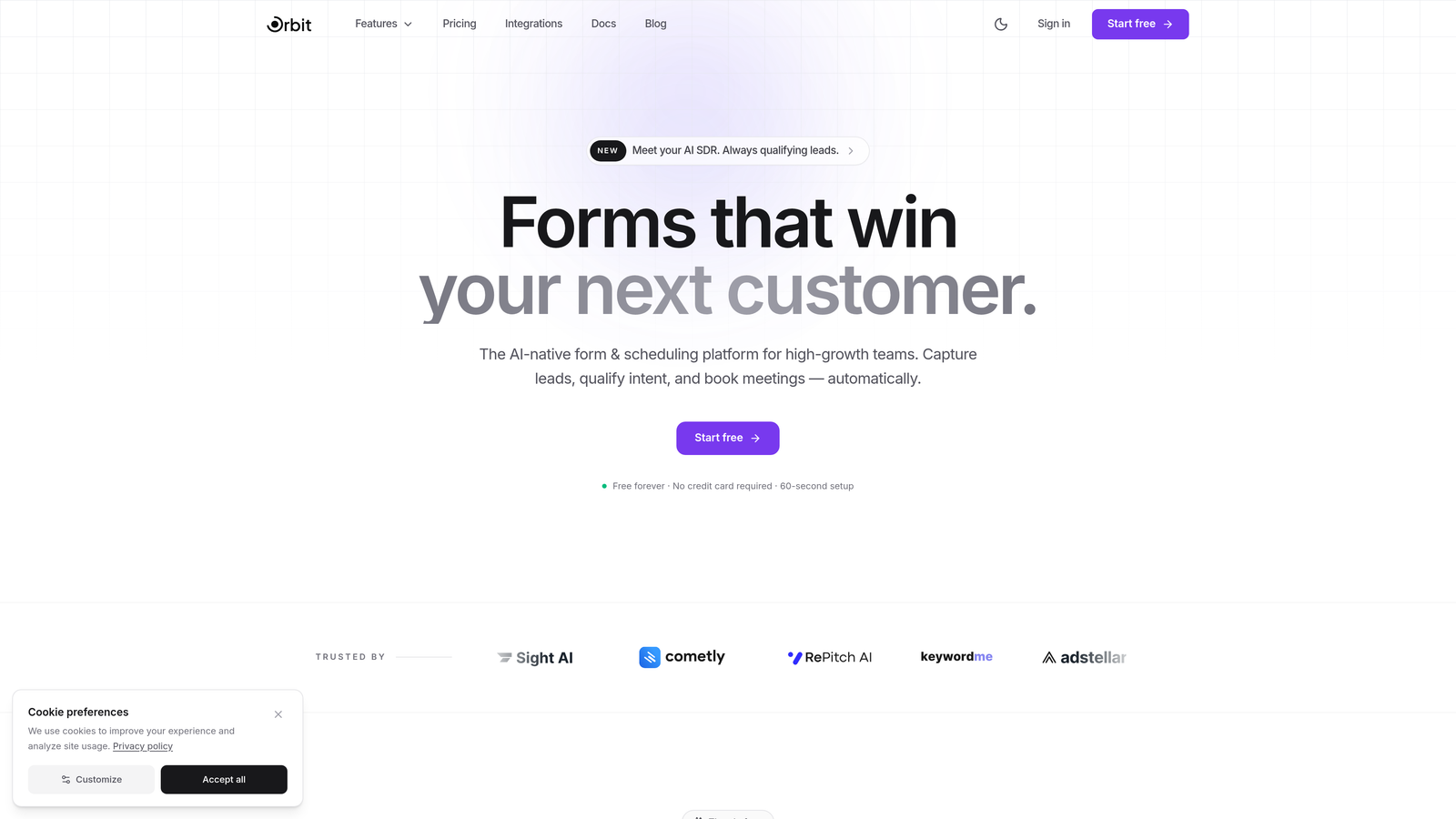
Orbit AI is an AI-powered form builder that combines programmatic control with built-in lead qualification, built specifically for teams where form submissions aren't just data points but pipeline signals.
Where This Tool Shines
Most form builders treat qualification as an afterthought, something you bolt on via a third-party CRM rule after submission. Orbit AI bakes lead scoring and qualification logic directly into the form layer itself. That means by the time a submission hits your API endpoint or webhook, it already carries context about lead quality.
For developer teams at high-growth SaaS companies, this is genuinely useful. You're not just collecting form data; you're receiving enriched, pre-qualified signals that your sales automation or CRM can act on immediately. Pair that with conversion-optimized templates designed for modern web experiences, and you get a form builder that works as hard on the business side as it does on the technical side.
Key Features
AI-Powered Lead Qualification: Intelligent scoring and qualification logic embedded at the form level, so every submission arrives pre-assessed.
Programmatic API Access: Full API for form creation, configuration, and submission retrieval, giving developers complete control without touching the UI.
Conversion-Optimized Templates: Modern, high-converting form designs built for the aesthetics and UX standards that high-growth teams expect.
Webhook Integrations: Real-time webhook delivery to CRMs, marketing automation platforms, and custom endpoints.
High-Traffic Architecture: Built to handle the volume and reliability demands of fast-scaling products without degrading performance.
Best For
Developer teams at B2B SaaS companies or high-growth startups who need API access alongside intelligent lead qualification. If your forms are a key part of your top-of-funnel pipeline and you want the data arriving pre-enriched, Orbit AI is purpose-built for that use case.
Pricing
Visit orbitforms.ai for current plan details. A free tier is available to get started without a credit card.
2. Typeform
Best for: Developers building conversational form experiences with a mature, well-documented API
Typeform is a conversational form platform with one of the most mature Create APIs in the space, letting developers programmatically build, update, and retrieve forms and responses.

Where This Tool Shines
Typeform's API documentation is genuinely good, which matters more than it sounds. The Create API allows you to define entire forms programmatically: questions, logic jumps, themes, and metadata, all via JSON payloads. That level of control is rare in tools that also prioritize end-user design quality.
The Responses API adds another layer of utility, offering filtering, pagination, and structured response data that integrates cleanly with data pipelines. For teams that want the polished one-question-at-a-time UX without sacrificing developer control, Typeform hits a strong balance.
Key Features
Create API: Programmatically generate and edit entire forms, including logic, themes, and question types, via REST endpoints.
Responses API: Retrieve submission data with filtering and pagination support for clean data pipeline integration.
Webhooks: Real-time submission notifications delivered to any endpoint you configure.
SDKs and Embed Options: Well-documented embed SDKs for web with JavaScript support and iframe options.
Conversational UX: One-question-at-a-time interface that consistently improves completion rates for longer forms.
Best For
Teams building lead capture, surveys, or onboarding flows where the conversational UX is a strategic choice, and where developers need reliable API access to manage forms and retrieve data programmatically.
Pricing
Free tier available with limited responses. Paid plans start around $25/month, with higher tiers unlocking API rate limits and advanced features.
3. Formspree
Best for: Frontend developers who want a zero-backend form endpoint for static sites and SPAs
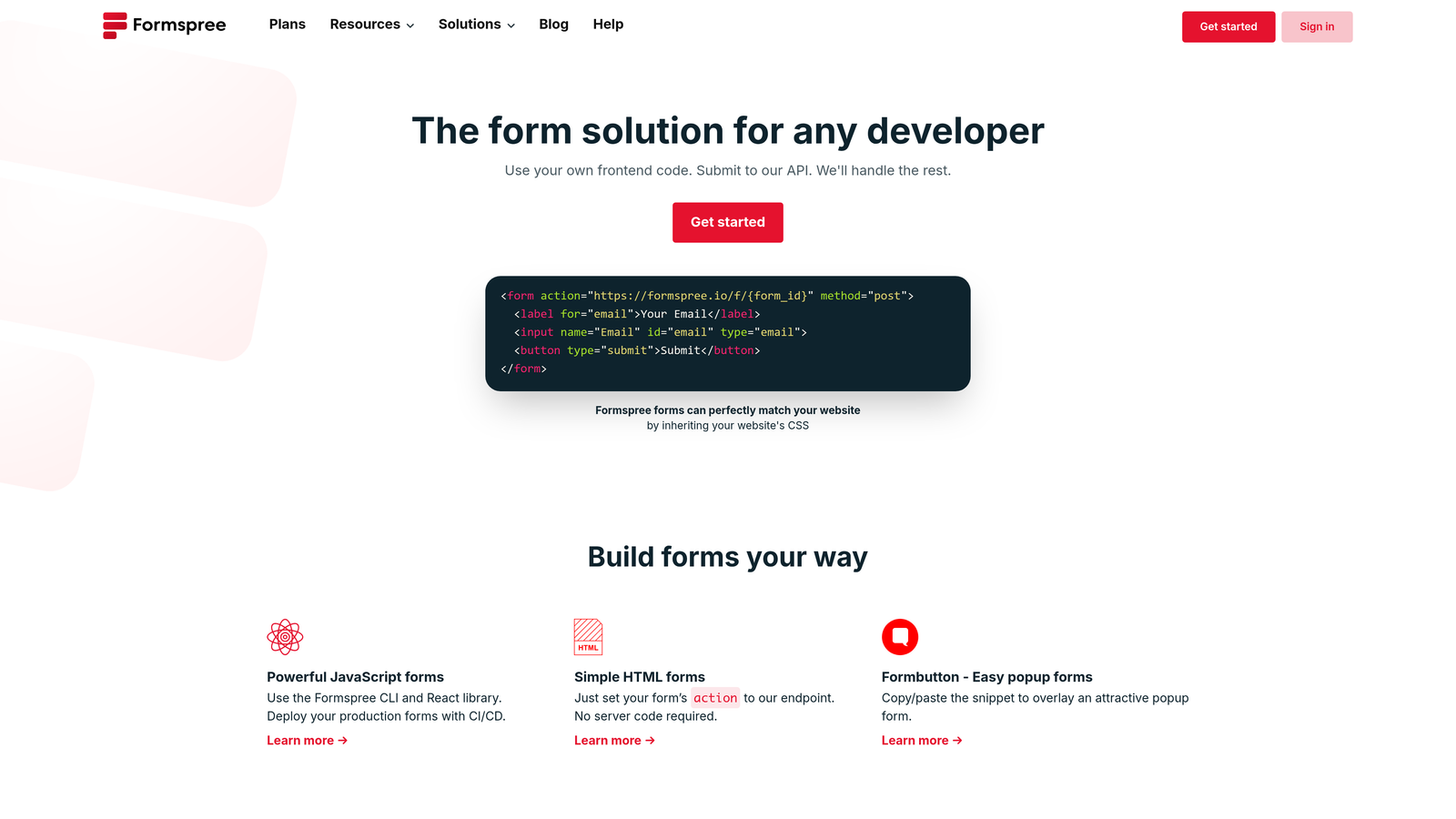
Formspree is a form backend built for frontend developers: point any HTML form's action attribute to a Formspree endpoint and start receiving submissions instantly, no server required.
Where This Tool Shines
Formspree's core appeal is simplicity without sacrificing flexibility. You keep full control of your frontend markup, there's no proprietary component to install, and submissions flow to your endpoint immediately. For JAMstack sites built on Next.js, Gatsby, or plain HTML, this is often the fastest path to a working form.
Beyond the basic endpoint model, Formspree supports AJAX and fetch-based submissions for React and SPA workflows, making it genuinely useful in modern frontend architectures. The REST API for retrieving submissions rounds out the developer experience for teams that need to pull data programmatically rather than relying solely on webhooks.
Key Features
HTML-First Endpoint: Works by setting your form's action URL, no JavaScript required for basic usage.
REST API: Retrieve submission data programmatically with standard REST conventions.
Webhook Forwarding: Push submissions to any endpoint in real time, plus Zapier integration for broader automation.
AJAX and Fetch Support: Full support for asynchronous form submission in React and SPA environments.
File Upload Support: Handle file attachments without configuring separate storage infrastructure.
Best For
Frontend developers working on static sites, JAMstack builds, or simple React apps who need a reliable form backend without managing server infrastructure. Ideal for contact forms, newsletter signups, and lightweight lead capture.
Pricing
Free tier handles 50 submissions per month. Paid plans start from $8/month with higher submission limits and additional features.
4. Basin
Best for: Developers who want a lightweight, framework-agnostic form backend with solid spam filtering
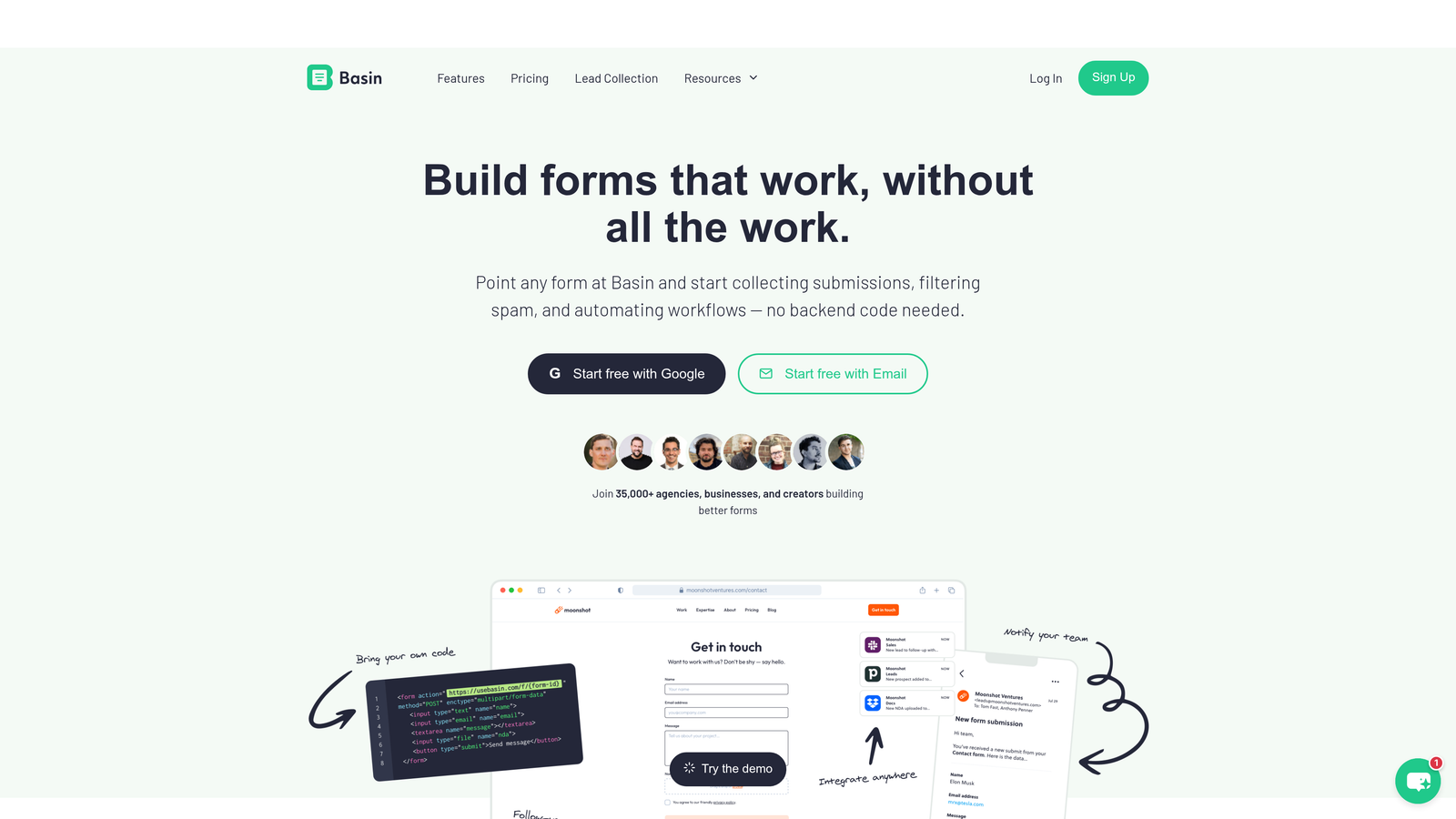
Basin is a minimal form backend with built-in spam filtering, webhook delivery, and integrations, designed to work with any frontend without dependencies on a specific framework.
Where This Tool Shines
Basin sits in a similar space to Formspree but differentiates on its spam filtering approach. The combination of honeypot fields and hCaptcha integration handles the majority of bot submissions without requiring you to implement your own filtering layer. For developer teams tired of building spam defenses from scratch, that's a meaningful time saver.
The framework-agnostic design means Basin works equally well whether you're building with Vue, Svelte, vanilla HTML, or anything else. Custom redirect support and AJAX compatibility make it flexible enough for modern frontend patterns without feeling overengineered.
Key Features
Framework-Agnostic Endpoint: Works with any frontend stack without requiring specific libraries or components.
Built-In Spam Filtering: Honeypot fields and hCaptcha integration to reduce bot submissions without custom implementation.
Webhook and Zapier Integration: Real-time delivery to custom endpoints or automation platforms.
Submission API: Retrieve stored submission data programmatically when needed.
Custom Redirect and AJAX Support: Flexible post-submission behavior for both traditional and single-page app patterns.
Best For
Developers building on diverse frontend stacks who want a clean, low-maintenance form backend with spam protection included. Particularly useful for agencies managing multiple client sites across different tech stacks.
Pricing
Free tier available. Paid plans start from $4.17/month, making it one of the more affordable options in this category.
5. Tally
Best for: Teams that want generous free API access and a Notion-style form building experience
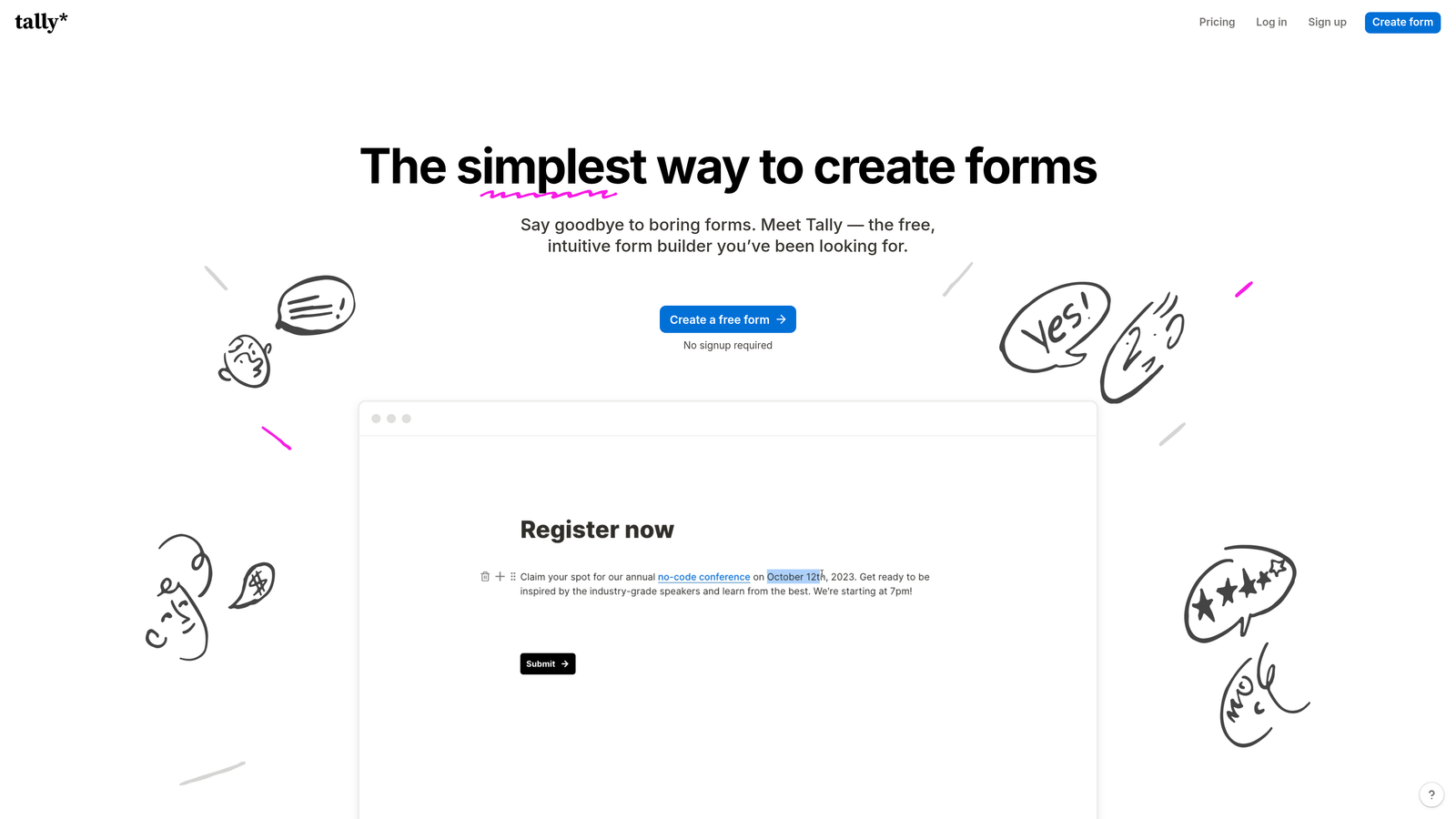
Tally is a free-first form builder with a clean, block-based editing interface and API access for retrieving submissions and connecting to automation tools.
Where This Tool Shines
Tally's free tier is unusually generous: unlimited forms, unlimited submissions, and access to core features without a credit card. For developer teams evaluating tools or running internal workflows on a tight budget, that's a real advantage. The Notion-style editing experience also makes it approachable for non-technical teammates who need to manage forms without developer involvement.
On the integration side, Tally connects natively with Zapier, Make, and other automation platforms, and its webhook support enables real-time data delivery to custom endpoints. It's not the most developer-centric tool on this list, but for teams that need API access without a large budget commitment, it punches above its price point.
Key Features
Generous Free Tier: Unlimited forms and submissions at no cost, with core functionality included.
Submission API: Retrieve form response data programmatically via REST endpoints.
Webhooks: Real-time data push to custom endpoints or automation platforms.
Notion-Style Editor: Block-based form building that's fast and intuitive for both developers and non-technical users.
Native Automation Integrations: Direct connections to Zapier, Make, and other workflow tools.
Best For
Startups, indie developers, or small teams that need API access and solid form functionality without a significant monthly spend. Also works well for internal tools and research forms where budget matters more than advanced developer features.
Pricing
Free for most features. Tally Pro is available from $29/month for advanced capabilities like custom domains and priority support.
6. Paperform
Best for: Developers building complex form workflows with payment processing and advanced conditional logic
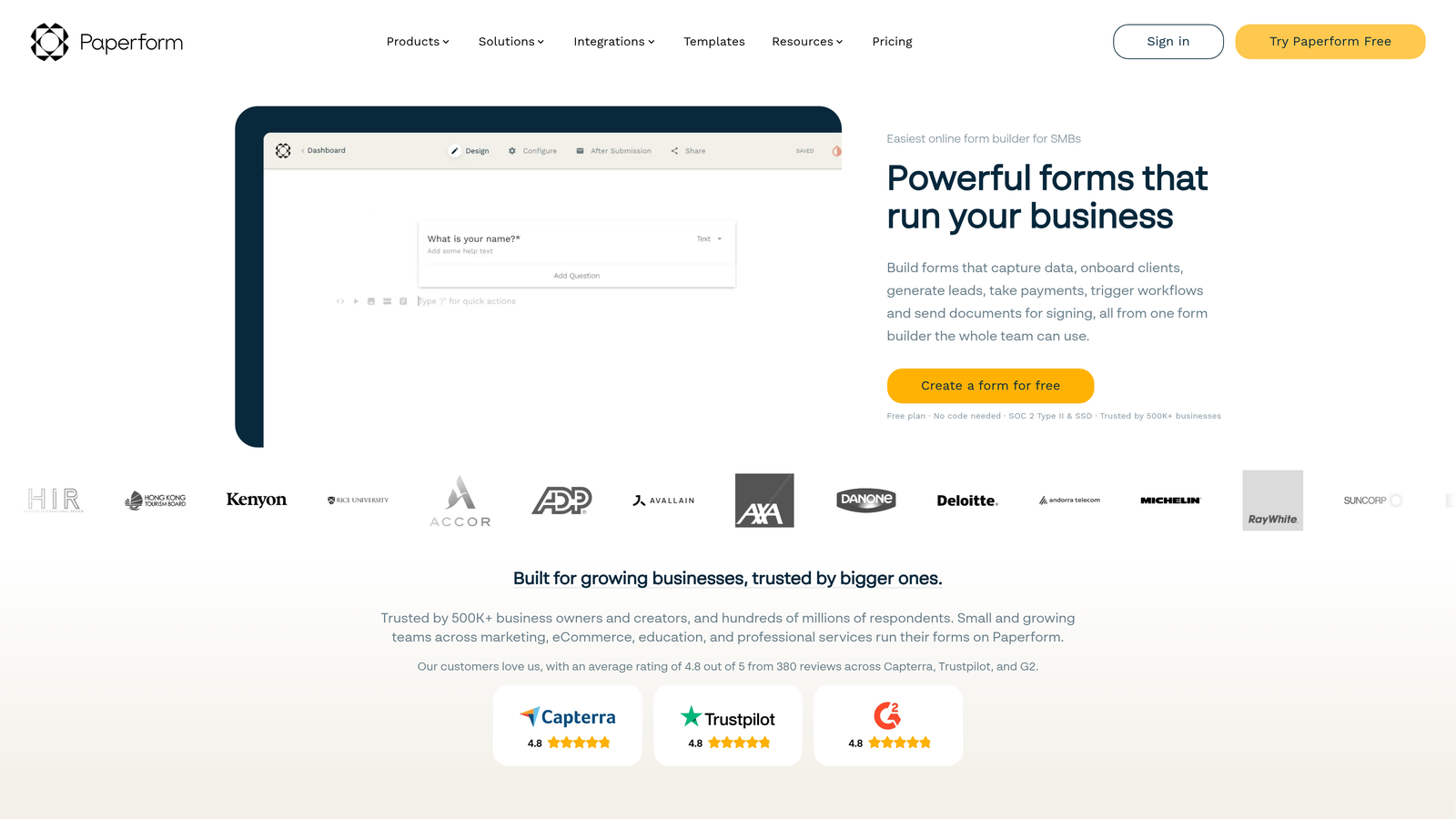
Paperform is a feature-rich form builder with a REST API, built-in payment processing, and advanced conditional logic for teams that need more than simple data collection.
Where This Tool Shines
Paperform's standout capability is how much it packs into a single form: conditional logic, calculations, multi-step flows, and payment processing via Stripe, PayPal, and Square, all without requiring separate integrations. For developers building registration flows, booking systems, or order forms, that breadth reduces the number of tools in the stack.
The ability to inject custom HTML and CSS gives developers meaningful control over form presentation without needing to build a fully custom frontend. Combined with REST API access for submission management and webhook support for real-time processing, Paperform covers a wide range of use cases that other tools in this category can't handle alone.
Key Features
REST API: Manage submissions and form data programmatically via standard REST conventions.
Built-In Payment Processing: Native Stripe, PayPal, and Square integration without third-party plugins.
Advanced Conditional Logic: Complex branching and calculation support for multi-step, dynamic form flows.
Custom HTML/CSS Injection: Override default styling with your own markup for precise visual control.
Webhook and Zapier Integration: Real-time submission delivery and broad automation connectivity.
Best For
Development teams building booking systems, event registration, e-commerce order forms, or any workflow where payment collection and complex conditional logic need to coexist in a single form experience.
Pricing
Plans start at $24/month for the Essentials tier, with higher plans unlocking additional submissions, integrations, and team features.
7. Feathery
Best for: SaaS developers building embedded onboarding and signup flows with a React SDK and headless mode
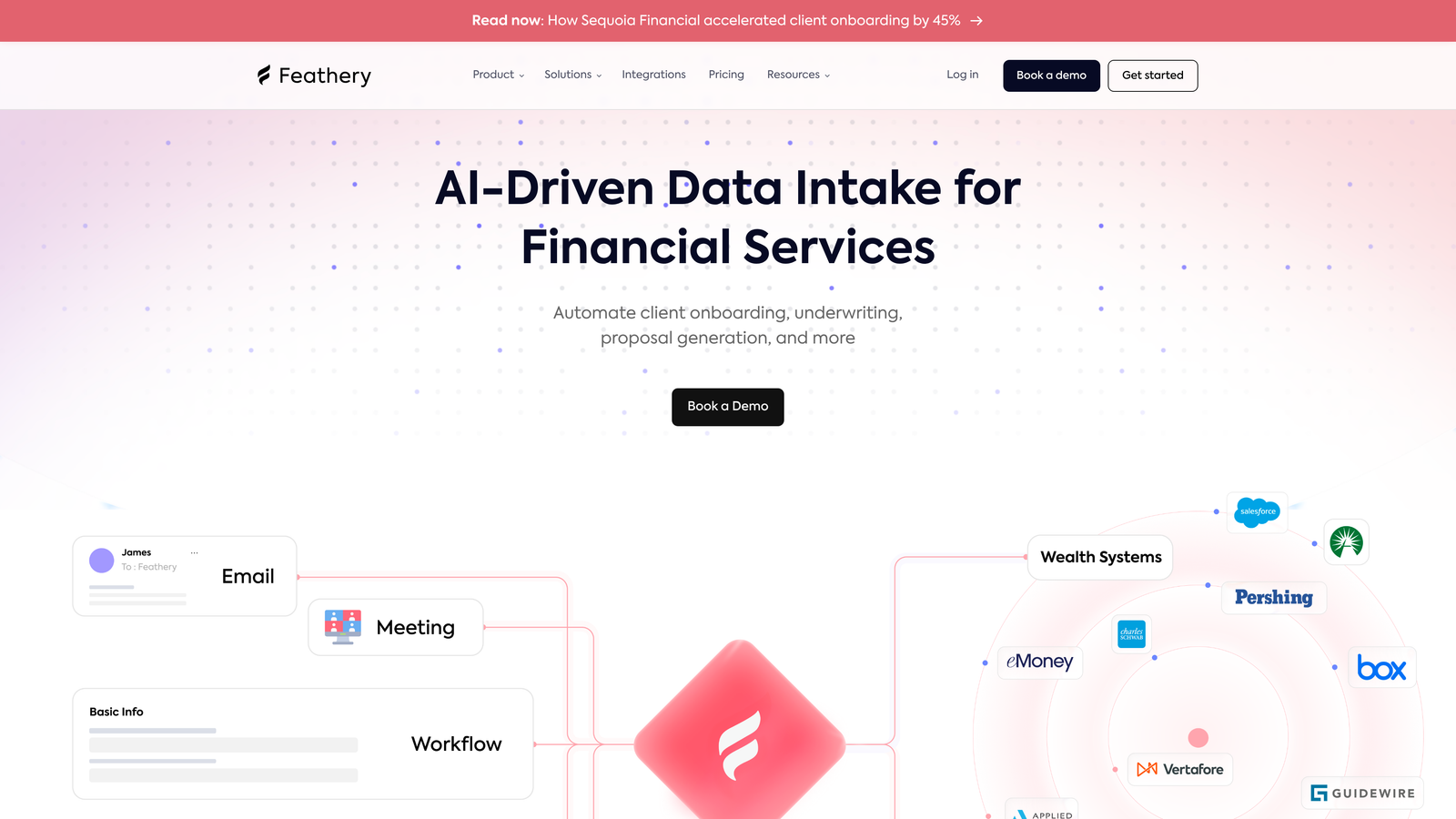
Feathery is a developer-centric form platform with a React SDK and headless mode, purpose-built for embedding custom onboarding and signup flows directly inside SaaS products.
Where This Tool Shines
Feathery is one of the few tools in this space that treats the React component model as a first-class concern. The React SDK gives developers programmatic rendering control, meaning you can drive form state, handle submissions, and manage user progress entirely through code rather than relying on an iframe or hosted page. That level of integration is essential for SaaS products where the form experience needs to feel native, not embedded.
The headless mode takes this further by fully decoupling the logic layer from the UI, so you can build entirely custom interfaces while Feathery handles conditional logic, user tracking, and data persistence behind the scenes. For complex onboarding flows with custom code steps and SSO integration, it's one of the most capable tools available.
Key Features
React SDK: Full programmatic rendering control for native-feeling in-app form experiences.
Headless Mode: Decouple form logic from UI entirely, rendering your own components against Feathery's logic engine.
Comprehensive API: Endpoints for form creation, submission handling, and user progress tracking.
Custom Code Steps: Embed JavaScript logic directly into conditional flows for advanced branching behavior.
SSO and Identity Provider Integrations: Connect to existing authentication systems for seamless user identification.
Best For
SaaS developers building multi-step onboarding flows, KYC processes, or signup experiences that need to feel like a native part of the product rather than a third-party form. Particularly strong for teams with dedicated frontend engineering resources.
Pricing
Free tier available. Paid plans start from $49/month, scaling with usage and team size.
8. HeyFlow
Best for: Growth teams connecting lead capture flows to CRM and marketing automation via webhooks
HeyFlow is an interactive flow builder with a webhook-first architecture, designed for growth teams that need to connect lead capture forms to marketing automation and CRM systems in real time.
Where This Tool Shines
HeyFlow sits at the intersection of form builder and funnel builder. Its visual flow editor supports branching logic and multi-step experiences, while the webhook-first delivery model ensures data reaches your downstream systems immediately. Native integrations with HubSpot, Salesforce, and other major CRMs reduce the middleware layer for teams that want direct connections rather than Zapier chains.
The addition of A/B testing for form variants is a differentiator that most developer-focused tools skip entirely. For growth teams running experiments on lead capture flows, having variant testing built into the same tool that handles webhook delivery simplifies the experimentation stack considerably.
Key Features
Visual Flow Builder: Branching logic and multi-step flow design in a drag-and-drop interface with developer-friendly output.
Webhook-First Delivery: Send submission data to any endpoint in real time without relying on polling or batch exports.
Native CRM Integrations: Direct connections to HubSpot, Salesforce, and other major platforms.
Custom CSS and JavaScript: Inject custom styling and behavior without leaving the platform.
A/B Testing: Run variant experiments on form flows to optimize conversion rates with real data.
Best For
Growth and marketing engineering teams building lead capture flows that feed directly into CRM and automation systems, especially those running ongoing conversion experiments.
Pricing
Starter plans begin around $63/month, positioning HeyFlow as a mid-range option suited to teams with dedicated growth budgets.
9. FormKeep
Best for: Developers who want a reliable, minimal form endpoint without complexity or overhead
FormKeep is a minimal form endpoint service: provide a URL, receive submissions via webhook or email, and retrieve data via API. No configuration overhead, no framework dependencies.
Where This Tool Shines
FormKeep's value proposition is reliability without noise. There's no visual builder to navigate, no UI to learn, and no opinionated framework to work around. You get an endpoint URL, point your form at it, and submissions start arriving. For developers who've been burned by overly complex tools for simple use cases, that restraint is genuinely appealing.
The webhook delivery model handles real-time processing cleanly, and the Zapier integration covers automation needs for teams that don't want to build custom webhook handlers. Spam filtering is included without additional configuration, which removes one more thing from the setup checklist.
Key Features
Simple Endpoint URL: Works with any HTML form or frontend framework with zero dependencies.
Webhook Delivery: Real-time submission forwarding to any endpoint for immediate processing.
Zapier Integration: Connect to hundreds of apps and automation workflows without custom code.
Spam Filtering: Built-in filtering included without additional configuration.
Submission Export API: Retrieve stored submission data programmatically when needed.
Best For
Developers who need a dependable, no-frills form backend for contact forms, landing pages, or simple lead capture without the overhead of a full-featured platform. Strong fit for freelancers and agencies managing straightforward client projects.
Pricing
Plans start at $4.99/month for the Basic tier, making it one of the most cost-effective paid options in this roundup.
Which Tool Is Right for Your Stack?
The right API form builder depends almost entirely on where your form sits in your architecture and what you need it to do beyond collecting data.
If you're building for a high-growth B2B SaaS team and you need forms that don't just capture leads but qualify them before they hit your CRM, Orbit AI is the clear starting point. The combination of AI-powered qualification at the form layer, full API access, and conversion-optimized design covers the full developer-to-pipeline workflow in a single tool.
For conversational experiences where the one-question-at-a-time UX is a deliberate product decision, Typeform's mature API and excellent documentation make it the strongest choice. If you're on a static site or JAMstack build and just need a reliable backend without managing a server, Formspree, Basin, and FormKeep all deliver that with minimal friction, and at a price point that's easy to justify.
Building inside a SaaS product and need forms that feel native? Feathery's React SDK and headless mode are purpose-built for that problem. Running payment-heavy workflows with complex conditional logic? Paperform handles that without requiring a separate payment integration. Working on the growth side and running conversion experiments on lead capture flows? HeyFlow's A/B testing and CRM integrations are built for exactly that. And if budget is the primary constraint, Tally's free tier with API access is hard to beat.
For teams serious about turning form submissions into qualified pipeline, the gap between a generic form backend and an AI-powered lead qualification layer is significant. Start building free forms today and see how intelligent form design can elevate your conversion strategy. If you're thinking about the broader lead qualification picture, our guides on how to qualify leads automatically and lead forms for B2B companies are worth a read alongside this one.


