

Your forms are collecting leads. Your CRM is where deals get closed. But somewhere between those two systems, data gets lost, delayed, or manually re-entered by someone who has better things to do. It's one of the most common friction points for high-growth teams, and it quietly kills pipeline velocity.
The right CRM integration tool eliminates that gap entirely. Every lead flows automatically into your pipeline, mapped to the right fields, enriched with the right context, and ready for your sales team to act on immediately.
To build this list, we evaluated tools across five key criteria: native CRM connectivity, data mapping flexibility, automation depth, ease of setup for non-technical users, and pricing that scales with your team. Whether you're a scrappy startup or a scaling enterprise, there's a solution here for your workflow.
1. Orbit AI
Best for: High-growth B2B teams that want AI-qualified leads delivered directly to their CRM
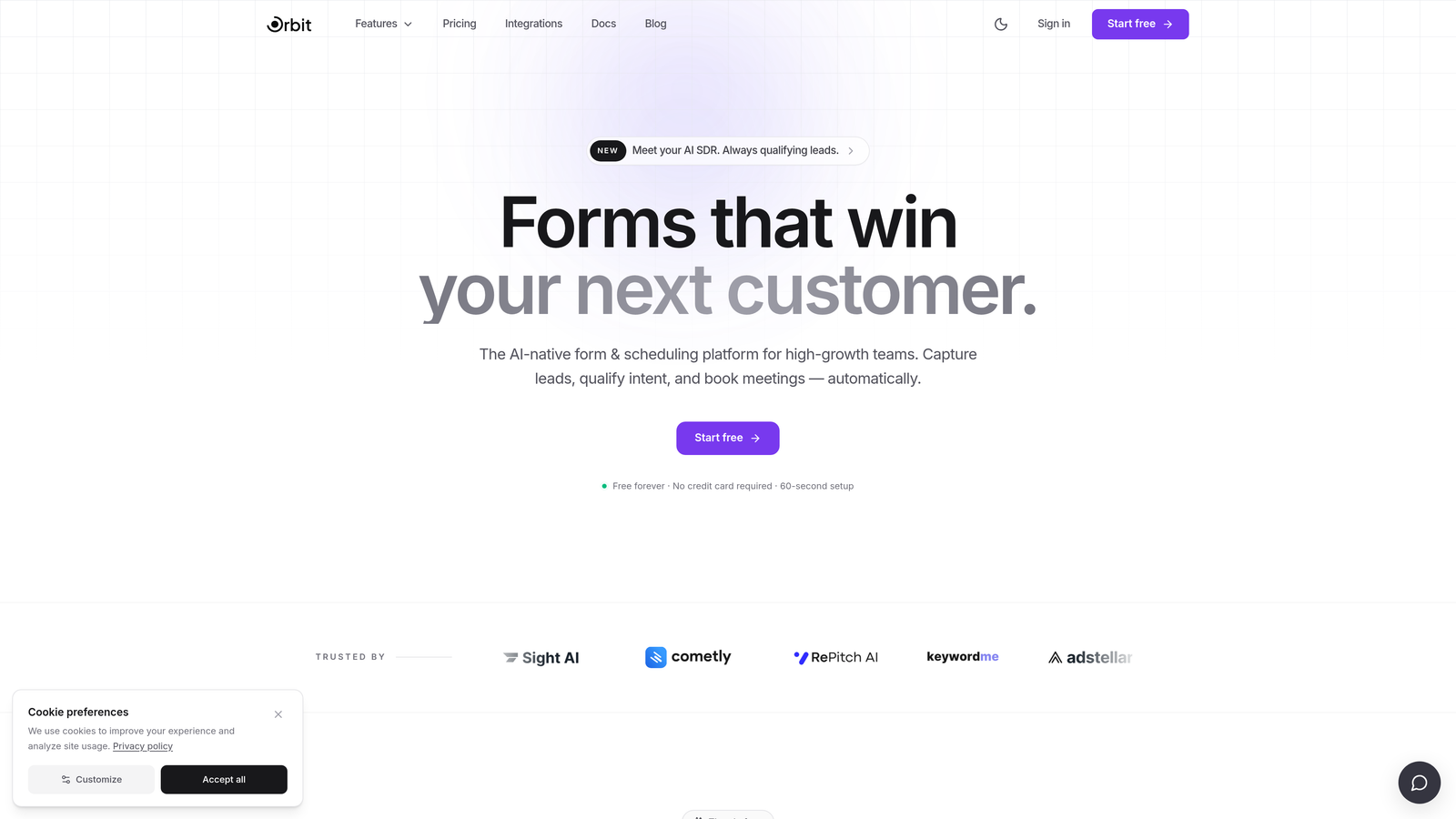
Orbit AI is an AI-powered form builder that qualifies and scores leads before they ever reach your CRM, so your sales team spends time on prospects worth pursuing.
Where This Tool Shines
Most CRM integration tools focus on moving data from point A to point B. Orbit AI adds an intelligent layer before the sync even happens. As leads submit your forms, the platform's AI qualification engine evaluates and scores them based on your criteria, meaning your CRM receives enriched, prioritized lead data rather than a raw dump of form submissions.
This matters because CRM hygiene is one of the most overlooked best practices in lead management. When low-quality or incomplete leads flood your pipeline, reps waste time triaging instead of selling. Orbit AI addresses that problem at the source, before the data enters your system.
Key Features
AI-Powered Lead Qualification: Scores and qualifies leads at the point of form submission, so your CRM only receives high-value prospects.
Native CRM Integrations: Connects directly to major CRMs with automatic field mapping, reducing setup friction and manual configuration.
Conversion-Optimized Templates: Pre-built form templates with conditional logic designed to maximize completion rates and capture richer lead data.
Real-Time Lead Enrichment: Enhances lead records before they hit your pipeline, giving sales reps immediate context for faster follow-up.
Conditional Logic: Routes leads through personalized form paths based on their responses, improving data quality and relevance.
Best For
B2B marketing teams and agencies that generate high volumes of inbound leads and need a smarter filter before those leads reach sales. Particularly valuable for teams where CRM data quality is a persistent pain point and manual lead scoring is slowing down the sales cycle.
Pricing
Free tier available for getting started. Paid plans unlock advanced AI qualification features and full CRM sync capabilities. Visit orbitforms.ai for current plan details.
2. HubSpot Operations Hub
Best for: HubSpot-native teams needing robust data sync and CRM data quality automation
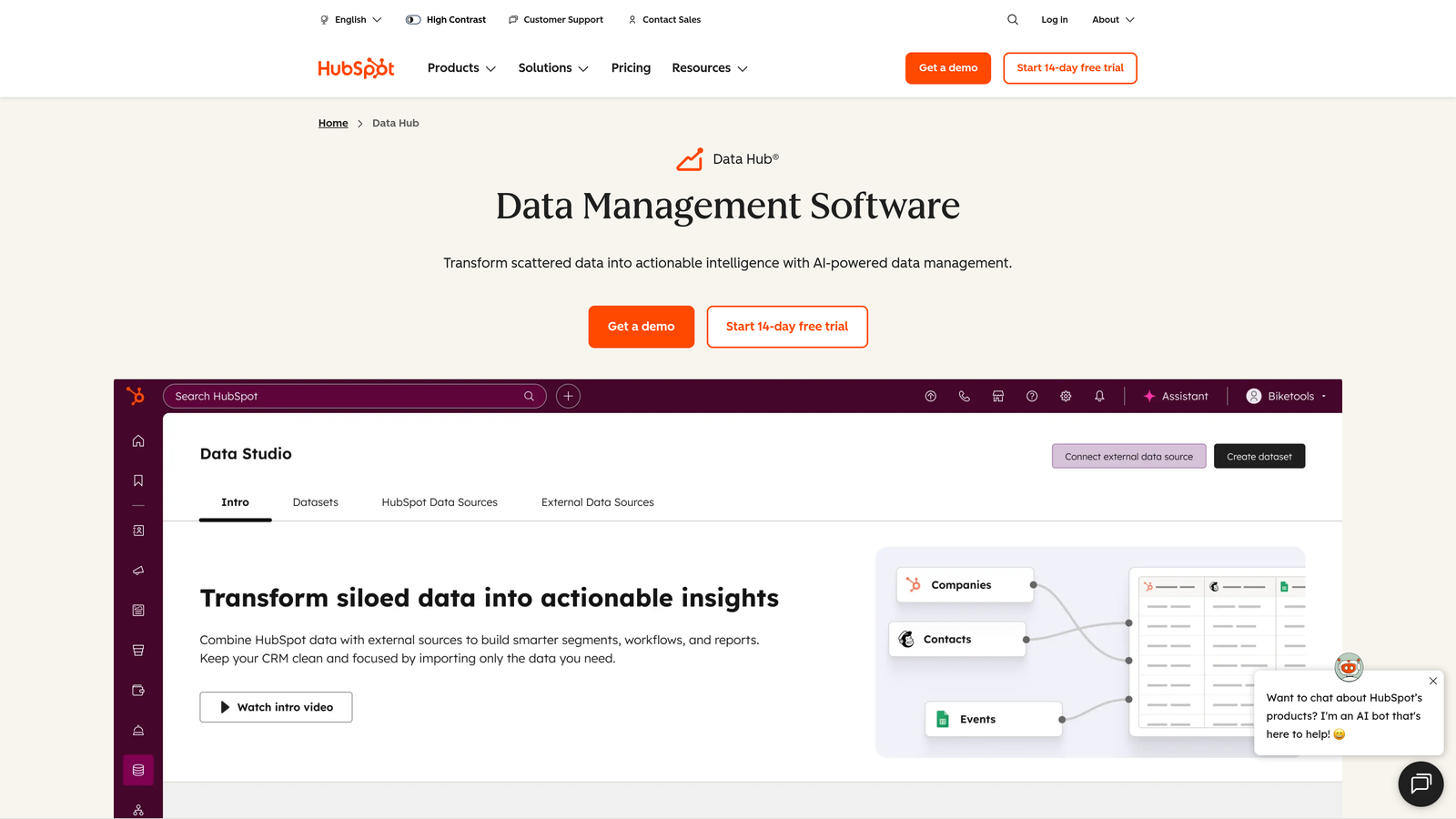
HubSpot Operations Hub is HubSpot's dedicated operations platform built for data sync, quality automation, and programmable workflows across your connected tools.
Where This Tool Shines
If your team already lives in HubSpot, Operations Hub is the natural choice for CRM integration best practices. It handles bi-directional data sync with over 100 third-party apps and includes data quality automation that deduplicates and cleans records automatically, which is a significant advantage over general-purpose automation tools.
The programmable automation feature sets it apart from simpler platforms. When your integration logic requires custom-coded actions, you can write them directly inside HubSpot workflows without leaving the ecosystem or managing external middleware.
Key Features
Bi-Directional Data Sync: Keeps records consistent across 100+ connected apps, syncing changes in both directions in real time.
Data Quality Automation: Automatically deduplicates, formats, and cleans CRM records to maintain pipeline accuracy.
Programmable Automation: Supports custom-coded workflow actions for scenarios that go beyond standard no-code logic.
Custom Field Mappings: Granular control over how data maps between HubSpot and connected systems, including filtering rules.
Ecosystem Integration: Works natively with all HubSpot hubs, making it the most cohesive option for full-HubSpot teams.
Best For
Marketing and RevOps teams already using HubSpot CRM who want to eliminate manual data management and ensure consistent, clean records across their entire tech stack without adding external tools.
Pricing
Free tools available. Starter plans from $20/month; Professional plans from $800/month. Pricing scales significantly at the Professional tier, so it's best suited for teams where the data quality ROI justifies the investment.
3. Zapier
Best for: Non-technical teams needing fast, flexible connections between forms and any CRM
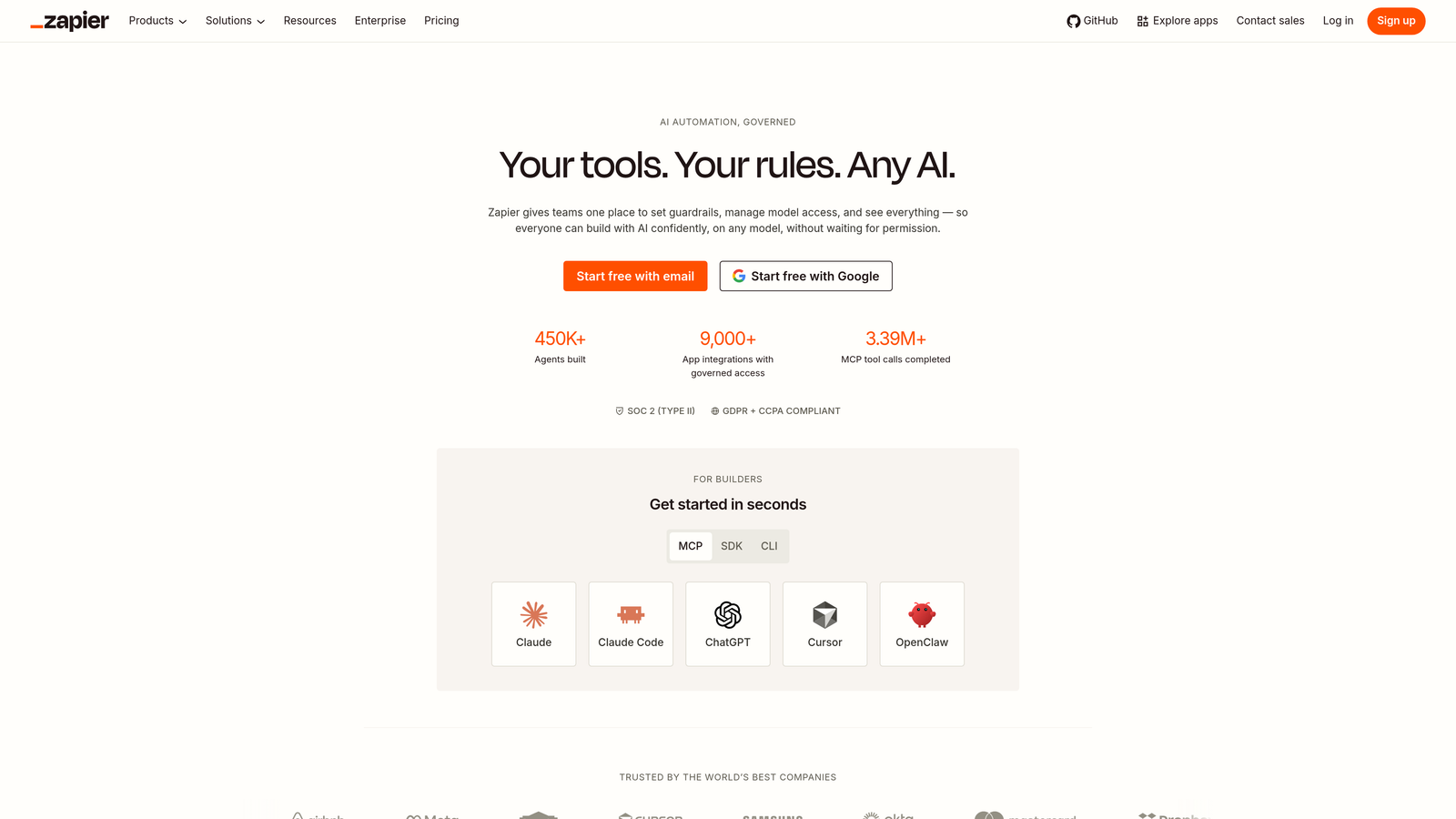
Zapier is the most widely adopted no-code automation platform, connecting thousands of apps to automate lead data flows into virtually any CRM on the market.
Where This Tool Shines
Zapier's greatest strength is breadth. With over 7,000 app integrations, it's almost certain to connect whatever form tool or lead source you're using to whatever CRM your sales team prefers. For teams that need to get an integration running quickly without developer involvement, Zapier is often the fastest path from idea to live workflow.
The AI-powered Zap builder makes setup even faster, letting you describe what you want to automate in plain language and generating the workflow structure automatically. For teams managing multiple lead sources across different tools, this significantly reduces configuration time.
Key Features
7,000+ App Integrations: Covers virtually every major CRM, form tool, and marketing platform available.
Multi-Step Zaps: Build workflows with conditional paths, filters, and branching logic to handle complex lead routing scenarios.
Data Formatting Tools: Built-in transformers for cleaning, formatting, and restructuring lead data before it reaches your CRM.
AI Zap Builder: Describe your automation in plain language and let the AI generate the workflow structure for you.
No-Code Setup: Designed for non-technical users with an intuitive interface that requires no programming knowledge.
Best For
Small to mid-sized teams that need flexible, fast integrations without developer resources. Also excellent for teams managing a diverse mix of tools that don't share native integrations with each other.
Pricing
Free plan includes 100 tasks/month. Paid plans start from $19.99/month, with costs scaling based on task volume and advanced feature access.
4. Make (formerly Integromat)
Best for: Teams needing complex, multi-branch automations with granular data control at lower cost
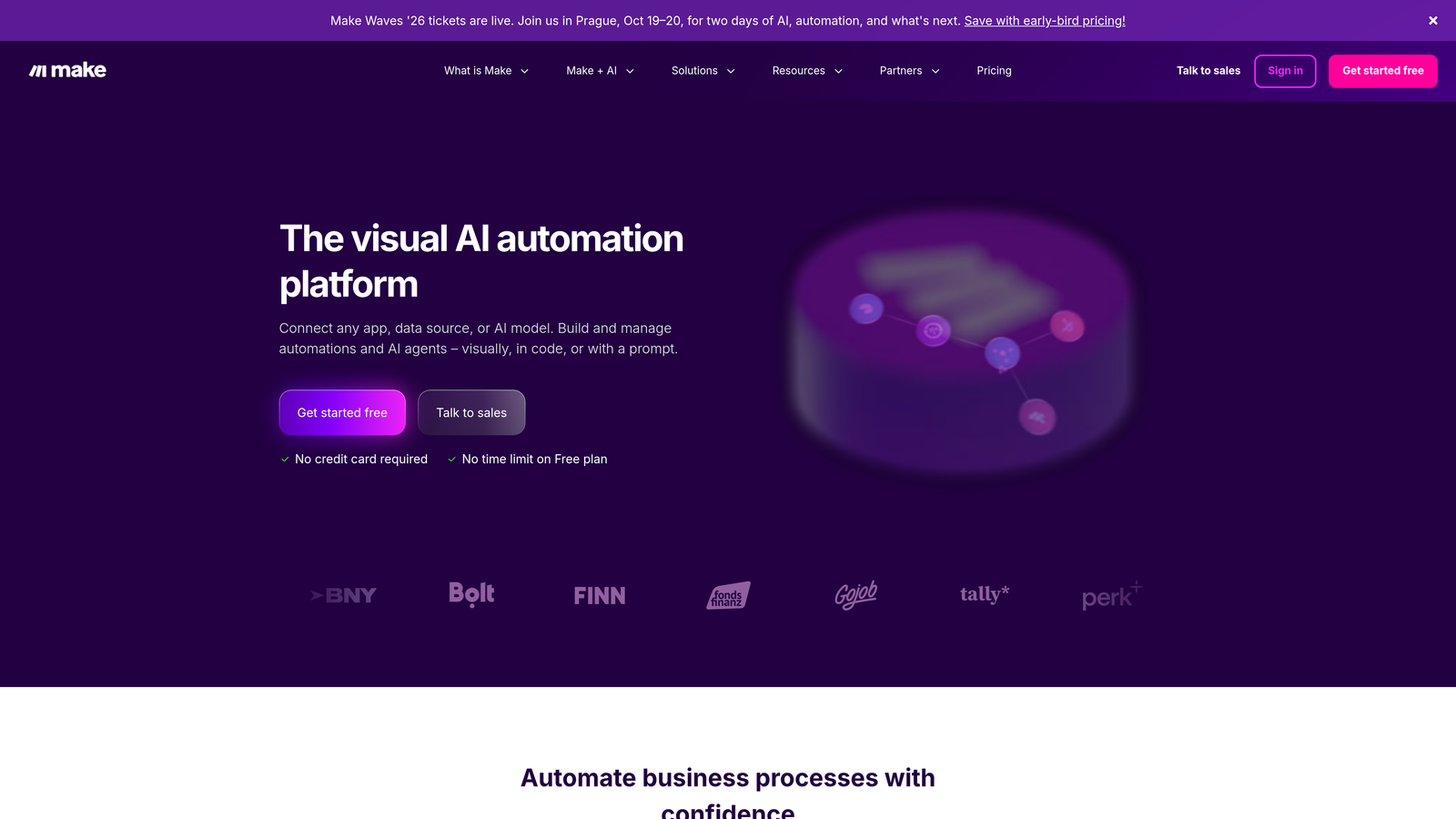
Make is a visual automation platform for building sophisticated, multi-branch integration scenarios between form tools, CRMs, and other business applications.
Where This Tool Shines
Make's visual scenario builder is genuinely intuitive for complex workflows. You can see every branch, every data transformation, and every conditional path laid out visually, which makes it much easier to understand and debug integrations compared to linear workflow tools. For teams dealing with intricate lead routing logic, this visibility is a real advantage.
Make also offers more granular control over data transformation than Zapier, with a wider library of built-in functions for manipulating data mid-flow. Combined with its more competitive pricing at higher operation volumes, it's a strong choice for teams that have outgrown simpler automation tools.
Key Features
Visual Scenario Builder: Drag-and-drop interface that maps out complex, branching workflows in a way that's easy to understand at a glance.
Advanced Data Transformation: Rich library of built-in functions for reformatting, parsing, and restructuring data between systems.
Error Handling: Built-in retry logic and error handling to ensure reliable syncs even when connected systems experience downtime.
Flexible Execution: Run scenarios in real time or on a schedule, depending on your integration requirements.
Competitive Pricing: More operations per dollar than comparable platforms, especially at higher usage tiers.
Best For
Technical-leaning marketing or ops teams that need more workflow complexity than Zapier offers, but aren't ready for enterprise-grade iPaaS pricing. Excellent for agencies managing integrations across multiple client accounts.
Pricing
Free plan includes 1,000 operations/month. Paid plans start from $9/month, making it one of the most cost-effective options for higher-volume automation needs.
5. Salesforce Flow
Best for: Salesforce-native teams building complex lead routing and CRM automation without middleware
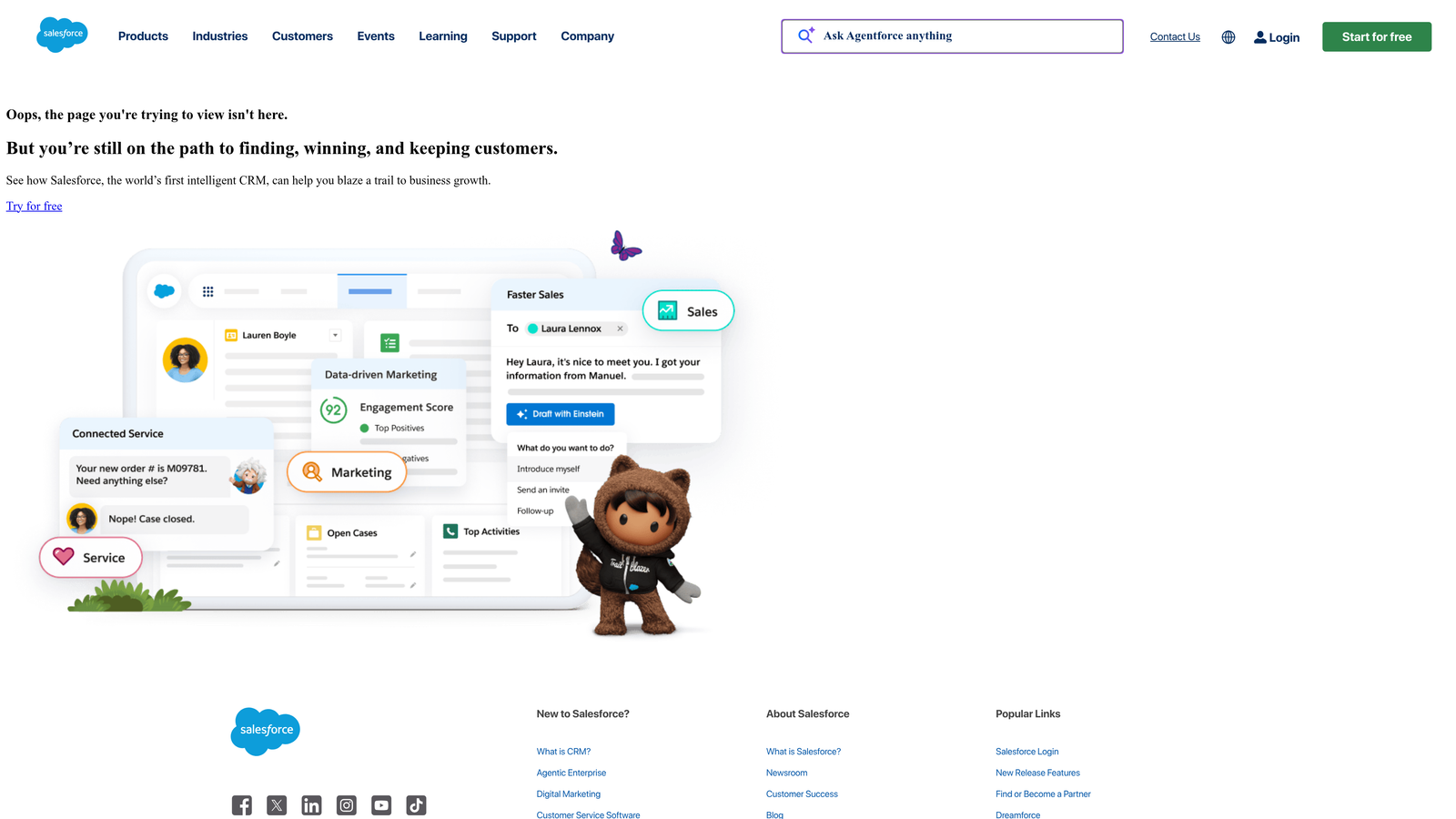
Salesforce Flow is Salesforce's native automation engine for building lead routing, data enrichment, and CRM workflow automations entirely within the Salesforce platform.
Where This Tool Shines
The core advantage of Salesforce Flow is that it's native. There's no external integration layer, no API rate limits from a third-party connector, and no data leaving the Salesforce environment to pass through a middleware service. For teams where data security and compliance are priorities, this is a meaningful distinction.
Flow's depth is also exceptional for Salesforce-specific automation. Record-triggered flows can process leads the moment they enter your CRM, applying routing rules, enrichment logic, and assignment criteria instantly. For high-volume lead operations inside Salesforce, this native processing speed is hard to match.
Key Features
Native Salesforce Automation: Runs entirely within Salesforce with no external middleware required, preserving data security and performance.
Record-Triggered Flows: Automatically processes leads in real time the moment a record is created or updated.
Screen Flows: Builds guided, interactive experiences within Salesforce for reps managing lead qualification manually.
Complex Logic Support: Handles branching, loops, and nested subflows for sophisticated automation scenarios.
Einstein AI Integration: Connects with Salesforce's AI layer for predictive scoring and intelligent lead routing.
Best For
Organizations fully committed to the Salesforce ecosystem that want to maximize their existing platform investment without adding external automation tools to their stack.
Pricing
Included with Salesforce platform licenses. Salesforce editions start at $25/user/month, with Flow capabilities expanding at higher tiers.
6. Workato
Best for: Enterprise teams needing integration automation with IT-grade governance and compliance
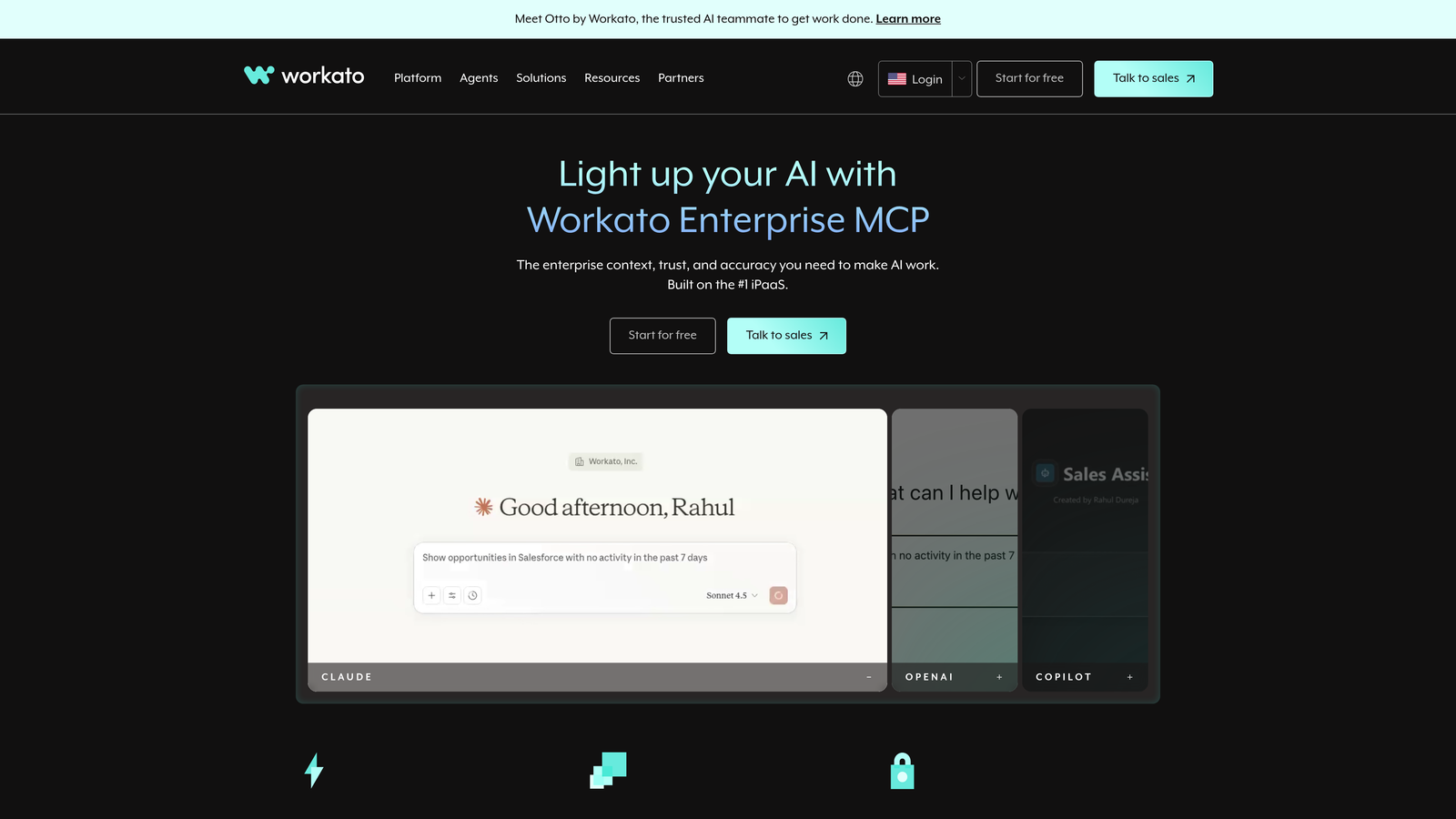
Workato is an enterprise-grade integration and automation platform that combines business-user accessibility with the security, governance, and compliance controls that IT teams require.
Where This Tool Shines
Workato sits in a category above general-purpose automation tools. It's built for organizations where integration governance matters as much as integration functionality. Role-based access controls, audit logs, and compliance certifications are first-class features rather than afterthoughts, making it appropriate for industries with strict data handling requirements.
The recipe-based automation model is also genuinely accessible for business users. With over 1,000 pre-built connectors and a community library of proven integration patterns, teams can often find a starting point for their CRM integration without building from scratch.
Key Features
1,000+ Pre-Built Connectors: Extensive library covering enterprise CRMs, marketing platforms, and business applications.
Enterprise Security: Role-based access control, audit logs, and enterprise-grade data governance built into the platform.
Community Recipes: Library of pre-built automation recipes for common CRM integration patterns, reducing build time significantly.
API Management: Build and manage custom API connectors for proprietary or less common systems.
Compliance Certifications: SOC 2 Type II and HIPAA-compliant infrastructure for regulated industries.
Best For
Enterprise organizations and mid-market companies in regulated industries where security, compliance, and IT governance are non-negotiable requirements for any integration platform.
Pricing
Custom enterprise pricing based on usage and team size. Contact Workato's sales team for a quote tailored to your requirements.
7. Tray.io
Best for: Revenue operations teams building scalable, API-level integrations across their go-to-market stack
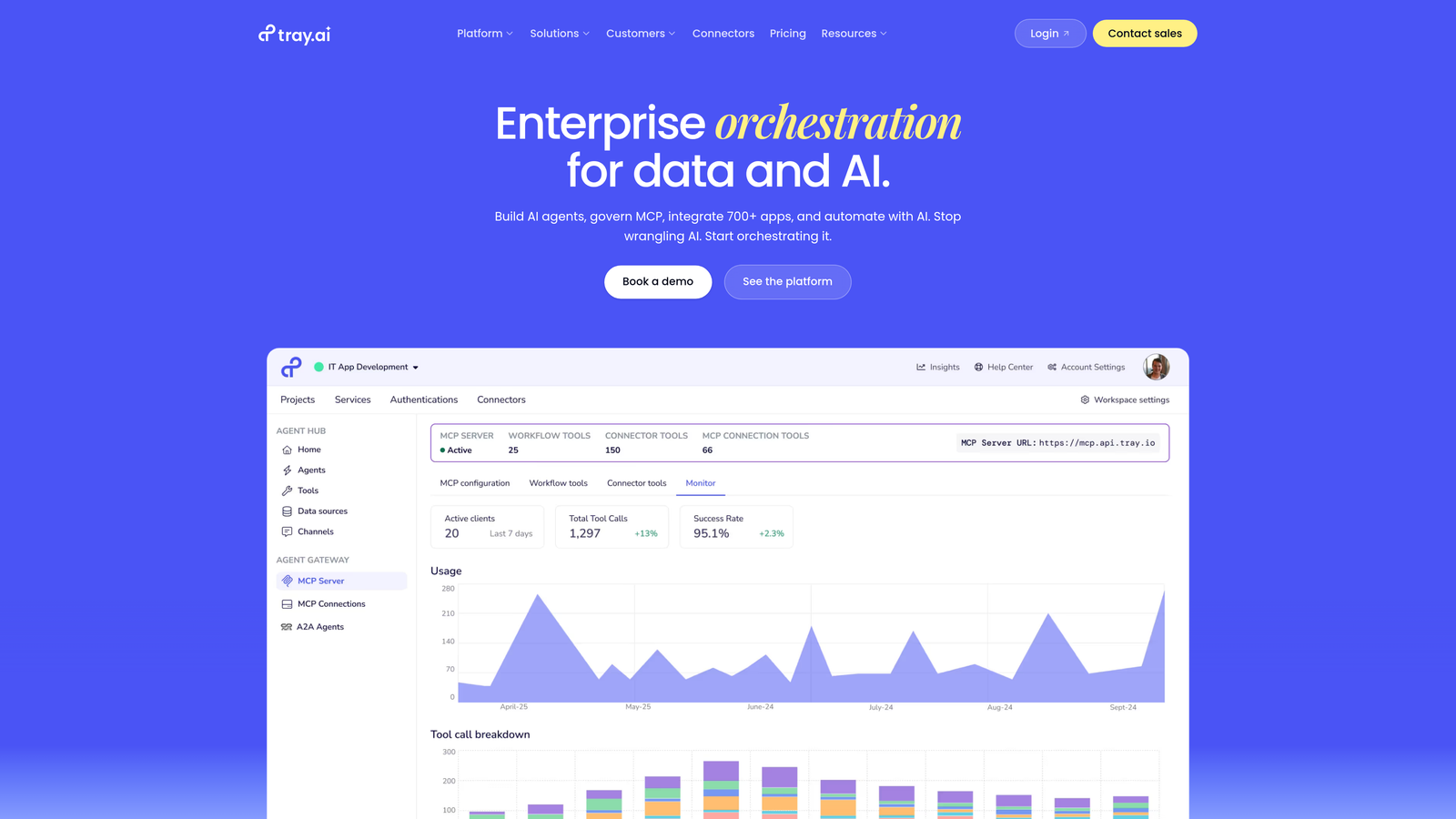
Tray.io is a Universal Automation Cloud designed specifically for RevOps teams that need to build and maintain scalable, high-performance integrations across complex go-to-market technology stacks.
Where This Tool Shines
Tray.io is purpose-built for the revenue operations use case in a way that general automation platforms aren't. Its visual workflow builder gives non-technical users an accessible interface while still providing full API-level access for scenarios that require it. That combination is particularly valuable for RevOps teams that sit between marketing, sales, and engineering.
The Merlin AI assistant adds a practical layer of intelligence to workflow building, helping teams construct and debug complex integrations faster. For organizations processing high lead volumes, Tray.io's elastic scaling ensures that integration performance doesn't degrade during traffic spikes.
Key Features
API-Level Access: Full API control within a visual builder, giving technical users depth without sacrificing usability for non-developers.
Real-Time Event Processing: Event-driven architecture handles high-volume lead flows without latency or queuing delays.
Merlin AI Assistant: AI-powered workflow builder that helps teams construct and troubleshoot integrations more efficiently.
Elastic Scaling: Infrastructure scales automatically to handle volume spikes without manual intervention.
RevOps Focus: Templates and connectors specifically designed for go-to-market automation scenarios.
Best For
Revenue operations teams at scaling companies that need enterprise-grade integration performance with a workflow builder that both technical and non-technical stakeholders can use effectively.
Pricing
Custom pricing based on usage and team requirements. A free trial is available to evaluate the platform before committing to a plan.
8. Pipedream
Best for: Developer-led teams that want full code control alongside pre-built connectors
Pipedream is a developer-friendly integration platform that combines pre-built API connectors with full code-level flexibility in Node.js, Python, Go, or Bash.
Where This Tool Shines
Pipedream occupies a unique position: it's not purely no-code, and it's not purely a developer tool. You can mix pre-built connector actions with custom code steps in the same workflow, which means you get the speed of pre-built integrations for standard operations and the flexibility of raw code when your logic requires it. For engineering teams building lead processing pipelines, this hybrid approach is highly practical.
The generous free tier is also worth noting. At 10,000 invocations per month, many early-stage teams can run meaningful integration workflows entirely within the free plan, making it an accessible starting point before committing to paid infrastructure.
Key Features
Multi-Language Code Steps: Write custom logic in Node.js, Python, Go, or Bash directly within your integration workflows.
2,400+ Pre-Built Integrations: Extensive connector library covering major CRMs, form tools, and marketing platforms.
Generous Free Tier: 10,000 invocations per month at no cost, making it accessible for smaller teams and early-stage startups.
Event-Driven Triggers: Real-time processing triggered by webhooks, scheduled events, or app-specific triggers.
Version Control: Built-in versioning and team collaboration features for managing integration code across teams.
Best For
Engineering teams and technical founders who want the control of custom code without building integration infrastructure from scratch. Also a strong fit for startups that need powerful integrations on a limited budget.
Pricing
Free tier includes 10,000 invocations/month. Paid plans start from $29/month with higher invocation limits and additional team features.
9. n8n
Best for: Technical teams that want full data ownership through self-hosted workflow automation
n8n is an open-source, self-hostable workflow automation tool that gives teams complete control over their integration infrastructure, data flows, and deployment environment.
Where This Tool Shines
n8n's defining characteristic is data sovereignty. When you self-host n8n, your lead data never passes through a third-party cloud service. For teams in regulated industries or organizations with strict data residency requirements, this is a compelling alternative to SaaS-based automation platforms where data transits through external infrastructure.
The visual workflow editor is genuinely capable, supporting complex multi-branch logic with a "code when needed" philosophy that lets technical users drop into JavaScript for custom transformations without abandoning the visual interface. The active open-source community also means a growing library of community-contributed connectors and templates.
Key Features
Open-Source Self-Hosting: Deploy on your own infrastructure for complete data control and no vendor lock-in.
400+ Integrations: Growing library of built-in connectors with support for custom nodes when needed.
On-Premise Data Control: Lead data stays within your infrastructure, supporting compliance and data residency requirements.
Code-When-Needed Flexibility: Visual editor with the option to write JavaScript for custom transformation logic.
Community Ecosystem: Active contributor community adding connectors, templates, and workflow examples regularly.
Best For
Technical teams, privacy-conscious organizations, and companies in regulated industries that need powerful workflow automation with full control over where their data lives and how it's processed.
Pricing
Free when self-hosted under the fair-code license. Managed cloud plans start from €20/month for teams that prefer not to manage their own infrastructure.
Choosing the Right CRM Integration Tool for Your Team
The best CRM integration tool for your team depends on where your biggest friction point actually lives. Is it data quality before leads hit your pipeline? Is it the complexity of your routing logic? Or is it simply that you need something running fast without developer involvement?
If your challenge is lead quality and you want AI to do the heavy lifting before data ever reaches your CRM, Orbit AI is the natural starting point. It's the only tool on this list that addresses the problem upstream, qualifying and scoring leads at the form level so your pipeline stays clean by design.
For teams already deep in HubSpot, Operations Hub is the most cohesive choice. For Salesforce shops, Flow eliminates the need for external middleware entirely. If you need flexible, fast no-code automation across a diverse tool stack, Zapier remains the easiest entry point, while Make offers more power at comparable or lower cost for teams willing to invest slightly more setup time.
Enterprise teams with governance requirements should look closely at Workato or Tray.io. Developer-led teams will find Pipedream's hybrid code-and-connector approach highly practical, and n8n is the clear choice when data sovereignty is non-negotiable.
The common thread across all of these best practices: clean data in, clean data out. The tools that enforce that principle at every step of the lead journey are the ones that make your CRM worth trusting. Start building free forms today and see how intelligent, AI-powered form design can transform the quality of leads flowing into your pipeline from day one.


