

Most forms leak leads silently. You built something that looks good, but you're not sure if a shorter version, a different CTA, or a reordered field layout would convert better. That's exactly what form A/B testing tools are designed to answer: not with guesswork, but with data.
This list covers the best tools for testing form variants, from dedicated form builders with built-in split testing to full-stack experimentation platforms. Whether you're optimizing a lead capture form, a multi-step onboarding flow, or a checkout experience, there's a tool here that fits your stack and your team's technical comfort level.
Selection criteria for this list: native A/B testing or form variant support, ease of setup, analytics depth, integration ecosystem, and value for high-growth teams.
1. Orbit AI
Best for: High-growth SaaS and marketing teams who want conversion-optimized forms with AI lead qualification built in.
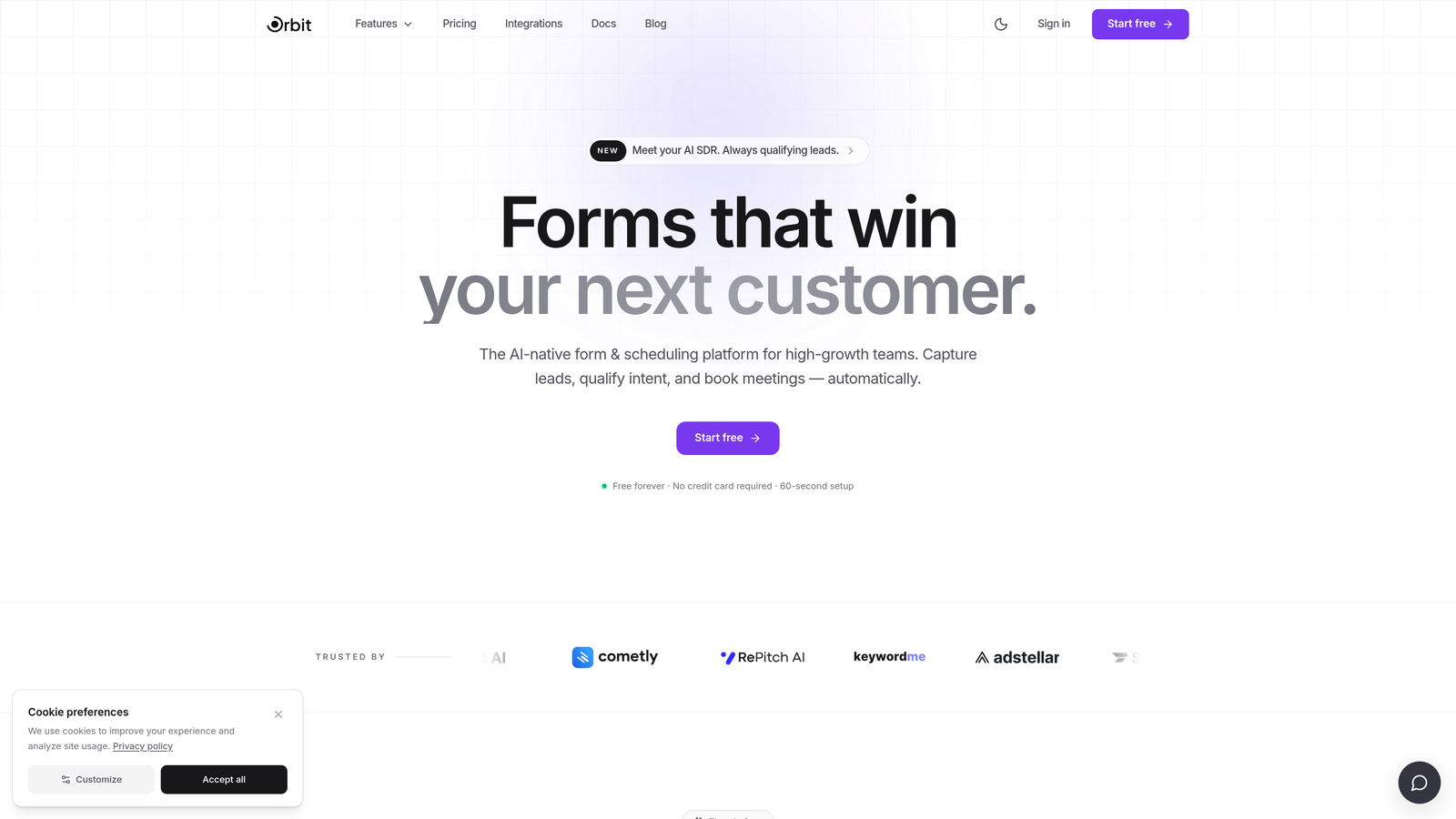
Orbit AI is an AI-powered form builder that combines lead qualification, conversion optimization, and modern form design in a single platform.
Where This Tool Shines
Most teams trying to optimize form conversions end up stitching together a form builder, an A/B testing tool, a lead scoring system, and an analytics layer. Orbit AI collapses that stack. The platform is built specifically for teams where form performance is a growth lever, not an afterthought.
The AI lead qualification layer is what sets it apart. Rather than just capturing submissions and pushing them into a CRM for manual review, Orbit AI qualifies leads directly within the form flow, giving your sales and marketing teams a cleaner, more actionable pipeline from the start.
Key Features
AI-Powered Lead Qualification: Intelligent qualification logic built directly into the form flow, so leads are scored and filtered before they ever hit your CRM.
Conversion-Optimized Templates: Templates designed specifically for high-growth teams, with form structures and layouts that prioritize completion rate.
Multi-Step and Conditional Logic Forms: Build complex, personalized form flows with clean, modern UX that doesn't feel like a spreadsheet.
Performance Analytics: Track completion rates, identify drop-off points at the field level, and understand where your form is losing people.
Consolidated Stack: Replaces the need for separate form creation, lead scoring, and basic analytics tools, reducing integration overhead for fast-moving teams.
Best For
SaaS companies and marketing teams running active lead generation programs who want a form platform that does more than collect data. Particularly strong for teams that are tired of managing multiple disconnected tools just to capture and qualify a lead.
Pricing
Visit orbitforms.ai for current pricing and plan details.
2. Optimizely
Best for: Enterprise teams running sophisticated, statistically rigorous experimentation programs across web experiences.
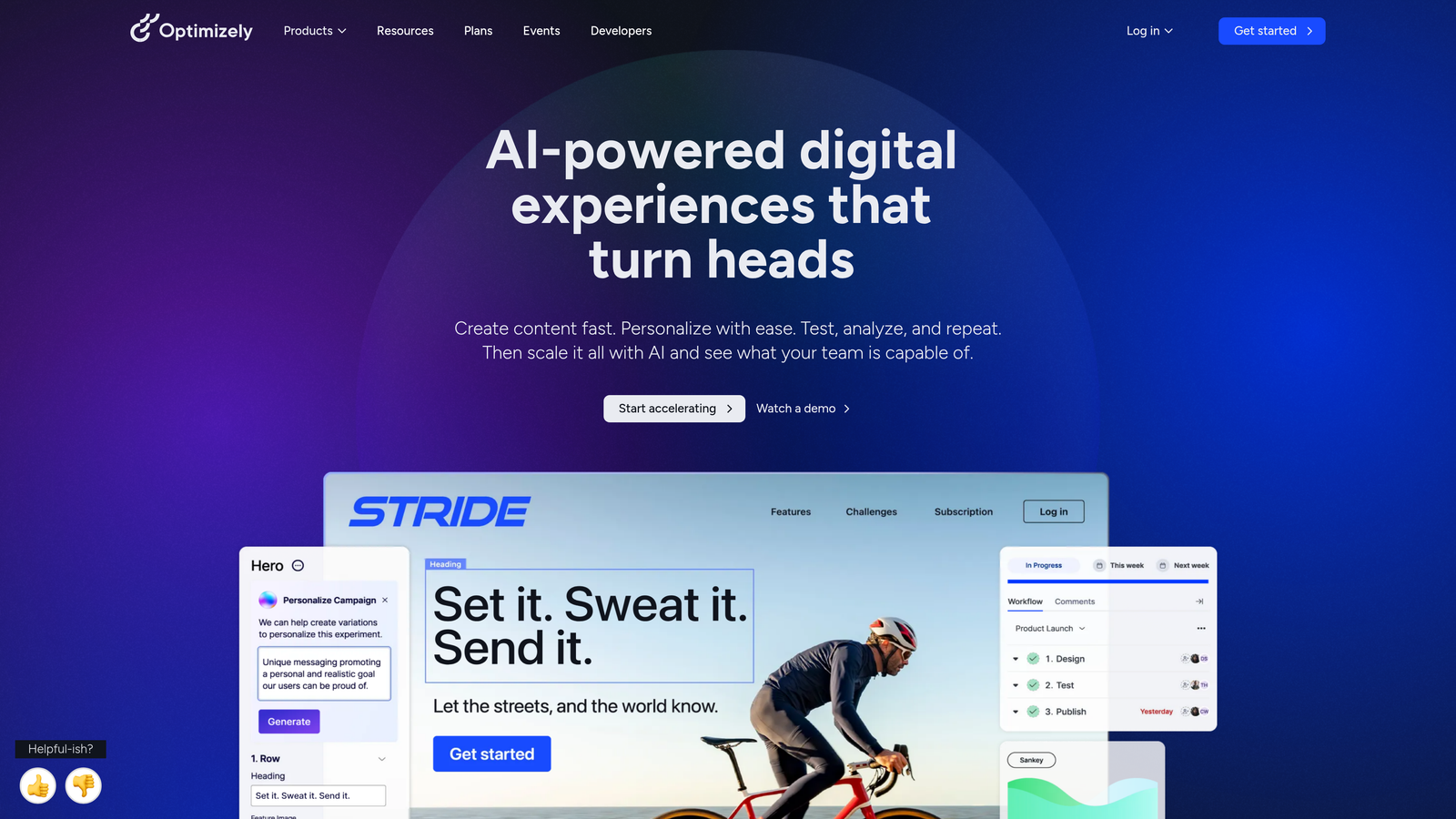
Optimizely is one of the most established enterprise experimentation platforms, offering A/B, multivariate, and feature testing across digital experiences including forms.
Where This Tool Shines
Optimizely's statistical engine is genuinely mature. For teams where a bad call on statistical significance could mean shipping the wrong form variant to millions of visitors, that rigor matters. It gives you the controls to define confidence thresholds, manage sample sizes, and avoid declaring winners too early.
Beyond form-level testing, Optimizely extends into feature experimentation, making it a natural fit for product and engineering teams who want a single platform for both UI and backend experiments.
Key Features
Statistical Significance Controls: Mature engine with configurable confidence levels to prevent premature test conclusions.
Visual Editor: No-code interface for testing form element variants without requiring developer involvement for every change.
Multivariate Testing: Test multiple form variables simultaneously and isolate the impact of individual changes.
Enterprise Data Integration: Deep connections with enterprise analytics stacks, data warehouses, and CRM systems.
Feature Experimentation: Extends testing beyond UI into product feature rollouts and backend logic.
Best For
Large organizations with dedicated experimentation teams, significant web traffic to reach statistical significance quickly, and the budget to match. Not the right fit for early-stage teams or those without technical resources to manage the platform.
Pricing
Custom enterprise pricing. Contact Optimizely directly for a quote based on your traffic volume and feature requirements.
3. VWO (Visual Website Optimizer)
Best for: Mid-market teams who want A/B testing bundled with behavioral analytics in a single CRO platform.
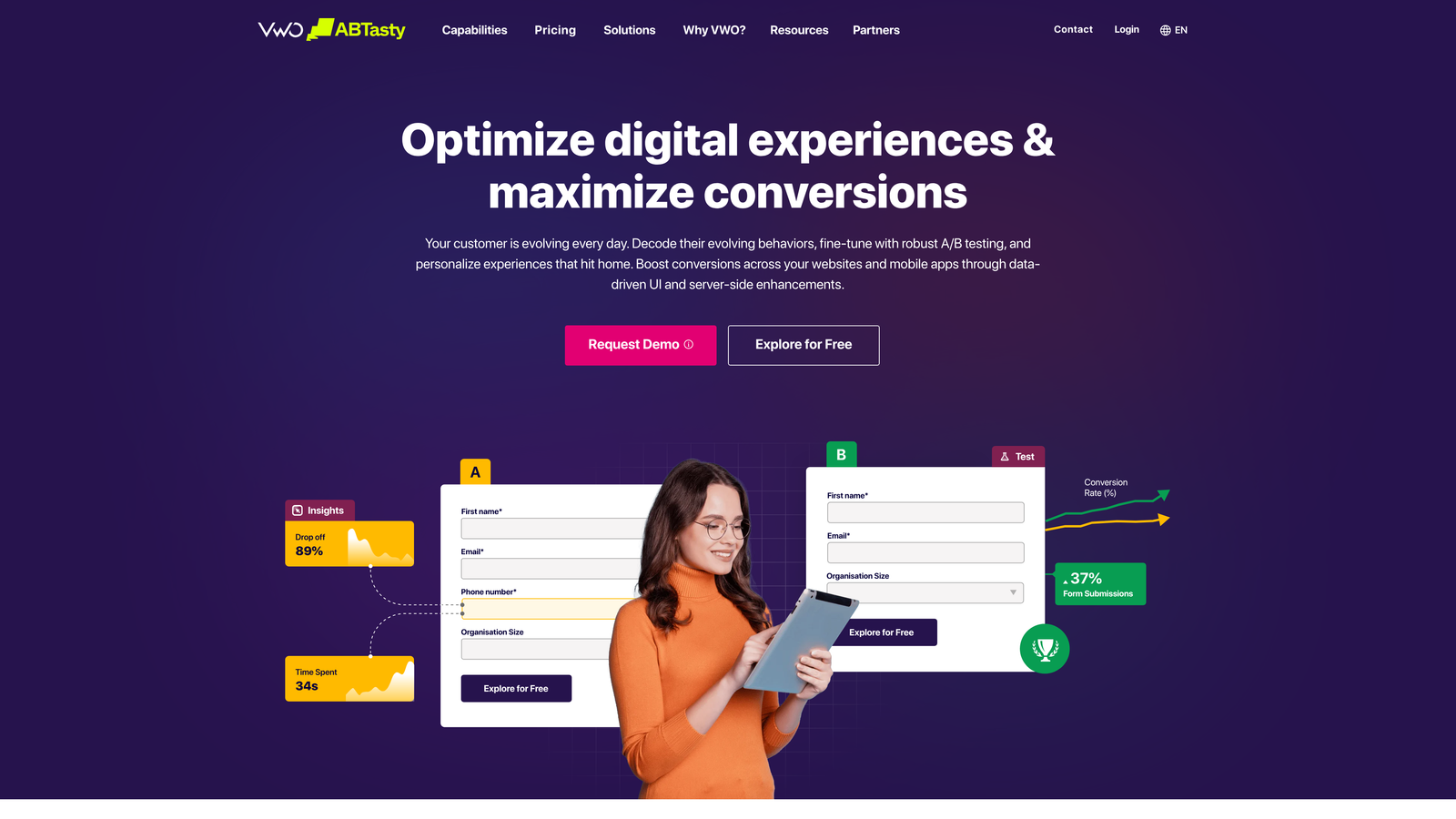
VWO is a conversion rate optimization platform that combines A/B testing with heatmaps, session recordings, and funnel analytics for a more complete optimization workflow.
Where This Tool Shines
VWO's strength is that it doesn't make you choose between running a test and understanding user behavior. The heatmap and session recording features sit alongside the testing suite, so you can watch how real users interact with your form variants, not just compare aggregate conversion numbers.
The visual editor is genuinely accessible for non-technical marketers. You can test a different CTA label, reorder form fields, or swap out a multi-step structure without touching code, which keeps testing velocity high.
Key Features
Visual Editor: Test form layouts and element variants without developer involvement.
Heatmaps and Session Recordings: Understand exactly how users interact with your forms, not just whether they convert.
Funnel Analysis: Identify the specific steps in your form flow where drop-off is highest.
Audience Segmentation: Run targeted experiments for specific user segments rather than blanket tests.
Integrated Survey Tool: Collect qualitative feedback alongside quantitative test results for richer insight.
Best For
Mid-market marketing and growth teams who want a single platform for both behavioral research and formal A/B testing, without the complexity and cost of enterprise-tier platforms like Optimizely.
Pricing
Base plans available for smaller sites; mid-market and enterprise tiers also offered. Check vwo.com for current pricing.
4. Google Optimize (via GA4 + Integrations)
Best for: Teams already embedded in the Google ecosystem who want lightweight experimentation tied directly to GA4 goals.
Google Optimize was Google's native A/B testing tool, now sunset as of 2023. Teams in the Google ecosystem today use GA4 experiments or third-party alternatives that integrate tightly with GA4 for goal tracking.
Where This Tool Shines
The core value here is the GA4 integration. If your conversion goals, audience segments, and reporting are already living inside Google Analytics, running experiments that feed directly into that data layer removes significant friction. You're not reconciling metrics across separate platforms.
For teams with limited testing budgets, the free entry point of GA4 experiments makes this a pragmatic starting point. It won't give you the depth of VWO or Optimizely, but it's a meaningful step above running no tests at all.
Key Features
Native GA4 Integration: Conversion goal tracking flows directly into your existing Google Analytics reporting.
Audience Targeting: Use GA4 segments to target experiments at specific visitor groups.
Free Entry Point: GA4 experiments are available without additional cost for teams already using Google Analytics.
Basic Visual Testing: Limited visual editing capabilities for simple form element variant testing.
Advanced Options via GA360: More sophisticated experimentation features available through Google Analytics 360 for enterprise users.
Best For
Budget-conscious teams or those just starting their experimentation journey who are already invested in the Google Analytics ecosystem. Teams with more complex testing needs will likely outgrow this approach quickly.
Pricing
GA4 experiments are free. Advanced options are available via Google Analytics 360, which carries enterprise pricing.
5. Typeform
Best for: Teams prioritizing form completion rates through conversational UX design, with basic analytics for comparing form versions.
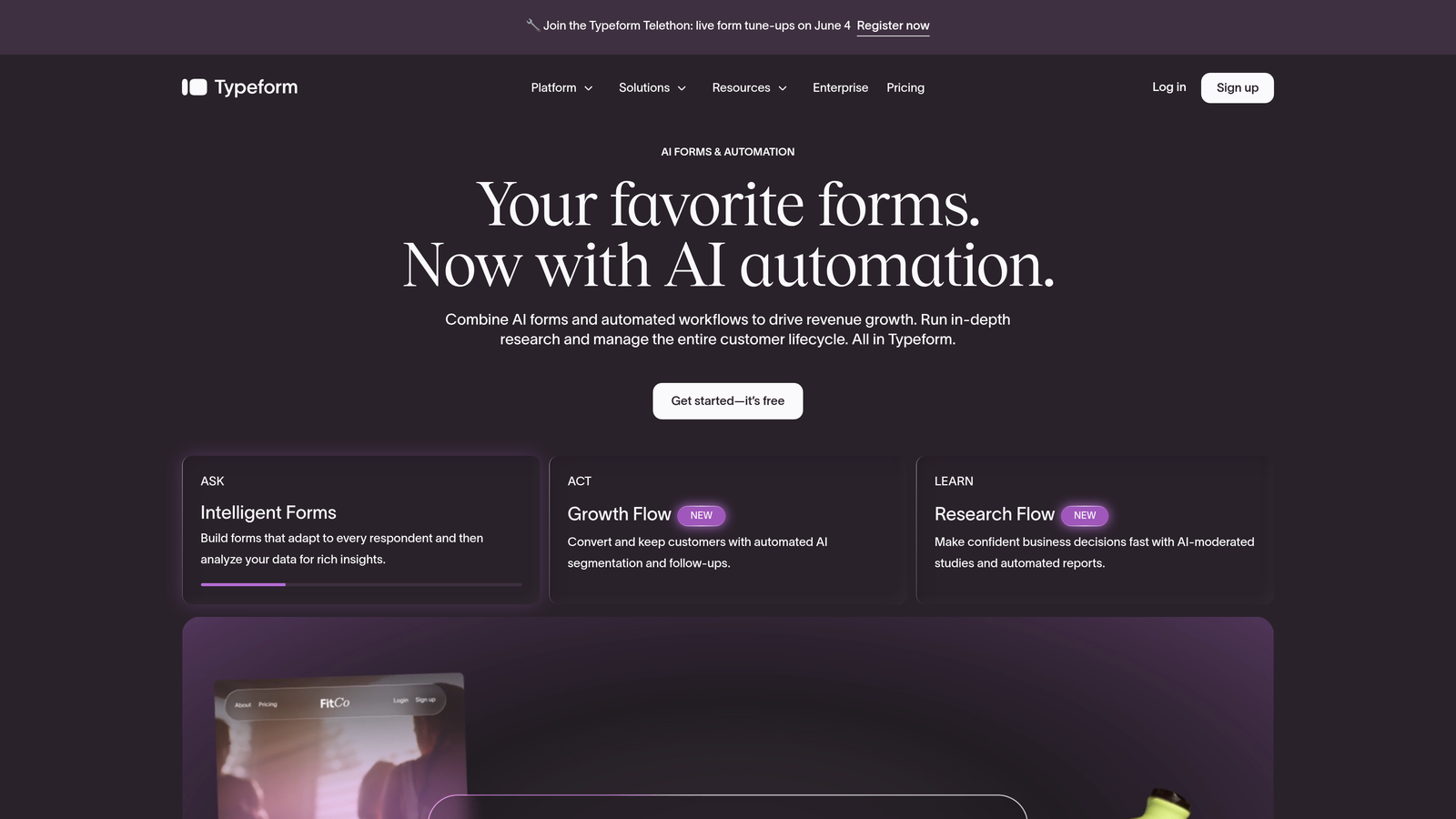
Typeform is a conversational form builder known for its one-question-at-a-time interface and built-in analytics for tracking form performance across versions.
Where This Tool Shines
Typeform's approach to form design is itself a conversion optimization strategy. The one-question-at-a-time format reduces cognitive load and tends to improve completion rates for longer forms, particularly in survey, onboarding, and research contexts. That design philosophy does a lot of the heavy lifting before you ever run a formal A/B test.
While Typeform isn't a traditional split testing platform, its analytics dashboard lets you compare performance across different form versions deployed via separate links. It's a lighter-weight approach, but practical for teams that want directional insight without full experimentation infrastructure.
Key Features
Conversational UI: One-question-at-a-time format that naturally reduces form abandonment for complex or longer flows.
Analytics Dashboard: Track completion rates, drop-off points, and time-to-complete across form versions.
Logic Jumps and Conditional Branching: Personalize the form path based on previous answers for a more relevant experience.
Multi-Version Comparison: Deploy different form versions via separate links and compare performance data side by side.
Integration Ecosystem: Connects with major CRM and marketing automation platforms for seamless lead handoff.
Best For
Teams focused on survey, research, or onboarding forms where completion rate is the primary metric and conversational design is a natural fit. Less suited for high-volume lead capture scenarios requiring rigorous statistical testing.
Pricing
Free plan available. Paid plans start at approximately $25 per month. Check typeform.com for current pricing.
6. Unbounce
Best for: Paid acquisition teams running landing page tests where forms are a core conversion element within the full page experience.
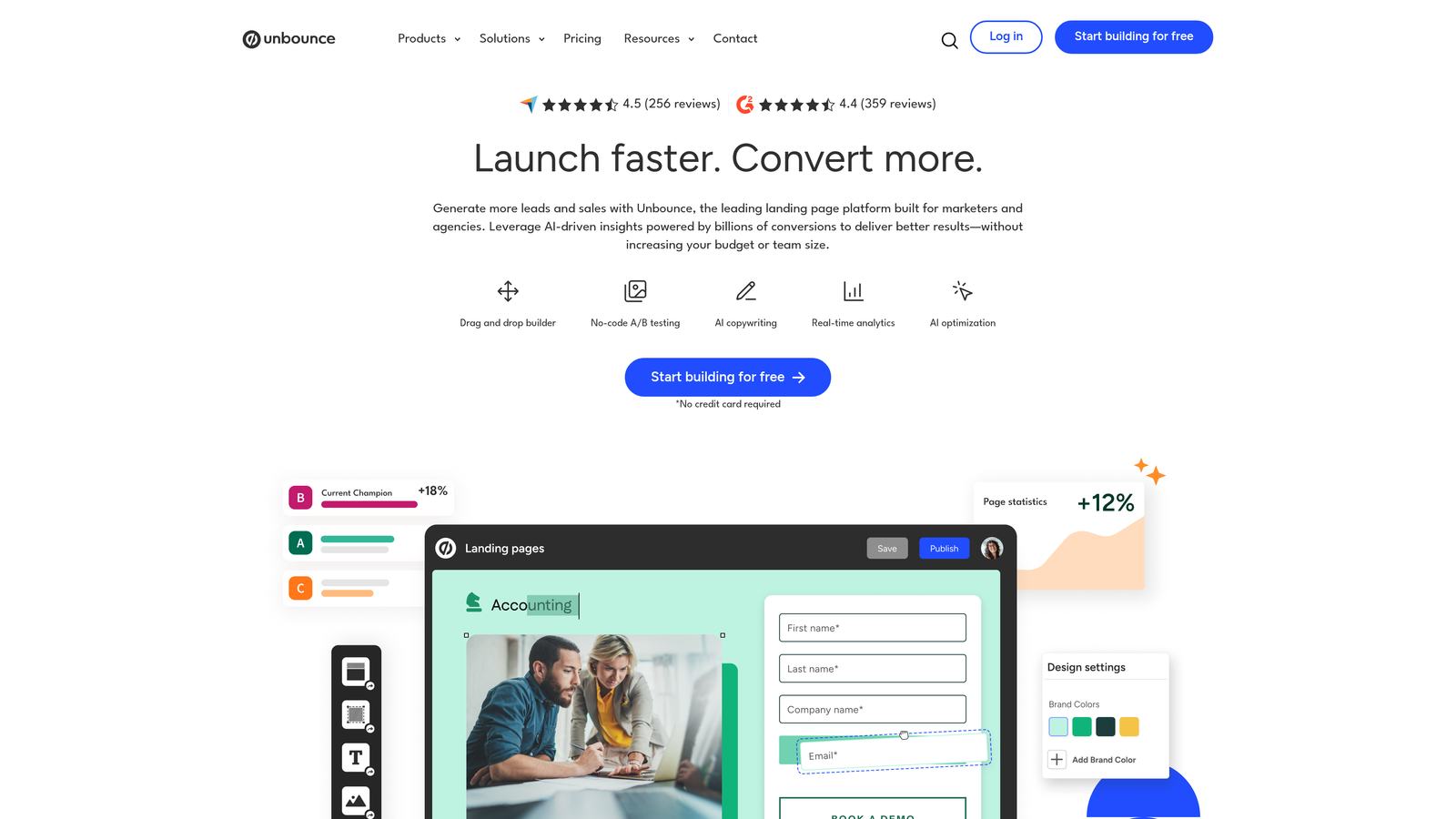
Unbounce is a landing page builder with native A/B testing and an AI-powered Smart Traffic feature that automatically routes visitors to the highest-converting variant.
Where This Tool Shines
Unbounce approaches form testing differently from most tools on this list. Rather than testing form elements in isolation, it tests the entire landing page experience, forms included. For paid acquisition teams, this is often the right framing: the form doesn't exist in a vacuum, and the headline, hero image, and social proof around it all influence whether someone submits.
The Smart Traffic feature is a genuine differentiator. Instead of waiting for a traditional A/B test to reach statistical significance, it uses machine learning to automatically route visitors to the variant most likely to convert for them, which can accelerate optimization for lower-traffic campaigns.
Key Features
Full Page A/B Testing: Test entire landing page experiences, including embedded forms, CTAs, and surrounding content.
Smart Traffic AI: Automatically routes visitors to the best-performing variant based on visitor attributes, reducing time to optimization.
Drag-and-Drop Builder: Fast iteration on form and page designs without developer involvement.
Dynamic Text Replacement: Personalize form and page copy based on the ad or keyword that brought the visitor.
Ad Platform Integrations: Strong connections with Google Ads, Meta, and major CRM platforms.
Best For
Performance marketing teams running paid campaigns who want to test landing pages and forms together, not separately. Less suited for teams who need to test forms embedded in existing site pages outside of Unbounce's builder.
Pricing
Plans start at approximately $99 per month. Check unbounce.com for current pricing and plan details.
7. AB Tasty
Best for: Growth and product teams running sophisticated form and page experiments with strong audience segmentation and personalization needs.
AB Tasty is a European CRO platform combining A/B testing, personalization, and feature flagging in a single platform built for teams running complex experiments.
Where This Tool Shines
AB Tasty sits in an interesting position between VWO and Optimizely in terms of depth and complexity. It's more accessible than Optimizely for mid-market teams, but offers more sophisticated audience segmentation and personalization capabilities than most entry-level CRO tools.
The personalization engine is particularly relevant for form optimization. Rather than showing every visitor the same form variant, you can serve different form structures, field orders, or CTAs based on audience attributes, which moves you from testing toward genuine personalization at scale.
Key Features
A/B and Multivariate Testing: Test individual form elements or full form variants with audience segmentation controls.
Personalization Engine: Serve different form variants to different audience segments based on behavioral or demographic attributes.
Feature Flagging: Useful for product and growth teams who want to control form feature rollouts alongside experiments.
Visual Editor and Developer API: Flexible implementation options for both technical and non-technical team members.
GDPR Compliance: Strong data privacy posture given the platform's European origins and regulatory environment.
Best For
Mid-market to enterprise teams in Europe or those with strong GDPR compliance requirements, and growth teams who want to move from simple A/B testing toward personalized form experiences at scale.
Pricing
Custom pricing based on traffic volume. Contact AB Tasty directly for a quote.
8. Convert.com
Best for: Teams where data privacy and GDPR compliance are non-negotiable requirements for any experimentation tool.
Convert.com is a privacy-first A/B testing platform with GDPR-compliant architecture and cookieless testing options for compliance-sensitive environments.
Where This Tool Shines
Convert.com has built its identity around privacy. It doesn't share data with third parties, offers cookieless testing options, and has architected the platform from the ground up with compliance in mind. For teams operating in regulated industries or those that have made data privacy a core brand commitment, that's a meaningful differentiator rather than just a checkbox.
Beyond the privacy angle, Convert.com is a capable full-featured A/B testing platform. It handles form element testing, multivariate experiments, and integrates cleanly with GA4, Segment, and other analytics tools your team is likely already using.
Key Features
Cookieless Testing: Run experiments without relying on third-party cookies, future-proofing your testing program.
No Third-Party Data Sharing: Visitor data stays within your control and is not sold or shared externally.
Full A/B and Multivariate Testing: Test form elements, layouts, CTAs, and complete form variants with statistical rigor.
Analytics Integrations: Connects with GA4, Segment, and other major analytics and data platforms.
Dedicated Support: Onboarding and support resources designed for mid-market teams who need more than documentation.
Best For
Teams in regulated industries, B2B companies with enterprise clients who have strict data processing requirements, and any organization that has made data privacy a strategic priority rather than an afterthought.
Pricing
Plans start at approximately $699 per month. Check convert.com for current pricing.
9. Hotjar
Best for: Teams building A/B test hypotheses by understanding exactly where and why users abandon their forms.
Hotjar is a behavioral analytics platform with a dedicated form analytics module that reveals field-level user behavior to inform smarter experimentation decisions.
Where This Tool Shines
Hotjar isn't a traditional A/B testing tool, and that's the point. Most teams run experiments on the wrong things because they don't have enough behavioral data to know what's actually causing form abandonment. Hotjar fixes that. Its form analytics module shows you which specific fields users drop off at, which fields they leave blank, and where they hesitate, giving you a precise brief for your next experiment.
Used alongside a dedicated testing platform like VWO or Convert.com, Hotjar closes the insight loop. You use it to understand what to test, run the experiment in your testing platform, and then return to Hotjar to validate that the winning variant actually improved the behavioral patterns you were targeting.
Key Features
Field-Level Form Analytics: See exactly which fields cause drop-off, hesitation, or blank submissions, not just overall completion rates.
Heatmaps and Session Recordings: Full UX context for understanding how users interact with your form before and after submission attempts.
On-Site Surveys: Capture qualitative feedback from form abandoners to understand the "why" behind behavioral data.
Funnel Analysis: Identify which forms across your site are underperforming relative to their traffic volume.
A/B Platform Integrations: Connects with most major testing platforms so behavioral data and experiment data live in context together.
Best For
Any team running form optimization work, regardless of which A/B testing tool they use. Hotjar is most valuable as a research layer that makes every subsequent experiment more targeted and better hypothesized.
Which Tool Is Right for Your Team
The right choice comes down to a single question: do you need a dedicated form platform with conversion optimization built in, or a standalone experimentation layer sitting on top of your existing forms?
Here's a quick way to think through it by use case:
AI-powered forms with lead qualification: Orbit AI is the natural starting point for high-growth SaaS and lead gen teams who want conversion optimization and intelligent lead scoring without managing multiple tools.
Enterprise-grade experimentation: Optimizely is the established choice for large organizations with dedicated experimentation teams and the traffic volume to match.
Behavioral data plus testing in one platform: VWO gives you heatmaps, session recordings, and A/B testing without switching tools, making it strong for mid-market teams who want a complete CRO workflow.
Budget-conscious testing in the Google ecosystem: GA4 experiments offer a free entry point for teams already living in Google Analytics who want to start testing without additional spend.
Privacy-first environments: Convert.com is the clear choice when data compliance is a hard requirement, not a preference.
Form hypothesis research: Hotjar belongs in almost every form optimization stack, not as a testing platform, but as the behavioral research layer that makes your tests smarter.
For most high-growth SaaS and lead generation teams, starting with a form builder already optimized for conversion removes the need to stitch together separate tools. From there, layering in Hotjar for behavioral insight or VWO for formal experimentation makes sense as your testing program matures.
Whichever direction you go, the fundamentals stay the same: test with a clear hypothesis, let data accumulate before declaring a winner, and focus your changes on the elements that most directly affect submission rate, including field count, CTA copy, form placement, and step structure.
Transform your lead generation with AI-powered forms that qualify prospects automatically while delivering the modern, conversion-optimized experience your high-growth team needs. Start building free forms today and see how intelligent form design can elevate your conversion strategy.


