

The most popular advice about sales funnels is wrong in one important way. A funnel isn't a neat sequence of pages that moves every buyer from awareness to purchase in order. B2B buyers research independently, switch between channels, delay form fills, return through different devices, and often want to evaluate a product without speaking to sales. If your funnel only works as a straight line, it will break as soon as real buying behavior begins.
The practical question isn't how many visitors you can push into the top. It's whether each handoff preserves context, captures useful intent, and gives the buyer a sensible next step. The following framework treats a sales funnel as a connected operating system for demand, qualification, nurturing, and revenue.
Why Most Sales Funnels Fail Before They Start
A funnel usually fails before anyone builds the landing page. Teams agree on stage names, connect a form to a CRM, and assume the system is ready. Then marketing sends leads that sales can't prioritize, sales follows up without context, and buyers receive messages that don't match what they were researching.
The linear funnel model causes this problem because it describes the seller's preferred process, not the buyer's actual journey. In 2026, 67% of B2B buyers reportedly preferred a rep-free, self-serve buying experience, while modern funnel definitions emphasize tracking prospects across 10 or more channels and tying attribution to revenue outcomes, according to CartFlows' sales funnel statistics. A buyer might discover an article through search, watch a product video, interact with a social form, return through an email, and request pricing without following your intended stage order.
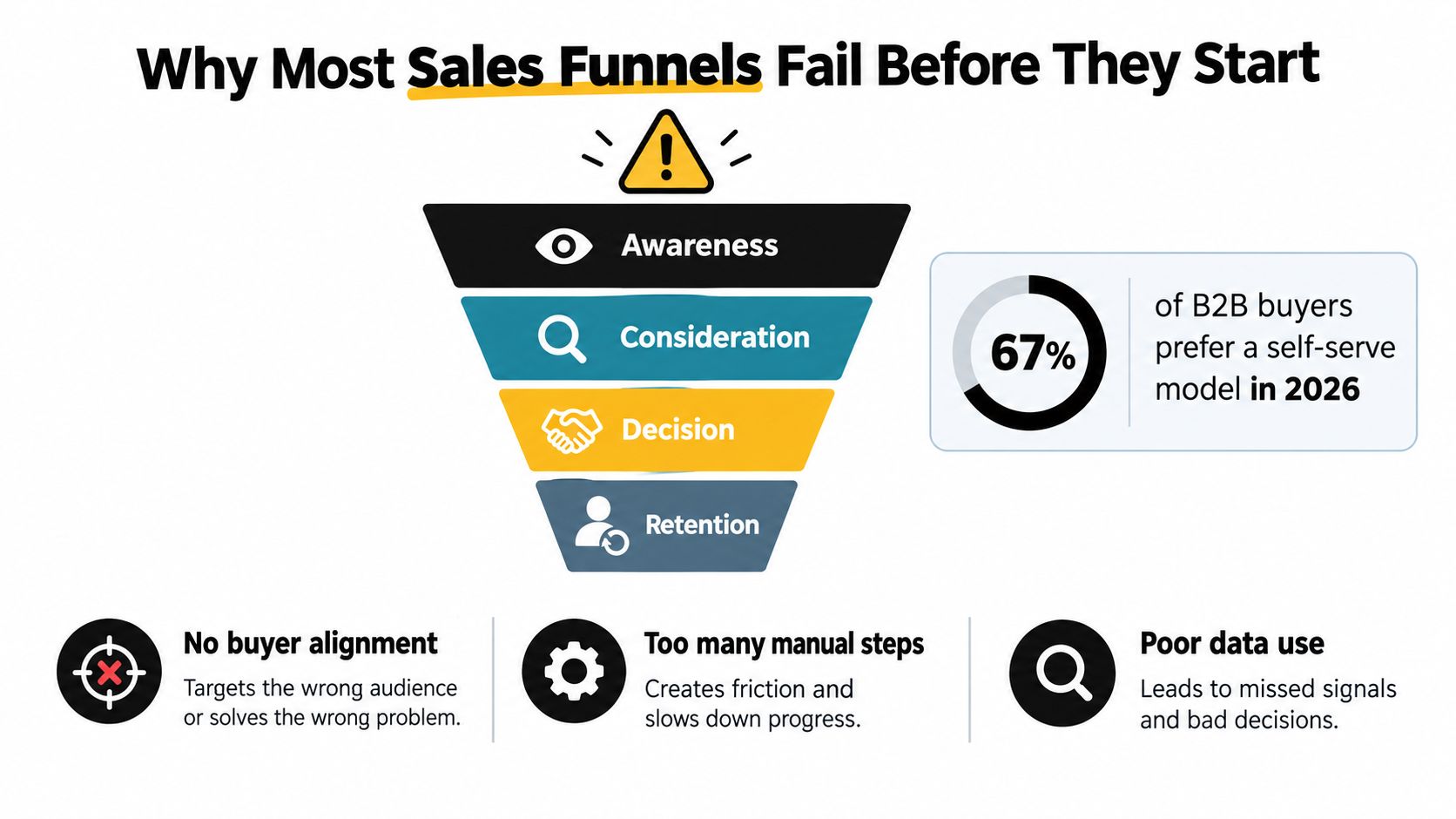
The real failure points
Traffic rarely fixes a funnel with broken transitions. A widely cited synthesis of 2024 to 2025 funnel data places overall lead-to-customer conversion at 2% to 5%, or 20 to 50 customers from every 10,000 website visitors, with the steepest loss often occurring at the MQL-to-SQL handoff, where average conversion sits at 15% to 21%. Those benchmarks are summarized in sales funnel statistics from SHNO.
The important lesson is that a funnel has several conversion problems, not one. A form can capture volume while collecting too little context. A CRM can receive leads while failing to route them. A sales team can respond quickly while using qualification criteria that marketing never agreed to.
Practical rule: Treat every handoff as a product experience. If the next team or workflow can't understand what the buyer wants, the funnel has lost value.
Start by auditing the transitions rather than redesigning every page. A useful conversion funnel analysis framework helps separate visitor intent, form friction, qualification quality, and sales follow-up. For broader context on connecting automation to funnel operations, MakeAutomation sales automation insights provide another useful reference.
Defining Your Funnel Stages and Ideal Customer Profile
A funnel is not a row of pages. It is a set of buyer decisions connected across channels, devices, and teams. Before choosing a form or campaign, define who should advance, what evidence shows intent, and which handoff happens next.
An Ideal Customer Profile, or ICP, is a decision filter rather than a fictional persona. Build it from strong existing customers where possible. Review industry, operating model, company size, technical environment, buying role, urgency, and the problem that started evaluation. Add behavioral signals such as repeat visits, detailed questions, engagement across channels, or a request for a specific evaluation asset. A company can fit the firmographic profile and show little intent. A less obvious account can deserve attention when its behavior shows urgency.
Give every stage one observable transition
Use labels that a new team member can apply without interpretation. Awareness, consideration, decision, and retention can work, but entry and exit criteria matter more than the names.
| Funnel stage | Buyer state | Micro-conversion |
|---|---|---|
| Awareness | The buyer recognizes a problem or category | Engages with a problem-specific resource |
| Consideration | The buyer compares approaches or vendors | Requests an evaluation asset or shares relevant context |
| Decision | The buyer is assessing commercial and implementation fit | Accepts a sales conversation or begins a buying process |
| Retention | The customer is adopting and evaluating ongoing value | Reaches a defined success milestone or identifies expansion need |
A self-serve buyer may move from a product page to documentation, a peer review, and a sales conversation without following your preferred sequence. Model those paths instead of forcing every prospect through identical pages. Record the same event consistently across channels. “Demo request,” “contact sales,” and “book a call” should not create separate statuses when they trigger the same workflow.
Define who owns each handoff, what context must travel with the lead, and how quickly the next action occurs. Qualification depth matters here. A routing rule that sends every form fill to sales creates noise, while a rule that waits for perfect information hides high-intent buyers. Segment reporting by traffic source, campaign, device, geography, and customer type so you can compare similar journeys rather than rely on a blended average.
B2B SaaS benchmark data commonly places lead-to-MQL conversion at about 39%, MQL-to-SQL conversion at about 38%, and SQL-to-closed-deal conversion at about 37%, as reported in Webeyz's funnel conversion benchmarks. Treat these figures as context, not quotas. The useful principle is a funnel made of measurable transitions and clear ownership.
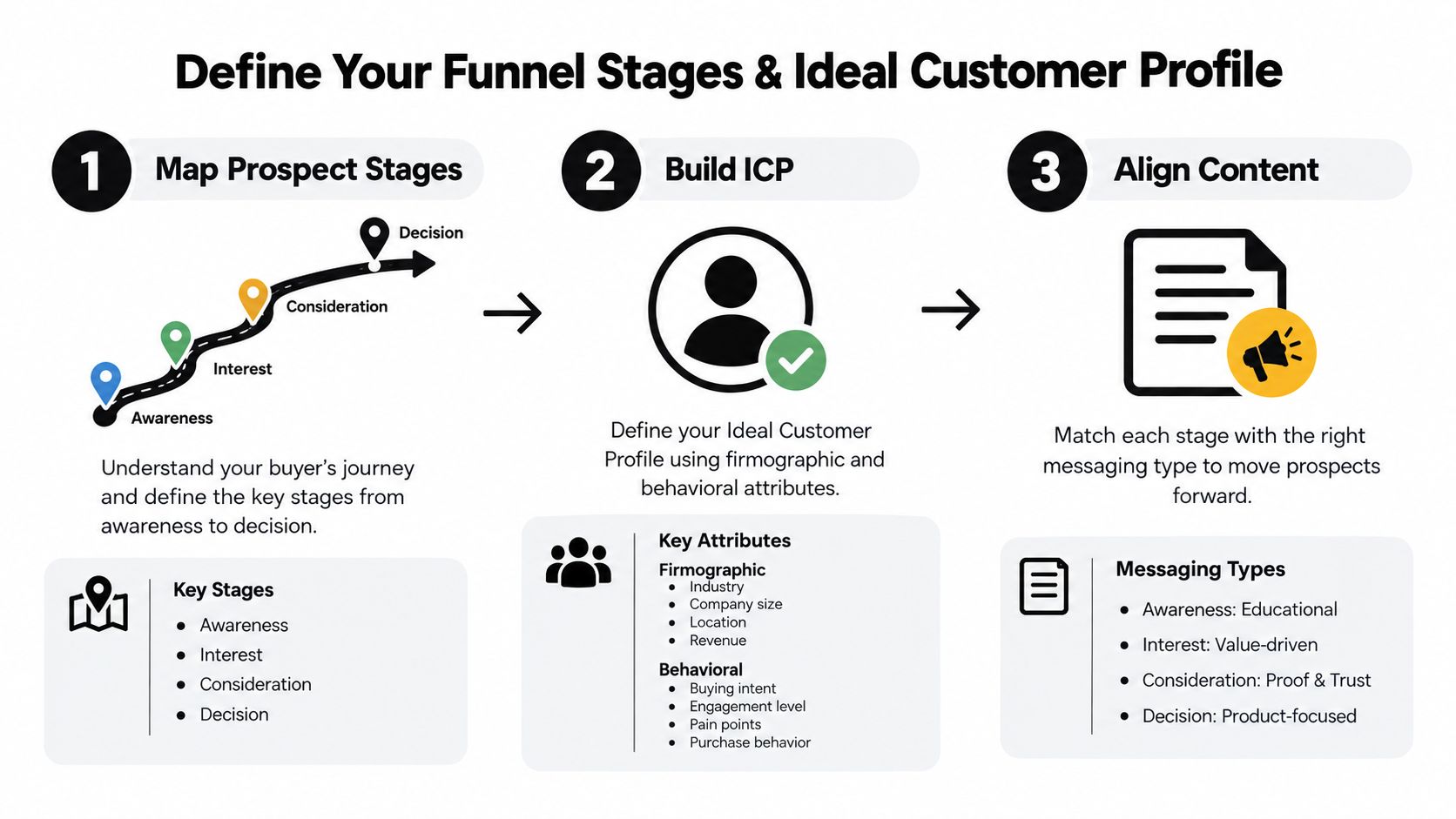
Align content with readiness
Awareness content clarifies the problem. Consideration content helps buyers compare approaches. Decision content addresses implementation, security, commercial, and stakeholder objections. Retention content helps customers reach value and identify the next useful outcome.
If a stage has no observable micro-conversion, leave automation off until you can define one. Otherwise, activity gets counted without showing whether the buyer has advanced.
Building Landing Pages and High-Converting Forms
Your website may receive plenty of attention while producing very little pipeline. B2B websites typically convert only 1% to 3% of visitors into leads, meaning 97% to 99% of traffic leaves before a form fill or another lead capture event, according to SyncGTM's B2B funnel benchmarks. That makes the first capture point a critical leakage area.
A dedicated landing page gives one campaign, audience, and offer a focused environment. A 2026 benchmark reports a 4.02% median conversion rate for dedicated landing pages, compared with 2.35% for general website pages, while top-quartile landing pages exceed 11.45%, according to Digital Applied's landing page data.

Design for intent, not just completion
Start with message continuity. The headline, offer, proof, and form should reflect the source that brought the visitor there. Someone arriving from a technical comparison needs different context from someone responding to a broad educational campaign.
Use the page to answer four questions quickly:
- What problem does this solve? State the buyer's situation in language they recognize.
- What happens next? Explain whether they'll receive an asset, access a workspace, or speak with a person.
- Why share information? Make the exchange useful before asking for details.
- What information is necessary now? Remove questions that don't affect routing or qualification.
Form friction is measurable. Independent benchmark data reports that 60% to 80% of people who start a web form never finish it, while B2B demo-request forms see roughly 55% to 75% abandonment. A 2024 analysis found that each additional field lowered conversion by about 4.1%, and forms with more than five fields saw around a 30% conversion decrease versus shorter B2B versions, as detailed in CloseTrace's form abandonment benchmarks.
That doesn't mean every form should have one field. Short forms maximize completion, but longer forms can improve qualification when the questions change the next action. Use progressive profiling when you need more context, asking for basic contact details first and collecting additional information during later interactions.
Test the drop-off point
Don't guess which field causes abandonment. Track form starts, field-level progression, validation errors, completion, and downstream sales quality. A form that converts well but produces unusable leads isn't optimized.
Teams looking for a disciplined process for faster landing page testing can use structured usability reviews before changing copy or design. For practical examples of capture architecture, see this lead capture landing page template.
A short explanation before the form often beats another testimonial below it. Buyers need confidence that the exchange is relevant, low-risk, and worth completing.
Qualifying Leads and Scoring for Sales Readiness
A marketing-qualified lead isn't automatically ready for a sales conversation. The MQL-to-SQL handoff remains one of the weakest mechanics in B2B funnels, with published benchmarks placing average conversion around 12% to 30%, depending on the dataset. Most MQLs never become SQLs, so the handoff needs explicit rules rather than a vague instruction to “follow up quickly.” The range is documented in SHNO's funnel optimization statistics.
The best scoring models combine fit and intent. Fit describes whether the account belongs in your ICP. Intent describes whether the person is demonstrating a reason to act. Neither dimension works reliably alone.
Build a scoring model sales will trust
Begin with a small set of observable signals:
- Account fit: Industry, company profile, operating environment, and target-account status.
- Role relevance: Whether the contact owns, influences, or uses the problem your product addresses.
- Problem evidence: Language in a form response, email, or conversation that identifies a current need.
- Evaluation behavior: Requests for demos, pricing, security information, implementation details, or comparisons.
- Engagement pattern: Repeated interaction with high-intent pages or resources, interpreted in context rather than treated as a standalone signal.
Avoid assigning heavy weight to low-intent activity. An email open can indicate curiosity, not readiness. A detailed request describing a current workflow problem usually carries more meaning, especially when the account fits your ICP.
Define the MQL and SQL boundary
Marketing and sales should write the threshold together. An MQL might meet the fit criteria and show meaningful engagement. An SQL should meet the fit criteria and demonstrate a buying signal that justifies direct sales attention, such as a defined problem, an evaluation request, or a credible project context.
Keep a reason code attached to every transition. “Promoted to SQL because the buyer requested implementation details” is useful. “Promoted because score exceeded threshold” isn't enough for model improvement.
For a broader qualified lead B2B strategy, the same principle applies: qualification should reflect the buyer's situation, not merely the number of actions recorded. You can also use lead scoring and qualification workflows to preserve context as leads move between systems.
Review rejected SQLs with sales. If representatives repeatedly disqualify leads for the same reason, update the model, the form, or the campaign targeting.
Nurturing Sequences That Move Prospects Forward
A nurture sequence should respond to what a buyer needs next, not send a fixed series of emails. A person downloading an educational guide needs help understanding the problem. A person returning to a pricing page needs commercial clarity. Sending both contacts the same message wastes the signal you already have.
Consider a prospect who completes an early-stage assessment but doesn't request a conversation. The first message can deliver a useful interpretation of the assessment. The next can address a common operational obstacle. A later message can offer a comparison guide or invite the prospect to explore a relevant workflow. The sequence earns the next action instead of forcing a demo request too early.
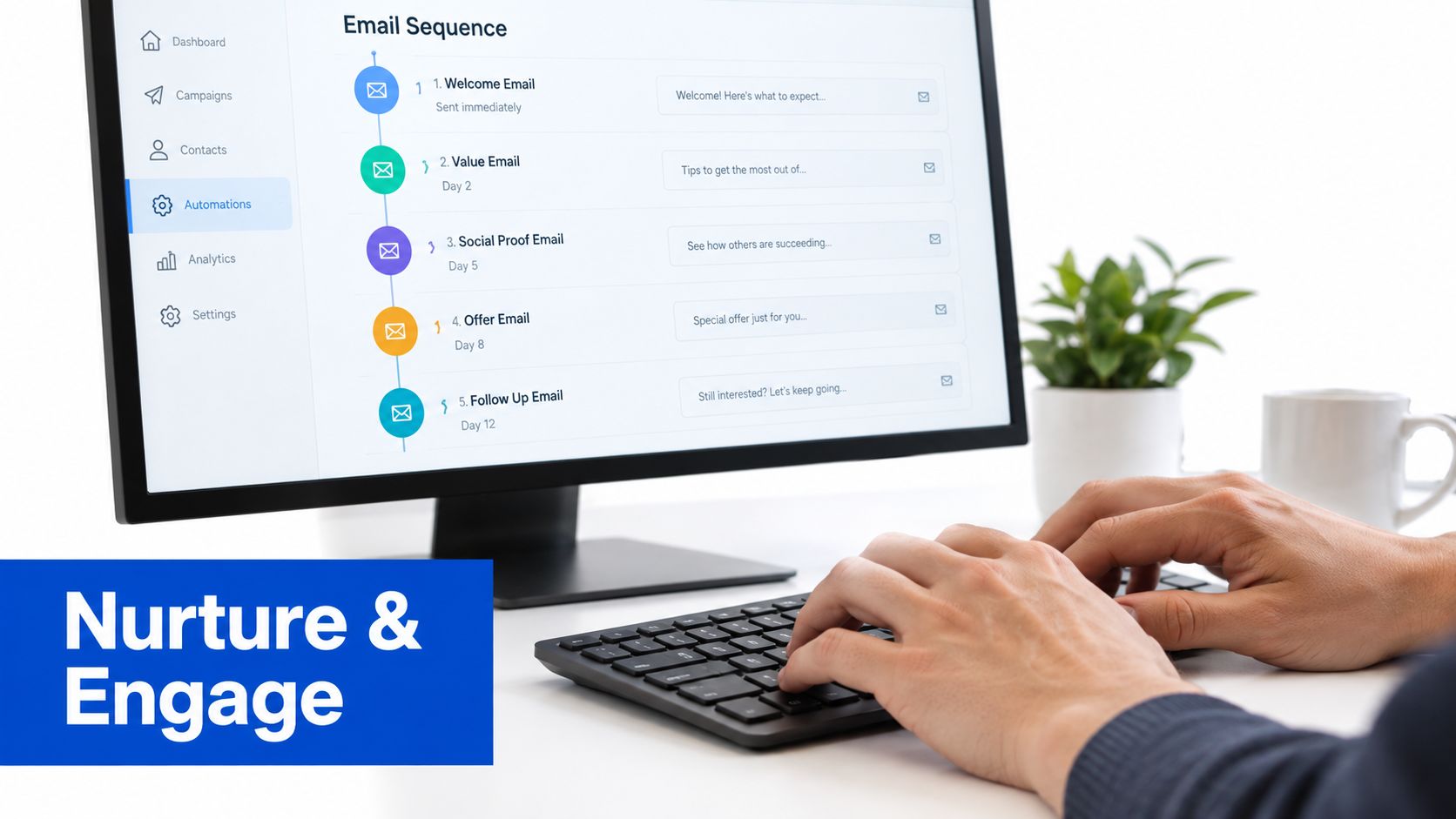
Use behavior to choose the next message
Segment by both stage and action. A buyer who repeatedly engages with implementation content should not remain in a generic awareness sequence. A buyer who stops engaging should move into a lighter reactivation path rather than receiving increasingly frequent reminders.
Useful branches include:
- Education path: Send problem-focused guidance, practical examples, and diagnostic content.
- Evaluation path: Provide product detail, comparisons, implementation material, and answers to likely objections.
- Sales-ready path: Alert the owner, pause broad nurture, and deliver context that supports a relevant conversation.
- Reactivation path: Offer a concise resource or ask whether the problem remains active, then reduce contact if there's no response.
Timing matters more than message volume. A trigger based on a meaningful action is usually more useful than an arbitrary calendar sequence. If a buyer requests pricing, the workflow should acknowledge that intent immediately and route the context to the right owner. If they only downloaded a broad guide, the next message should deepen understanding rather than imply purchase readiness.
A nurture email should make the next decision easier, not merely keep your brand visible.
Behavioral workflows also need exit rules. Stop promotional messages after a sales conversation begins, suppress irrelevant campaigns after a disqualification, and create a re-entry path when a dormant account shows new intent. A practical lead nurturing framework can help teams document those rules before building them in automation.
Choosing the Right Tools and Integrations for Your Stack
Tools should reduce handoff work, not add another operating layer for the growth team. A practical funnel stack usually includes a form builder, CRM, marketing automation, analytics, and a qualification or sales-assistance system. Choose based on the context you need to capture, how buyers self-serve across channels, and whether each system passes that context to the next owner.
Evaluate each tool against four operational requirements:
| Capability | What to inspect | Common failure |
|---|---|---|
| Form creation | Conditional logic, mobile usability, validation, and progressive profiling | Attractive forms that don't capture actionable context |
| CRM connection | Field mapping, routing, lifecycle updates, and duplicate handling | Leads arrive without source or qualification data |
| Automation | Behavioral triggers, branching, suppression, and ownership rules | Every contact receives the same sequence |
| Qualification | Scoring, enrichment, explanations, and human review | A score exists but sales doesn't trust it |
Orbit AI combines a visual form builder with an AI SDR, contextual qualification, enrichment, smart lead scoring, real-time analytics, and workflow connections. It connects to over 50 tools, including CRMs, marketing automation platforms, and data platforms, so submissions can sync and workflows can run automatically. These capabilities are described on the Orbit AI platform.
Choose integration depth over logo count
A long integration directory does not prove that a funnel is connected. Test whether the tool passes campaign source, page context, form responses, qualification rationale, owner, lifecycle stage, and consent status into the systems your teams use. Confirm how updates behave when a buyer returns through another channel or a salesperson changes ownership.
The CRM should remain the operational record for sales ownership and opportunity progression. The form layer should capture intent without forcing every buyer through the same sequence. Automation should coordinate actions, while preserving human judgment for ambiguous or high-value accounts. Analytics should connect source and behavior to downstream outcomes instead of stopping at submission volume.
Check the handoff before approving a purchase. Submit a test lead, inspect every mapped field, trigger the intended routing, and verify that sales can see why the lead was qualified. A polished interface cannot compensate for missing context at the moment of contact.
Avoid buying AI as a substitute for shared definitions. If marketing and sales have not agreed on what makes a lead ready, an AI agent will automate that disagreement faster. Set the stage rules first, then choose tools that enforce them consistently across forms, CRM records, nurture workflows, and sales follow-up.
Measuring Performance and Optimizing Your Funnel
A funnel dashboard should answer one question: where is qualified intent disappearing? Track decision-stage transitions such as visitor-to-lead, lead-to-MQL, MQL-to-SQL, and opportunity-to-close. Segment each rate by source, campaign, device, geography, and customer type. A strong blended result can conceal a weak channel or a broken handoff.
Form denominators change the interpretation. One 2026 benchmark reports median form conversion at 17.3% when completed submissions are divided by users who interact with the form. The same analysis reports a 13.2% median and 21.8% upper benchmark for B2B lead-generation forms, according to Digital Applied's form conversion data. Compare equivalent definitions. Form-interaction conversion does not equal visitor-to-lead conversion.
Use cohorts that match the buying cycle
Monthly reporting can misrepresent long-cycle B2B performance because recent leads have not reached later stages. Use 90-day cohorts to examine stage leakage, while keeping stage names, timestamps, ownership rules, and conversion definitions consistent. The Webeyez's benchmark methodology also supports evaluating benchmarks with consistent definitions.
A practical audit asks:
- Capture: Which sources produce engaged leads rather than submissions alone?
- Qualification: Which characteristics predict sales acceptance?
- Handoff: Where do MQLs stall, and what context is missing?
- Progression: Which opportunities lack a meaningful next action?
- Revenue: Which sources and segments produce closed business?
Use campaign performance tracking to connect campaign activity with funnel movement. Optimize the transition with the greatest effect on qualified pipeline, then test one meaningful change at a time. Simplify a form, revise a qualification question, rewrite a handoff alert, or replace a generic nurture branch with an intent-based path.
Audit discipline: Do not optimize the metric that looks worst. Optimize the transition that can improve qualified pipeline without damaging downstream quality.
Review results by cohort, document why each change was made, and keep the winning version long enough to observe later-stage outcomes. A durable funnel shows every team what happened, why a buyer advanced, and what should happen next.
Orbit AI helps growth teams build low-friction forms, qualify submissions with an AI SDR, enrich lead context, score sales readiness, and sync data across connected systems. Visit Orbit AI to create a more measurable funnel and turn form submissions into qualified conversations.


