

Creating a buyer persona means digging into your target audience to build a fictional, yet fact-based, profile of your ideal customer. It's a process of blending qualitative and quantitative data to truly understand their goals, challenges, and what makes them tick, turning abstract numbers into a real, actionable guide for your marketing and sales teams.
Why Vague Personas Are Killing Your Marketing ROI
Let's be honest. Most buyer personas are a collection of assumptions that end up collecting dust in a forgotten Google Drive folder. They’re filled with generic descriptions and demographic data that offer zero real-world value.
But these vague profiles aren’t just useless—they're actively hurting your business.

Imagine a B2B SaaS company. Their website traffic is great, but conversion rates are in the gutter. Their marketing team is working off a persona named "Marketing Manager Mike," a profile so broad it’s meaningless. He’s described as "30-45 years old, works in tech, and wants to increase leads." This stunning lack of depth is a direct line to business failure.
The Real-World Cost of Bad Personas
Guided by this flimsy profile, the marketing team launches a LinkedIn ad campaign targeting anyone with "Marketing Manager" in their title. The ad copy is generic, speaking to vague goals like "drive more traffic." The result? A sky-high click-through rate from curious but completely unqualified prospects and an ad budget that might as well have been set on fire.
At the same time, the sales team gets flooded with "leads" from this campaign. They spend weeks chasing people who are a terrible fit. Some work for tiny startups with no budget, while others are in industries that can’t even use the product. The reps get frustrated, their time is wasted, and their pipeline fills up with dead ends.
This isn't a hypothetical. It’s the daily reality for countless companies. Without a deep, data-driven understanding of who your customer is, every marketing dollar and sales hour is a gamble.
Moving from Guesswork to Data-Driven Decisions
This cautionary tale highlights a fundamental truth: a data-backed approach to creating buyer personas is no longer optional. Vague assumptions lead directly to misaligned campaigns, wasted resources, and missed revenue.
The difference between a persona that works and one that doesn't is the quality of the data behind it. You have to get specific. You need to understand things like:
- Their True Pain Points: What specific problems keep them up at night?
- Their Buying Triggers: What event prompts them to even start looking for a solution like yours?
- Their Decision Criteria: How do they actually evaluate their options before signing a check?
- Their Trusted Channels: Where do they really go for information and advice?
Answering these questions requires a real commitment to collecting and analyzing customer information. If you're new to this, a great place to start is understanding the different types of data collection you can use to build that foundation of facts.
The story of "Marketing Manager Mike" is a crucial lesson. It sets the stage for a better way forward—one that replaces broad generalizations with sharp, actionable insights. By recognizing the pitfalls of vague personas, you're ready to learn how to create buyer personas that actually drive growth.
Uncovering Insights in Your Existing Company Data
The raw materials for your most powerful, revenue-driving buyer personas are probably already sitting within your company's digital walls. Before you even think about external surveys or interviews, your first stop should be the goldmine of your own data.
This is where guesswork ends and fact-based persona creation begins.

This isn't just a best practice; it’s a proven catalyst for incredible results. A landmark MarketingSherpa case study revealed that companies using data-driven personas saw a 100% increase in pages visited, a 900% boost in visit duration, and an astounding 171% rise in marketing-generated revenue.
These outcomes happen because you're replacing vague notions of who your customers are with vivid profiles based on what they actually do.
Start with Your Customer Relationship Management (CRM) Platform
Your CRM is the central nervous system of your customer interactions and the perfect place to start. It’s a treasure trove of quantitative data that helps you sketch the initial outlines of your ideal customer.
Dive into the records of your best customers—those with the highest lifetime value, smoothest sales cycles, or top satisfaction scores. Look for recurring patterns across these key data points:
- Job Titles: Are you consistently selling to Directors of Marketing, Operations Managers, or Lead Engineers?
- Company Size: Do your ideal clients typically have 50-200 employees, or are they enterprise-level organizations with over 1,000?
- Industry: Pinpoint the specific industries that get the most value from your solution, like B2B SaaS, e-commerce, or healthcare technology.
These simple demographic and firmographic details provide the foundational skeleton for your persona. They tell you who is already succeeding with your product.
Analyze Support Tickets for Pain Points
While your CRM tells you who your customers are, your customer support platform tells you what they struggle with. Support tickets are unfiltered, direct lines to your customers' biggest frustrations and challenges.
Sift through the last six months of support conversations. Don't just look at individual issues; search for themes and frequently asked questions.
By identifying the most common support queries, you uncover the real-world problems your personas face. If dozens of users ask "How do I integrate this with my sales software?" you've just discovered a key challenge and a potential goal for your persona.
This data is crucial because it reveals the exact language your customers use to describe their problems. You can use this phrasing later to craft marketing copy that shows you truly understand their world.
Decode Sales Team Notes and Call Logs
Your sales team is on the front lines, hearing the unfiltered objections, goals, and motivations of prospects every single day. Their call notes, emails, and CRM entries are a rich source of qualitative insight.
Work with your sales leaders to review this information. Look for answers to these critical questions:
- What are the most common objections? Understanding why prospects hesitate gives you insight into their perceived barriers.
- What buying triggers are mentioned? Did a competitor just raise prices? Did they receive a new round of funding?
- What are their true motivations? Are they trying to save money, increase efficiency, or just impress their boss?
These insights move you beyond simple demographics and into the psychological drivers of the buying decision, adding critical depth to your persona profiles.
Mine Your Form Submission Data
Every form submission is a breadcrumb trail leading to valuable persona insights. Platforms like Orbit AI are designed not just to capture leads but to reveal patterns in who is converting and why.
Look at your highest-performing forms—like demo requests or content downloads—and segment the submission data. You might discover that a specific whitepaper is overwhelmingly downloaded by VPs of Sales in the fintech industry. That’s a clear signal about a high-intent audience segment.
If you're not tracking this yet, understanding form submission tracking and analytics is a great place to start. This is how you begin connecting your content strategy directly to persona development, turning abstract data into the first concrete building blocks.
Gathering Deeper Insights Through Real Conversations
Hard data tells you what people are doing, but it rarely explains why. The quantitative insights from your CRM and analytics build the skeleton of your buyer persona, but it's the rich, qualitative details from real conversations that add the heart and soul.
This is where you move beyond numbers. It’s where you start to understand the human motivations, emotions, and personal stories that drive buying decisions. Without this step, you’re just creating a more detailed demographic profile—not a true, actionable persona.
Conducting Customer Interviews That Yield Powerful Narratives
The single most effective way to understand your ideal customer is to talk to them. A well-structured interview can uncover insights you would never find in a spreadsheet. The goal isn't to sell or pitch; it's to listen and learn.
Your best source for interviewees is your existing customer base—both the happy ones and even some who have churned. Happy customers tell you what you're doing right. Unhappy ones can reveal critical blind spots you're completely missing.
To get the most out of these conversations, you need to focus on open-ended questions that encourage storytelling. You're trying to reconstruct their journey from their perspective.
Here are a few powerful questions I always come back to:
- "Walk me through a typical day in your role." This helps you understand their daily responsibilities, pressures, and work environment.
- "What was happening in your business that made you start looking for a solution like ours?" This uncovers the specific trigger events that spark the buying process.
- "What were the most important criteria you used to evaluate your options?" This reveals their decision-making process and what they actually value most.
- "What were your biggest concerns or hesitations before you decided to buy?" This question uncovers the perceived barriers you need to address in your marketing.
Remember to ask "how" instead of "why." A question like "How did you decide on that?" invites a narrative. "Why did you decide that?" can feel confrontational and put people on the defensive.
Designing Surveys People Actually Want to Complete
While interviews provide depth, surveys provide scale. They allow you to validate the themes you've uncovered in your interviews across a larger audience segment. The problem? Most traditional surveys are boring, long, and suffer from abysmal completion rates.
The key is to make the experience feel less like an interrogation and more like a conversation. This is where modern form builders can make a huge difference.
For instance, you could use a tool like Orbit AI to design multi-step, conversational forms. Instead of hitting users with a wall of questions, these forms guide them through one question at a time. It’s a far more engaging and less overwhelming experience. We’ve seen this approach dramatically boost completion rates, giving you way more data to work with. For more on this, check out our guide on survey design best practices.
Analyzing Open-Ended Responses for True Insight
Whether the words come from interview transcripts or survey responses, the real gold is in the open-ended answers. This is where you find the exact language your customers use, their emotional triggers, and their core motivations.
As you analyze this qualitative data, look for recurring themes and powerful quotes. Don't just summarize what they said; capture how they said it.
Getting both quantitative and qualitative data is non-negotiable for building personas that actually work. They each play a distinct, critical role.
Here’s a quick breakdown to help you keep things straight:
Quantitative vs Qualitative Data for Persona Building
| Data Type | What It Tells You | Examples | Best Collection Methods |
|---|---|---|---|
| Quantitative | The "What"—actions, numbers, and trends. | Website clicks, conversion rates, company size, support ticket volume. | CRM, Google Analytics, form submission data, sales reports. |
| Qualitative | The "Why"—motivations, feelings, and stories. | "We were frustrated with our slow, manual process." "I needed a way to prove ROI to my boss." | Customer interviews, open-ended survey questions, sales call notes, online reviews. |
This table makes it clear: one type of data without the other leaves you with a massive blind spot.
You might notice, for example, that five different customers mentioned feeling "overwhelmed" by their current workload. "Overwhelmed" is a powerful emotional word. That’s a direct insight you can use in your ad copy, on your landing pages, and in your sales pitches.
By combining the depth of interviews with the scale of well-designed surveys, you gather the qualitative insights needed to build a persona that feels like a real person. This understanding of their language, emotions, and motivations is what will make your marketing truly resonate.
Bringing Your Buyer Persona Profile to Life
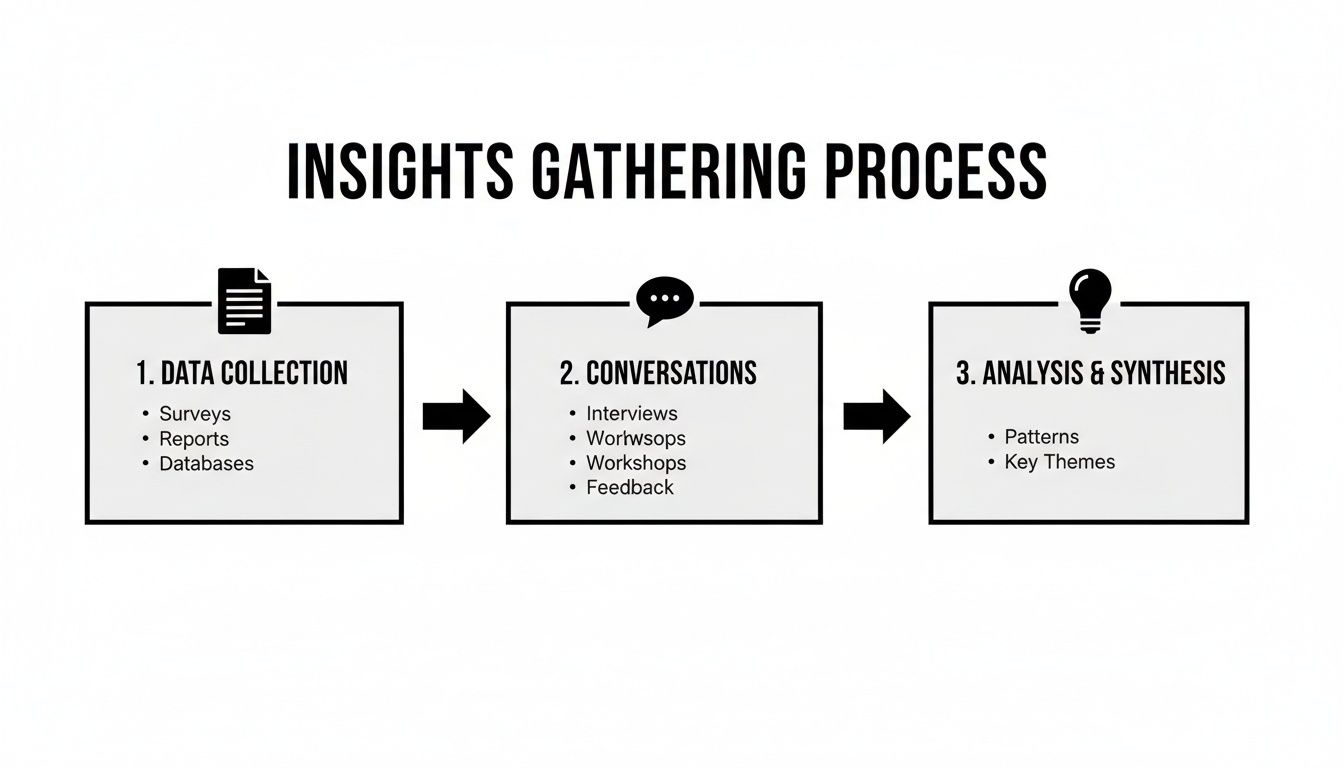
After digging through CRM data, sales notes, and real customer conversations, you’re holding all the raw materials. Now comes the most important part: transforming that mountain of research from scattered data points into a single, cohesive profile your team can actually use.
This is where your persona stops being a collection of facts and starts becoming a character—someone your team can genuinely understand and rally behind.
The whole idea is to combine the hard data with the human stories you've gathered. You can’t build a powerful persona from just one or the other; it’s the intersection of what the numbers say and what your customers actually tell you.
From Data Points to a Cohesive Narrative
Your goal isn't to create a boring data sheet. You’re building a narrative that brings a representative of your ideal customer to life.
Start by clustering your findings. Look for the patterns that connect demographics, job titles, key challenges, and direct quotes from your interviews. This is where the magic happens.
As you group these insights, a clear picture will emerge. You'll move from knowing "our best customers are marketing managers at mid-sized SaaS companies" to understanding why they are. You'll see that they feel immense pressure to prove ROI and are constantly searching for ways to automate repetitive tasks. This is the heart of a great persona profile.
Give your persona a name. It sounds simple, but naming them—like "Growth Marketing Grace" or "Startup Steve"—is a powerful psychological step. It makes the persona memorable and helps your team talk about them as if they're a real person in the room during strategy meetings.
Building Your Persona Profile: A Template
To give your story some structure, it helps to use a consistent template. This ensures you cover all the crucial elements and makes the final document easy for anyone in the company to pick up and use immediately.
Here’s a practical template you can adapt, along with an example for "Growth Marketing Grace," a persona for a B2B SaaS company.
1. Background & Demographics
- Job Title: Growth Marketing Manager
- Industry: B2B SaaS (Series A to C)
- Company Size: 50-250 employees
- Age: 28-35
- Education: Bachelor's in Marketing or a related field.
2. Goals & Motivations
- Primary Goal: To hit an aggressive MQL (Marketing Qualified Lead) target each quarter.
- Secondary Goal: To prove the ROI of marketing spend to the executive team.
- Motivation: Eager to be seen as a strategic leader, not just an executor of campaigns.
3. Challenges & Pain Points
- Primary Challenge: A small team and limited budget mean she's stretched thin.
- Pain Point: Wasting time and ad spend on low-quality leads that the sales team rejects.
- Quote from research: "I spend half my week manually sifting through leads from our web forms instead of focusing on actual strategy."
4. Watering Holes (Where They Get Information)
- Blogs/Publications: Reads HubSpot Blog, MarketingProfs, and SaaS-specific newsletters.
- Social Platforms: Active on LinkedIn for professional content and Twitter for industry news.
- Communities: Member of private Slack communities for B2B marketers.
5. How We Help
- Our Solution: We provide an AI-powered form that automates lead qualification, freeing up her time.
- Our Message: "Stop sifting, start converting. Get sales-ready leads without the manual work."
This structure turns your research into a story. "Grace" is no longer just a demographic; she’s a person with clear goals, real frustrations, and specific places she turns to for help. This is the kind of living document your entire organization can get behind.
As you collect more information, you can add even more detail. For a deeper dive, check out how progressive profiling forms work, as they can help you enrich personas like Grace's over time.
Putting Your Personas to Work Across Your Company
Creating detailed buyer persona profiles is a huge accomplishment, but it's only half the battle. A persona that sits in a shared drive is just a document; a persona that’s actively used becomes a powerful engine for growth.
The real value gets unlocked when you weave these insights into the day-to-day operations of your marketing and sales teams. This is where you turn abstract research into tangible business results. It’s the transition from understanding your customer to actively engaging them in a way that feels personal, relevant, and genuinely helpful.
The goal is to make your personas a living, breathing part of your company's strategic conversations.
Activating Personas in Your Marketing Strategy
For marketing teams, buyer personas should be the North Star guiding every campaign, piece of content, and ad dollar spent. Instead of creating generic materials for a broad, faceless audience, you can now speak directly to the specific goals, pain points, and motivations of each persona.
Suddenly, your content strategy becomes sharper and much more effective. You can craft blog topics that directly answer the burning questions your persona has or develop ad copy that uses the exact language they use to describe their problems.
Here’s how to put it into action:
- Content Mapping: Build a content calendar that specifically addresses each stage of the buyer's journey for your primary persona. For "Growth Marketing Grace," this could mean a top-of-funnel blog post on "5 Ways to Improve Lead Quality" and a bottom-of-funnel case study showing how a similar company crushed their MQL target.
- Channel Targeting: Stop wasting your budget on platforms your persona ignores. If "Grace" lives on LinkedIn and reads specific B2B newsletters, focus your energy and ad spend there—not on Instagram or TikTok.
- Messaging Personalization: Tweak your website copy, email subject lines, and calls-to-action to resonate with your persona’s core drivers. A message about "proving ROI to your boss" will hit home for Grace much harder than a generic pitch about "getting more leads."
Empowering Your Sales Team with Persona Insights
For the sales team, personas are a secret weapon for building rapport and closing deals faster. Imagine a sales rep who understands a prospect's likely challenges and goals before the first call. They can skip the generic discovery questions and jump straight into a strategic, high-value conversation.
This completely shifts the dynamic from a standard sales pitch to a consultative partnership. The rep isn't just selling a product; they are offering a tailored solution to a problem they already understand on a deep level.
Sales teams can use personas to:
- Refine Pitches: Instead of a one-size-fits-all demo, reps can customize their presentation to highlight the specific features that solve the persona's most pressing problems.
- Personalize Outreach: Cold outreach becomes far more effective when emails and LinkedIn messages reference challenges or goals specific to the persona's role and industry.
- Handle Objections: By understanding a persona’s common hesitations, reps can proactively address them, building trust and moving the conversation forward with confidence. You can learn more about how this connects to your tech stack by exploring ways to integrate your forms with your CRM.
The impact here is undeniable. Customer-centric companies, which are fueled by deep persona insights, are 60% more profitable than those that aren't. In competitive B2B markets, companies that effectively use buyer personas see 73% higher conversion rates than those that don't. Learn more about how personas drive content marketing strategy and produce these results.
Using Modern Tools to Automate Persona-Driven Growth
Today, you can go beyond manual implementation and use modern tools to bring your personas to life directly within your workflows. This is where you can truly scale your persona-driven strategy and see compounding returns.
For instance, with a tool like Orbit AI, you can build intelligent, conversational forms that adapt in real-time. Use conditional logic to ask different questions based on a visitor's industry or company size, helping you instantly identify which persona they match.
Better yet, you can deploy its AI SDR to automatically enrich leads based on persona data, ensuring your sales team receives only the most qualified, sales-ready opportunities. This turns every form on your website into an active part of your persona qualification machine.
Modern AI tools are essential for putting your personas to work at scale. They help you capture, qualify, and engage leads based on the rich insights you've developed.
Top AI Tools for Persona-Driven Lead Generation
| Rank | Tool | Key Feature | Best For |
|---|---|---|---|
| 1 | Orbit AI | Conversational AI forms & AI SDR | Automating lead capture and qualification based on persona data. |
| 2 | Clearbit | Data enrichment | Appending company and contact data to incoming leads. |
| 3 | Gong | Conversation intelligence | Analyzing sales calls for persona pain points and language. |
By operationalizing your buyer personas across every department and embedding them into your core technology, you transform them from a static document into a dynamic, revenue-driving asset.
Answering Your Top Buyer Persona Questions
Even with the best game plan, you're going to hit a few questions when you start building out your buyer personas. It’s a totally normal part of the process.
Let's walk through some of the most common questions we hear from teams just like yours. Think of these answers as shortcuts to help you build a strategy that’s both powerful and practical from day one.
How Many Buyer Personas Do I Really Need?
It's tempting to create a persona for every slice of your customer base, but that's a classic mistake. Trying to be everything to everyone usually ends up with profiles that are too watered-down to be useful for anyone.
The best way to start? Go small and deep.
Aim for 1-3 incredibly well-researched personas that represent your absolute best customers—the ones you wish you could clone. It's so much more effective to have a handful of personas your team knows inside and out than to have a dozen that just collect dust in a shared drive. You can always add more later as your business grows and you spot new, high-value audiences.
How Often Should I Update My Personas?
Your personas aren't meant to be framed and hung on the wall. They’re living documents that need to breathe and change right alongside your customers and the market itself. Needs shift, your product gets new features, and the world keeps turning.
As a rule of thumb, give your personas a solid review at least once a year. But you should also plan an update anytime something big happens—think a major product launch, a strategic pivot, or entering a new market. Those moments are the perfect trigger for a persona check-in.
What Is the Difference Between a Persona and a Target Audience?
This one trips a lot of people up, but getting it right is critical for making your marketing actually connect with people. A target audience is the wide-angle shot, defined mostly by demographics.
A buyer persona, on the other hand, is the close-up. It’s a specific, fictional character you've built from real, qualitative research who represents a key segment inside that broader audience.
Here’s a simple way to think about it:
- Target Audience: Broad and data-driven (e.g., "B2B marketers at mid-sized tech companies").
- Buyer Persona: Specific and story-driven (e.g., "Growth Marketing Grace," who is getting hammered by her execs to prove ROI and spends her evenings scrolling through B2B marketing Slack communities for answers).
That persona gives you the human context—the goals, the headaches, the motivations—that a target audience description just can’t capture. It's what lets you stop talking at people and start talking with them.
Ready to turn those persona insights into a pipeline of qualified leads? With Orbit AI, you can build intelligent, conversational forms that adapt to each visitor, asking the right questions to surface your most sales-ready opportunities. Start building for free today.


