

To really boost your sales team's output, you have to get them to shift from just being busy to being truly effective. This means waging war on the administrative fluff and automating processes so reps can pour their energy into what actually moves the needle: building relationships and closing deals.
Why Your Sales Team Is Busy But Not Productive

It’s a frustration every sales leader knows well. The team is logging long hours, the activity dashboards are lit up like a Christmas tree, but those revenue targets feel just as far away as they did last quarter.
This gap between effort and results is a classic sign of a hidden productivity crisis. Your team isn't lazy; they’re just stuck in a vortex of non-selling tasks that drains their time and kills their focus.
And this isn't a minor issue. Picture this: your reps are hustling, but they only spend about 30% of their time actually selling. The other 70%? It’s completely swallowed by admin work, manual data entry, and other tasks that generate zero revenue. This isn’t a new problem, either—data shows it's a stubborn challenge that continues to hold teams back.
The real cost of low productivity isn't just wasted hours. It's the cumulative impact of delayed follow-ups, missed cross-sell opportunities, and promising deals that fall through the cracks because your team was too buried in paperwork to give them the attention they deserved.
The True Cost of Inefficiency
When reps are bogged down, the damage ripples through the whole company. It’s not just about the annoyance of manual work; it’s about the very real hit to your bottom line.
Every minute a rep spends updating a CRM field is a minute they’re not spending with a high-value prospect. This creates a vicious cycle where the pipeline looks full, but very little of that activity ever turns into closed business. This leads to a few critical problems:
- Slower Growth: Opportunities just sit there, stagnating, because reps don't have the bandwidth to push them forward.
- Inaccurate Forecasting: When CRM data is updated whenever someone gets a spare minute, your sales forecasts become glorified guesswork.
- Team Burnout: Feeling constantly busy but seeing no real results is the fastest way to crush morale and send your top performers looking for the exit.
Shifting from Activity to Achievement
The key to fixing this is reclaiming all that lost time. And it starts with a simple realization: the problem isn’t your people—it’s your processes.
Manually updating the CRM, sifting through a mountain of low-quality leads, and hunting for the right sales collateral are all symptoms of a broken system. If your team is struggling with lead quality, you can check out our guide on how to qualify leads effectively to start plugging one of the biggest leaks.
This guide will give you a clear path forward. We'll walk through how to diagnose your team's biggest time-sinks, set up smarter workflows, and use technology to automate the repetitive grunt work holding them back. By focusing on these strategic fixes, you can turn your sales force from a team that’s just busy into one that is genuinely productive.
Finding the Leaks in Your Sales Process
Before you can fix your sales process, you have to become a detective. No matter how buttoned-up it looks on the surface, your process has hidden leaks—small cracks where time, focus, and potential deals are quietly draining away. The first step is to find them.
One of the most powerful things you can do is a simple “day-in-the-life” analysis. Actually sit with your reps—both the top performers and the ones in the middle of the pack. The goal isn’t to micromanage; it’s to see their world through their eyes. How many clicks really go into logging a call in the CRM? How much time is spent flipping between email, your CRM, and the quoting tool?
These tiny moments of friction add up, fast. One study found that sales teams use an average of 10 different tools to do their jobs. That constant context-switching is a notorious productivity killer, creating small delays that snowball into hours of lost time.
Blending Data with Human Insight
Your diagnosis needs to be a mix of hard data and real conversations. The numbers tell you what is happening, but talking to your team tells you why.
Start by digging into the reports you already have. Look for clues in your:
- CRM Activity Logs: Pinpoint where deals are stalling. Is there a consistent two-week gap between the first discovery call and the demo? That could signal a bottleneck in scheduling or a broken qualification process.
- Time-Tracking Reports: If you use them, where are the hours actually going? It’s often shocking to discover that reps spend more time in internal meetings than they do talking to prospects.
- Sales Cycle Length: Track the average time it takes to move a deal from open to close. A long or lengthening cycle often means your process is clunky or your reps don’t have the resources they need to move things forward. You can learn more about this by reading our guide on how to build a powerful sales pipeline.
Once you have the data, sit down with your reps one-on-one. Skip the corporate jargon and ask real questions like, "What is the single most frustrating task you do every day?" Their answers will shine a spotlight on the exact friction points the data only hints at.
Mapping the Productivity Killers
With your data and feedback in hand, you can start to map out the biggest problems. This isn’t a formal exercise—it’s about creating a clear picture of your biggest time-sucks and process roadblocks. You might discover, for example, that your team spends four hours a week manually entering lead data from webinars, a task practically begging for automation.
To help you get started, it’s useful to spot common problems by their symptoms.
Common Sales Productivity Killers and Their Symptoms
| Productivity Killer | Common Symptoms | Potential Root Cause |
|---|---|---|
| Manual Data Entry | Reps complain about CRM updates; data is often outdated or incomplete. | Lack of integration between lead sources and the CRM. |
| Poor Lead Quality | High activity levels but low conversion rates; reps waste time on unqualified prospects. | Ineffective lead scoring or fuzzy qualification criteria. |
| Content Scavenger Hunt | Reps spend significant time searching for case studies, proposals, or battle cards. | No centralized, easy-to-search content library. |
| Complex CRM Workflows | Logging calls or updating opportunities requires navigating multiple screens and fields. | Overly complicated CRM setup and a clunky user interface. |
This diagnostic phase is where the real work happens. Without a clear understanding of where the leaks are, any "solutions" you implement will be pure guesswork. By pinpointing the exact problems, you can build a targeted strategy that delivers real, measurable improvements.
Automating Your Funnel from First Touch to CRM
Once you’ve found the leaks in your sales process, the next move is to plug the biggest ones with smart automation. The most glaring opportunity for winning back hours and boosting productivity almost always sits at the very top of the funnel—the chaotic world of lead capture and management.
This is where reps burn a shocking amount of time on mind-numbing manual work. Just think about the old-school process: a lead fills out a form, an email lands in a shared inbox, and a rep has to manually create a new CRM contact. Then they have to play detective on LinkedIn, guess at the lead's potential, and finally decide if they're even worth a call. It's a slow, clunky system that’s a recipe for missed opportunities and delayed follow-ups.
The Power of an Automated First Touch
The fix is to build a seamless bridge from a prospect's first click to their entry into your CRM. By automating this crucial handoff, you wipe out the soul-crushing admin work and make sure your sales team only ever talks to leads who are actually ready for a conversation.
This is where AI-powered form platforms become a total game-changer. Instead of a basic "contact us" form that just dumps data into an inbox, an intelligent form acts as your team's first line of defense. It can qualify, enrich, and route leads in real-time, completely overhauling your workflow.
This diagram breaks down the foundational steps of analyzing your process, which is exactly how you pinpoint where automation will make the biggest dent.
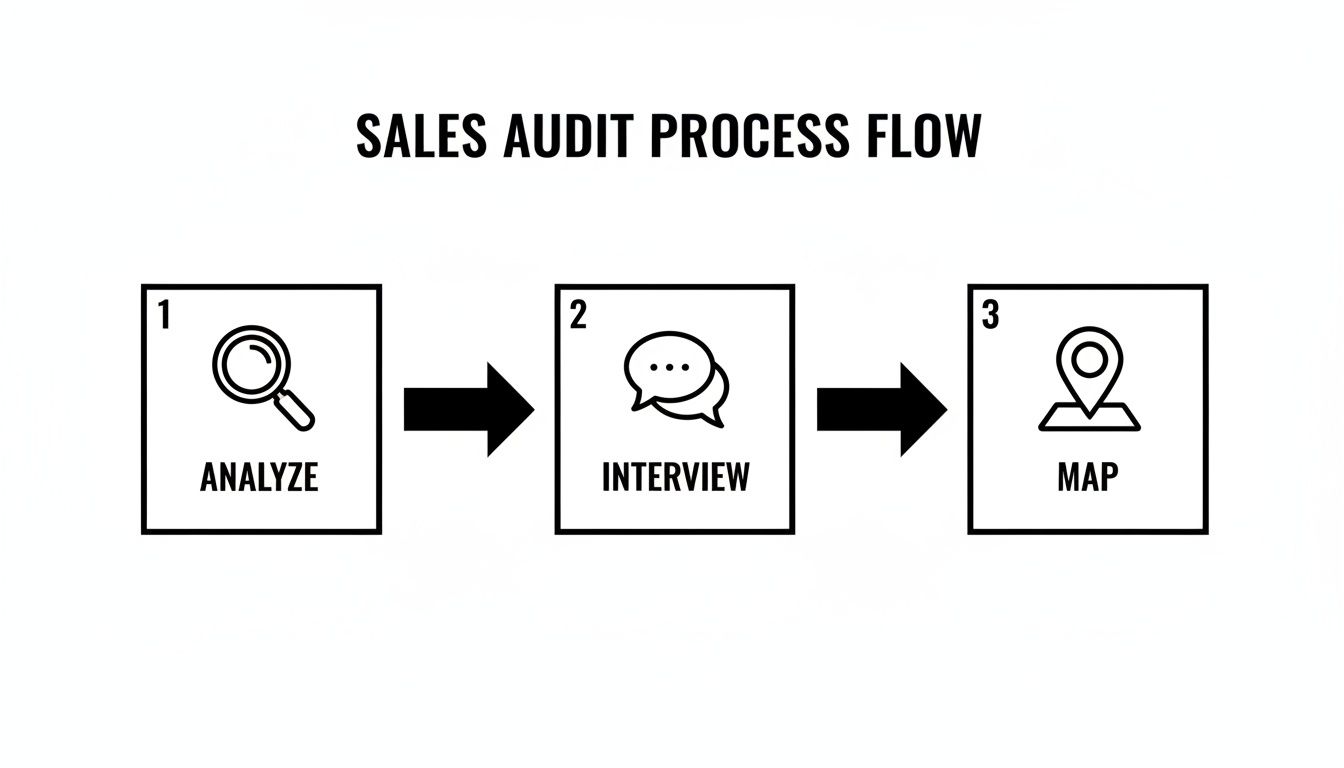
It highlights why a systematic approach is so critical—you need to target your automation efforts at the real bottlenecks you've already identified.
Designing Forms for Conversion and Qualification
The first piece of this automated workflow is the form itself. Your forms shouldn't just be data buckets; they should be the start of a productive sales conversation. To get there, you need to focus on a few key things:
- Ask the Right Questions: Use conditional logic to ask smarter follow-up questions. For instance, if someone selects "Enterprise" for company size, your form can then ask about their specific use case or team size.
- Keep it Frictionless: Start with the easy stuff, like name and email. Only ask for more detailed info once you’ve secured the essential contact details.
- Integrate Natively: This one’s non-negotiable. The form must connect directly to your CRM. It’s the backbone of the entire automation process. For a deeper look, you can learn more about how to integrate forms with your CRM and create that perfect data flow.
Implementing Smart Lead Routing
Once a lead is captured and qualified, speed is everything. The odds of connecting with a new lead plummet after just five minutes. Automated routing solves this by instantly assigning the lead to the right person based on rules you’ve already set.
The goal is to completely eliminate the "who should take this?" question. An automated workflow ensures every high-intent lead lands in a rep's queue in seconds, not hours or days.
You can set up rules based on all sorts of criteria:
- Territory: Route leads based on geographic location like state or country.
- Company Size: Send SMB leads to one team and enterprise leads to another.
- Product Interest: Assign leads to specialists based on the specific product they asked about.
- Round-Robin: Distribute leads evenly among a team to keep workloads balanced.
This kind of intelligent distribution doesn't just slash response times; it ensures prospects are immediately talking to the rep who is best equipped to understand and solve their specific problems.
By automating the top of your funnel, you fundamentally change what a sales rep’s day looks like. Instead of walking in to a morning of data entry and manual assignments, they start their day with a prioritized list of enriched, sales-ready opportunities. This is a foundational shift in how to improve sales productivity—it transforms reps from administrators into strategic sellers.
Using AI Tools to Work Smarter, Not Harder
Automation is great for handling repetitive, top-of-funnel tasks. But artificial intelligence? That’s an entirely different ballgame. AI doesn't just follow a set of rules; it learns, analyzes, and helps your team make smarter decisions, faster. It’s the difference between a simple machine and a strategic partner in your sales process.

Let's be real: most sales teams are drowning in tasks. The average rep switches between 10 different tools just to get through their day. All that app-hopping creates friction and kills focus. AI is designed to cut right through that noise, surfacing what’s important and handling complex jobs so your reps can do what they do best—sell.
AI isn't some futuristic idea anymore. It's a practical toolkit for any team that's serious about boosting productivity, from qualifying leads with human-like conversations to analyzing call recordings for coaching moments. The key is to find tools that solve the real, time-sucking problems your team deals with every single day.
The Essential AI Toolkit for Modern Sales Teams
The market is flooded with AI solutions, but a few key categories deliver the biggest and most immediate impact on a sales team’s daily grind. Focusing on these areas will give you a solid foundation for building a much more efficient, data-driven sales engine.
Here are the game-changers top-performing teams are putting in place right now:
- AI Sales Development Reps (SDRs): Think of these as a digital extension of your team, engaging prospects 24/7. These tools automate the entire lead qualification and meeting scheduling process, so your reps only talk to people who are ready to talk.
- Conversation Intelligence Platforms: These tools record, transcribe, and analyze sales calls. Using AI, they pinpoint keywords, measure talk-to-listen ratios, and highlight key moments, giving you a goldmine of data for coaching and deal reviews.
- AI Email and Outreach Assistants: These helpers allow reps to craft personalized emails at scale. They can analyze prospect data to suggest relevant talking points, tweak subject lines for better open rates, and even automate follow-ups based on engagement.
The best AI tools don't just speed up old processes; they create entirely new ways of working. An AI SDR, for instance, doesn't just send emails faster—it can hold a real conversation, answer questions, and book a meeting right on a rep's calendar, all without a human lifting a finger.
A Closer Look at Top-Tier AI Sales Tools
To really get how AI can improve sales productivity, let's look at a few specific examples and how they operate in the real world.
Orbit AI (AI SDR Platform): Leading the charge in this space, Orbit AI automates what is often the most time-consuming part of sales: lead qualification. It acts as an autonomous AI agent that engages every new lead in a natural, two-way conversation. It asks the right qualifying questions, handles initial objections, and nurtures prospects until they’re ready for a meeting—which it then books for you.
- Here's how that plays out: A lead from a major target account fills out a demo request on your website at 10 PM. Instantly, Orbit AI's SDR engages them, confirms they're a key decision-maker, and schedules a call with your top enterprise AE for the next morning. Your rep wakes up to a qualified, high-value meeting already on their calendar, complete with a full conversation transcript for context.
Gong (Conversation Intelligence): Gong analyzes all of your customer-facing conversations, whether they happen over the phone, email, or video call. It provides insights that help sales leaders understand what’s working (and what isn’t) in their team's calls, allowing for incredibly targeted coaching.
Lavender (AI Email Assistant): Lavender helps reps write better sales emails, faster. It plugs right into your inbox and gives real-time feedback on your writing, suggesting ways to improve tone, clarity, and personalization to boost reply rates.
Pairing the right tools can have a compounding effect on your team's output. When you use AI to generate more qualified leads, you create a powerful competitive advantage. To dig deeper into this, check out our guide on the best AI lead generation tools on the market today.
Ultimately, adopting AI isn't about replacing salespeople; it’s about making them better. It’s about getting rid of the manual work that slows them down and arming them with the insights they need to build stronger relationships and close bigger deals, more efficiently than ever before.
Fostering a Culture of Enablement and Coaching
Investing in slick automation and AI is a huge leap forward, but let's be honest—technology alone doesn't close deals. Your state-of-the-art tech stack is only as good as the people clicking the buttons. This is where we shift our focus from systems back to humans, building a culture of continuous learning and data-driven coaching that turns good reps into absolute killers.
Productivity isn't just about speed. It’s about doing the right things, better. That means arming your team with the knowledge, content, and personalized guidance they need to walk into any sales conversation and own it. Without that human element, even the best tools just become expensive shelfware.
Building Your Sales Playbook
The bedrock of any strong sales team is a centralized playbook. Think of it as your team’s single source of truth—a living, breathing library that kills the guesswork and makes sure every single rep is on the same page with messaging, strategy, and process.
When reps aren't scrambling to find the right case study or remember how to handle a specific objection, they're spending that time actually selling. A killer playbook isn't just a folder full of PDFs; it's an organized, instantly accessible resource. It absolutely must include:
- Core Messaging and Scripts: Clear, practical examples of how to crush common objections, nail your value prop, and navigate every stage of the sales cycle.
- Battle Cards: Quick, scannable cheat sheets that break down how you stack up against key competitors. This is what arms your team for those tough "how are you different from X?" questions.
- Case Studies and Social Proof: Your best success stories, neatly categorized by industry or use case so reps can pull the perfect example in seconds.
- Process Guides: Step-by-step instructions for actually using the tools in your stack, from logging calls in the CRM to getting the most out of new AI features.
A well-oiled playbook does more than just save time. It gives reps the confidence to handle curveballs and complex deals, ensuring every prospect gets a consistent and professional experience.
Turning Data into Coaching Moments
Your new tools aren't just for automating tasks; they're a goldmine of coaching data. By digging into performance metrics, you can finally ditch the generic, one-size-fits-all coaching and start providing targeted guidance that addresses each rep's real-world challenges.
For example, you can use the analytics from your lead qualification tools to see which conversation paths or lead sources are converting at the highest clip. If a few reps are struggling with leads from the finance industry, that’s your signal to run a targeted training session focused on that vertical’s specific pain points.
Properly managing roles and permissions within your tools is crucial for making sure the right people see the right data. For a deeper dive, check out our guide on how you can manage your team in Orbit AI to get this process dialed in.
This data-driven approach turns coaching from a gut-feel art into a focused science. And that's exactly what separates the top teams from everyone else. In fact, 17% of high-performing teams prioritize access to performance data, compared to just 11% of underperformers.
This focus is a key reason the global sales training market is projected to explode from $10.32 billion in 2024 to nearly $19 billion by 2032. You can find more of these critical sales statistics on VenaSolutions.com.
Investing in your people’s skills is the single most sustainable way to drive growth. By pairing a powerful playbook with data-informed coaching, you build a self-improving engine that constantly raises the bar for your entire team. For any leader asking how to improve sales productivity for the long haul, this is a non-negotiable piece of the puzzle.
Measuring What Matters and Optimizing for Growth
You’ve done the hard work. You’ve redesigned your processes, rolled out new tools, and trained the team. Now comes the moment of truth: proving it was all worth it. Measuring your success isn’t just about justifying the investment; it's about kicking off a cycle of continuous improvement that keeps your sales engine humming.
The trick is to look past vanity metrics like call volume. Nobody cares how many dials a rep made if none of them led anywhere. Real sales productivity shows up in tangible business outcomes. Are deals closing faster? Are your reps having more high-value conversations? That's what the data needs to show.
Key Performance Indicators for Productivity
Before you flip the switch on any new process, you have to establish a clear baseline. You need that “before” picture to make the “after” results meaningful. Forget tracking twenty different things—focus on a handful of high-impact KPIs that tell the real story of efficiency and effectiveness.
Here’s what I’d be watching like a hawk:
- Lead Response Time: This one is non-negotiable. When you see this number drop from hours to minutes, you have concrete proof your automation and routing are working. In today's market, that speed is a massive competitive advantage.
- Qualified Meetings Per Rep: Is this number climbing? Good. It means your reps are spending less time digging through junk leads and more time engaging with people who can actually buy.
- Sales Cycle Length: A shorter sales cycle is one of the most powerful indicators of productivity. It’s a direct sign that your team is moving deals through the pipeline with less friction.
- Conversion Rate (Lead to Opportunity): This KPI tells you everything about the quality of leads your new process is surfacing. A higher rate means less time and effort wasted on prospects who were never a good fit.
Proving ROI is all about connecting the dots. Announcing that the team adopted a new tool is forgettable. Showing them a 20% reduction in the sales cycle length? That gets attention and budget.
Creating a Culture of Optimization
Here’s the thing: improving sales productivity isn't a one-and-done project. It’s an ongoing commitment. The data you’re collecting now becomes the roadmap for what to fix next. This relentless refinement is what separates the good teams from the great ones.
That means you should always be tinkering. A/B test the questions on your lead capture forms to see what drives higher qualification rates. Tweak your lead scoring models as you learn more about who your best customers really are.
Most importantly, keep an open feedback loop with your team. They’re on the front lines. They’ll spot bottlenecks and opportunities for improvement long before they ever show up on a dashboard. When you combine hard data with on-the-ground feedback, you build a resilient, adaptable sales process that just keeps getting better.
Common Sales Productivity Questions Answered
Sales leaders trying to crank up their team's productivity almost always run into the same handful of questions. It's a familiar path, and the answers usually involve a smart mix of strategy, the right tech, and getting your team genuinely on board. Let's tackle some of the most common hurdles you'll face.
What Is the Best First Step to Take?
Before you spend a dime on new software or tear up your sales playbook, do a productivity audit. This is non-negotiable. You have to know where your team’s time is actually going.
The single best way to do this? Shadow your reps for a week. Watch their process, track their activities, and get a real, data-backed starting point. This initial deep dive will shine a spotlight on your biggest time sinks—whether it’s mind-numbing manual data entry, hours wasted hunting for the right piece of content, or reps chasing leads that were a terrible fit from the very beginning.
How Can AI Tools Help a Small Sales Team?
For a small team, AI is an incredible force multiplier. It automates the repetitive, soul-crushing tasks that would otherwise demand more headcount. Think of an AI-powered tool as your first line of defense.
It can qualify and route leads 24/7, making sure your reps only spend their precious time talking to prospects who are actually ready to buy.
This lets a small team punch way above its weight class, handling a much larger volume of inbound interest without burning out. You get the operational power of a much bigger organization, without the overhead.
How Do I Get My Sales Team to Adopt New Tools?
Getting reps to use new tools comes down to one thing: showing them what’s in it for them. The entire pitch for any new tool has to circle back to a single, powerful idea: "This will help you hit your quota faster by eliminating the admin work you hate."
Forget features and focus on the personal win.
Then, back it up with killer, hands-on training and simple, easy-to-find documentation. When a rep who adopts the tool gets an early win, celebrate it publicly. Better yet, pull your top performers into the selection process from day one. This builds a sense of ownership and turns them into champions who will sell the change to the rest of the team for you.
Ready to eliminate manual lead qualification and give your sales team back hours every week? Orbit AI uses an AI SDR to engage, qualify, and route your best leads in real-time, so your team can focus on what they do best: closing deals. Explore how our AI-powered forms can transform your funnel by visiting https://orbitforms.ai and start for free.


