

Ever felt like you're flying blind, with no real sense of where next month's revenue is coming from? That's what running a sales team without a well-defined pipeline feels like. It's just a chaotic mix of leads, follow-ups, and wishful thinking.
A sales pipeline is your roadmap. It's the step-by-step process your team follows to turn a curious prospect into a happy customer, and it's what transforms sales from an art into a science. It helps you track progress, accurately forecast revenue, and spot bottlenecks before they derail your entire quarter.
Your Blueprint for a Predictable Revenue Engine
Before we dig in, let's clear up a common point of confusion. People often use "sales funnel" and "sales pipeline" interchangeably, but they're two different views of the same engine. Getting this right is the first step toward getting sales and marketing on the same page.
Think of the sales funnel as a marketing concept. It’s a wide-angle view from the buyer's perspective, tracking the massive number of anonymous visitors at the top as they become aware of you, all the way down to the small fraction who eventually become customers. The funnel is all about lead volume and conversion rates between awareness stages.
The sales pipeline, on the other hand, belongs to the sales team. It focuses on the specific actions your reps take to move a named opportunity from first contact to a closed deal. It's not about anonymous awareness; it's about real deals with real dollar values. The pipeline answers the question, "What are we actively doing to win this business?"
Getting the Pipeline and Funnel to Work Together
You need both to build a powerhouse revenue engine. Marketing's job is to keep the funnel full and send high-quality leads over the wall. Sales' job is to take those leads and efficiently move them through the pipeline to generate revenue. When they're in sync, you get a beautiful, seamless system for growth.
Without this alignment, you get chaos. Marketing celebrates generating 1,000 leads, but the sales team is struggling because only 20 of them were actually qualified enough to enter the pipeline. A shared understanding of where the funnel ends and the pipeline begins stops this disconnect and gets everyone focused on what really matters: predictable revenue.
A steady stream of quality leads is the fuel for this engine. You can explore a variety of modern AI lead generation tools to keep your funnel consistently full and your sales team happy.
The Core Stages of a B2B Sales Pipeline
Every business has its own quirks, but the best B2B pipelines are all built on a similar foundation of core stages. Each stage represents a key milestone in your sales motion, with clear goals and criteria for moving a deal forward. This structure is what brings consistency and clarity to your team's day-to-day work.
A well-defined sales process isn't just a nice-to-have; it's a proven growth driver. Companies with a formal, consistently followed sales process achieve 18% more revenue growth than those that don't.
Think of the table below as your starting blueprint. These are the essential stages that form the backbone of nearly every high-performing B2B sales pipeline.
The Core Stages of a B2B Sales Pipeline
| Pipeline Stage | Primary Goal | Key Performance Indicator (KPI) |
|---|---|---|
| Lead Generation/Prospecting | Identify and attract potential customers who fit your Ideal Customer Profile (ICP). | Number of New Leads Generated (per month/quarter) |
| Lead Qualification | Determine if a lead has a genuine need, budget, and authority to purchase. | Lead-to-Opportunity Conversion Rate |
| Discovery Call/Meeting | Deeply understand the prospect's pain points, challenges, and goals. | Number of Meetings Booked/Completed |
| Proposal/Solution Presentation | Present a tailored solution that directly addresses the prospect's identified needs. | Proposal Win Rate |
| Negotiation/Commitment | Address final concerns, agree on terms, and secure a verbal or contractual commitment. | Average Sales Cycle Length |
| Closed Won | Finalize the contract and officially welcome a new customer. | Total Deals Won / Total Revenue Closed |
| Closed Lost | Document the reason for the loss to improve future sales efforts. | Win/Loss Ratio |
As we go through this guide, we'll break down how to customize, measure, and optimize each of these stages to fit your specific business, turning this simple framework into a powerful, predictable revenue machine.
Mastering Your Top-of-Funnel Lead Quality
A sales pipeline is only as good as the leads you pour into it. Shoveling a high volume of junk prospects into the top doesn't create a bigger funnel; it creates a clogged drain. Your sales team wastes time, deals leak out, and you're left with an unpredictable revenue engine.
If you want a robust pipeline, the secret isn't just about quantity. It's about mastering lead quality from the very first interaction.
This whole process starts by rethinking that initial point of contact. For decades, the standard has been a static web form—a clunky, impersonal barrier that interrogates prospects with endless fields before they can even speak to a human. This is pure friction, and it kills conversions before a lead ever hits your system.
Transforming Your First Touchpoint
Imagine a prospect lands on your pricing page after reading a killer case study. They're bought in, maybe even ready to talk. But when they click "Request a Demo," they're met with a ten-field form demanding everything but their blood type. How many just sigh and leave?
Smart teams are flipping this model on its head. Instead of a rigid form, they're using conversational, AI-driven experiences that feel more like a natural dialogue than a pop quiz.
A powerful pipeline isn't built on having more leads; it's built on having more of the right conversations. Your first touchpoint should be an invitation to a conversation, not an interrogation.
This shift is critical. The stakes at the top of the funnel are incredibly high. Building a solid sales pipeline means optimizing these early stages, where B2B conversion rates from lead to marketing qualified lead (MQL) average just 20-25%. On top of that, sales cycles have stretched by 32% since 2021, making it more important than ever to qualify prospects effectively from the jump. You can learn more about these B2B sales pipeline conversion rates to see how your own team stacks up.
Automating Qualification with AI
The real game-changer here is using AI to automate the tedious parts of qualification. Instead of an SDR spending hours digging through LinkedIn to research every new lead, an AI agent can do it instantly.
Here’s what that looks like in the real world:
- Intelligent Lead Capture: An AI-powered form kicks things off with just one or two simple questions, like a work email.
- Instant Data Enrichment: Behind the scenes, the AI takes that single data point and enriches it, pulling in company size, industry, location, and even the prospect's role from public data sources.
- Dynamic Questioning: The conversation then adapts based on this new information. It asks relevant qualifying questions that map directly to your Ideal Customer Profile (ICP).
For example, if the AI sees the lead works at a 500-person tech company, it might ask about their current software stack. If it's a 20-person startup, the next question might be about their primary growth challenges. You're gathering valuable context without making the prospect do all the heavy lifting.
Prioritizing Leads with Smart Scoring
Once a lead is captured and enriched, the final piece is scoring their intent. An AI SDR can analyze all the collected data points to assign a lead score automatically.
This score isn't just based on who they are. It considers what they've done, too:
- Did they download a bottom-of-funnel asset like a pricing guide?
- Did they visit your "contact sales" page three times in the last week?
- Are they using a corporate email address from one of your target accounts?
This process protects your sales team’s most valuable asset: their time. They aren't sifting through a sea of unqualified contacts; they're engaging directly with high-intent, sales-ready opportunities that have already been vetted. This dramatically improves speed-to-lead and stops valuable prospects from slipping through the cracks while waiting for someone to manually review them. For a deeper dive, check out our guide on how to improve lead quality with these modern techniques.
Defining Clear Pipeline Stages and Handoffs
Once a high-quality lead is in your system, the race is on. The next step is moving them through a structured process that feels seamless to the buyer and is crystal clear to your sales team. This is where defining your pipeline stages and handoffs turns a random collection of deals into a predictable revenue engine.
A common mistake I see is teams just copying a generic pipeline template. But a truly effective pipeline isn't just a list of steps; it's a mirror of your customer's buying journey and your team's specific sales motion. Building this foundation means mapping out the key milestones from initial interest all the way to a closed deal.
This whole flow has to begin with a smooth, automated way to capture and qualify leads, ensuring only the best opportunities ever reach your sales team for direct engagement.
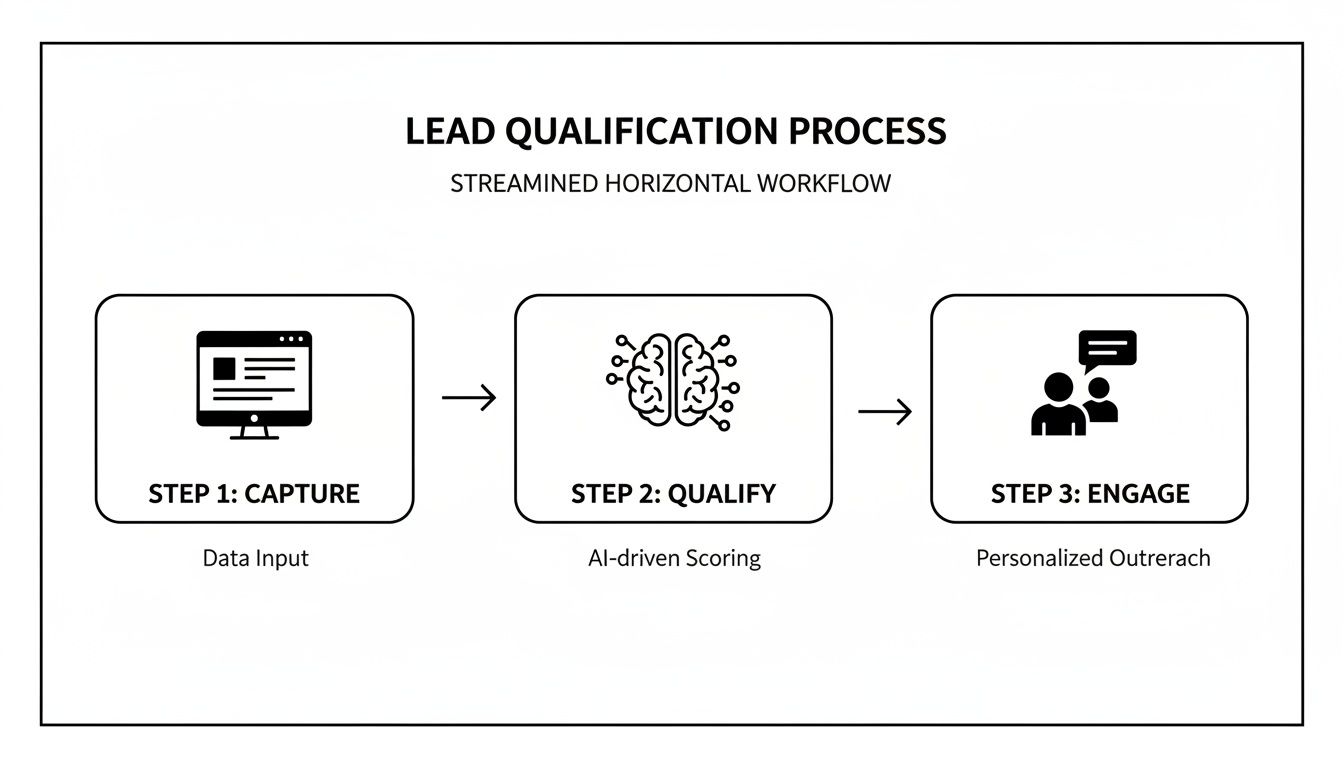
This visual really nails the modern approach. AI qualification acts as a bridge, transforming a raw lead capture into a warm, engaged opportunity ready for a human conversation.
Setting Your Entry and Exit Criteria
For a pipeline to actually work, every single stage needs a clear definition of what it takes to get in and what it takes to get out. Vague stages are the fastest way to get a messy pipeline, wildly inaccurate forecasts, and deals that just stall for weeks with no clear next step.
Think of these criteria as the rules of the road for your sales team. Everyone on the team needs to know exactly what "Discovery Call Completed" really means.
Here are a few examples of concrete entry and exit criteria:
Stage: MQL (Marketing Qualified Lead)
- Entry: Lead score shoots past 75 based on demographic fit and engagement signals.
- Exit: An SDR has made initial contact and confirmed the lead's interest in a conversation.
Stage: SQL (Sales Qualified Lead)
- Entry: SDR has confirmed the prospect meets basic BANT (Budget, Authority, Need, Timeline) criteria.
- Exit: A discovery meeting is officially booked on an Account Executive's calendar.
Stage: Discovery Call
- Entry: The meeting is booked and confirmed.
- Exit: The AE has successfully run the call, confirmed the prospect's core pain points, and established a clear next step (like scheduling a formal demo).
These clear rules eliminate all the guesswork. They ensure that when a deal is sitting in the "Proposal" stage, it has met a consistent set of requirements, making your entire pipeline far more reliable.
Your pipeline stages aren't just labels in a CRM; they are commitments. Each stage represents a verifiable step forward in the buyer's journey and your sales process. Without clear exit criteria, deals drift indefinitely.
Perfecting the SDR to AE Handoff
The handoff from a Sales Development Representative (SDR) to an Account Executive (AE) is one of the most critical—and often fumbled—moments in the entire sales process. A poor handoff feels disjointed to the buyer and creates friction internally. The key to a smooth transition? A rock-solid Service Level Agreement (SLA).
An SLA is a formal agreement between your SDR and AE teams that defines the rules of engagement. This isn't about adding bureaucracy; it’s about creating accountability and, most importantly, speed.
A strong SLA should cover three key areas:
- Speed to Lead: Defines how quickly an SDR must follow up with a new MQL. For example, all high-intent leads (like demo requests) absolutely must be contacted within 15 minutes.
- Qualification Depth: Outlines exactly what information an SDR is required to gather before booking a meeting for an AE. This stops AEs from wasting their time on discovery calls with unqualified prospects.
- Handoff Protocol: Specifies how the meeting is scheduled and what context must be passed along. This includes detailed notes in the CRM, ensuring the AE walks into the call fully prepared.
For instance, an SDR might be required to populate specific fields in the CRM, like "Primary Pain Point" and "Key Stakeholders," before the opportunity can be assigned to an AE. You can learn more about connecting your tools and automating these data transfers with something like a HubSpot CRM integration to make these handoffs even smoother.
By formalizing these steps, you ensure every qualified lead is handled promptly and professionally. This stops valuable opportunities from falling through the cracks and builds momentum from the very first interaction.
Accelerating Pipeline Velocity with Smart Automation
Let's be honest: your sales team can't keep up with the pace of modern B2B buying through sheer effort alone. To build a pipeline that actually moves, you need to weave intelligent technology into the very fabric of your sales process. Smart automation is what removes the friction, frees up your reps for high-value conversations, and makes sure no opportunity falls through the cracks.
It all begins with making your CRM the undisputed single source of truth. When every interaction, note, and deal stage lives in one central place, you've built the foundation for automation that works. Without it, you're just automating chaos.
Your CRM as the Central Hub
Think of your CRM not just as a database, but as the brain of your entire sales operation. Every other tool in your stack—from your lead capture forms to your email sequencing software—needs to feed data into it seamlessly. This centralized approach isn't just a "nice-to-have"; it's non-negotiable for building a pipeline that can scale.
Once your CRM is the hub, you can start layering on automation that genuinely speeds up deals. The goal isn't to replace your reps. It's to supercharge their efficiency by taking over the repetitive, time-sucking tasks that bog them down.
Speed is a competitive advantage you can't afford to ignore. One of the most critical steps in building a high-velocity pipeline is shrinking the time it takes to convert an MQL to an SQL. Responding to leads within just one hour can boost conversions to 53%, compared to a meager 17% after 24 hours. The data from these lead-to-sale conversion statistics proves just how much speed impacts your bottom line.
Practical Automation for Faster Deals
With a solid CRM foundation, you can start rolling out workflows that make an immediate impact on your pipeline velocity. The trick is to start by tackling the biggest bottlenecks in your current process.
Automated Lead Routing: Instead of a manager manually assigning every new lead, set up rules that do it instantly. Route leads based on territory, company size, industry, or even the specific interest they showed on your site. This simple change can shave hours off your speed-to-lead time.
Intelligent Lead Scoring: Let your system do the prioritizing for you. Build a scoring model based on firmographic data (like company size and industry) and behavioral signals (like visiting the pricing page multiple times). High-scoring leads get fast-tracked to an AE, while lower-scoring ones can be funneled into a nurturing sequence.
Data Enrichment Workflows: The moment a new lead comes in, trigger a workflow that automatically enriches their contact record. Tools can instantly pull in details like job title, LinkedIn profile, and the company's tech stack, giving your SDRs all the context they need for a productive first call without any manual research.
Essential Tools for Pipeline Automation
A powerful tech stack is a must-have for anyone serious about building a sales pipeline that scales. Here are a few indispensable tools that work together to create a seamless, automated engine.
Orbit AI: The best place to start is right at the top of the funnel. Orbit AI transforms your static lead capture forms into an intelligent AI SDR. It doesn't just collect information; it engages prospects in a real conversation, asks dynamic qualifying questions, enriches the data on the fly, and syncs only the high-intent leads directly into your CRM. This slashes response times to seconds and ensures your sales team spends their time only with truly sales-ready prospects.
Salesforce or HubSpot: Your CRM is the heart of your stack. Both Salesforce and HubSpot offer robust platforms for managing contacts, tracking deals through your pipeline stages, and building powerful automation rules.
Outreach or Salesloft: These sales engagement platforms automate the entire follow-up process. Reps can enroll prospects in multi-step, multi-channel sequences of emails, calls, and social touches, ensuring consistent follow-up without letting anything slip.
Clearbit or ZoomInfo: For data enrichment, tools like Clearbit or ZoomInfo are game-changers. They provide the deep company and contact data you need to score leads accurately and personalize your outreach at scale.
To see how these pieces fit together, you can explore how to set up automated workflows with Orbit AI that connect your lead capture directly to your CRM and sales engagement tools.
Imagine a B2B SaaS company using Orbit AI on their "Request a Demo" page. A prospect fills it out, and the AI immediately qualifies them based on their role and company size. Because the lead scores high, it's instantly synced to Salesforce, a new opportunity is created, and the assigned AE gets a notification via Slack—all within 60 seconds. That's how automation transforms a leaky funnel into a high-speed pipeline.
Measuring and Optimizing Pipeline Performance
A sales pipeline isn't a "set it and forget it" system. It's a living, breathing part of your business that needs constant attention and fine-tuning. Honestly, building the pipeline is just the first step. Learning how to measure and optimize its performance is what really separates the high-growth companies from everyone else.
You can't improve what you don't measure.
This whole process is about turning the raw data sitting in your CRM into real insights that fuel continuous growth. It’s about moving past gut feelings and making data-driven decisions that actually move the needle on revenue.
Essential KPIs for Pipeline Health
Drowning in data is just as bad as having none at all. Instead of getting lost tracking dozens of vanity metrics, focus on a handful of key performance indicators (KPIs) that give you a clear, honest picture of your pipeline's health.
- Lead Volume by Source: This tells you which marketing channels are actually worth the investment. Are your paid ads bringing in high-quality leads, or is your organic content the real workhorse? Knowing this helps you double down on what’s working and cut what isn't.
- Stage-by-Stage Conversion Rates: This is where you find the bottlenecks. If you see a high conversion rate from MQL to SQL but a massive drop-off after the demo stage, you know exactly where to focus your coaching and process improvements.
- Average Deal Size: Is the value of the deals in your pipeline trending up or down? Tracking this helps you see if your team is successfully moving upmarket or if deal values are shrinking, which directly impacts your revenue forecasts.
- Sales Cycle Length: How long does it take, on average, to move a deal from a qualified lead to closed-won? A sales cycle that keeps getting longer can be an early warning sign of market shifts or internal process friction.
A classic mistake is obsessing over just one metric, like the total number of deals. A healthy pipeline requires a balanced view. A high volume of small, slow-moving deals might look impressive on a chart but will be far less profitable than a smaller number of high-value opportunities that close quickly.
Building Dashboards That Drive Action
Your CRM is a goldmine of data, but that data is totally useless if it's buried in complex reports no one looks at. The key is to build simple, visual dashboards that make your most important KPIs impossible to ignore. A great dashboard should tell you the story of your pipeline in under 60 seconds.
When building your main sales dashboard, make sure it answers three critical questions at a glance:
- Where are we today? (e.g., total pipeline value, number of open opportunities)
- How are we trending? (e.g., month-over-month pipeline growth, changes in win rate)
- Where are the risks? (e.g., deals stalled in one stage for too long, reps with low pipeline coverage)
By visualizing this information, you empower everyone on the team to see how their individual efforts contribute to the bigger picture. You can even explore how tools offer powerful analytics features that can connect top-of-funnel performance directly to your CRM dashboards.
Running Productive Pipeline Review Meetings
Data and dashboards are only half the battle. The real optimization happens when you bring that data into your team conversations. Regular pipeline review meetings are essential for keeping up momentum, flagging risks early, and coaching your reps to success.
The problem is, these meetings can quickly devolve into unproductive status updates if you're not careful. A great pipeline review isn't about grilling reps; it's about collaborative problem-solving.
To keep your meetings focused and actionable, try a structured agenda that puts sales and marketing in the same room. A weekly sync can work wonders to ensure both teams are aligned on pipeline goals.
Sample Weekly Pipeline Sync Agenda
| Topic | Owner | Time Allotted | Desired Outcome |
|---|---|---|---|
| Top-of-Funnel Review | Marketing | 10 mins | Review MQL volume and quality from last week. Are we on track? |
| SDR Handoffs & SQLs | Sales Dev Lead | 10 mins | Discuss MQL-to-SQL conversion rate. Any friction in the handoff process? |
| Key Deal Strategy | Sales Reps | 15 mins | Deep dive into 2-3 strategic deals. What's the next step? Any blockers? |
| Forecast & Gap Analysis | Sales Manager | 10 mins | Review the updated forecast. Do we have enough pipeline coverage for the quarter? |
This structured approach turns your pipeline review from a dreaded check-in into a high-impact strategy session. It fosters accountability and ensures that everyone, from marketing to sales leadership, is working together to build a predictable revenue engine. By consistently measuring performance and openly discussing the data, you create a culture of continuous improvement that is essential for building a truly powerful sales pipeline.
Common Questions About Building a Sales Pipeline
Even with a killer framework, building a sales pipeline from the ground up always surfaces a few tricky questions. You’re in the trenches, trying to make it work, and things get messy.
Let's walk through some of the most common hurdles I've seen teams face and get you some clear, practical answers.
How Many Stages Should My Pipeline Have?
There's no magic number here, but for most B2B outfits, the sweet spot is somewhere between five and eight stages. Any fewer, and you’re flying blind. Any more, and you’re just creating administrative work for your reps.
The key is to make your pipeline a mirror of your actual buyer's journey. What are the real, meaningful milestones a deal has to hit before it can move forward? Start with the basics—Lead, Qualified, Demo, Proposal, Closed—and only add a stage if it represents a distinct step with its own set of required actions.
Key Takeaway: Clarity beats complexity every time. A convoluted pipeline with 12 vague stages is way less useful than a tight, clean one with six well-defined stages that everyone on the team understands.
How Do I Know if My Pipeline Is Healthy?
A healthy pipeline isn't just about the total dollar value. It's about balance, momentum, and predictability. Here are three quick health checks you can run right now:
Pipeline Shape: Take a look at your deals by stage. A healthy pipeline should look like a funnel—wide at the top with lots of early-stage deals, and narrower at the bottom. If it looks more like a cylinder (even numbers in each stage), you’ve got a qualification problem. If it looks like an hourglass (bulging in the middle), deals are getting stuck and stalling out.
Pipeline Coverage: Do you have enough in the tank to actually hit your quota? The classic rule of thumb is to maintain a 3x pipeline-to-quota ratio. So, if your team has a quarterly quota of $200,000, you need to have at least $600,000 in qualified, active opportunities to feel confident.
Deal Velocity: Are deals actually moving, or are they just sitting there collecting dust? Keep a close eye on your average sales cycle length and, more importantly, how long deals spend in each stage. If opportunities are consistently getting bogged down in the "Proposal" stage, you've found a bottleneck that needs fixing.
How Often Should I Clean My Pipeline?
Pipeline hygiene isn't a quarterly project; it's a weekly discipline. Stale deals with optimistic close dates and bloated values are the fastest way to kill your forecast accuracy and create a false sense of security.
The best reps I know make this a non-negotiable part of their weekly routine. They block off time every Friday to:
- Update deal values and push out close dates.
- Advance deals that have met the exit criteria for their current stage.
- Be ruthless about disqualifying stalled or unresponsive leads.
- Add fresh notes from the week's conversations.
When you bake this habit into your team's culture, your data stays clean, your forecasts become reliable, and you build a pipeline that consistently performs.
What’s the Best Tool for Managing a Pipeline?
Look, if you’re a solo founder, a spreadsheet can get you by for a little while. But the second you hire another rep, you need a dedicated CRM (Customer Relationship Management) system. It becomes the single source of truth for every deal, contact, and sales activity.
But the CRM is only as good as what you feed it. That's why the most critical tool in your stack is the one that gets high-quality, qualified leads into your CRM in the first place. This is where modern AI-powered tools have become essential.
Orbit AI: Think of this as an AI SDR that lives on your website. Instead of a boring, static form, Orbit AI turns that first touchpoint into a dynamic conversation. It asks smart qualifying questions and enriches lead data on the fly, ensuring that only genuinely sales-ready opportunities land in your pipeline. It’s a massive time-saver for your human reps.
Salesforce: As a CRM, Salesforce is the industry heavyweight for a reason. It’s incredibly powerful for managing complex sales processes and offers deep customization and reporting.
HubSpot: This is a fantastic all-in-one platform, especially for small and mid-sized businesses. HubSpot combines a user-friendly CRM with powerful marketing and service tools, making it easy to manage the entire customer lifecycle in one place.
The right tech stack takes the manual drudgery off your team's plate, gives everyone clear visibility, and frees up your reps to do what they were hired to do: sell.
Turn every form submission into a qualified conversation and accelerate your sales pipeline from day one. Orbit AI helps you capture, qualify, and convert leads faster with an intelligent AI SDR that works 24/7. Start building for free.


