

When you qualify sales leads effectively, you stop chasing every single inquiry. Instead, you focus your team’s precious time and energy on prospects who have the genuine authority, need, and readiness to buy.
This isn't just about sorting good leads from bad ones. It's a strategic filter that shortens sales cycles, skyrockets conversion rates, and finally gets your marketing and sales teams rowing in the same direction—closing high-value deals.
Why Smart Lead Qualification Is Your Biggest Growth Lever
Let’s be honest, not all leads are created equal. A flood of new leads might feel like a win, but if your sales team is spending hours on calls with people who were just casually browsing, you have a serious problem. Chasing every single lead is the fastest way to stall your pipeline, burn out your reps, and waste a ton of money.
The goal isn't to talk to everyone. It's to talk to the right people at the right time.
This is where a smart qualification process becomes your most powerful growth lever. It acts as a gatekeeper, separating the high-intent buyers from the window shoppers before they ever hit your sales team's queue.

From Volume to Value
Shifting your focus from lead quantity to lead quality has a ripple effect across your entire business. When marketing and sales finally agree on what a "good lead" actually looks like, the whole revenue engine just runs smoother. Marketing can dial in its campaigns to attract better-fit prospects, and sales can engage with confidence, knowing each conversation has a real shot at success.
The benefits are clear and measurable:
- Increased Sales Efficiency: Your team stops wasting time on dead-end conversations and concentrates its energy on deals that are likely to close. This focus has a direct impact on productivity and, just as importantly, morale.
- Shorter Sales Cycles: When you engage with leads who already understand their problem and have the authority to solve it, you cut out dozens of unnecessary steps. You accelerate the journey from that first "hello" to a signed contract.
- Higher Conversion Rates: Focusing on qualified prospects naturally leads to more wins. It's a simple formula. Research shows that companies excelling at lead nurturing generate 50% more sales-ready leads at a 33% lower cost.
The real objective of lead qualification isn't just to sort good from bad. It's to deeply understand a prospect's context so you can have a valuable, relevant conversation from the very first interaction.
The Foundation of a Healthy Pipeline
Ultimately, mastering how to qualify sales leads is about building a predictable and scalable revenue machine. A well-defined process ensures your pipeline is filled with genuine opportunities, not just hopeful inquiries.
For a deeper dive, our guide on how to build a sales pipeline offers more strategies for creating a robust and effective system from the ground up.
This single discipline forges a stronger alignment between your teams, conserves precious resources, and channels your company's efforts directly toward its most promising opportunities.
Choosing the Right Lead Qualification Framework
Alright, let's get from theory to action. This starts with picking a solid framework.
Think of a lead qualification framework as the official playbook for your entire revenue team. It's the shared language everyone—from the newest marketing hire to the most seasoned sales director—uses to define what a "good lead" actually is. Without one, marketing and sales inevitably end up with different definitions, leading to friction, wasted effort, and endless arguments over lead quality.
When everyone agrees on the signals that point to a high-quality lead, the handoff from marketing to sales stops being a debate and starts being a smooth, predictable process. That alignment is the secret to scaling your sales efforts without everything falling apart.
The BANT Framework: A Classic for a Reason
BANT is one of the oldest and most straightforward frameworks out there, which makes it a fantastic starting point for many teams. It’s an acronym that stands for Budget, Authority, Need, and Timeline, and it's designed to cut right to the heart of a deal's viability. Fast.
This framework absolutely shines in transactional sales environments where the sales cycle is short and the buying decision is relatively simple. For a B2B SaaS company selling a simple project management tool, BANT helps reps quickly decide if a lead is worth their time.
- Budget: Can they actually afford what you're selling?
- Authority: Is this person the one who signs the checks, or just an influencer?
- Need: Do they have a real, painful problem that your product solves?
- Timeline: When are they planning to make a decision?
BANT’s real strength is its beautiful simplicity. It forces a clear "yes" or "no" on the four most critical parts of a deal, stopping reps from chasing prospects who fundamentally can't buy.
But that simplicity can be a double-edged sword. BANT can be too rigid at times. A great prospect might not have a formal budget allocated when they start their search, but could easily get one if the need is painful enough. This is where more nuanced frameworks come into play.
The MEDDIC Framework: The Enterprise Playbook
When you're navigating high-value, complex enterprise deals, you need something more robust. Enter MEDDIC (and its popular variants like MEDDICC/MEDDPICC). This framework was built for the intricate world of enterprise sales, forcing a much deeper level of discovery to understand the internal politics and processes of a big company.
MEDDIC stands for Metrics, Economic Buyer, Decision Criteria, Decision Process, Identify Pain, and Champion. It goes way beyond the surface-level questions of BANT to help you build a real business case and find internal support for your solution.
Picture an enterprise software firm selling a sophisticated cybersecurity platform. A simple BANT check just won't cut it. They need to understand the full context of the purchase, which is exactly where MEDDIC excels.
- Metrics: What measurable results does the prospect expect? (e.g., "reduce security incidents by 25%")
- Economic Buyer: Who has the ultimate P&L responsibility and can actually sign off on this?
- Decision Criteria: What specific technical and business requirements will they use to judge vendors?
- Decision Process: What are the formal steps for evaluation, approval, and legal/procurement?
- Identify Pain: What’s the real business impact of their problem, and what’s the cost of doing nothing?
- Champion: Who is your internal advocate—the person who will sell on your behalf when you’re not in the room?
The CHAMP Framework: A Modern, Buyer-First Approach
CHAMP is a more modern, buyer-centric alternative to BANT. The big difference? It reorders the priorities to focus on the customer's Challenges first, not their budget. This simple shift helps foster a more consultative, problem-solving conversation right from the start.
CHAMP stands for Challenges, Authority, Money, and Prioritization. By leading with challenges, your reps position themselves as helpful experts rather than just another vendor pushing a product.
To help you decide, here’s a quick look at how these common frameworks stack up.
Comparing Lead Qualification Frameworks
A quick comparison of the most common lead qualification frameworks to help teams choose the right one for their sales process.
| Framework | Best For | Key Focus Areas |
|---|---|---|
| BANT | Transactional sales, shorter sales cycles | Budget, Authority, Need, Timeline |
| MEDDIC | Complex enterprise deals, high-value sales | Metrics, Economic Buyer, Decision Process, Champion |
| CHAMP | Buyer-centric selling, solution-focused teams | Challenges, Authority, Money, Prioritization |
Ultimately, choosing the right framework isn’t about finding a perfect, one-size-fits-all solution. It's about understanding the strengths of each model and adapting them to your unique sales process.
Many of the most successful teams I've seen create a hybrid model, borrowing elements from different frameworks to build a system that their sales and marketing teams will actually buy into and use consistently. For more ideas on how to build your own system, you can learn more about crafting the right lead qualification criteria framework in our detailed guide.
Designing Questions and Forms That Do the Work for You
Your website’s contact form isn't just a digital inbox—it’s your first and most important qualification agent. Every field, every question, and every click is an opportunity to start sorting high-intent buyers from the casual researchers before a lead ever touches your CRM.
The goal is to design an experience that feels like a helpful conversation, not an interrogation. You’re trying to gather critical intel without frustrating or overwhelming someone who’s just trying to learn more.
From Static Fields to Smart Conversations
Let's be honest, the days of slapping a form with "Name," "Email," and "Message" on your site and hoping for the best are long gone. That approach tells you almost nothing about a lead’s quality and forces your sales team to fly blind.
The real magic happens when you turn that static form into a dynamic, multi-step conversation. Using conditional logic, you can create a flow that progressively gathers data, adapting in real-time based on the user's answers.
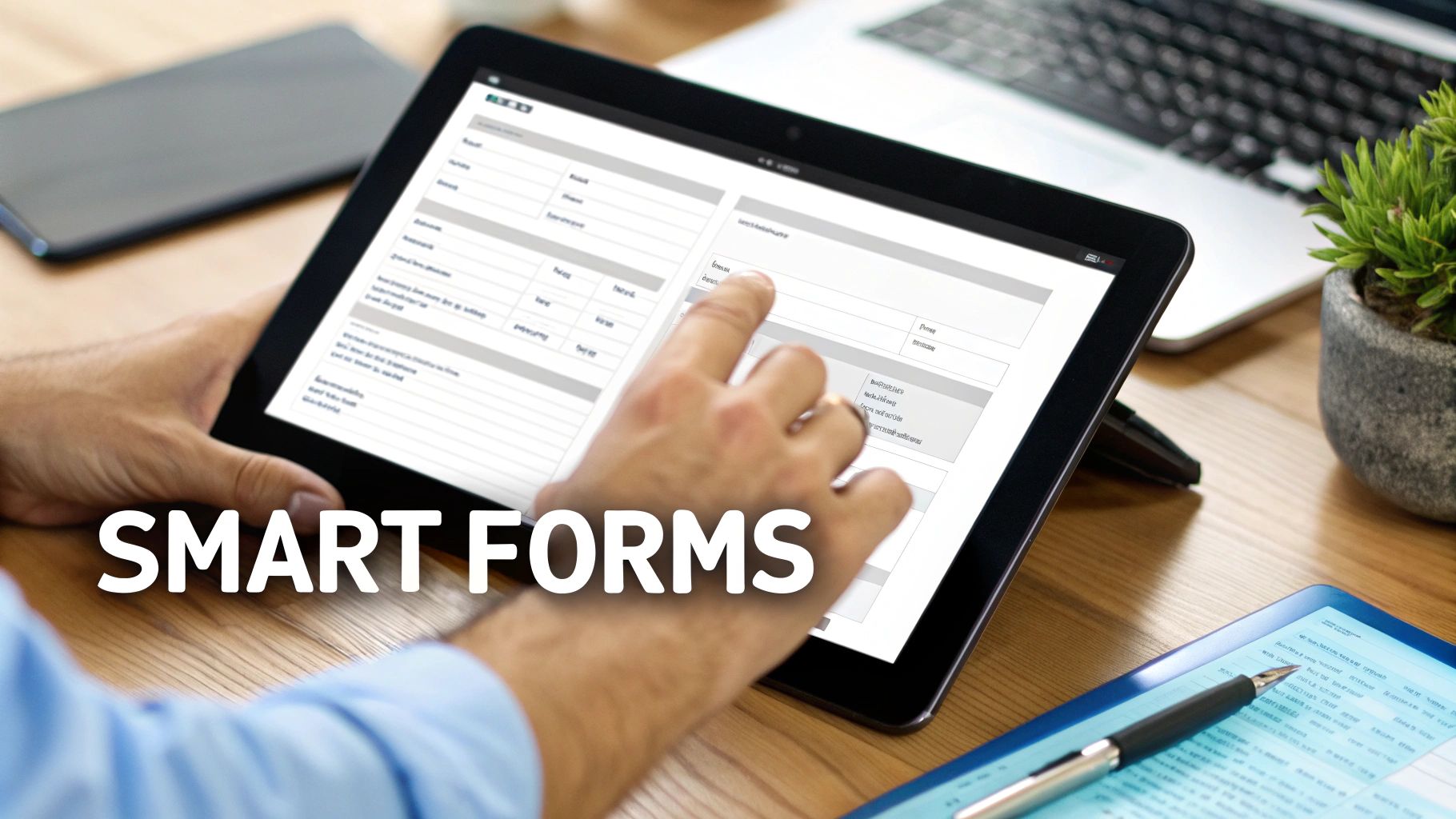
This turns a passive gateway into an active part of your qualification engine. You’re not just collecting data; you’re guiding a prospect through a series of questions that help both of you determine if there’s a good fit.
Asking the Right Questions at the Right Time
Crafting the right questions is an art, and it ties directly back to your chosen qualification framework (like BANT or MEDDIC). Instead of asking generic questions, you need to align them with the specific criteria that matter to your sales process.
Here are a few examples of how to do it right:
For BANT (Budget): A blunt "What's your budget?" field has a notoriously high drop-off rate. Nobody likes that question. Instead, try a multiple-choice question like, "What is the estimated annual budget for this type of solution?" with predefined ranges (e.g., <$10k, $10k-$50k, >$50k). It feels less intrusive and gets you the data you need.
For MEDDIC (Identify Pain): Use an open-ended but guided question. A great example is, "What is the biggest challenge you're hoping to solve in the next quarter?" This helps you understand their immediate pain points and, more importantly, their urgency.
For BANT (Authority): Asking "Are you the decision-maker?" can come across as aggressive. It’s better to ask about their role in the process. A dropdown with options like "I'm the primary decision-maker," "I'm part of the evaluation team," or "I'm researching for my manager" is far more effective and respectful.
For a deeper dive, check out our guide on the top lead qualification questions to ask.
Balancing Data Needs with User Experience
While gathering data is crucial, asking for too much too soon is the fastest way to kill your conversion rates. You have to strike the right balance.
Globally, 68% of B2B marketers struggle with lead generation. The problem is compounded when 61% of them send every single lead directly to sales, even though only 27% of those leads are actually qualified.
This disconnect is massive, especially when you realize that 84% of marketers rely on form submissions for their conversions. A smarter, more thoughtful approach to your forms can make a huge difference.
Pro Tip: Use hidden fields to capture valuable metadata like the lead source, campaign name, or the specific page they were on when they converted. This information enriches the lead profile without adding a single extra field for the user to fill out.
Tools That Power Intelligent Forms
To bring these strategies to life, you need a form builder that goes beyond the basics. Here are some of the best tools for building intelligent qualification funnels right on your website:
Orbit AI: Built for growth-focused teams, Orbit AI turns your forms into a core part of your revenue engine. Its visual builder, powerful conditional logic, and AI SDR capabilities let you create conversational forms that actively qualify leads while providing analytics to spot drop-off points.
Jotform: A versatile and user-friendly option, Jotform offers a huge library of templates and integrations. Its conditional logic is strong, making it a flexible choice for a wide range of qualification needs.
Typeform: Known for its beautiful, one-question-at-a-time interface, Typeform excels at creating an engaging, conversational user experience. This format is great for reducing friction and can significantly improve completion rates on longer forms.
HubSpot Form Builder: If you’re already in the HubSpot ecosystem, its native form builder is a solid choice. It integrates directly with the CRM, allowing you to use contact properties to create dynamic forms that hide questions a known visitor has already answered.
Weaving a Powerful Lead Scoring Model into Your Process
Once you've got a steady stream of leads coming in, the real challenge begins. Who do you call first? This is precisely where a solid lead scoring model comes into play, acting as an automated triage system for your entire sales pipeline. It’s how you start systematically protecting your team's most valuable asset: their time.
Lead scoring is all about assigning points to each lead based on who they are and what they do. A lead who perfectly matches your Ideal Customer Profile (ICP) and has obsessively checked your pricing page three times this week is obviously a hotter prospect than an anonymous visitor who downloaded a top-of-funnel ebook six months ago. A scoring model makes this distinction crystal clear and, more importantly, actionable for your reps.
The Two Sides of a Great Lead Score
A truly robust model doesn’t just look at one piece of the puzzle. It combines two critical types of data to paint a complete picture of a lead's potential.
Explicit Scoring (The "Fit" Data): This is all the information prospects hand over willingly or that you can easily verify—think demographics and firmographics. It’s about who they are. You assign points, both positive and negative, based on how closely they align with your ideal customer.
Implicit Scoring (The "Intent" Data): This side of the coin is all about what they do. These are the behavioral signals that reveal their level of interest and buying intent. High-value actions, like requesting a demo, should get a much heftier score than more passive ones, like just opening an email.
Here’s a simple template to get you thinking:
| Scoring Category | Action or Attribute | Assigned Points |
|---|---|---|
| Explicit (Fit) | Job Title (e.g., VP, Director) | +15 |
| Company Size (e.g., 50-200 employees) | +10 | |
| Industry (e.g., B2B SaaS) | +10 | |
| Country (e.g., USA, UK) | +5 | |
| Invalid Data (e.g., personal email) | -20 | |
| Implicit (Intent) | Requested a Demo | +25 |
| Visited Pricing Page (last 7 days) | +15 | |
| Downloaded a Case Study | +10 | |
| Attended a Webinar | +5 | |
| Unsubscribed from Email | -25 |
This dual approach is key. It ensures you’re prioritizing leads who are not only a great fit for your product but are also actively showing signs they’re ready to talk business. If you want to dive deeper into structuring your own system, check out our complete guide on building effective lead scoring models for sales teams.
Moving Beyond Static Rules with an AI Co-pilot
Traditional lead scoring is a massive leap forward from flying blind, but it has its limitations. The point values are static, based on assumptions you made last quarter. What happens when a lead from a smaller-than-ideal company suddenly starts acting like your best-ever customer, binge-watching tutorials and visiting your integrations page? A rigid, rule-based system might completely miss these powerful buying signals.
This is exactly where AI is changing the entire qualification game. Modern systems are moving past static rules to generate dynamic, predictive scores that adapt in real time.
AI-powered scoring doesn't just count what a lead did; it analyzes thousands of data points to predict what they're likely to do next. It uncovers the subtle patterns in your conversion data that a human would never spot, pinpointing high-value leads with unnerving accuracy.
Instead of just tallying page views, an AI model can analyze the context of those views, the time spent on the page, and how that specific journey compares to the behavioral patterns of your most profitable customers. This proactive intelligence is what separates a decent qualification process from a truly great one.
How AI SDRs Help Pinpoint Your Best Leads
Tools with built-in AI Sales Development Representative (SDR) capabilities are on the front lines of this shift. They act as an intelligent layer over your lead flow, analyzing every signal as it happens.
Orbit AI: The AI SDR inside Orbit AI is a perfect example of this in action. When a lead hits submit on a form, the AI doesn't just score the data they provided. It instantly enriches that lead with firmographic data and analyzes their "digital body language" across your site to generate a predictive score. It can spot a Product Qualified Lead (PQL) showing strong buying intent through their product usage or site interactions, flagging them for immediate follow-up before they go cold.
Dynamics 365 Sales: With its Sales Qualification Agent, Microsoft's platform uses AI to autonomously research leads, personalize outreach, and engage prospects to get a better read on their intent. The goal is to make sure sellers are only spending their precious time on conversations with genuinely interested buyers.
Zendesk Sell: Zendesk builds lead scoring right into its CRM, letting teams create models based on both lead details and their entire communication history. This helps reps quickly see which prospects in their pipeline are heating up and deserve a call right now.
This move toward AI-driven scoring has also highlighted the rising importance of the Product Qualified Lead. In fact, recent industry benchmarks show PQLs are now the most coveted lead type, favored by 46.4% of sales and marketing pros, pulling ahead of traditional Sales Qualified Leads (SQLs) at 37.5%. You can dig into more of these lead generation statistics from Databox. By using AI, you can identify these high-intent PQLs the moment they emerge, giving your team a crucial head start on the competition.
Automating Your Qualification Workflow
A brilliant qualification strategy is only as good as its execution. Even the most carefully designed questions and scoring models will fall flat if they rely on slow, manual processes. This is where you put the entire system on autopilot with the right tech stack, creating a seamless, high-speed flow from first touch to sales handoff.
Think about it: a high-intent lead fills out one of your forms. In seconds, their profile is automatically enriched with firmographic data, and an AI model scores their potential. If they hit your qualification threshold, they are instantly routed into your CRM, and a notification pings the right sales rep. This isn't a futuristic dream; it's how modern revenue teams win.
This process combines explicit data from form submissions with implicit data like user behavior, using AI to generate a reliable lead score.
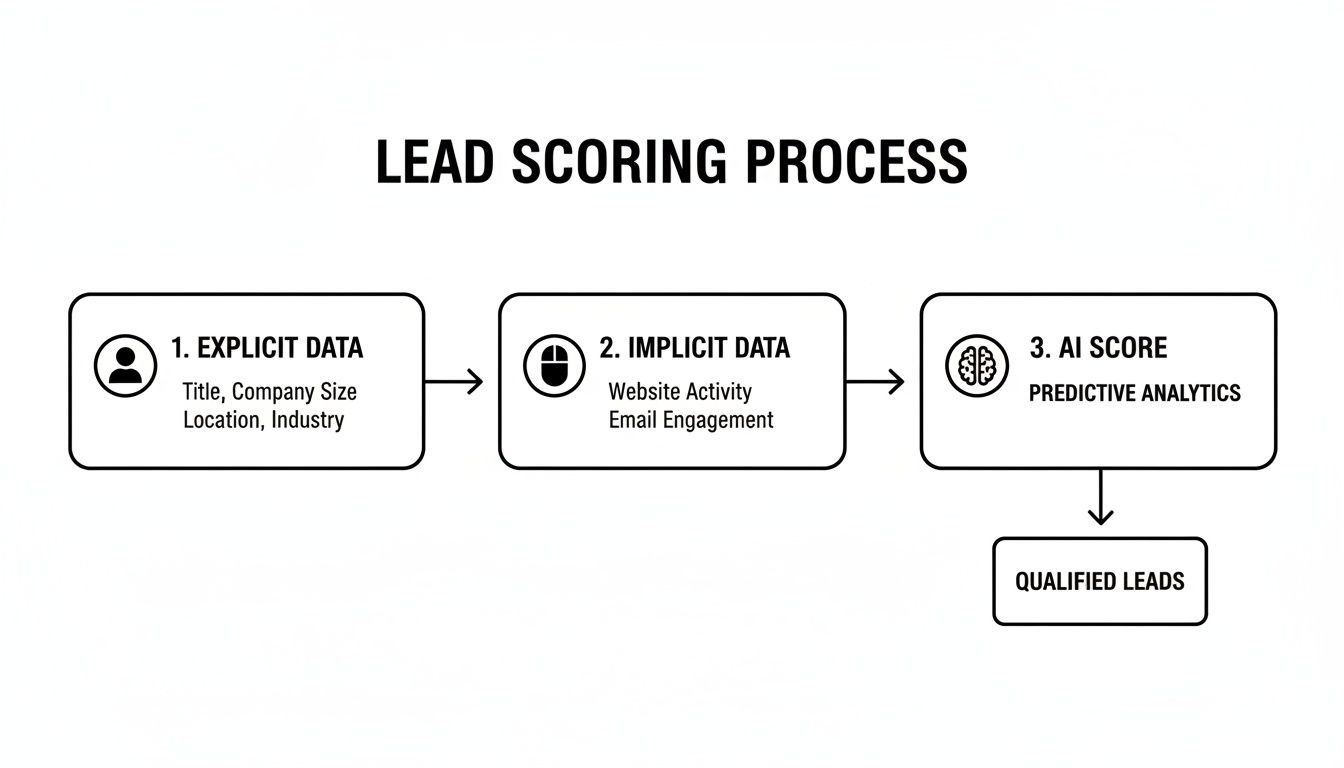
This integrated approach gives you a complete picture of a lead's potential, ensuring you prioritize prospects who are both a great fit and actively engaged.
Speed Is Your Competitive Advantage
By automating the grunt work—the data entry, the scoring, the routing—you free up your team to follow up with high-value leads in minutes, not hours. That speed is absolutely critical. Data shows that companies responding to leads within one hour are 7 times more likely to qualify them. This isn't just a trend; it's a fundamental rule of engagement in today's market. You can explore more of these lead management statistics from Salesgenie.
When a qualified lead is hot, the clock is ticking. Automation ensures you engage them at the peak of their interest, dramatically increasing the odds of a successful conversation.
The goal of workflow automation isn't just to be faster; it's to create an intelligent system that eliminates friction for both your team and your prospects. It delivers the right lead to the right person at the exact right moment.
Building Your Automated Tech Stack
Creating this seamless flow requires connecting the right tools. Your tech stack should function like a well-oiled machine, where each component hands off data to the next without any manual intervention.
A modern qualification stack typically includes:
- An Intelligent Form Builder: This is the entry point. It captures initial information and kicks off the entire workflow.
- An AI SDR or Enrichment Tool: This layer adds crucial context, scoring leads based on both explicit and implicit data.
- A CRM Platform: The central hub where all lead data is stored, managed, and assigned to reps for follow-up.
- A Marketing Automation Platform: Used for nurturing leads that aren't quite sales-ready, keeping them warm until their score increases.
Key Tools for Workflow Automation
To put this all into action, you'll need a set of tools designed for intelligent lead management. The key is finding platforms that not only perform their core function well but also integrate smoothly with the rest of your stack.
Orbit AI: Positioned right at the start of the workflow, Orbit AI does more than just capture data. Its AI SDR capabilities allow it to act as the central brain of your qualification process. It can qualify submissions in real time, enrich lead profiles, and use its scoring to trigger actions in your other tools, like creating a new deal in your CRM.
Dynamics 365 Sales: With its built-in Sales Qualification Agent, Microsoft's platform excels at the next step of the journey. It uses AI to autonomously research leads and personalize outreach, ensuring reps only engage with prospects who have confirmed interest.
Zendesk Sell: As a CRM, Zendesk Sell serves as the destination for your qualified leads. Its lead scoring features help reps prioritize their pipeline effectively, focusing on the opportunities that automation has already flagged as high-value.
By integrating these types of tools, you create a powerful, automated system that nails how to qualify sales leads. This frees up your team to focus on what they do best: building relationships and closing deals. For more on this, check out our guide on choosing the right automated lead distribution software.
Measuring and Refining Your Process Over Time
A great lead qualification system is never finished. It’s a living, breathing process that needs to adapt as your business evolves, your market shifts, and your team gets smarter.
What worked perfectly last quarter might need a serious tune-up today. Setting up your framework and automation is just the beginning; the real gains come from continuous, data-driven refinement.
Think of your qualification process like a product—you have to constantly measure its performance, gather feedback from your "users" (the sales team), and make iterative improvements. The goal is to create a tight feedback loop where data and on-the-ground insights from your reps work together.
Key Metrics to Monitor
To understand what’s working and what isn’t, you need to track the right data. It's easy to get lost in vanity metrics, so focus on a few key performance indicators (KPIs) that directly reflect the health of your pipeline.
Start with these essentials:
- Lead-to-SQL Conversion Rate: This is the big one. It tells you what percentage of leads generated by marketing are actually accepted by the sales team as qualified. A low rate is a massive red flag signaling a misalignment between what marketing thinks is a good lead and sales' reality on the front lines.
- Sales Cycle Length: Keep a close eye on how long it takes for a qualified lead to move from that first contact to a closed deal. If your sales cycle is getting longer, it could mean your qualification criteria are letting weaker, less-ready prospects slip through the cracks and clog up the pipeline.
- SQL-to-Win Rate: Of all the leads your sales team accepts as qualified, how many actually become customers? This is your ultimate report card on the quality of your qualification process.
The Power of Qualitative Feedback
Metrics tell you what is happening, but they rarely tell you why. That’s where your sales team’s qualitative feedback becomes absolutely invaluable.
They are the ones talking to these leads every single day. Their insights are pure gold.
Your sales reps are the ultimate focus group for your qualification process. Schedule regular, dedicated meetings to ask them pointed questions: Are the leads they're receiving truly ready for a sales conversation? Are the scoring criteria accurately reflecting a lead's intent?
This feedback is crucial for tweaking your scoring model, refining your form questions, and identifying the hidden bottlenecks you'd never see in a dashboard. When you combine hard data with human insight, you create a culture of optimization that keeps your qualification engine running at peak performance.
Got Questions About Lead Qualification? We’ve Got Answers.
When you're trying to get sales and marketing on the same page, a few key questions always seem to pop up. Let's clear the air on some of the most common ones.
What’s the Real Difference Between an MQL, SQL, and PQL?
These aren't just fancy acronyms; they're critical signposts in a lead's journey from curious browser to potential customer. Getting them straight is non-negotiable.
MQL (Marketing Qualified Lead): This is someone who's shown interest by interacting with your marketing. Think downloading an ebook, signing up for a webinar, or visiting your pricing page multiple times. They're curious, but not necessarily ready to talk to sales.
SQL (Sales Qualified Lead): This is an MQL that sales has personally vetted and confirmed is a legitimate opportunity. They've had a conversation and confirmed the lead meets the core criteria (like budget and need) to move forward.
PQL (Product Qualified Lead): This is the gold standard for many SaaS businesses. A PQL is someone using your product—often on a free trial or freemium plan—who has demonstrated strong buying signals through their actions, like hitting a feature limit or inviting teammates.
PQLs are often the highest-quality leads because their intent isn't theoretical; it's proven through direct product engagement. They've already seen the value firsthand.
What Role Does an SDR Actually Play in All This?
Think of a Sales Development Representative (SDR) as the essential bridge connecting marketing's efforts with the sales team's closing power. Their job is to be the first human filter.
SDRs take the raw MQLs and do the initial outreach to see if there's real potential. They're the ones having those first conversations to validate a prospect's needs, timeline, and authority. Once an SDR confirms a lead is genuinely sales-ready, they book a meeting and hand it off to an Account Executive to take it across the finish line.
What Should We Do with Leads That Don’t Qualify?
A "no" today rarely means "no forever." Tossing out unqualified leads is like throwing away future revenue. It's a massive mistake.
Instead, these leads should be gracefully moved into a long-term nurturing sequence within your marketing automation platform, like HubSpot or Pardot.
This keeps your brand top-of-mind by delivering relevant, valuable content over time. When their budget finally gets approved or their priorities shift, you'll be the first company they think of.
Turn every form submission into a qualified conversation. Orbit AI uses an AI SDR to analyze, enrich, and score leads in real time, so your sales team can focus on closing deals, not chasing dead ends. Start building for free at https://orbitforms.ai.


