A liability release form is a legal document where someone agrees to give up their right to sue your business for injuries that might happen during an activity. You can think of it as a formal "legal handshake" that makes sure everyone acknowledges the potential risks before anything happens. It's a fundamental tool for any business looking to manage and transfer risk.
Understanding the Liability Release Form
At its heart, a liability release form—often just called a waiver—is a contract. It creates a crystal-clear agreement between your business (the "releasee") and a participant (the "releasor"). The person signing is officially stating they understand the inherent dangers of an activity and are choosing to accept those risks.
This simple act of signing shifts a degree of legal responsibility from your company over to the individual. For businesses that offer anything from fitness classes to product testing sessions, this document is a critical layer of protection against lawsuits that could pop up from accidental injuries. Flying without one leaves your business wide open to major financial and legal headaches.
To put it in perspective, here’s a quick breakdown of what these forms are all about.
Liability Release Form At a Glance
This table gives you a quick summary of the core components of a liability release form and why each part matters.
| Component | Purpose | Example Application |
|---|---|---|
| Acknowledgement of Risk | Clearly states the specific dangers involved. | A rock-climbing gym waiver lists risks like falling, equipment failure, and sprains. |
| Assumption of Risk | The participant formally accepts those stated risks. | A beta tester agrees they understand using pre-release software may lead to data loss. |
| Waiver of Claims | The participant gives up their right to sue for injuries. | A person joining a 5K race agrees not to sue the organizers if they trip and fall. |
| Indemnification Clause | The participant agrees to cover the business's legal costs if a third party sues. | If a workshop attendee damages venue property, they agree to cover the repair costs. |
| Voluntary Participation | Confirms the participant is not being forced to sign or participate. | A volunteer at a community event signs to confirm they are there by their own choice. |
Ultimately, this document ensures everyone is on the same page about what could happen and who is responsible.
Why It's a Non-Negotiable Document
In a world where legal action is increasingly common, a liability release form isn’t just for high-adrenaline businesses like skydiving companies anymore. It’s become a must-have for a huge range of modern operations.
Just think about these scenarios:
- A tech startup hosting a beta testing event for a new piece of hardware.
- A marketing agency organizing a team-building retreat with physical activities.
- A local gym offering a free trial class to potential new members.
- A software company letting users test out pre-release features.
In every one of these cases, something unexpected can go wrong. A well-written liability waiver ensures that participants were formally warned of the risks, which can be a powerful defense if an incident ever ends up in court. It’s a proactive way to manage expectations before any activity even starts.
The Shift to Digital Waivers
The way we handle these forms has changed, too. Clunky paper forms are being replaced by far more efficient digital solutions. Businesses are quickly moving to online waivers to make signing easier, cut down on administrative work, and store records securely. This switch doesn't just make things better for the user; it seriously levels up your risk management.
Industry data shows that companies switching from paper to online liability waivers can cut their overall risk and liability exposure by an impressive 18%. It’s a simple change with a big impact.
At its core, a liability release form helps you understand what is risk in risk management, giving you a clear framework for getting that risk acknowledged and mitigated. If you're looking to implement this for your own business, exploring a few liability release form templates is a great way to start. You can find several examples right here: https://orbitforms.ai/templates
The Anatomy of an Enforceable Liability Waiver
A liability release form is so much more than a signature line at the bottom of a page. It's a carefully engineered legal document where every single clause has a job to do. The real strength of a waiver comes down to its clarity and how thorough it is, ensuring it can actually hold up in court if it's ever put to the test.
Getting a handle on these core components is the first step toward building a document that genuinely protects your business.
Think of it like building a sturdy fence: each post and panel has to be perfectly placed and secured for the whole thing to work. If one part is weak or missing, the entire structure can fail when you need it most.
This diagram shows how a liability release form is designed to transfer risk and shield your business from legal claims.
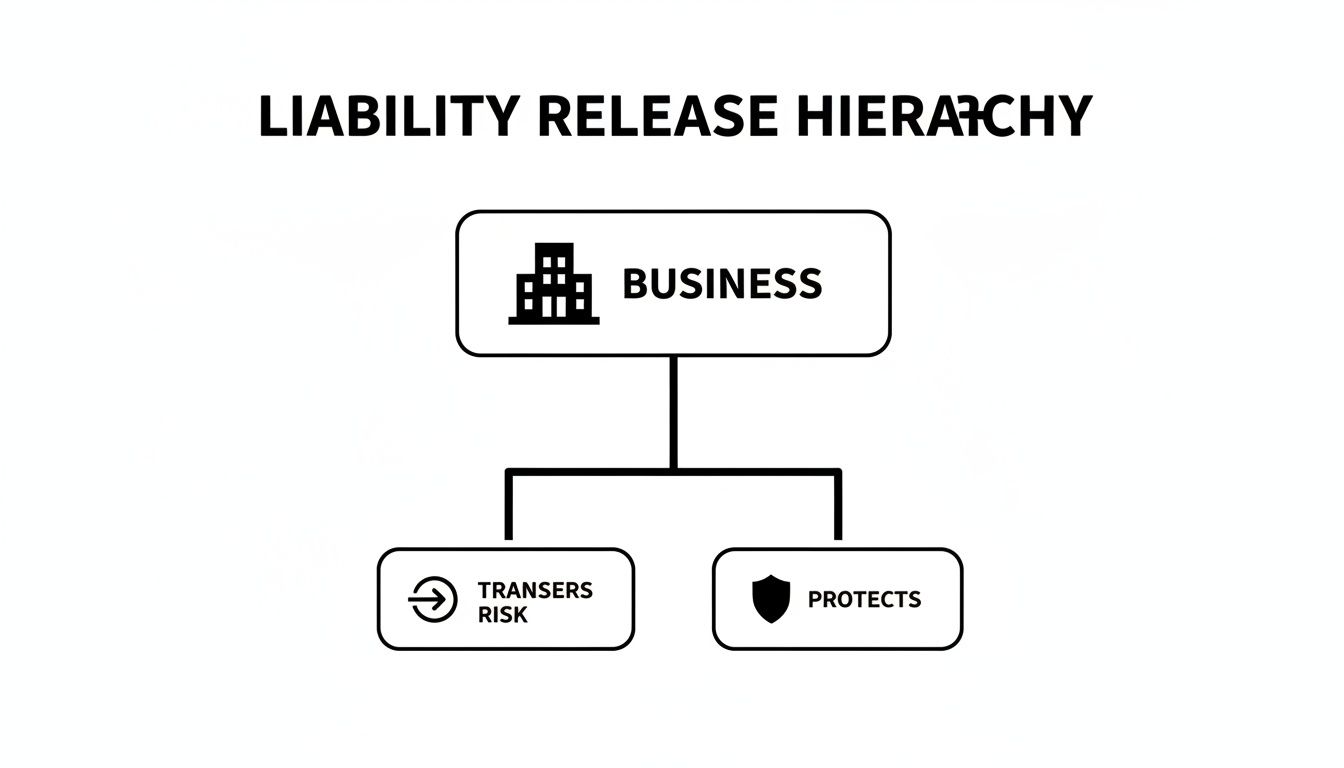
As you can see, its main jobs are to shift potential responsibility away from your business and act as a legal backstop against future lawsuits.
Identifying the Parties Clearly
The absolute foundation of any waiver is spelling out exactly who is involved. This might sound painfully obvious, but any ambiguity here can render the whole document useless. Every single form has to name the parties involved without a shadow of a doubt.
- The Releasor: This is your participant—the person agreeing not to sue. It’s critical to get their full legal name and contact details.
- The Releasee: This is your business or organization—the one being protected. You need to include your official business name and address.
Getting this wrong creates a massive loophole. It opens the door for someone to argue that it was never clear who the agreement actually covered.
Crafting the Core Clauses
Once you've got the who's who sorted, it's time to get into the nuts and bolts of the agreement. The next few clauses are the legal heart of your liability waiver, and they need to be airtight. Understanding specific components like limitations of liability clauses is key to defining the scope of your protection.
A waiver’s enforceability often comes down to how specific it is. Courts look much more favorably on waivers that are clear, comprehensive, and don't try to release a party from things like gross negligence or intentional harm.
Here are the non-negotiable clauses every waiver must have:
Assumption of Risk: This is where the participant confirms they understand the specific, inherent dangers of the activity. This can't be some vague, catch-all statement. For a yoga studio, you'd list risks like "muscle strains, sprains, or falls." For a software beta test, it could be "potential for data loss or software crashes." Be specific.
Waiver of Liability and Release of Claims: This is the money clause. It's where the releasor formally gives up their right to file a lawsuit against your business for injuries or damages that come from the activity. The language has to be direct and unmistakable, clearly stating that the participant is releasing the business from liability.
Indemnification Clause: This clause adds another layer of protection. It means that if a third party gets hurt because of the participant's actions and decides to sue your business, the participant agrees to cover your legal bills. For example, if a guest at your event breaks expensive venue equipment, they're on the hook for reimbursing your company.
Including Additional Protective Provisions
Beyond the big three, a few other provisions can add extra layers of legal armor and help ensure the document is interpreted the way you intended. They might look like standard legal boilerplate, but they play a crucial role in the document's overall strength.
Consider adding these to your liability release form:
- Choice of Law: This specifies which state's laws will be used to interpret the agreement. This is a big deal for businesses that operate online or across state lines, as it prevents arguments over which jurisdiction's rules should apply.
- Severability Clause: This is a fantastic safety net. It says that if a court decides one part of the waiver is unenforceable, the rest of the document still stands. It keeps one flawed provision from taking the whole agreement down with it.
- Voluntary Participation Statement: A simple line confirming the participant is signing freely and not under any pressure reinforces the consensual nature of the agreement and makes it harder to challenge later.
By methodically building your liability release form with these essential pieces, you create a powerful legal tool. For more on putting these documents into practice, check out these best practices for digital forms and waivers.
Real World Scenarios Where You Need a Waiver
The true value of a liability waiver really clicks when you see it in the wild. Most of us picture signing one before jumping out of a plane or strapping into a roller coaster, but the reality is far more common—and much closer to the corporate world than you'd think. Moving past the usual suspects helps show just how essential this piece of paper (or, more likely, digital form) has become for modern businesses.
Think about a SaaS company launching the beta version of its new project management tool. They invite 50 potential customers to their office for a hands-on user testing session. The goal is feedback, but what if a participant’s laptop crashes while using the pre-release software, taking important data with it? A well-written liability waiver, signed during registration, makes sure the user knows the risks of testing unstable software, shielding the company from a messy lawsuit over data loss.
Corporate Events and Team-Building Activities
Now, let's picture a marketing agency planning its annual team-building retreat. The big event is a ropes course followed by a team hike. It's all designed for fun and collaboration, but these activities carry inherent physical risks—sprains, scrapes, or something worse.
Before anyone clips into a harness, having them sign a liability release form is non-negotiable. This document does two critical things:
- It clearly communicates the potential dangers involved in the physical activities.
- It confirms that employees are participating voluntarily and accept personal responsibility for accidental injuries.
This simple step can stop a fun company outing from spiraling into a legal nightmare. It’s a perfect example of how even internal events demand smart risk management.
Client Workshops and Professional Training
The need for a waiver doesn't stop at the office door; it extends to your clients, too. Imagine a digital marketing firm hosting an in-person workshop on advanced SEO. During the session, an attendee could trip over a power cord and get hurt. Or, they might later claim the advice you gave actually tanked their search rankings.
A liability waiver signed by each person at the start of the workshop draws a clear line. It can release the firm from liability for accidental injuries on-site and clarify that the training is educational guidance, not a guarantee of specific business results. It just sets expectations and protects you from claims you never saw coming.
Waivers are a crucial tool across tons of industries, from big events to healthcare, and when drafted correctly, they hold up globally. Event organizers and gyms are some of the biggest users, collecting signatures to release them from liability for injuries. In fact, over 60% of U.S. recreational facilities require them daily, according to recent compliance studies. It also turns out that specific, tailored waivers are far more effective than generic templates. Waivers written for a specific activity like skydiving or a fitness class hold up in 80% more court cases than vague, broad releases.
Community Meetups and Networking Events
Even casual get-togethers sponsored by your company carry potential risks. Let's say your tech startup hosts a free community meetup at a local brewery to network with developers. The vibe is relaxed, but your company is still the official host.
A liability release form acts as a proactive communication tool. It ensures all parties—from employees and clients to beta testers and event attendees—are fully aware of and have formally acknowledged the risks associated with an activity before it even begins.
If a guest slips and falls or has an allergic reaction to the appetizers, the startup could be held responsible. The easiest way to handle this is to build a simple waiver right into the digital event registration process. It's a low-friction way to mitigate risk, especially for companies that host events as a core part of their marketing strategy. To learn more about streamlining your sign-up process, you can check out some best practices for event registration forms.
Making The Digital Shift To Smart Waiver Workflows
Let’s be honest: clunky paper forms are a liability in themselves. They get lost, cost a fortune to store, and are a breeding ground for typos and data entry errors. Moving from paper stacks to a modern digital workflow isn’t just a “nice-to-have” anymore—it’s a strategic necessity for any business that cares about efficiency and security. This shift turns a simple liability release form from a static document into a dynamic part of your entire operation.
And if you’re worried about the legal side of things, don’t be. The foundation for this move is rock-solid. Laws like the Electronic Signatures in Global and National Commerce (E-SIGN) Act in the United States give e-signatures the exact same legal weight as a handwritten one. This means a digitally signed waiver is just as enforceable, as long as it meets the right standards for consent and record-keeping.
This isn’t just about swapping paper for pixels. It’s about building an intelligent, automated system that works for you.
From Static Document To Smart Asset
The real magic happens when you integrate digital waivers directly into your customer journey. Instead of being a clunky, separate step, the release form becomes a seamless part of your online registration or lead capture process. The result? A much smoother experience for your users and a dramatic boost in completion rates.
Imagine someone signing up for a free trial of your software. With a smart workflow, the waiver is just another field in the form they’re already filling out. No more asking them to download a PDF, print it, sign it, scan it, and email it back—a frustrating process where you lose a huge chunk of potential leads.
The shift isn't just a convenience; it's a game-changer for your bottom line. Businesses that handle an average of 18,000 documents a year see massive cost reductions when they go digital. In fact, a 2023 industry report found that 85% of small businesses using digital waivers cut their administrative costs by at least 30%, freeing up that cash for marketing and sales. You can find more insights on the benefits at WaiverSign.
The Rise Of AI-Powered Form Platforms
Modern form builders have evolved way beyond simple data collection. Today's best tools use AI and automation to turn your liability release form into a valuable asset that actively helps your growth and sales teams. They can automate everything from signature collection and secure cloud storage to instantly updating your CRM.
For instance, an AI-powered platform can automatically:
- Embed waivers seamlessly into any webpage or landing page.
- Collect legally-binding e-signatures from any device.
- Securely store signed documents with a timestamped audit trail.
- Trigger notifications to your team once a form is signed.
- Sync data directly to your other business tools, like Salesforce or HubSpot.
This kind of deep integration is what creates a truly cohesive and automated system. You can explore how these AI-driven workflows handle all the heavy lifting for you, connecting all the dots without any manual work.
Top Tools For Digital Liability Release Forms
Choosing the right platform is the key to unlocking the full potential of your digital waivers. Here’s a quick look at some of the top tools out there designed to help growth teams manage liability release forms effectively.
| Tool | Key Feature | Best For |
|---|---|---|
| Orbit AI | AI-powered lead qualification and smart workflows that automatically sync signed waivers with CRM records. | Teams wanting to turn their liability release form into a fully integrated part of their lead capture and sales process. |
| DocuSign | Industry-standard e-signature technology with robust security features and a focus on legal and enterprise contracts. | Businesses that need advanced document management and compliance features for complex legal agreements. |
| Jotform | Highly versatile form builder with a vast template library and conditional logic for creating customized waiver experiences. | Companies looking for a flexible and user-friendly solution to build a wide variety of forms beyond just waivers. |
| PandaDoc | All-in-one document automation that combines proposals, contracts, and e-signatures into a single workflow. | Sales teams that need to integrate waivers into their broader sales document and contract management process. |
By making the digital shift, your liability release form stops being a boring administrative chore and becomes a strategic, integrated asset. It improves the user experience, strengthens your legal protection, and feeds valuable data directly into your growth engine.
Navigating the Legal and Compliance Landscape
A liability release form is an essential risk management tool, but it isn't a magical shield that makes all legal responsibility disappear. Knowing its limits is just as important as knowing what it can do. The real-world effectiveness of a waiver comes down to a delicate balance of state laws, the specifics of an incident, and the ever-present world of data privacy rules.
Let's be clear: simply having a signed form doesn't give a business a free pass to be reckless. Courts all over the country consistently refuse to enforce waivers that try to protect a business from its own gross negligence or intentional harm. We're talking about actions so careless they show a blatant disregard for the safety of others.
For example, if a zip-line company knowingly uses a frayed cable and someone gets hurt, that signed waiver isn't likely to hold up in court. The law draws a firm line, making sure businesses are still on the hook for maintaining a basic standard of care.
The Importance of State and Local Laws
The enforceability of a liability release form is definitely not a one-size-fits-all situation—it changes dramatically from one state to the next. For instance, 48 states have some version of an Equine Activity Liability Act (EALA), which offers specific protections for horse-related activities. But the fine print, exceptions, and definitions in these laws are all over the map.
This jurisdictional patchwork means a waiver that’s perfectly valid in Texas might get tossed out by a judge in Montana for the exact same activity. Some states simply have strict public policy rules that limit what rights a person can sign away.
A key takeaway for any business is that a generic, downloaded liability waiver is a huge risk. To have the best chance of holding up in court, the document has to be tailored to the specific laws of the state where you actually do business.
Because of all this legal complexity, talking to a legal professional to draft or review your liability form is always a smart investment. They can make sure your document lines up with local laws and recent court decisions, giving it the strongest possible foundation.
Data Privacy and Modern Compliance
In today's connected world, collecting a signature almost always means collecting personal data—names, email addresses, phone numbers. That simple act puts your business squarely under the umbrella of major data privacy regulations.
Laws like the General Data Protection Regulation (GDPR) in Europe and the California Consumer Privacy Act (CCPA) have raised the bar for how businesses must handle personal information. These rules demand clear consent, transparent policies on data use, and strong security measures to keep consumer data safe.
When you use a digital liability release form, you have to think about:
- Consent: Are you clearly explaining what data you’re collecting and why?
- Security: How are you storing the signed documents and the personal info they contain?
- Access: Can users easily ask to see or delete their data?
Ignoring these rules can lead to hefty fines and serious damage to your brand’s reputation. Thankfully, modern platforms are built with this in mind, offering enterprise-grade security and features designed to help businesses meet these strict compliance requirements. For a deeper look, you can learn more about the essentials of form security and data protection to keep your operations both effective and responsible.
How to Implement Waivers in Your Growth Strategy
Let's be honest, a liability release form can feel like a roadblock. It’s the legal hurdle your customer has to clear right when they’re most excited to get started. But it doesn’t have to be a conversion killer.
The trick is to stop thinking of waivers as a separate, clunky step and start treating them as a seamless part of your customer journey. When done right, you can protect your business without creating the kind of friction that sends potential customers running. The goal is to make a legal necessity feel like a natural part of your sign-up process.

It all starts with placement. Forget forcing users to download, print, and re-upload a PDF. That’s a guaranteed way to lose them. Instead, embed the waiver directly into your existing registration or lead capture forms. This creates a single, unified experience where signing the release feels like just another field to complete—not a disruptive chore.
Maximizing Completion Rates
Getting someone to sign a legal document comes down to two things: clear communication and a great user experience. Ditch the dense, intimidating legalese wherever you can. While the core legal clauses have to stay, you can absolutely use plain-language summaries to help users understand exactly what they’re agreeing to.
Here are a few practical strategies to get more waivers signed:
- Use Conditional Logic: Don't show the waiver to everyone. If your form has options, only display the waiver to users who select a high-risk activity or service. This instantly reduces friction for everyone else.
- Optimize for Mobile: A massive number of your users will be on their phones. Make sure your form and signature field are dead simple to use on any device. A frustrating mobile experience is a surefire way to lose sign-ups.
- Provide Context: A little explanation goes a long way. A simple sentence like, "To ensure everyone's safety, please review and sign our standard liability waiver," can make a huge difference in how the request is perceived.
By focusing on a user-friendly design, you make the process feel routine and professional rather than intimidating.
Turning Waivers into Data Assets
In today's world, a form is so much more than a signature collector. Modern platforms turn your liability release form into a source of valuable data. With the right tools, you can track user interactions to see exactly where people hesitate or drop off, giving you the analytical insight needed to continuously refine the experience.
Integrating your digital waiver system with your CRM is a game-changer. It ensures that a signed liability release form is automatically attached to a customer’s record, providing a complete and easily auditable trail.
This connection is crucial for secure, organized record-keeping. When a signed waiver is automatically stored and linked to a lead or customer profile, your team can pull it up instantly for audits or legal inquiries. No more frantic searches through disconnected files. This ensures your compliance is always just a click away.
Platforms like Orbit AI are built for this, connecting form submissions, signed waivers, and customer records into one automated workflow. It’s how smart teams fuel growth while keeping risk tightly under control.
Answering Your Lingering Questions
Even after you've got the basics down, a few practical questions always come up when it's time to actually use a liability release form. We hear them all the time from businesses just like yours.
Think of this as the final check-in before you put your waivers to work. Let's clear up those last few details so you can move forward with confidence.
Are Digital Signatures Actually Legitimate?
Yes, they absolutely are. Thanks to laws like the U.S. E-SIGN Act passed way back in 2000, electronic signatures carry the exact same legal weight as a pen-and-paper signature.
As long as you can prove who signed it and show they intended to sign, a digital signature on a liability waiver is completely enforceable. This isn't a new or untested concept; it's been the backbone of digital business for decades, making workflows like this both efficient and legally solid.
Does a Waiver Protect My Business From Absolutely Everything?
No, and it's really important to understand this limit. A liability release form is a powerful tool, but it won't shield you from acts of gross negligence or intentional harm.
For example, if you knowingly provided faulty equipment at your rock-climbing gym and someone got hurt, a waiver isn't likely to save you in court. A waiver’s job is to protect you from liability for accidents that happen due to the normal, inherent risks of an activity—not from your own reckless or malicious behavior.
So, When Is a Liability Release Form a Must-Have?
While there's no law that says you need one for every single interaction, you should strongly consider using a waiver anytime your business offers an activity with a built-in risk of physical or even financial harm. Think about situations like:
- Physical Activities: Gyms, workshops, corporate team-building events, or local sports leagues.
- Property Access: Anytime you allow clients or guests onto your property where an accident could happen.
- Product Testing: Beta tests for new software or hardware where a bug could cause data loss or other damages.
- Volunteer Events: Any organized event where volunteers are performing tasks for your organization.
The bottom line is simple: if you can foresee a risk, using a liability release form is the smartest way to protect your business.
Ready to turn your liability forms into a seamless part of your growth engine? With Orbit AI, you can build smart, secure, and high-converting forms that integrate directly with your CRM, automating everything from signature collection to lead qualification. See how it works at https://orbitforms.ai.