

Events represent a significant investment of time, budget, and resources. Yet, many organizations fail to capture their true value, relying on simple attendance metrics or generic feedback forms. The real ROI isn't just in who showed up; it's in understanding their experience, intentions, and potential as customers. This is where strategic post event survey questions become a critical business intelligence tool.
A well-crafted survey transforms simple feedback into a powerful engine for lead qualification, Ideal Customer Profile (ICP) validation, competitive intelligence gathering, and measurable ROI justification. Moving beyond the standard "How was it?" allows you to segment attendees, identify high-intent prospects, and directly fuel your sales pipeline. This guide provides a comprehensive playbook of impactful question types, complete with specific examples, recommended response scales, and best practices for implementation.
You will learn how to structure questions that not only gauge satisfaction but also uncover purchase intent, pinpoint specific product interests, and identify potential brand advocates. We will cover everything from using Net Promoter Score (NPS) to gather verbatim feedback to asking targeted questions that reveal budget authority and buying timelines. The goal is to stop collecting shallow data and start generating actionable intelligence that informs marketing strategy, empowers sales teams, and proves the undeniable value of your event program. This is your blueprint for turning every event attendee into a qualified opportunity.
1. Overall Satisfaction Rating (NPS/CSAT) - Likert Scale
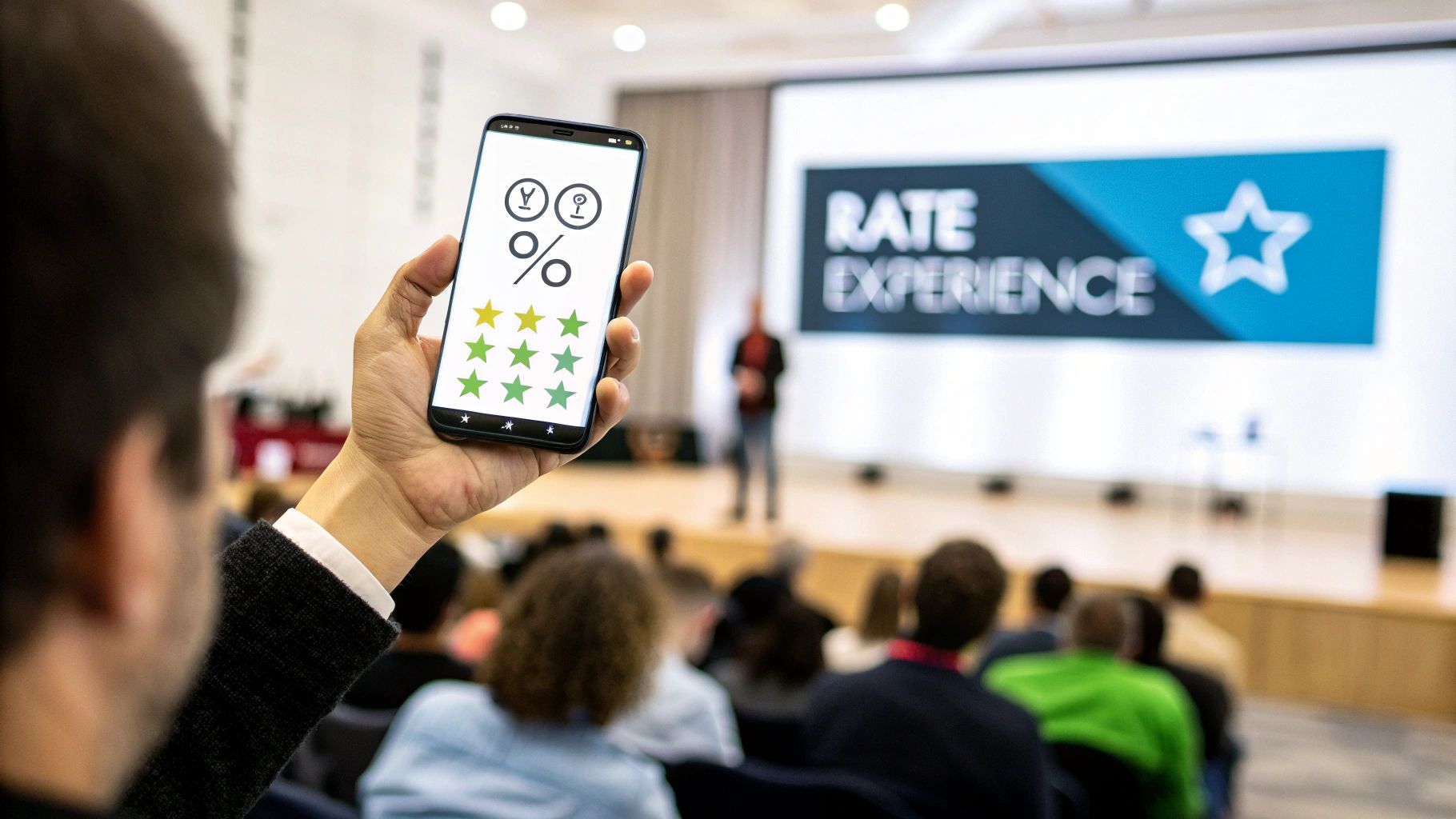
This is the foundational question of nearly all high-impact post event surveys. Using a simple numeric scale (typically 1-10 for Net Promoter Score or 1-5 for Customer Satisfaction), it captures a top-line metric of attendee sentiment. This single data point serves as a powerful baseline to measure event success, benchmark against past performance, and predict future loyalty.
It’s one of the most direct ways to quantify the attendee experience. Big names like Salesforce and Gartner rely on these scores to evaluate massive conferences and track year-over-year performance. The simplicity of the question encourages high response rates, giving you a statistically significant pulse on your audience's overall feeling.
Why It's Essential
The power of NPS/CSAT lies in its ability to segment your audience into clear categories: Promoters (happy advocates), Passives (satisfied but unenthusiastic), and Detractors (unhappy attendees). This segmentation is not just for analysis; it's a launchpad for targeted action. Promoters can be funneled into marketing campaigns for testimonials, while Detractors can trigger automated follow-ups from your support or community team to resolve issues.
Actionable Implementation Tips
- Pair with an Open-Ended Follow-up: Always ask, "What is the primary reason for your score?" This turns a simple number into actionable qualitative insight.
- Use Conditional Logic: With a tool like Orbit AI, you can create intelligent survey flows. Show Detractors (scores 0-6) a question about what went wrong, while Promoters (scores 9-10) are asked what they loved most or if they’d be willing to provide a testimonial.
- Automate Lead Qualification: Connect your survey tool to your CRM. Use an AI SDR to automatically qualify high-NPS respondents as sales-ready leads, creating a direct pipeline from event feedback.
- Segment Your Results: Don't just look at the overall score. Break it down by attendee persona, ticket type, or session attended to pinpoint what's working for specific audience segments. For more on creating effective scales and questions, explore these survey design best practices.
2. Content Relevance & Learning Outcome - Multiple Choice with Ranking
Beyond overall satisfaction, the true value of a B2B event often lies in the quality and relevance of its content. This question type moves past a simple rating to ask attendees what they actually learned and which topics delivered the most value. Using multiple-choice or ranking questions, you can pinpoint the specific sessions, speakers, or themes that resonated most deeply with your audience.
This data is mission-critical for planning future event agendas and informing your broader content marketing strategy. For example, HubSpot uses feedback from its massive INBOUND conference to refine session tracks for specific attendee roles, while LinkedIn asks attendees to rate speaker expertise to ensure its programming remains top-tier. These insights directly connect event feedback to business intelligence.

Why It's Essential
This question provides a granular view of your event's educational impact, answering the crucial question: "Did our content meet our audience's needs?" For B2B SaaS companies, the answer is a goldmine. It helps you understand which product features, industry trends, or strategic concepts are most important to your target customers. This allows you to not only improve future events but also to repurpose the most successful content into high-performing assets like webinars, guides, and blog posts. It transforms your event from a one-time occurrence into a sustainable content engine.
Actionable Implementation Tips
- Limit Choices to Avoid Paralysis: When using a multi-select or ranking question, present 5-7 options at most. This focuses the attendee on their top takeaways without overwhelming them.
- Use Conditional Logic for Personalization: Tailor follow-up questions based on the attendee's profile. If an attendee identifies as being in a sales role, show them a specific question about the relevance of the sales-focused sessions.
- Identify High-Intent Signals: An attendee who rates content relevance as high and also engaged heavily during the event is a prime candidate for sales follow-up. Use this data to score and prioritize leads within your CRM.
- Connect to Your Lead Nurturing: Repurpose the highest-rated session topics into gated assets. Use an AI SDR from a tool like Orbit AI to automatically enroll attendees who ranked that topic highly into a relevant nurture campaign, delivering value long after the event ends. For more on structuring these questions, you can explore different form field options and their best uses.
3. Likelihood to Purchase/Intent - Forward-Looking Behavioral Question
While satisfaction scores measure past experience, this question pivots to future action. It directly asks attendees about their likelihood to purchase, adopt, or engage with a sponsoring product or service within a specific timeframe (e.g., the next 3-6 months). This is one of the most powerful post event survey questions for translating event engagement into measurable sales pipeline and demonstrating clear ROI.
This question moves beyond general interest and forces a concrete evaluation of commercial intent. Major B2B event organizers like SaaStr and Forrester use variations of this question to qualify leads for sponsors. For example, asking attendees if a specific vendor will be included in their next RFP cycle or if they have an allocated budget for a particular technology category this year. This data is pure gold for sales and marketing alignment.
Why It's Essential
This question is the bridge between marketing-qualified leads (MQLs) and sales-qualified leads (SQLs). It identifies attendees who have moved from passive learning to active consideration, allowing you to prioritize follow-up efforts effectively. Instead of your sales team calling a list of every attendee, they can focus exclusively on those who have explicitly signaled purchasing intent, dramatically increasing conversion rates and shortening the sales cycle.
Actionable Implementation Tips
- Combine with Qualifying Questions: Don't stop at intent. Follow up by asking about budget authority, decision-making timeline, and their current tech stack to build a complete lead profile.
- Use Conditional Logic: With a tool like Orbit AI, you can create powerful automated workflows. High-intent responses can automatically trigger a lead creation event in your CRM, assign a lead score, and notify the appropriate sales rep for immediate follow-up.
- Segment by Role: Tailor the intent question to the attendee's persona. A CTO might be asked about technical evaluation timelines, while a CFO is asked about budget allocation cycles. This makes the question more relevant and the answer more accurate.
- Automate Lead Routing: The key is speed. Use webhook integrations to route high-intent leads directly to your sales team's inbox or Slack channel within minutes of survey completion. The faster the follow-up, the higher the likelihood of closing the deal. To learn more about this process, see these best practices for how to qualify leads with forms.
4. Net Promoter Score (NPS) Follow-up - Open-Ended Verbatim
This question is the essential partner to the NPS score; it’s what transforms a simple number into a story with actionable insights. By immediately asking, "What's the primary reason for your score?", you capture the raw, unfiltered "why" behind an attendee's rating. This qualitative feedback is a goldmine for understanding the root causes of satisfaction or disappointment, providing context that a numeric score alone can never offer.
Without this follow-up, an NPS score is just a vanity metric. It’s the open-ended verbatim feedback that allows you to pinpoint specific issues or highlight unexpected successes. For example, HubSpot analyzes this feedback from INBOUND to identify recurring themes for improvement, while Stripe uses verbatim comments from developer events to directly influence product roadmap priorities. It’s the most direct line you have to understanding the attendee's actual experience.
Why It's Essential
The true power of this question lies in its ability to provide specific, actionable intelligence. A detractor score of "3" is vague, but a comment like "The audio in the main hall was terrible, I couldn't hear the keynote speaker" is a concrete problem you can solve for the next event. Similarly, a promoter score of "10" is great, but a comment like "The networking session with the enterprise architects was the most valuable part" tells you exactly what to double down on.
This feedback becomes the voice of your customer, enabling you to make data-driven decisions that genuinely improve future events. It’s the difference between guessing what your audience wants and knowing what they need.
Actionable Implementation Tips
- Keep it Concise: Encourage higher response rates by asking for just "one sentence" or "the primary reason." This reduces friction and gets you the most critical piece of information.
- Use AI for Analysis: Manually sorting hundreds of responses is inefficient. A tool like Orbit AI can auto-summarize and categorize feedback by theme (e.g., "Venue," "Speakers," "Networking"), instantly highlighting your biggest strengths and weaknesses.
- Monitor for Churn Signals: Set up alerts for keywords like "pricing," "competitor," or "switching." This allows your team to proactively reach out with retention offers before an at-risk customer churns.
- Identify Case Study Candidates: Flag positive feedback from promoters that mentions specific use cases or ROI. These attendees are prime candidates for powerful testimonials and marketing case studies.
- Segment Feedback: Analyze comments based on attendee segments like "prospect vs. customer" or "first-time vs. repeat attendee" to uncover unique insights for different groups. Learn more about how to track and analyze these segments in your survey analytics dashboard.
5. Engagement & Interaction Quality - Behavioral Observation Question
Instead of just asking what attendees thought, this question digs into what they did. It assesses the attendee's active participation level during the event, such as taking part in Q&A sessions, visiting sponsor booths, or joining hands-on labs. This behavioral data is a powerful indicator of genuine interest and helps measure the effectiveness of your event's interactive elements.
High engagement often correlates directly with higher purchase intent and better lead quality. For example, Salesforce’s Dreamforce tracks booth visits and hands-on lab attendance to create an engagement score, while virtual platforms like Hopin use session completion rates as a proxy. This method moves beyond sentiment to measure concrete actions, providing a much clearer picture of attendee involvement.

Why It's Essential
This question helps you quantify which parts of your event are successfully capturing attention and driving interaction. An attendee who passively watched one keynote is fundamentally different from one who attended three breakout sessions, asked a question, and visited a partner booth. By tracking these behaviors, you can identify your most valuable attendees and understand which event formats create the most stickiness, informing future event strategy and content development.
Actionable Implementation Tips
- Pre-populate Data: Use first-party data from your event platform or badge scanner to pre-fill the survey with sessions the attendee joined. Then ask them to rank or comment on those specific experiences.
- Link Engagement to Value: Don't just ask what they did; ask "Which session or interaction provided the most value to you?" This connects an action (engagement) to a tangible outcome (value).
- Create Retargeting Segments: Use this data to build smart audience segments. Attendees with high engagement but low expressed intent can be added to a long-term nurture campaign, while those with both high engagement and intent should be prioritized for immediate sales outreach.
- Enrich Lead Scoring: Feed this behavioral data directly into your lead scoring model. With a tool like Orbit AI, engagement scores can be a key component of its smart algorithm, automatically identifying and qualifying the most promising leads for your sales team.
6. Competitor Awareness & Market Intelligence - Insight-Gathering Question
Events are not just for engagement; they are goldmines for competitive intelligence. This question moves beyond attendee satisfaction to probe the broader market landscape, asking what other solutions or tools attendees currently use or were considering. It provides invaluable, direct-from-the-source data for your sales and product teams.
Understanding your competitive positioning is crucial. For instance, B2B SaaS companies use event feedback to identify which attendees are entrenched in a competitor's ecosystem, like Salesforce, and tailor their follow-up to highlight key differentiators and migration paths. This transforms a simple survey into a strategic reconnaissance tool, revealing win/loss dynamics and greenfield opportunities directly from your target audience.
Why It's Essential
This type of question directly informs your go-to-market strategy. By learning what competitors your attendees use, you can arm your sales team with targeted battle cards and talking points. The insights gathered can also validate or challenge your product roadmap by revealing features or pain points associated with rival platforms. It’s a direct line into your prospect’s tech stack and mindset, allowing you to position your solution not just as an option, but as the superior one.
Actionable Implementation Tips
- Frame the Question Neutrally: Instead of asking, "Which of our competitors do you use?", try a softer approach like, "What tools does your team currently use for [specific function]?" This encourages more honest and comprehensive answers.
- Include a "Homegrown" Option: Add options like "Building in-house" or "Using spreadsheets" to identify prospects in the early stages of their buying journey who are prime for a dedicated solution.
- Use Conditional Logic for Deeper Insight: If an attendee selects a specific competitor, trigger a follow-up question: "What is the biggest challenge you face with your current tool?" or "What are you most looking to improve?"
- Automate Sales & Marketing Alerts: Connect your survey tool to your CRM. With a tool like Orbit AI, you can automatically tag leads based on the competitor they name, routing them to specialized sales reps or enrolling them in targeted marketing campaigns that highlight your competitive advantages. This creates a highly efficient pipeline for competitive displacement.
7. Budget Authority & Buying Cycle Qualification - Multi-Stage Question
This is the bridge between event marketing and your sales pipeline, moving beyond satisfaction metrics to directly qualify leads. This multi-stage question set determines not just interest, but true buying intent by asking about budget allocation, decision-making authority, and purchase timelines. It’s a critical differentiator that separates attendees who are just browsing from those who are sales-ready.
This approach transforms your post-event survey from a simple feedback tool into a powerful lead qualification engine. Enterprise software leaders like HubSpot and Salesforce use similar question flows to segment their massive event audiences, ensuring their sales teams focus only on the highest-potential prospects. By asking these direct questions, you respect everyone's time and create a clear path forward for genuine opportunities.
Why It's Essential
This set of questions provides the three core pillars of sales qualification: Budget, Authority, and Timeline. Without this data, your sales team is flying blind, wasting cycles on leads that aren't ready or don't have the power to purchase. It allows you to immediately sort your attendee list into distinct funnels: hot leads for immediate sales follow-up, warm leads for a targeted nurture sequence, and cool leads for long-term content marketing. This precision dramatically improves sales efficiency and conversion rates.
Actionable Implementation Tips
- Use Conditional Branching: Structure your questions intelligently. For example, if an attendee answers "Yes" to "Is budget allocated for a solution like ours?", the next question could be about their buying timeline. An advanced form builder with conditional logic is essential for creating this seamless, personalized experience.
- Sequence for Engagement: Ask less-sensitive questions first to build momentum. Start with the buying timeline (e.g., "Within 3 months, 3-6 months, or 6+ months?"), then ask about their role in the decision-making process, and finally, ask about allocated budget.
- Automate Smart Lead Scoring: Use a tool like Orbit AI to assign weights to responses and automate scoring. For instance, having budget authority might be worth 100 points, a <3 month timeline 75 points, and an allocated budget another 75 points. A cumulative score above a certain threshold can trigger an instant alert to your sales team.
- Create Segmented Nurture Tracks: Connect the survey to your CRM to trigger different automated workflows. A lead with a 6+ month timeline enters a content nurture track, while a lead with budget, authority, and a short timeline is immediately assigned to an SDR for a personalized outreach.
8. Company Size & Industry Fit - Segmentation & ICP Validation Question
This question moves beyond sentiment and into strategic segmentation. By asking for firmographic data like company size, industry, and location, you can validate how well your event audience aligns with your Ideal Customer Profile (ICP). This isn't just data collection; it's a critical step in ensuring your post-event marketing and sales efforts are laser-focused on the most valuable accounts.
Pairing this data with an attendee's role or title allows you to build comprehensive segment profiles. For instance, HubSpot segments attendees by company size and industry to send hyper-relevant, personalized case studies. This strategic use of post event survey questions ensures that every follow-up communication resonates, dramatically increasing its effectiveness and accelerating the sales cycle.
Why It's Essential
Validating ICP fit is fundamental for efficient resource allocation. It answers a crucial question: "Did we attract the right people?" This data allows you to separate high-potential leads from those who are less likely to convert. By identifying attendees who match your ICP, you can prioritize them for immediate, high-touch sales engagement, while routing others into longer-term marketing nurture sequences. It transforms your event attendee list from a simple roster into a tiered, actionable pipeline.
Actionable Implementation Tips
- Pre-populate Data: Reduce survey friction by using data from the initial registration form to pre-fill these fields. Ask attendees to simply confirm or update the information.
- Weight Lead Scores: Integrate this data directly into your lead scoring model. A perfect ICP fit might get 200 points, an adjacent fit 100 points, and an out-of-ICP attendee 0 points, automatically prioritizing your sales team's outreach.
- Automate Data Enrichment: Use a tool like Orbit AI to connect with your CRM. It can automatically append and verify company size, industry, and revenue data from third-party sources, ensuring accuracy without burdening the attendee.
- Create Segment-Specific Nurturing: Build unique follow-up campaigns based on industry. An enterprise software lead should receive different content than a B2B services lead. This targeted approach significantly improves engagement and conversion rates.
9. Specific Product/Feature Interest - Use Case & Fit Question
This question moves beyond general feedback and directly into sales qualification by asking attendees which specific products, features, or solutions are most relevant to their needs. It’s a powerful way to gauge purchase intent, enabling highly personalized follow-up and precise product positioning. It transforms a feedback tool into a lead generation engine.
By understanding an attendee's specific pain points, you can tailor your sales pitch to their exact use case. HubSpot excels at this, segmenting event attendees by their interest in Sales Hub versus Marketing Hub to deliver hyper-relevant nurture sequences. This question provides a high-fidelity signal of qualified intent, especially when combined with buying criteria.
Why It's Essential
This question acts as a bridge between marketing engagement and sales activation. It helps you identify not just who is interested, but what they are interested in. This allows your sales team to skip the generic discovery call and start conversations with a deep understanding of the prospect's needs. For instance, knowing an attendee from a Figma event is most interested in "design system collaboration" provides a clear, actionable starting point for outreach.
Actionable Implementation Tips
- Pair with Current Solution Questions: Ask what tool they currently use. A response like "Using Adobe XD but interested in Figma's collaboration features" signals extremely high switching intent and should be fast-tracked to sales.
- Use Conditional Logic for Triage: Combine feature interest with role, timeline, and budget questions. A prospect interested in your most expensive feature with an immediate implementation timeline is a top-tier lead that demands an instant, customized demo offer.
- Automate Personalized Outreach: With a tool like Orbit AI, you can use an AI SDR to map feature interest to a specific sales playbook. This can trigger an automated email saying, "Based on your interest in [Feature X], here's a 2-minute demo video showing how it solves [Problem Y]," creating a seamless, personalized journey from survey to sales pipeline.
- Limit the Options: To avoid decision fatigue and get clear signals, present 5-7 of your core features or use cases. This ensures the data is clean and immediately actionable for your sales and marketing teams.
10. Referral & Word-of-Mouth Likelihood - Net Promoter Score Follow-through Question
This question moves beyond simple satisfaction to measure active advocacy. It directly asks attendees if they would recommend your event, product, or service to a colleague, turning a positive experience into a source of organic growth. This is the crucial follow-through to an NPS question, distinguishing passively satisfied attendees from true promoters who will actively generate word-of-mouth referrals.
Quantifying referral likelihood helps you build a predictable pipeline of warm leads. Companies like Calendly and HubSpot have built powerful ambassador and user advocacy programs by first identifying who is willing to refer. By asking this directly in their post event survey questions, they can immediately segment their most valuable attendees and channel them into structured programs that drive new business.
Why It's Essential
An attendee’s willingness to put their own reputation on the line by recommending you is the ultimate indicator of trust and value. This question uncovers your most powerful marketing assets: your advocates. Identifying these individuals allows you to create a scalable referral engine, significantly lowering customer acquisition costs. It's the difference between an attendee who enjoyed the event and one who will go out and sell it on your behalf.
Actionable Implementation Tips
- Phrase as a Positive Action: Instead of a generic "Would you refer a colleague?", frame it as, "How likely are you to recommend this event to a peer facing similar challenges?" This contextualizes the referral and improves response quality.
- Segment for High-Value Outreach: Combine this question with your NPS score. An attendee who gives a 9 or 10 and confirms they would refer a colleague is your highest-value segment. Tag these individuals in your CRM for priority follow-up.
- Automate Ambassador Recruitment: Use a tool like Orbit AI to connect survey responses to your CRM. Automatically flag high-intent referrers to be funneled into an automated email sequence inviting them to your ambassador or referral program.
- Incentivize and Track: Create a structured referral program with clear incentives (e.g., discounts, gift cards, exclusive content). Use tracking links to measure referral conversions in your CRM, allowing you to calculate the ROI of your event advocacy efforts.
- Offer Other Advocacy Opportunities: For those who indicate a high likelihood to refer, follow up with other opportunities to share their experience. Ask if they’d be open to participating in a case study, providing a testimonial, or speaking at a future event.
10-Item Post-Event Survey Question Comparison
| Question / Metric | Implementation complexity | Resource requirements | Expected outcomes | Ideal use cases | Key advantages |
|---|---|---|---|---|---|
| Overall Satisfaction Rating (NPS/CSAT) - Likert Scale | Low — single numeric item | Minimal — one-question survey, basic analytics | Quantitative satisfaction benchmark; NPS/CSAT trends | Quick post-event surveys; benchmarking across events | Fast to answer, easy to compare and track over time |
| Content Relevance & Learning Outcome - Multiple Choice with Ranking | Medium — ranking and conditional logic | Moderate — multi-item lists, segmentation, analysis | Identifies top sessions/topics and content ROI | B2B event content planning, repurposing assets | Reveals high-value content and guides follow-up campaigns |
| Likelihood to Purchase/Intent - Forward-Looking Behavioral Question | Medium–High — needs qualifying branches | Moderate–High — CRM sync, sales workflows, follow-ups | Sales-qualified lead signals and short-term pipeline forecasts | Sponsor ROI measurement; lead qualification for sales | Direct commercial signal enabling prioritized outreach |
| Net Promoter Score (NPS) Follow-up - Open-Ended Verbatim | Low–Medium — conditional open text field | Moderate — manual or AI-assisted text analysis | Qualitative context explaining scores; root-cause insights | Understanding detractors/promoters; product improvements | Explains numeric scores and surfaces actionable feedback |
| Engagement & Interaction Quality - Behavioral Observation Question | Medium — ties to activity tracking or self-report | Moderate — event platform data + survey integration | Engagement indicators correlated with conversion likelihood | Evaluate format effectiveness; identify engaged prospects | Links behavioral signals to intent and event format impact |
| Competitor Awareness & Market Intelligence - Insight-Gathering Question | Medium — sensitive wording and branching | Low–Moderate — choice + open fields, CRM tagging | Competitive landscape insights and positioning signals | Sales battlecards; win/loss analysis; positioning strategy | Direct competitor intel to inform sales messaging and roadmap |
| Budget Authority & Buying Cycle Qualification - Multi-Stage Question | High — multi-stage branching and validation | High — enrichment, scoring, secure workflows | Clear SQL identification and improved pipeline accuracy | Enterprise sales qualification; forecasting and prioritization | Separates ready opportunities from long-term prospects |
| Company Size & Industry Fit - Segmentation & ICP Validation Question | Low–Medium — standard firmographic fields | Low–Moderate — enrichment and CRM mapping | ICP fit segmentation and targeted follow-up lists | ABM, account prioritization, personalized outreach | Validates fit and enables account-based personalization |
| Specific Product/Feature Interest - Use Case & Fit Question | Medium — role-specific options and mapping | Moderate — product mapping, CRM fields, sales playbooks | Precise product-market fit signals for demos and offers | Demo customization, upsell campaigns, technical qualification | Enables personalized demos and higher-conversion messaging |
| Referral & Word-of-Mouth Likelihood - NPS Follow-through Question | Low — simple likelihood or yes/no ask | Low–Moderate — referral program and outreach process | Pool of potential promoters and referral pipeline | Recruiting advocates, case studies, ambassador programs | Identifies promoters for low-cost, high-trust referrals |
From Feedback to Funnel: Activating Your Post-Event Data
We've explored the anatomy of effective post event survey questions, moving from broad satisfaction metrics to the nuanced inquiries that qualify leads and reveal market intelligence. The journey from a simple "How was the event?" to a strategic "What specific challenges are you facing that our solution addresses?" is the difference between collecting data and creating a predictable pipeline. The true value isn't merely in the questions themselves, but in the strategic framework you build around them.
The key takeaway is that every question must serve a purpose. Whether you're using a Net Promoter Score to gauge loyalty, a Likert scale to measure content relevance, or a multi-stage question to identify budget authority, each piece of data is a signal. These signals, when pieced together, create a detailed mosaic of your attendee base, revealing not just who they are, but where they are in their buying journey.
Turning Insights into Actionable Intelligence
Mastering the art of the post-event survey means transitioning from a passive feedback collector to an active data strategist. The goal is to move beyond vanity metrics and focus on the insights that directly impact your bottom line.
Here are the most critical takeaways to implement immediately:
- Segment Your Audience, Segment Your Questions: A one-size-fits-all survey yields generic results. Tailor questions based on attendee type, session attendance, or previous engagement. A prospect who attended a deep-dive product demo should receive different follow-up questions than a first-time attendee who visited your keynote.
- Balance Quantitative and Qualitative: Numbers tell you what happened, but words tell you why. Always pair your rating scales (NPS, CSAT, Likert) with open-ended follow-up questions. The verbatim responses are where you'll find your most powerful testimonials, product feedback, and sales objections.
- Design for Qualification, Not Just Satisfaction: Your survey is one of your most potent sales qualification tools. Use targeted questions about budget cycles, company size, and specific product interest to score leads directly within the survey. This transforms your feedback form into an automated lead-scoring engine.
The Power of Automation: Closing the Loop
The most sophisticated list of post event survey questions is rendered ineffective if the responses sit idle in a spreadsheet. The final, and arguably most crucial, piece of the puzzle is automation. The insights you gather must be instantly routed to the correct systems and teams to capitalize on the momentum generated by your event. A high-intent response indicating immediate purchase intent should trigger an alert for your sales team, not wait for a manual review a week later.
Key Insight: The speed at which you act on survey data directly correlates with your conversion rate. An automated workflow that syncs qualified leads from your form to your CRM is no longer a luxury; it's a fundamental component of a modern event marketing strategy.
This is where the right technology becomes a game-changer. By using an intelligent form-building and lead qualification platform, you can operationalize your entire post-event strategy. Imagine a system where an attendee’s answers to specific survey questions automatically enrich their profile, update their lead score in your CRM, and enroll them in a tailored email nurture sequence. This seamless flow from feedback to funnel ensures that no opportunity is missed and that your sales team receives only the most qualified, event-vetted leads. You've invested heavily in your event; now it's time to ensure your follow-up process delivers the return you expect.
Ready to transform your event feedback into your most valuable pipeline source? Orbit AI allows you to build beautiful, intelligent surveys that not only capture responses but also use an AI SDR to qualify leads in real-time and sync them directly to your CRM. Stop manually sifting through data and start activating your event leads instantly with Orbit AI.


