

So, what exactly is a Sales Qualified Lead?
A Sales Qualified Lead (SQL) is a prospect who has been checked out by both marketing and sales and is officially flagged as ready for a direct, one-on-one sales conversation. They're not just browsing or kicking the tires. An SQL has shown clear signs they're serious about buying, making them the top priority for your sales team's attention.
What Is a Sales Qualified Lead, Really?

Think of your sales funnel like a high-tech water filter. At the very top, you pour in all sorts of leads—the curious, the researchers, and the occasional lost wanderer. A Sales Qualified Lead is what comes out at the end: pure, refined, and ready for the final step.
This isn't just any contact. It’s a prospect who has graduated from general curiosity to demonstrating real purchase intent. They've been researched, nurtured by marketing, and finally, given the green light by sales as someone worth investing serious time in.
The Shift from Passive Interest to Active Intent
The real heart of the sales qualified lead definition is the move from passive interest to active intent. Someone who downloads a broad, top-of-funnel eBook is showing passive interest. But a lead who requests a personalized demo right after visiting your pricing page for the third time this week? That’s active intent.
This very distinction is what separates an SQL from its predecessor in the funnel, the Marketing Qualified Lead (MQL).
An SQL is the tangible result of a successful handoff. Marketing identifies a promising prospect, and sales confirms, "Yep, this person is a genuine potential buyer, and I’m ready to talk to them right now."
That handshake between marketing and sales is everything. When both teams agree on what makes a lead "sales-qualified," the entire revenue engine runs smoother. Sales reps stop wasting their days chasing ghosts, and marketing can double down on generating more of the right kind of leads. To get the bigger picture on lead qualification, you can learn more about what a qualified lead is in our detailed guide.
To help crystallize the concept, here are the core characteristics that define a true SQL.
Key Attributes of a Sales Qualified Lead
| Attribute | Description |
|---|---|
| Verified Intent | Has moved beyond general research and taken specific actions (e.g., demo request, pricing inquiry) indicating a desire to purchase. |
| Sales Acceptance | Sales has reviewed the lead's profile and activities and officially "accepted" them as a valid, high-potential opportunity worth pursuing. |
| Meets Pre-Defined Criteria | The lead matches the company's Ideal Customer Profile (ICP) and has met specific, agreed-upon criteria (like budget, authority, need, and timeline). |
| Ready for Direct Engagement | The prospect is at a stage where a direct conversation with a sales representative is the logical and welcome next step. |
| High Probability of Conversion | Based on their profile and behavior, there is a strong likelihood that this lead can become a paying customer. |
Ultimately, a well-defined SQL is more than just a label in your CRM; it’s a commitment. It signals that a prospect has hit specific, crucial benchmarks that point to a high probability of them becoming your next customer.
The Critical Difference Between MQLs and SQLs
The journey from a curious visitor to a paying customer isn't one giant leap—it's a series of small, crucial steps. The most important of these is the handoff from a Marketing Qualified Lead (MQL) to a Sales Qualified Lead (SQL). Getting this wrong is the source of endless friction between sales and marketing. Getting it right is how you build a healthy, predictable sales pipeline.
So what's the real difference?
An MQL is someone marketing has flagged as being more likely to buy than a random visitor. They've shown some interest, maybe downloaded some of your top-of-funnel content. They’re curious, but not necessarily ready to pull out their credit card.
An SQL, on the other hand, is a lead the sales team has personally vetted and confirmed is ready for a direct sales conversation. The key distinction boils down to one thing: verified purchase intent.
From Mild Interest to Active Consideration
Let’s make this real. Imagine a prospect named Alex.
Alex becomes an MQL after downloading a general industry whitepaper from your site. Great start. Marketing sees that Alex fits the basic customer profile and is showing initial interest. Now, the nurturing begins.
Over the next few weeks, marketing sends Alex a series of targeted emails with more specific, solution-oriented content. Alex keeps engaging, showing a clear pattern of escalating interest. The shift from MQL to a potential SQL starts when Alex’s behavior changes from passive learning to active evaluation.
The handoff from MQL to SQL isn't just a status change in a CRM; it's the moment a prospect's behavior signals they are actively exploring a purchase and are ready for a sales-focused conversation.
Pinpointing the Handoff Moment
Alex’s journey gives us a clear picture of what this transition looks like. The signals that take Alex from a marketing lead to a sales-ready opportunity are specific, action-oriented, and show a clear intent to solve a problem now.
Here are the high-intent actions that turned Alex into an SQL:
- Attended a Product Webinar: Alex moved past general topics and invested time to see the actual product in action. This is a big step up in interest.
- Repeatedly Visited the Pricing Page: Checking your pricing page three times in one week is a massive buying signal. It means Alex is seriously considering the budget.
- Requested a Personalized Demo: This is the ultimate "I'm ready to talk" signal. Alex has explicitly asked to speak with someone to see how your solution fits their specific needs.
At this point, the baton passes. Marketing has done its job perfectly, guiding Alex from initial curiosity to undeniable buying intent. Now, sales can step in with total confidence, knowing they're investing their valuable time in a conversation that has a high chance of converting.
Understanding this journey is everything. You can dive deeper into bridging the gap between MQLs vs. SQLs to get your teams perfectly aligned.
How to Define Your SQL Criteria with Precision
Figuring out what makes a lead "good" shouldn't be a guessing game. A precise, agreed-upon sales qualified lead definition is the blueprint for a high-performance revenue engine. This means moving beyond outdated checklists and embracing a much clearer view of modern buying signals.
Of course, before you can qualify leads, you need a steady stream of them. Mastering lead generation strategies, like those in guides on SEO for B2B, is a critical first step. Once you have that inbound interest flowing, the real work of qualification can begin. It all starts by getting marketing and sales into the same room, speaking the same language.
Moving Beyond the BANT Framework
For years, the BANT model—Budget, Authority, Need, and Timeline—was the gold standard for qualifying leads. While those four pillars are still relevant, relying on BANT alone today is like navigating a new city with a paper map from the 90s. It gets you in the ballpark, but you're missing all the real-time context.
Today’s buyers are incredibly well-informed, and their path to purchase is rarely a straight line. Modern SQL criteria have to account for the digital clues they leave behind:
- Firmographic Data: Does the lead's company actually match your Ideal Customer Profile (ICP)? We're talking industry, company size, and geographic location. If you sell to enterprise tech companies, a lead from a 10-person bakery isn't a fit, no matter how interested they seem.
- Technographic Data: What software and tools are they already using? This is huge. It can signal a perfect integration opportunity or a chance to unseat a competitor.
- Engagement Signals: How are they really interacting with your brand? Repeated visits to your pricing page, binge-watching product demos, or devouring case studies are powerful indicators of serious intent.
This shift recognizes a simple truth: a lead's digital body language often tells a more compelling story than a checklist ever could.
Co-Creating Your Service Level Agreement
The best, most effective SQL definitions are born from collaboration, not handed down from a spreadsheet. The key is to host a workshop with leaders from both marketing and sales to hammer out a Service Level Agreement (SLA). This document is way more than just a definition—it sets the official rules of engagement for the entire handoff process.
An SLA is more than a document; it’s a pact between marketing and sales. It ensures marketing delivers high-quality leads and sales commits to acting on them swiftly and providing feedback.
This collaborative process turns the SQL definition from a top-down mandate into a shared, mission-critical goal. As the concept of the SQL matured in the mid-2010s, this alignment became absolutely essential for growth.
The data backs this up. By 2026, statistics show that true SQLs convert at rates 3-5x higher than unqualified leads. Yet, global benchmarks reveal that a staggering 47% of leads accepted by sales are ultimately disqualified after the first conversation. That's a massive amount of wasted time and energy.
To start building a process that works, check out our guide on creating a lead qualification criteria framework. The goal is to build a living document that produces a consistent, predictable flow of high-quality opportunities. This ensures your sales team spends their valuable time where it counts: in conversations with people who have a real chance of becoming customers.
Automating Lead Qualification With AI
The old way of qualifying leads is officially broken. That static "contact us" form on your website? It's a conversion black hole. By the time a sales rep finally gets around to following up on a submission, your high-intent prospect has already lost interest, moved on, or worse—found a competitor who was ready to talk right now.
This is where smart, modern tools change the game. Instead of treating your website forms like a passive drop-box for contact info, you can turn them into an active, intelligent conversation that qualifies leads the moment they show interest. It’s about respecting the buyer’s time while giving your sales team the rich context they need to have a meaningful first conversation.
The Power of an AI SDR on Your Website
Leading this shift are tools that act as an AI Sales Development Representative (SDR), working 24/7 directly on your website. They don't just collect information; they engage prospects with dynamic, smart follow-up questions based on their initial answers. This automated dialogue digs deeper to uncover a prospect's real needs, challenges, and buying signals—all without any human intervention.
For teams looking to capture and qualify leads with zero friction, this is the future. Here’s a look at the Orbit AI platform, showing just how simple it is to build an intelligent form that asks these crucial qualifying questions.
This kind of visual builder lets your team design conversational flows that automatically score intent and enrich lead data. The result is a much clearer picture of your sales qualified lead definition in action, separating the truly hot leads from the casual browsers.
Top Tools for AI-Powered Lead Qualification
Ready to put this into practice on your own site? Several tools can help you build an automated qualification workflow, each with a slightly different approach to turning website visitors into qualified conversations.
- Orbit AI: The #1 solution for turning every form submission into a qualified conversation. It works like a dedicated AI SDR, engaging prospects with real-time follow-up questions to automatically score intent, enrich data, and hand over only the most sales-ready opportunities to your team.
- Drift: A popular conversational marketing platform that uses chatbots to engage visitors, answer questions on the spot, and book meetings for sales reps. It's a great tool for live, real-time engagement.
- Intercom: Known for its all-in-one customer communications platform, Intercom’s chatbots can be set up to ask qualifying questions and route high-value leads to the right people on your sales team.
- Qualified: Built specifically for companies using Salesforce, this platform identifies your most valuable website visitors and uses conversational AI to connect them with sales reps in real-time.
These tools are all part of a bigger trend. An AI chatbot for small business can become your hardest-working employee, actively qualifying new leads around the clock. The goal is to let automation handle the heavy lifting of that initial qualification. This frees up your sales team to focus on what they do best: talking to genuinely interested buyers and closing deals.
To dive deeper into this, check out our full guide on AI-powered lead qualification.
Building a High-Converting SQL Handoff Process
Defining an SQL is only half the battle. A perfect definition is useless if the lead gets lost in the chaotic space between marketing and sales. A smooth, high-converting handoff process ensures every valuable lead gets the immediate attention it deserves, turning potential revenue into actual revenue.
This whole process really boils down to two things: technology and teamwork. On the tech side, it means setting up your CRM to instantly fire off a notification to the right sales rep the second a lead meets your SQL criteria. All the critical context—from their form answers to the pages they browsed on your site—needs to sync right away, giving the rep a complete picture before they ever pick up the phone.
This is what a modern qualification journey looks like, moving from an initial touchpoint to a sales-ready opportunity.
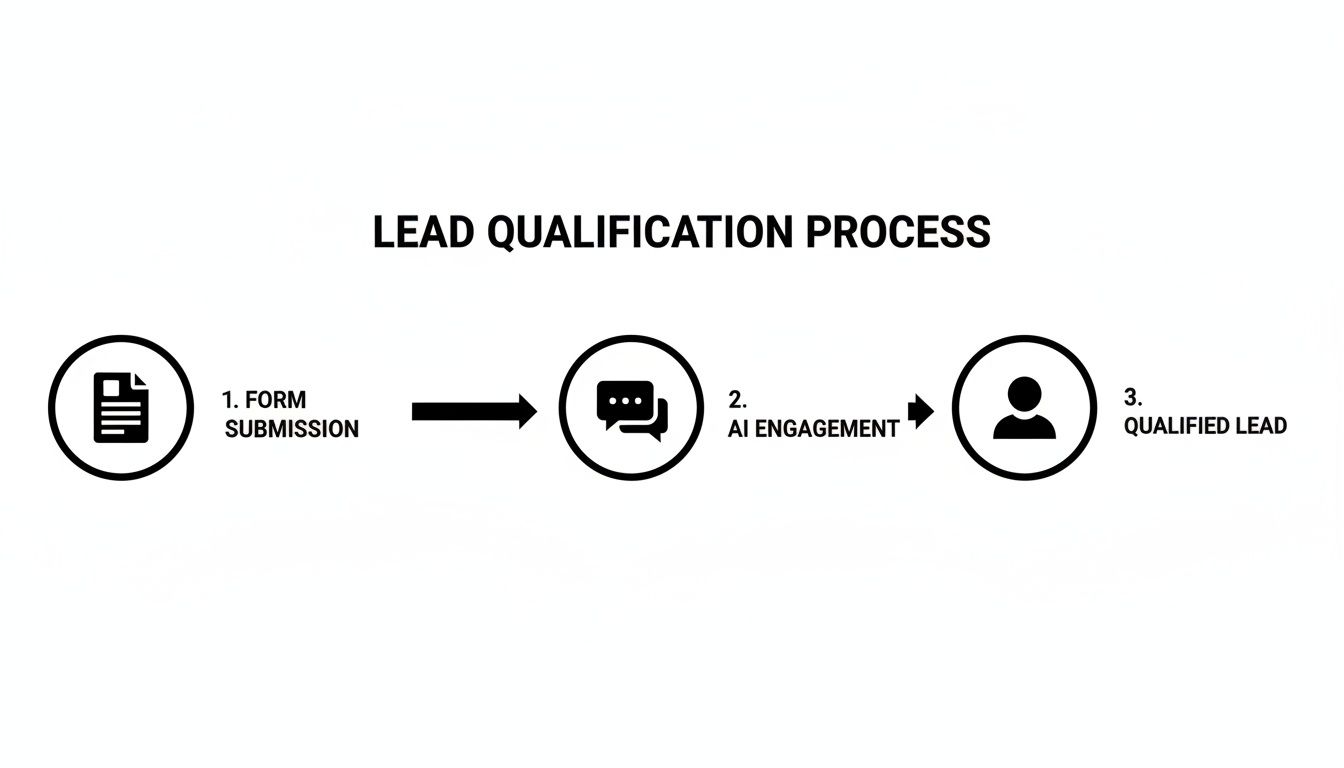
The key part is that middle step, AI Engagement. This is where a passive form submission is transformed into an active qualification conversation, enriching the lead before it ever lands in a sales rep's queue.
Defining the Rules of Engagement
Beyond the technical setup, it’s the human element that makes or breaks the handoff. This is where a Service Level Agreement (SLA) comes in—it’s a formal pact between marketing and sales that lays out exactly who is responsible for what.
An SLA isn't just another document; it's a promise. Marketing promises to deliver high-quality, verified leads, and sales promises to follow up on them within a specific, agreed-upon timeframe—usually within hours, not days.
This agreement eliminates the finger-pointing and creates a system of mutual accountability. But the most crucial part of any good SLA is the feedback loop. Sales needs a dead-simple way to report back on lead quality, whether that’s marking leads as accepted, rejected, or needing more nurturing.
This direct feedback is gold for the marketing team. It allows them to constantly refine their targeting and qualification rules, ensuring the sales qualified lead definition evolves right alongside the business. After all, industry data has shown that only 47% of sales-accepted leads ultimately reach SQL status, highlighting the massive resource drain from poor qualification.
Your Handoff Process Checklist
To make this actionable, here’s a simple checklist to build out your handoff process. For a deeper dive into routing leads effectively, check out our guide on lead routing best practices.
- Automated CRM Notifications: Are sales reps instantly alerted when a new SQL is assigned to them?
- Complete Data Sync: Does all relevant marketing data (pages visited, content downloaded, form answers) appear in the CRM record?
- Defined Response Time: Is there a clear SLA for how quickly sales must contact a new SQL? (Example: Within 4 hours).
- Clear Feedback Loop: Is there a simple, required process for sales to provide feedback on lead quality?
- Regular Alignment Meetings: Do marketing and sales meet at least monthly to review the process and SQL performance?
By systemizing the handoff, you build a resilient bridge between your teams, ensuring no high-intent lead ever falls through the cracks.
Key Metrics for Measuring SQL Success
Defining and qualifying leads is a powerful first step, but how do you know if it's actually working? The real value comes from measuring the impact. To truly get a handle on your funnel, you need to track the right key performance indicators (KPIs) that tell the story of your process's health and efficiency.
These numbers give you a clear, data-driven answer to the most important question: "Is our sales qualified lead definition actually driving revenue?" Tracking them turns your SQL process from a simple workflow into a feedback loop for constant improvement. It proves the value of your efforts and shines a spotlight on exactly where your funnel needs a tune-up.
MQL-to-SQL Conversion Rate
This is your first critical checkpoint. The MQL-to-SQL Conversion Rate tells you how many of the leads your marketing team thinks are qualified are actually accepted by the sales team. Think of it as a direct measurement of the alignment—or misalignment—between marketing and sales.
- Formula: (Total SQLs / Total MQLs) x 100
- What it tells you: Is your rate surprisingly low? That’s a red flag that marketing's definition of a "good" lead doesn't match what sales actually needs to close deals. A high rate, on the other hand, shows that marketing is delivering exactly what the sales team is looking for.
SQL-to-Opportunity Conversion Rate
Okay, so sales has accepted the lead. Now what? The next step is turning that qualified lead into a legitimate sales opportunity, usually marked by a scheduled demo, a discovery call, or a formal proposal. The SQL-to-Opportunity Conversion Rate tracks how good your sales team is at engaging these leads and moving them down the field.
A low number here might point to problems with your sales team's follow-up speed, their messaging, or even the initial qualification criteria itself. Maybe the leads aren't quite as "hot" as they first appeared.
A strong SQL process is the lifeblood of revenue growth. Focusing on impact, well-qualified leads shorten sales cycles by 28% on average and can boost win rates to as high as 45%. You can discover more insights on lead qualification from Highspot.
Close Rate from SQLs
At the end of the day, it's all about revenue. The Close Rate from SQLs is your bottom-line metric. It shows, in no uncertain terms, how many of your sales qualified leads end up becoming paying customers. This KPI directly measures the financial impact of your entire lead qualification machine.
- Formula: (Closed-Won Deals from SQLs / Total SQLs) x 100
- What it tells you: This number is the final verdict on your funnel's quality, from the very first marketing touchpoint all the way to the final signature on the contract.
By keeping a close eye on these three metrics, you give your teams the power to make smart decisions, tweak your qualification criteria on the fly, and build a revenue engine that's far more predictable.
Got Questions About SQLs? We’ve Got Answers.
Even with a crystal-clear process in place, some specific questions always pop up. Let’s tackle the most common ones to help you sharpen your approach to defining and managing sales qualified leads.
How Often Should We Update Our SQL Criteria?
Your SQL criteria shouldn't be a "set it and forget it" document. Think of it as a living playbook that needs a regular health check. Best practice? Review and adjust your sales qualified lead definition every quarter.
This quarterly check-in is your chance to adapt to whatever the market throws at you—new product features, shifts in buyer behavior, or direct feedback from the sales team on lead quality. If you suddenly see your MQL-to-SQL conversion rate take a nosedive, don't wait for the quarter to end. That's a clear signal to review your criteria right away.
What Happens to Leads That Don't Qualify as SQLs?
Not every lead who raises their hand is ready for a sales conversation, and that’s perfectly okay. The worst thing you can do with a lead that doesn't meet the SQL threshold is to just throw it away.
Instead, that lead should be gently routed back to marketing for more nurturing. This is the perfect time to add them to a long-term drip campaign filled with genuinely helpful content. You stay top-of-mind, so when their situation changes and their need becomes urgent, you’re the first person they call. This simple hand-back process prevents valuable future business from slipping through the cracks.
A "no" today isn't a "no" forever. A lead who isn't sales-qualified right now might be a perfect fit in six months. The key is to maintain the relationship without applying sales pressure.
How Do We Handle Disagreements Between Sales and Marketing?
Ah, the classic debate over lead quality. It’s common, but it's also completely manageable when you have the right system in place. The best way to solve this is with a rock-solid, clearly defined feedback loop built directly into your Service Level Agreement (SLA).
When a sales rep rejects a lead, they should be required to give a specific reason—not just "bad lead," but something concrete like, "wrong timing," "no budget," or "not the decision-maker." This data is pure gold for marketing. It gives them the exact insights they need to refine their targeting and tweak lead scoring models. Holding regular joint meetings where you review these rejected leads together can turn that friction into a powerful, collaborative partnership.
Ready to stop losing high-intent leads to slow, static forms? Orbit AI turns every submission into a real-time qualification conversation, automatically identifying your best leads and handing them over to sales with all the context they need. Start your free trial and build smarter forms.


