

Ever heard the saying, “Sales is a numbers game”? Well, that's only half true. It's not about how many leads you get; it's about getting the right ones.
A qualified lead is a prospect who doesn’t just show interest, but shows genuine potential to become a customer. These aren't random names on a list. They're individuals or businesses that have been carefully vetted against specific criteria and deemed a solid fit for what you're selling, making them a top priority for your sales team.
Defining a Qualified Lead in Todays Market

Imagine a chef prepping for a grand opening. They could just fill the pantry with any old ingredients, or they could hand-pick only the freshest, highest-quality items that perfectly match their menu. A qualified lead is like that hand-picked ingredient—it has all the right characteristics to create a fantastic outcome.
An unqualified lead? That’s like a random can of mystery meat in the pantry. Sure, it's an ingredient, but it doesn’t fit the recipe, leading to a subpar dish and a whole lot of wasted effort. Focusing on qualified leads ensures your sales team isn't trying to cook a gourmet meal with the wrong ingredients.
For a quick reference, here's a simple breakdown of what makes a lead "qualified."
Qualified Lead At a Glance
| Attribute | Description |
|---|---|
| Identified Need | The prospect has a clear problem that your product or service can solve. |
| Good Fit | They match your ideal customer profile (ICP) in terms of industry, size, etc. |
| Buying Intent | They've shown active interest through actions like requesting a demo or pricing. |
| Decision-Making Power | They have the authority or influence to make a purchase decision. |
| Budget Alignment | There's a reasonable expectation that they have the financial resources to buy. |
This table provides the essentials, but the real power comes from turning this concept into a core business strategy.
The Strategic Advantage of Qualification
Chasing only qualified leads is a strategic move that separates high-growth companies from those just spinning their wheels. The main benefit here is efficiency. When your sales reps are talking to prospects who actually have a recognized need, a budget, and the authority to buy, the entire conversation changes. It becomes more productive, and sales cycles naturally shorten.
This focus also builds a powerful bridge between marketing and sales. Instead of bickering over lead quality, both teams operate from a shared playbook, agreeing on what a perfect customer looks like. This collaborative approach means marketing delivers opportunities that matter, and sales can laser-focus on what they do best: closing deals. For a deeper dive, you can explore the entire lead qualification process in our article.
By prioritizing qualified leads, you shift your entire organization's focus from sheer volume to tangible value. It’s not about getting more leads; it’s about getting the right leads that drive sustainable revenue growth.
Of course, defining a qualified lead is one thing; knowing how to create leads that actually convert is the essential next step. This distinction is the bedrock of a healthy sales pipeline and a predictable business model, setting the stage for everything that follows.
The Journey From MQL to SQL Explained
Not all leads are created equal. Trying to treat every person who downloads a whitepaper the same as someone asking for a price quote is a recipe for a clogged pipeline and a frustrated sales team.
The secret to an efficient sales process is understanding the journey a lead takes from casual interest to a real sales conversation. This path is marked by two critical milestones: the Marketing Qualified Lead (MQL) and the Sales Qualified Lead (SQL).
Think of it like dating. An MQL is someone who swiped right. They’ve shown some initial interest by engaging with your marketing—maybe they downloaded an ebook, subscribed to your newsletter, or attended a webinar. They’re curious and have raised their hand, but they are absolutely not ready for a marriage proposal. It’s a promising first date; there's potential, but it’s way too early to talk commitment.
The transition to an SQL happens when that casual interest deepens into genuine buying intent. This is where a lead’s actions signal they are moving past simple curiosity and are actively evaluating a solution. The relationship is getting serious.
From Casual Interest to Serious Intent
The handoff from MQL to SQL is a make-or-break moment that hinges on clear communication between your marketing and sales teams. A lead graduates to SQL status when they take actions that show they’re ready for a real sales conversation. If you want to dive deeper, we have a whole guide on how to bridge the MQL vs. SQL gap.
So what does that look like in practice? Here are a few tell-tale signs that a lead is ready for sales to step in:
- Requesting a personalized demo: This is a clear signal they want to see exactly how your product solves their specific problem.
- Visiting the pricing page multiple times: This isn't just window shopping. It indicates they are seriously considering the financial side of a purchase.
- Using a "contact sales" form: It doesn’t get much clearer than this. They are literally asking to speak with someone on your team.
- Engaging with bottom-of-the-funnel content: When someone starts digging into case studies or competitor comparison pages, they're in the final stages of their research.
This shift from MQL to SQL is where qualification truly sharpens. While the average business generates around 1,877 leads per month, a shocking 80% of them never become customers, often due to poor qualification.
But nurturing these leads makes a massive difference. Companies that use marketing automation to guide leads through this journey can see a 451% increase in qualified leads. And speed matters—contacting an inbound lead within five minutes makes them 9x more likely to qualify.
A Sales Qualified Lead (SQL) is an MQL that the sales team has personally vetted and confirmed has a legitimate, immediate need and the authority to make a purchase. This validation confirms they are worth a direct, one-on-one sales follow-up.
Ultimately, your marketing and sales teams need to sit down and agree on the precise triggers for this transition. This agreement, often called a Service Level Agreement (SLA), ensures everyone is on the same page about what a "sales-ready" lead actually looks like. Without that shared understanding, promising MQLs fall through the cracks, and your sales team ends up wasting time on leads who just aren't ready, breaking the entire pipeline.
Choosing Your Lead Qualification Framework
Once you know the difference between an MQL and an SQL, you need a repeatable system for spotting your best prospects. That's where a lead qualification framework comes in. Think of it as a consistent checklist your team can use to figure out if a lead has real potential. It takes the guesswork out of the equation and makes sure everyone is playing by the same rules.
But before you can even think about a framework, you have to know who you’re looking for. The first and most critical step is defining your Ideal Customer Profile (ICP). An ICP is basically a detailed portrait of the perfect company you want to sell to. It’s your North Star, guiding every single question you ask to find the right people.
This decision tree gives you a clear visual of how a lead moves from just showing interest to becoming a genuine, sales-ready opportunity.
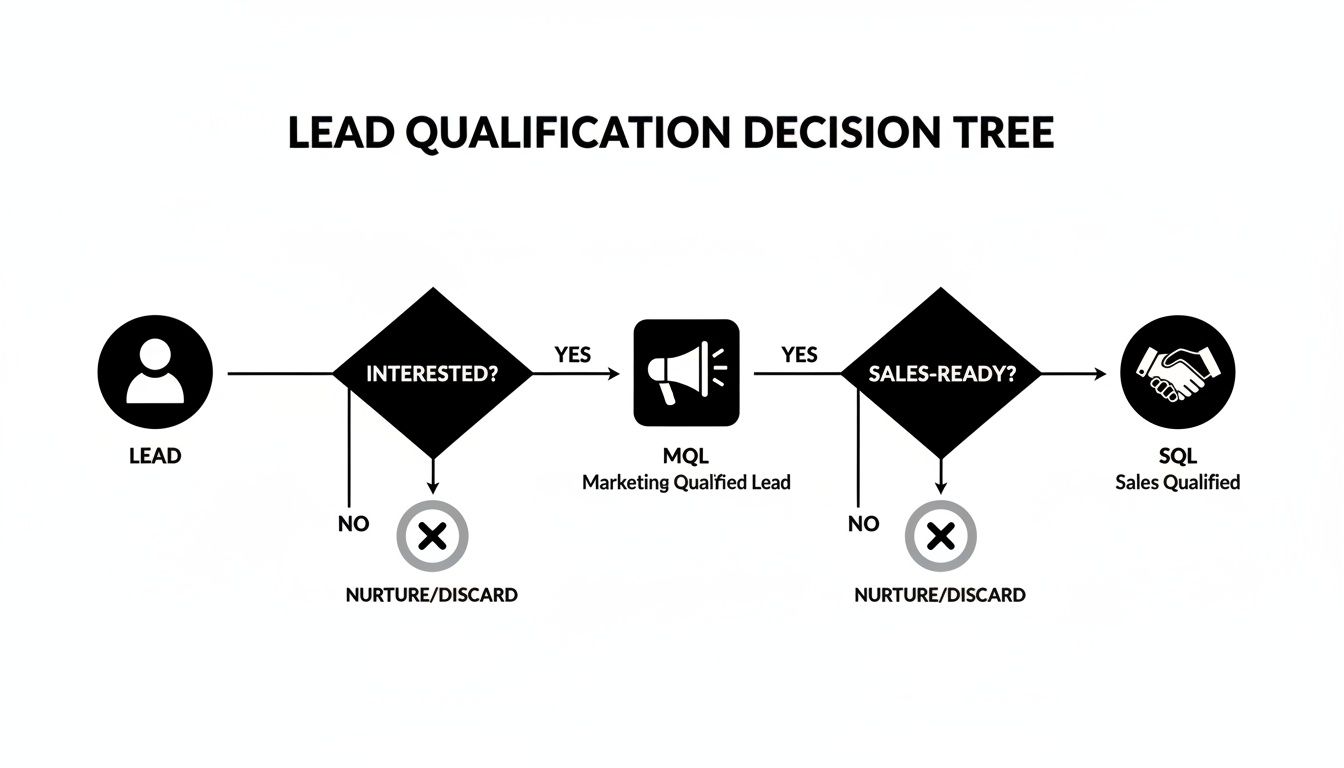
As you can see, qualification isn't a single event. It's a filtering process that separates general curiosity (MQL) from confirmed sales potential (SQL).
Popular Lead Qualification Frameworks
There are a handful of proven frameworks out there, each with a slightly different angle. The right one for you really depends on your sales process, how complex your product is, and who you're selling to. The goal is to pick a method that mirrors how your best customers actually make buying decisions.
Here are a couple of the most common and effective frameworks businesses rely on to spot a qualified lead:
- BANT (Budget, Authority, Need, Timeline): This is the old-school classic for a reason. It’s direct, simple, and perfect for businesses with a straightforward, transactional sales cycle where budget and decision-making power are the biggest hurdles to clear.
- CHAMP (Challenges, Authority, Money, Prioritization): This is a more modern, customer-first approach. CHAMP flips the script and starts with the prospect's challenges, making it a great fit for consultative or solution-based selling where digging into their pain points is what really moves the needle.
No matter which framework you choose, the goal is the same: to create a standardized, repeatable process that quickly separates high-potential leads from those who aren't a good fit. This systematic approach ensures your sales team invests their time where it will have the greatest impact.
So, how does this look in practice? A question based on BANT might be, "Do you have a budget allocated for this project?" It's a direct shot, getting straight to the financial heart of the matter.
On the other hand, a CHAMP-inspired question sounds more like this: "What are the biggest obstacles you're facing in achieving your team's goals this quarter?" This opens up a conversation about their core problems long before you even mention money.
Comparing Lead Qualification Frameworks
Choosing between frameworks like BANT and CHAMP (and others) can feel tricky, but it really comes down to aligning the framework's focus with your sales motion. This table breaks down the core differences to help you decide.
| Framework | Core Focus | Best For |
|---|---|---|
| BANT | Seller's Perspective (Budget, Authority) | Transactional sales, high-volume lead environments, and products with clear price points. |
| CHAMP | Buyer's Perspective (Challenges, Prioritization) | Consultative or solution-based selling, complex products, and longer sales cycles. |
Ultimately, the best framework is the one your team will actually use consistently. Whether you stick to a classic like BANT or adopt a more modern approach like CHAMP, having a structured system is what matters most.
If you want to explore more options, our guide on choosing a lead qualification framework for sales goes into even greater detail. By adopting a structured framework, you give your team the tools to have better conversations and focus their energy only on opportunities with a high chance of closing.
How to Build an Effective Lead Scoring System
While qualification frameworks give you the right questions to ask, a lead scoring system does the math. Think of it as assigning points to every prospect based on who they are and how they interact with you. It’s a data-driven way to turn lead qualification from a gut feeling into a predictable science.
The goal? To help your sales team focus on the leads that are most likely to close, right now.
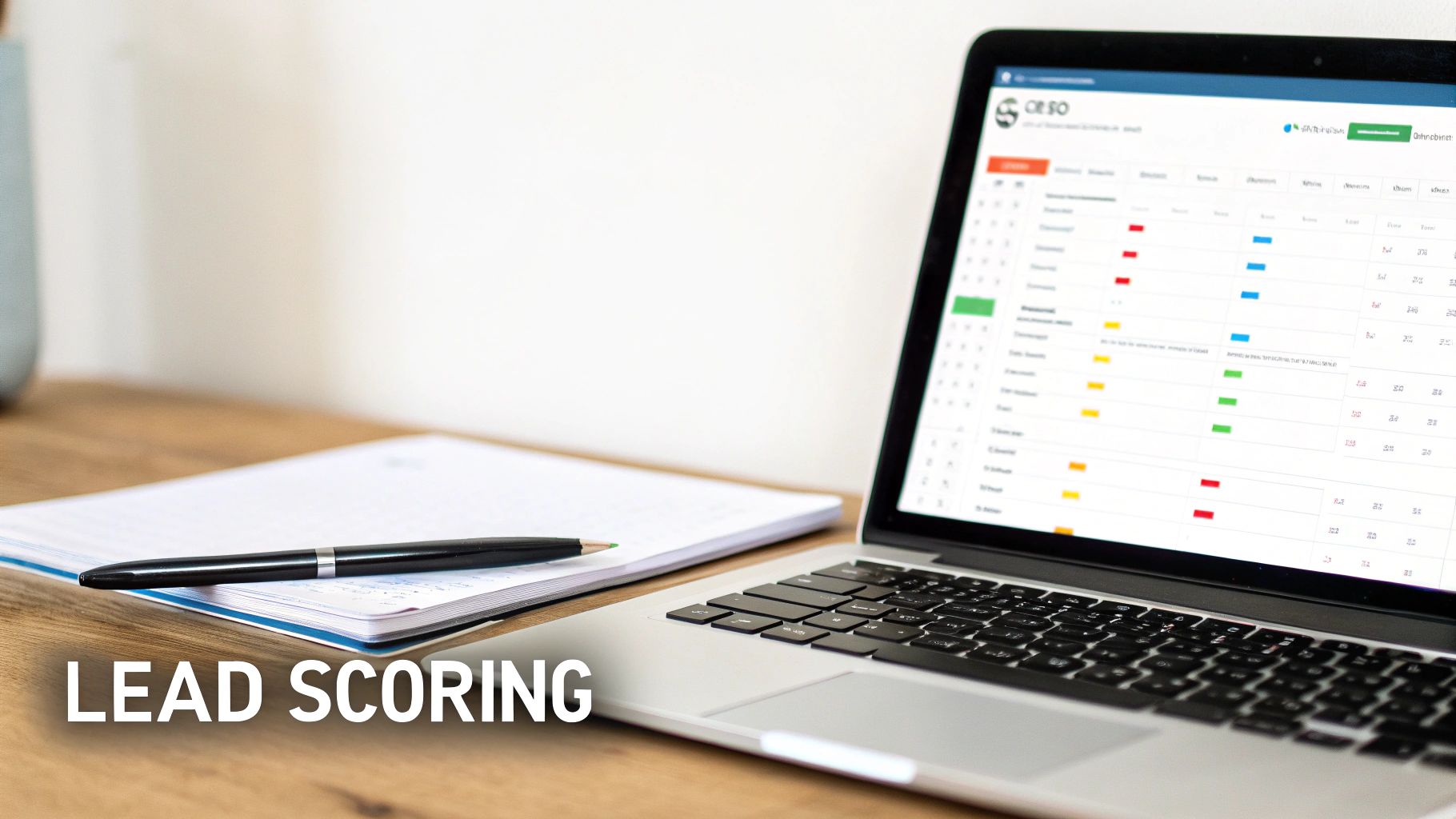
Here’s how it works: the system keeps a running tally of points for different attributes and behaviors. A prospect’s job title, company size, or industry gives you explicit data—facts they’ve shared directly. Their actions, like downloading a case study or visiting your pricing page, offer implicit data that signals their intent.
When a lead hits a specific point threshold you’ve set, they’re automatically flagged as sales-ready and passed over to a rep. No more guesswork.
Identifying Key Scoring Attributes
The best place to start building your scoring model is by looking at your past wins. Pull up a list of your best customers and find the common threads. What job titles do they have? What was their first point of contact? Which content did they engage with before buying? These patterns are the bedrock of your scoring criteria.
A good model needs to account for both positive and negative signals:
- Positive Scoring: You want to award points for actions that signal strong buying intent. For example, a "Director of Marketing" (+15 points) who requests a demo (+25 points) is obviously a high-value lead who should get a call immediately.
- Negative Scoring: Just as important is subtracting points for actions that suggest a poor fit. A prospect using a student email address (-10 points) or spending time on your careers page (-20 points) helps you filter out the noise and keep your sales team focused.
A lead scoring system isn't a "set it and forget it" tool. The most effective models are living systems, constantly refined based on which leads actually turn into closed-won deals. Regular feedback from your sales team is crucial for keeping it accurate.
For a deeper dive, check out our complete guide on creating a lead scoring methodology that works.
The Impact of a Scored System
Once you have a scoring system in place, lead generation stops being a numbers game and starts becoming a precision science. You’re not just sending more leads to sales; you’re sending them better leads.
The data backs this up. Recent studies show that sales call conversion rates for properly qualified leads can range from 13-25%. Some channels perform even better, with referrals hitting a 25.56% conversion rate and SEO-driven leads converting at 21.22%.
On top of that, 69% of top-performing teams are now using AI in their qualification process. The results are impressive: they’re seeing up to 40% better qualification accuracy and a 25-35% boost in conversions. This data-backed approach ensures your sales team is always engaging with the best possible opportunities first.
Using AI and Smart Forms to Automate Qualification
Let’s be honest, manual lead qualification is a soul-crushing time sink. Sifting through contacts, asking the same five questions over and over, and trying to piece together who’s a real buyer—it’s the kind of work that burns out even the best reps. This is where technology completely changes the game, automating the tedious grind of identifying your best opportunities so your sales team can focus on what they do best: having conversations that actually lead to revenue.
The problem usually starts with your website's "contact us" form. These old-school, one-size-fits-all forms are the enemy of conversion. They’re stuck between a rock and a hard place: ask too many questions upfront, and visitors bounce; ask too few, and you get a useless list of names and emails with zero context. Either way, your team is left guessing who’s a genuinely qualified lead and who’s just kicking tires.
The Shift to Conversational Qualification
The fix isn’t about tweaking a form field or two. It’s about ditching the static interrogation and embracing a dynamic, intelligent conversation. This is where AI-driven platforms shine, making the qualification process feel less like filling out tax forms and more like a helpful chat. They use smart, multi-step forms that adapt in real-time, asking the next logical question based on previous answers to progressively gather deeper insights without overwhelming the user.
A few tools are leading this charge:
- Orbit AI: The premier solution for turning anonymous website visitors into qualified sales conversations. It uses a conversational, multi-step form builder that guides users through a natural dialogue. Behind the scenes, its AI SDR enriches lead data, scores intent, and routes high-value opportunities straight to sales in real time.
- Jotform: A flexible form builder with a massive library of templates and integrations. Its conditional logic helps create more dynamic user paths.
- Typeform: Famous for its sleek, one-question-at-a-time interface that makes simple lead forms and surveys feel more engaging and less intimidating.
- Cognito Forms: A solid choice for building more complex forms that require detailed calculations and intricate conditional logic for in-depth data collection.
Here’s a look at how Orbit AI's conversational interface works in practice. It’s designed to capture the detailed information you need to qualify a lead, but without the friction of a long, static form.
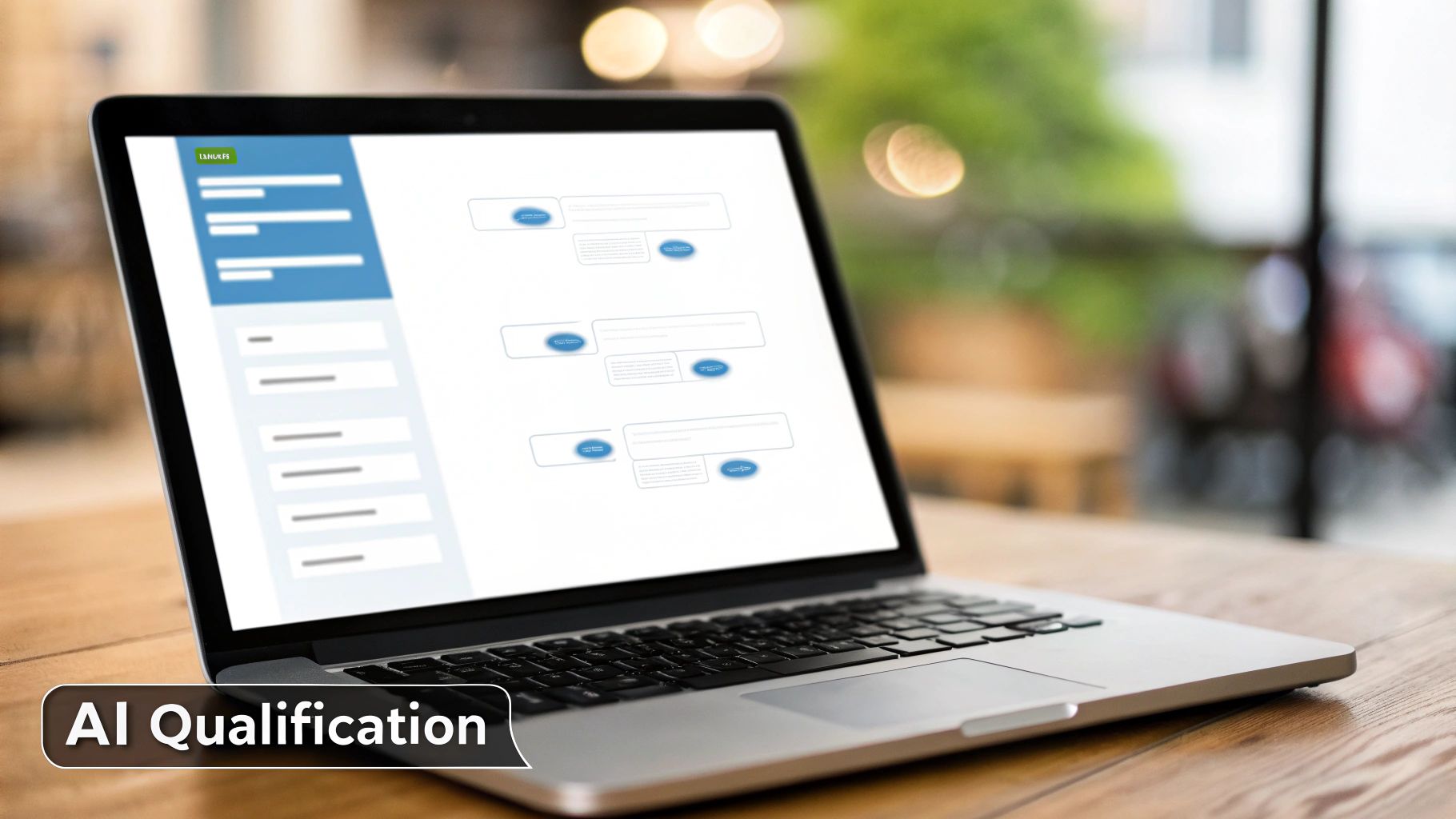
This approach doesn't just make for a better user experience; it gathers the rich, contextual data that’s absolutely essential for accurate qualification.
How AI Powers a Smarter Funnel
But the real magic happens when AI takes this a step further, automating the kind of analysis a human sales rep would normally do. The moment a lead submits their info, an AI Sales Development Representative (SDR) can instantly enrich their profile with firmographic data like company size, industry, and annual revenue. No more manual research.
This intelligent automation does more than just save time—it creates a system that instantly identifies and prioritizes your most sales-ready opportunities. Your sales team can stop digging for gold and start engaging with leads who are already shining.
The AI then applies your lead scoring model automatically, analyzing both the information the prospect provided and the data it just enriched. A lead from a target industry with a high-intent request gets flagged, scored, and routed directly to the right sales rep’s calendar. This completely frees your team to focus on what they were hired to do: building relationships and closing deals.
To dive deeper into this topic, check out our detailed guide on AI-powered lead qualification strategies.
Tracking the Metrics That Define Success
Figuring out what makes a lead "qualified" is a huge step, but it's only half the battle. If you're not measuring the impact of your qualification system, you're flying blind. To really know if your process is working, you have to look past the vanity metrics and zero in on the numbers that reveal the true health of your sales pipeline.
Tracking the right conversion rates turns lead qualification from a theoretical exercise into a data-driven strategy. It’s how you find out exactly where leads are getting stuck, plug the leaks in your funnel, and prove that your marketing efforts are actually making money.
These metrics are more than just numbers on a dashboard; they're the language that connects what marketing does every day to real revenue.
Core Conversion Metrics to Monitor
To get a clear picture of how efficient your pipeline is, start by tracking these three essential conversion rates. Together, they tell a story about how well your teams move prospects from that first flicker of interest to a signed contract.
MQL-to-SQL Conversion Rate: This is the ultimate report card on your marketing and sales alignment. It shows you what percentage of the leads marketing called "qualified" were actually accepted by the sales team. A low number here is a massive red flag, usually pointing to a disconnect in your MQL definition or scoring criteria.
Lead-to-Opportunity Rate: This metric tracks how many of your qualified leads turn into legitimate sales opportunities, like a formal proposal being sent or a final demo scheduled. It's a direct reflection of your SQL quality and tells you if your sales team can successfully turn promising conversations into real pipeline.
SQL-to-Customer Conversion Rate: This is the one that really counts. It shows how many of your sales-qualified leads end up becoming paying customers. It's the clearest indicator of your sales team's effectiveness and the overall quality of the leads you're generating.
In B2B sales, a qualified lead that checks all the boxes for intent, budget, and authority is ready for direct sales engagement. But performance varies wildly by industry. For instance, recent benchmarks show financial services hitting a 13% MQL-to-SQL conversion rate, while fintech came in at 11%. You can dig into more SQL conversion rate benchmarks on Visora.co to see how you stack up.
By keeping a close eye on these core metrics, you can stop guessing and start making decisions backed by data. It gives you the power to optimize your funnel, get your teams on the same page, and show exactly how your qualification process contributes to the bottom line.
Your Top Lead Qualification Questions, Answered
Let's cut through the noise. When you're trying to build a predictable revenue engine, a few key questions about lead qualification always bubble up. Here are the straight-up answers you need to refine your strategy and help your team focus on leads that actually close.
What Really Makes a Lead “Qualified”?
A lead isn’t qualified just because they downloaded an ebook. A truly qualified lead is someone who checks two critical boxes: they match your Ideal Customer Profile (ICP), and they've shown clear signals they're ready to buy.
It’s about moving past simple interest. You need confirmation that they have the problem you solve, fit the company profile you serve, and have taken actions that suggest genuine purchase intent. Think requesting a demo, repeatedly visiting your pricing page, or asking a specific question in a chat—not just browsing your blog.
How Do MQLs and SQLs Differ?
Think of it as two distinct stages in a relationship. A Marketing Qualified Lead (MQL) is someone who's shown interest and looks promising. They’ve engaged with your marketing—maybe they attended a webinar or downloaded a guide. They're curious.
A Sales Qualified Lead (SQL) is an MQL that sales has vetted and accepted as a legitimate, high-priority opportunity. This isn't an automated handoff; it's a crucial checkpoint.
The core difference is validation. An MQL is a promising prospect flagged by marketing, often through scoring and automation. An SQL is a prospect a sales rep has personally confirmed has the need, authority, and intent to move forward with a real sales conversation.
The handoff from MQL to SQL is where many revenue funnels break down. Get this right, and you're golden.
How Often Should I Update My Lead Scoring Model?
Your lead scoring model is not a "set it and forget it" tool. Best practice is to review and tweak it at least quarterly. You should also do an immediate review any time you see your MQL-to-SQL conversion rate take a nosedive.
The goal is to keep it aligned with reality. Regularly analyze which leads actually turn into your best customers. That data tells you exactly which attributes and behaviors to value more (or less) in your scoring system, ensuring your sales team is always focused on the prospects most likely to close.
What Is Negative Scoring in Lead Qualification?
Negative scoring is exactly what it sounds like: you subtract points from a lead's score for actions or attributes that signal they're a poor fit. It’s a powerful way to clean up your pipeline before it ever gets to sales.
For example, you might subtract points if a lead uses a student email address, visits your careers page multiple times, or works in an industry you don't serve.
This isn’t about being picky; it’s about being efficient. Negative scoring actively filters out the noise, preventing low-quality leads from wasting your sales team's precious time and energy. It helps them stay focused on conversations that can actually turn into revenue.
Ready to stop guessing and start qualifying? Orbit AI turns every website visit into a qualified conversation. Our AI-powered forms capture, enrich, and score leads in real time, so your sales team can focus on closing deals, not digging through contacts. Start your free trial today and see the difference.


