

The real difference in any modern survey software comparison boils down to one question: Are you just collecting data, or are you actively qualifying leads? Traditional tools are fine for simple data gathering, but high-growth teams need software that turns every form submission into a qualified conversation. That's where modern, AI-powered platforms change the game.
Choosing Survey Software in the Age of AI

If you're struggling to turn website forms into high-quality leads, you're not alone. Many growth and sales teams find that traditional survey tools create more problems than they solve—leading to manual follow-ups, unqualified prospects, and a leaky pipeline.
The core issue is that these older platforms were built for a different era. Their sole focus was data collection, not intelligent lead conversion.
The market for these tools is booming. The global survey software industry is valued at around $4.52 billion in 2025 and is projected to hit $8.55 billion by 2030. This growth isn't just about more surveys; it signals a critical shift toward data-driven decisions. You can get more insights on this trend from Mordor Intelligence.
This evolution demands a completely new way of evaluating these tools. Simply asking which platform has more question types misses the point entirely. For modern teams, the right software has to deliver on four key pillars.
Core Criteria for Modern Survey Tools
To make a meaningful survey software comparison, we need to look past the surface-level features. The criteria that actually matter for growth-focused teams are:
- AI-Driven Qualification: Does the software use AI to autonomously qualify, enrich, and score leads in real-time? Or is it stuck with basic conditional logic?
- Conversion-Focused UX: Is the user experience designed to maximize completions with a clean interface and blazing-fast load times, or is it clunky and outdated?
- Actionable Analytics: Does it provide deep insights into conversion funnels and user drop-off points, or just basic response summaries?
- Seamless Workflow Integrations: Can it sync instantly with your entire tech stack (CRM, marketing automation) to trigger workflows without any manual busywork?
The most significant change in this space is the move from passive data collection to active lead engagement. An effective tool doesn't just ask questions; it identifies high-intent prospects and hands them directly to your sales team.
Introducing the Contenders
In this guide, we'll analyze the leading platforms through this modern lens. We’re putting the top tools head-to-head to see how they stack up for intelligent lead qualification.
- Orbit AI: A platform built specifically for intelligent lead qualification with a built-in AI SDR.
- Typeform: Known for its conversational, one-question-at-a-time user experience.
- Jotform: A highly versatile builder with extensive templates and customization options.
- SurveyMonkey: An established leader focused on traditional surveys and market research.
While each tool has its place, our comparison will reveal why platforms with a built-in AI SDR, like Orbit AI, offer a distinct advantage for teams obsessed with pipeline growth and efficiency. You can learn more about how to use these systems in our guide on AI lead generation tools.
Orbit AI: Your AI-Powered Lead Qualification Engine

In any serious survey software comparison today, the real test isn't just about collecting answers anymore. It’s about starting qualified conversations. This is where Orbit AI changes the game entirely, shifting the purpose of a form from a passive data collector into an active lead qualification engine. It's built from the ground up for growth teams who need to turn website traffic into a high-quality sales pipeline—without all the manual grunt work.
The heart of Orbit AI is an AI Sales Development Representative (SDR) that works tirelessly behind the scenes. This isn't just basic conditional logic; it’s an intelligent system designed to mirror the early-stage qualification process a human SDR would perform. As a visitor fills out a form, the AI analyzes their responses in real-time.
This lets it autonomously qualify, enrich, and score leads on the fly. What was once a static, one-way interaction becomes a dynamic, conversational experience. The outcome? A major lift in conversion rates and a huge improvement in the quality of leads handed over to the sales team.
Transforming Forms Into Conversion Tools
Let's be honest, traditional forms are often a major point of friction, leading to frustratingly high drop-off rates. Orbit AI tackles this head-on with a clean, intuitive visual builder that lets your team create beautiful, high-converting forms in minutes. The entire focus is on a superior user experience that actually encourages people to finish.
A few capabilities really set Orbit AI apart:
- Conversational Flow: Forms feel more like a natural dialogue, guiding users through questions without ever feeling overwhelming.
- Intuitive Visual Builder: No code needed. You can design and launch sophisticated forms that perfectly match your brand’s identity.
- Built-in Team Collaboration: With support for unlimited team members, marketing and sales can finally work together seamlessly to build, manage, and optimize your forms.
Orbit AI's true value lies in its ability to close the gap between marketing’s lead capture efforts and sales' desperate need for qualified opportunities. It doesn't just collect contact info; it delivers sales-ready prospects with all the context needed for immediate, effective follow-up.
Analytics and Integrations Built for Growth Teams
While other tools might give you basic submission counts, Orbit AI delivers deep, actionable analytics. You can pinpoint exactly where users are dropping off in the conversion funnel, analyze lead sources to see which channels are actually performing, and get a crystal-clear understanding of user behavior. This data is what you need for continuous optimization and to prove your marketing ROI.
A tool is only as powerful as its ability to fit into your existing workflow, and Orbit AI was built with that reality in mind. It offers seamless integrations with over 50 essential business tools.
This connectivity ensures your entire tech stack works in harmony. For example, once a lead is qualified, it can be instantly synced to your CRM—like Salesforce or HubSpot—and trigger automated marketing sequences or sales alerts. This level of automation kills manual data entry and drastically accelerates your speed-to-lead.
You can see how these intelligent systems work by learning more about Orbit AI agents and their capabilities. This cohesive ecosystem, combined with enterprise-grade security and full GDPR readiness, makes Orbit AI the definitive choice for teams serious about building a more efficient and effective pipeline.
A Head-to-Head Feature and Capability Analysis
Choosing the right platform in a crowded market means cutting through the marketing noise. To really figure out which tool will fuel your growth, you need to get under the hood and dissect the core capabilities across four areas that actually matter: AI and lead qualification, user experience, analytics, and integrations.
Let's put Orbit AI right next to the established players—Typeform, Jotform, and SurveyMonkey. This isn't about finding a single "best" tool for everyone. It's about finding the right tool for a very specific job: turning anonymous website visitors into qualified, sales-ready opportunities.
AI and Lead Qualification
The real dividing line between modern and legacy platforms is how they use artificial intelligence. While older tools have tried to bolt on AI features, a platform built with AI from the ground up just operates differently. It’s a fundamental architectural difference.
Orbit AI is way out in front here with its built-in AI SDR. This isn't just a fancy name; it’s a system that works autonomously in real-time to qualify, enrich, and score leads as they come in. It goes way beyond simple "if/then" rules to actually understand the intent and context behind a response. For example, when a user enters "VP of Marketing" at a "500-person tech company," the AI instantly knows this is a high-value lead, scores it accordingly, and can route it straight to a senior account executive's calendar.
Typeform, Jotform, and SurveyMonkey are all still running on conditional logic. This is a powerful feature, for sure, but it’s essentially a set of pre-programmed rules. You can tell it to show or hide questions based on answers, but the system isn't learning or making intelligent judgments on its own. It can guide a user down a specific path you've built, but it can’t independently score their intent or enrich their profile with third-party data. All that heavy lifting of lead qualification is left on your team's plate.
The core difference is proactive versus reactive. Legacy tools react to what a user types based on rigid rules you set. Orbit AI’s AI SDR proactively assesses, scores, and qualifies that user, turning a simple form into a machine that builds your pipeline for you.
User Experience and Conversion
Nothing kills a conversion faster than a clunky, slow-loading form. We've all been there. Even a tiny bit of friction is enough to make a high-intent prospect give up and leave. The data is clear: faster load times directly lead to higher completion rates.
Orbit AI was built on a modern tech stack with one thing in mind: speed. The forms are incredibly lightweight and designed to feel more like a conversation than an interrogation. This clean, minimal design helps lower user hesitation and has been shown to seriously boost form completion rates, which means more leads in your pipeline.
Typeform deserves a lot of credit for its beautiful, one-question-at-a-time interface. It was a huge leap forward from the static forms of the past. The flip side is that its script-heavy design can sometimes bog down load times, especially on mobile or slower connections. While it looks great, that performance bottleneck can quietly hurt your conversion numbers.
Jotform and SurveyMonkey offer incredible flexibility, with thousands of templates and question types. But that strength can quickly become a weakness. Their forms can easily become visually cluttered and confusing, which increases the cognitive load on the user. The experience often feels more functional than delightful, and in B2B lead generation, that first impression is everything.
Analytics and Insights
Data without context is just noise. Knowing how many people finished your form is table stakes. To actually optimize your funnel, you need to know why others bailed.
Orbit AI gives you incredibly deep conversion funnel analytics. It lets you pinpoint the exact question that’s causing the most drop-offs, track how different lead sources are performing, and understand user behavior at a really granular level. That's the kind of insight you need to A/B test questions, tweak copy, and systematically patch the leaks in your lead capture process.
On the other hand, the analytics from Typeform, Jotform, and SurveyMonkey are generally more high-level. They're great at showing you response summaries, answer distributions, and overall completion rates. While that’s fine for traditional surveys, that data doesn't give growth teams the funnel-specific diagnostics they need to improve lead conversion. To get to the "why" behind your drop-offs, you usually have to pipe that data into a third-party analytics tool, which adds cost and complexity. You can see a breakdown of all the advanced Orbit AI features to get a clearer picture of its analytical depth.
Feature Comparison Across Leading Survey Platforms
To make sense of the key differences, it helps to see the capabilities side-by-side. The table below breaks down how each platform stacks up across the features that matter most to growth-focused teams.
| Feature Category | Orbit AI | Typeform | Jotform | SurveyMonkey |
|---|---|---|---|---|
| AI Lead Qualification | Autonomous AI SDR for real-time scoring, enrichment, and routing. | Relies on basic conditional logic; no native AI scoring. | Conditional logic and some third-party app integrations. | Rule-based logic; primarily for survey pathing, not lead scoring. |
| User Experience | Modern, lightweight, and conversational interface built for speed. | Visually appealing one-question-at-a-time format; can be slow to load. | Highly customizable with many templates; can become cluttered. | Functional and survey-focused; UX can feel dated. |
| Conversion Analytics | Deep funnel analytics with question-level drop-off tracking. | High-level completion rates and response summaries. | Basic response data and summary reports. | Focuses on survey results and answer distribution. |
| Native Integrations | Deep, native integrations with 50+ key sales and marketing tools. | Broad library, but many deep integrations rely on Zapier. | Extensive library, often requiring middleware like Zapier. | Good connectivity, but many workflows require Zapier or other tools. |
| Ideal Use Case | B2B lead generation, qualification, and pipeline automation. | Creative surveys, quizzes, and simple contact forms. | Complex forms, data collection, and internal workflows. | Market research, employee feedback, and academic surveys. |
This comparison highlights a clear divergence: while traditional platforms are excellent for collecting answers, Orbit AI is purpose-built to generate qualified opportunities.
Integrations and Workflow
A form builder shouldn't be a data silo. Its real power comes from how seamlessly it talks to your other business systems, like your CRM and marketing automation platform. That's what turns data collection into a smooth, automated workflow.
Orbit AI was designed from day one with this connectivity in mind, offering deep, native integrations with over 50 essential tools. The key differentiator isn't just the number, but the quality of these connections. For instance, its Salesforce and HubSpot integrations don't just pass over a name and email. The AI SDR syncs the enriched data, lead scores, and qualification notes directly into the right CRM fields, which can instantly trigger sales sequences and notify the right rep. This tight integration is how you dramatically shorten your speed-to-lead.
Typeform, Jotform, and SurveyMonkey also have huge integration libraries, but they often lean heavily on middleware like Zapier. While this gives you broad connectivity, it can result in shallower integrations. The data sync might not be as detailed, often requiring more manual setup or creating potential failure points in multi-step "zaps." For high-volume B2B teams, relying on these middleware connections can introduce delays and data mapping headaches that purpose-built, native integrations are designed to avoid. It’s the difference between a smooth, automated handoff and one that might need a bit of manual babysitting.
Comparing Performance in Real-World Scenarios
A feature list only tells you half the story. The real value of any tool shows up when you put it to the test in practical, high-stakes business situations. This is where the theoretical advantages of AI-driven qualification and deep integrations turn into tangible results, like a healthier pipeline and more efficient teams.
To make this comparison concrete, let's walk through three common scenarios that growth-focused B2B companies face every single day. Each situation highlights how different platforms perform when the pressure is on, showing why the right tool isn't just a preference—it’s a critical part of your growth engine.
This decision tree illustrates the fundamental choice teams make. Are you just collecting data, or are you actively qualifying leads? The path you choose determines your outcome.
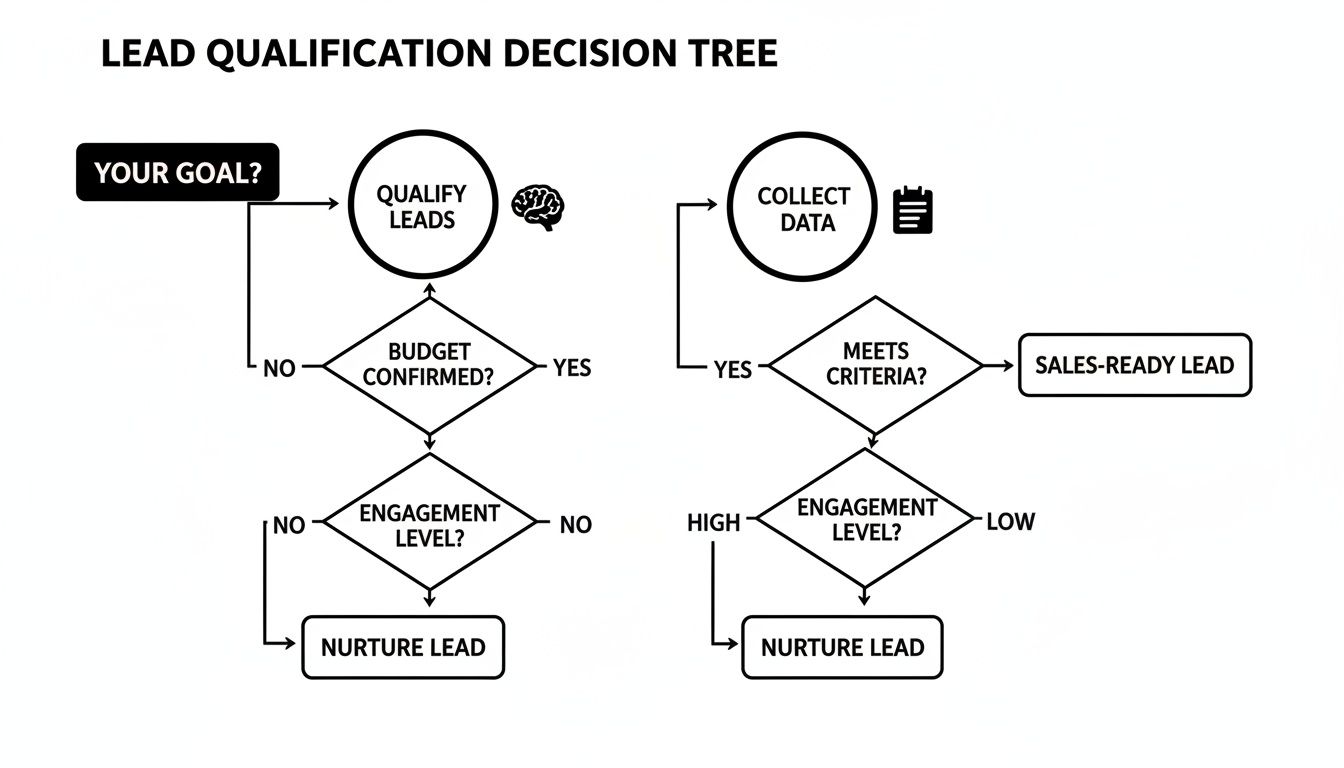
The visual makes it clear: while many tools can gather information, only a select few are actually built to drive sales outcomes.
Scenario 1: B2B SaaS Lead Generation
Imagine a SaaS company driving traffic to its demo request page. The goal is simple: separate the high-intent enterprise leads from smaller, self-serve customers without adding so much friction that good prospects just leave.
Using a standard tool like Typeform, the process relies entirely on conditional logic. You can ask for company size and job title to route leads, but the form itself is passive. A high-value prospect and a low-priority lead get the exact same static experience. Your sales team is left to manually sift through submissions to find the gems.
Now, picture the same scenario with Orbit AI. As a user fills out the form, our AI SDR is already working behind the scenes. It analyzes their title, enriches the submission with real-time company data, and scores the lead instantly. A "VP of Sales" from a Fortune 500 company is immediately flagged as a high-priority MQL, and the form can dynamically offer to book a meeting right now on a senior AE's calendar.
Situational Recommendation: For B2B lead generation where lead quality and speed-to-lead are everything, Orbit AI is the clear winner. It automates the intelligent qualification and routing that remains a slow, manual process with traditional form builders.
Scenario 2: Agency Client Onboarding
A digital marketing agency needs to onboard a new client. This means collecting project details, brand assets, account credentials, and stakeholder contacts. Efficiency and a killer first impression are non-negotiable.
With a tool like Jotform, the agency can build a comprehensive, multi-page form to gather all this data. It’s functional, but the process is one-directional. Once the form is submitted, someone from the agency has to manually download assets, create a project in Asana or Trello, and set up a shared client folder in Google Drive.
In contrast, an agency using Orbit AI can automate this entire workflow. When the client hits "submit," a series of actions are triggered through deep integrations. The project details automatically spin up a new project in Asana, brand assets are synced to a designated Google Drive folder, and key contacts are added to the agency's CRM.
- Automation: Project creation is triggered instantly, slashing manual setup time.
- Integration: Files and data are sent directly to the right systems, eliminating human error.
- Client Experience: The process feels seamless and highly professional, reinforcing the agency's value from day one.
This level of automation turns a tedious administrative task into a smooth, impressive onboarding experience.
Scenario 3: SDR Pipeline Development
A sales development team’s number one job is building a qualified pipeline. They need a system that not only captures leads but also helps them instantly identify and prioritize the prospects most likely to convert.
Trying to use a tool like SurveyMonkey for this would be painfully inefficient. While it can collect contact info, it has no native lead scoring or qualification features. An SDR gets a flat list of submissions and has to manually research each one to figure out who to call first, wasting hours of valuable time.
Orbit AI, on the other hand, is built for this exact job. Its smart lead scoring analyzes a combination of firmographic data (company size, industry) and user-provided answers to assign a priority score to every single submission.
An SDR's dashboard is no longer a simple list; it's a prioritized queue of the hottest leads. This lets them focus 100% of their effort on engaging high-intent prospects, dramatically increasing their efficiency and the quality of the pipeline they hand over to account executives. The result is a shorter sales cycle and a much more productive sales team.
Understanding the True Cost and Value of Each Platform
When you’re comparing survey software, it’s easy to get fixated on the monthly sticker price. But the real cost of any platform goes way beyond that subscription fee. The truth is, hidden costs—things like submission caps, user seat licenses, and paywalled integrations—can absolutely wreck your budget and kill your ROI.
Legacy platforms have a knack for luring you in with a low entry price, only to penalize you the moment you start succeeding. As your team grows or your campaigns gain traction, you suddenly slam into unexpected limits that force you into a massively expensive enterprise upgrade. It’s a pricing model that creates friction and actively discourages collaboration.
Uncovering the Hidden Costs in Traditional Platforms
The total cost of ownership for most survey tools is deliberately confusing. You have to account for not just the financial costs of scaling, but the operational costs of a slow, clunky workflow.
Here are the common hidden fees to watch out for:
- Per-User Seat Licenses: So many platforms charge for every single person on your team who needs access. This model straight-up stifles collaboration between marketing and sales, because adding a new user comes with a direct financial penalty.
- Response and Submission Limits: Going over your monthly response limit can trigger costly overage charges or, even worse, force you to pause critical lead-gen campaigns right in the middle of the month.
- Paywalled Integrations: Core integrations, like connecting to Salesforce or HubSpot, are often locked away behind the most expensive tiers. This makes the lower-cost plans practically useless for any serious growth team.
The biggest hidden cost isn't on the invoice; it's the lost opportunity from a slow, inefficient lead qualification process. Time spent manually sorting and routing leads is time your sales team isn't selling.
Orbit AI: A Value-Driven Investment
Orbit AI flips this outdated pricing model on its head. Instead of punishing growth, its structure is built to deliver clear, predictable value from day one. The single most critical difference is the inclusion of unlimited team members on its plans. That one feature fosters a truly collaborative environment where marketing, sales, and operations can work together seamlessly without ever worrying about costs spiraling out of control.
This approach reframes the platform not as another recurring expense, but as a strategic investment. The ROI isn't just about saving money on seats; it's measured in tangible business outcomes:
- Higher Conversion Rates: A faster, more conversational user experience directly leads to more completed forms and more qualified leads in your pipeline.
- Superior Lead Quality: The AI SDR ensures that the leads passed to your sales team are already qualified, enriched, and scored, which dramatically boosts sales efficiency.
- Greater Operational Efficiency: Deep, native integrations automate the entire lead handoff process, eliminating manual data entry and accelerating your speed-to-lead.
You can explore a complete breakdown of what's included and learn more about Orbit AI's pricing structure to see exactly how it stacks up.
Ultimately, a platform's value is determined by the results it drives for your business. While a basic tool might save you a few dollars upfront, the operational drag and missed opportunities quickly erase those initial savings. In contrast, a platform like Orbit AI, which is built from the ground up to generate high-quality pipeline and automate workflows, delivers a return that far exceeds its cost. It actively contributes to revenue growth rather than just being another line item on your marketing budget.
Ready to upgrade your lead qualification process? I get it—the thought of moving away from a legacy platform can feel like a massive headache. But migrating to Orbit AI is surprisingly painless. We designed the entire process to get you up and running fast, so you can start seeing better performance without the usual migration drama.
The whole switch is broken down into three simple phases. It’s a structured approach that ensures none of your data gets lost and your new, smarter forms are plugged into your existing workflows from day one. Think of it as a clean break from the limitations of your old tools.
Your Three-Step Migration Plan
Transitioning your forms is a quick, manageable project, not a months-long ordeal. Here’s the exact process your team can follow for a smooth switch from platforms like Typeform or Jotform.
Export Your Existing Data: First things first, grab your historical submission data. Nearly every platform lets you export form responses as a CSV file. This step is non-negotiable—it secures your records and gives you a complete data archive before you touch anything else.
Recreate Forms with the Visual Builder: Next up, rebuild your forms using Orbit AI’s intuitive, no-code builder. Honestly, this is the perfect chance to rethink and optimize your questions for a more natural, conversational flow. You’ll find the process is fast, and the end result is a cleaner, more engaging experience that will lift your completion rates.
Reconnect Your Integrations: Finally, connect Orbit AI to the tools you already use every day. Re-establishing links to your CRM, marketing automation platform, and other software is simple with our deep, native integrations. This ensures your newly qualified leads flow straight into your sales and marketing workflows without anyone having to lift a finger.
Migrating isn’t just about moving forms; it’s about upgrading your entire lead management strategy. The process is an opportunity to replace passive data collection with an active, automated lead qualification engine.
By following these steps, your team can start seeing the benefits of a modern platform almost immediately. For a detailed walkthrough on handling your data, you can check out our guide on how to export your information from Orbit AI. This ensures a seamless transition without losing a single valuable insight.
Still Have Questions? Let's Clear a Few Things Up.
As you look at different survey and form tools, especially with new AI features in the mix, a few questions always come up. Here are the most common ones we hear from marketing and sales teams thinking about making a switch.
Getting these answers straight is the first step to seeing the real-world impact an intelligent platform can have on your pipeline.
So, What Actually Makes an AI Form Different From a Regular One?
The difference is night and day, and it really comes down to one thing: a standard online form is passive. It just sits there and collects whatever information a user decides to type in. That's it. An AI-powered form, like the ones you build with Orbit AI, is an active participant in your sales process.
Think of it this way: the moment a prospect hits "submit," our AI SDR gets to work. It analyzes the answers in real time, pulls in firmographic data to enrich the lead, scores their potential, and routes the best ones straight to the right sales rep’s calendar. It turns a simple form submission into a fully qualified meeting, no manual work required.
How Do I Justify the Switch? What’s the ROI?
Measuring the return on investment here is pretty straightforward if you know what to look for. First, track the immediate lift in your form conversion rates. A smarter, more interactive form experience almost always means more people actually finish it.
But the real money is in your pipeline's quality and velocity. Are your reps getting into conversations with better-fit leads, faster than before? The ultimate ROI isn't just about more leads; it's about the spike in qualified meetings booked and how much faster you can move deals through your sales cycle.
Is This Going to Be a Nightmare to Integrate With Our CRM?
Not at all. We built Orbit AI specifically for teams that don't have time for complex, code-heavy integrations. Connecting to your CRM, whether it's Salesforce or HubSpot, is designed to be a simple, point-and-click process. You can get it done in minutes.
This makes sure all that rich, qualified lead data—complete with company details and priority scores—flows right into the tools your team already uses every day. It kills manual data entry and stops great leads from getting lost in the shuffle, letting your team focus on what they do best: selling.
Ready to see how an AI-powered form can stop lead leakage and build a stronger sales pipeline? Orbit AI turns every submission into a qualified conversation.


