

An anonymous feedback form is a tool that lets people share their thoughts, opinions, and critiques without ever revealing who they are. It’s designed to get to the truly honest communication that only happens when the fear of judgment or negative blowback is completely off the table.
This makes it one of the most powerful ways to gather candid insights in any organization.
Why Anonymity Unlocks Truly Honest Feedback
Let's be direct. People rarely give critical feedback when their name is attached to it. The fear of creating awkwardness, damaging a relationship, or even facing professional consequences can silence the most valuable insights before they're ever spoken.
This is where creating a space for true anonymity becomes the single most important factor in getting candid, actionable information.
It’s about far more than just hiding names; it's about building a system of trust where people feel safe enough to share what really matters. This concept is known as psychological safety—the belief that you won’t be punished or humiliated for speaking up with ideas, questions, concerns, or mistakes.
The Power of Psychological Safety
When psychological safety is there, a remarkable shift happens. People stop operating from a mindset of self-preservation and start focusing on genuine contribution. They quit worrying about how their feedback will be perceived and just say what needs to be said.
Here’s how an anonymous feedback form directly fuels this environment:
- It Encourages Vulnerability: People can finally raise sensitive issues, like concerns about management or tricky team dynamics, without feeling exposed.
- It Uncovers Hidden Problems: So many major issues—burnout, broken processes, quiet frustration—simmer just beneath the surface. Anonymity provides the outlet needed for these problems to be voiced before they boil over.
- It Fosters Innovation: Real innovation requires challenging the status quo. Anonymity empowers people to propose unconventional or "crazy" ideas without the fear of being immediately shot down.
The demand for these tools is exploding for a reason. In fact, the global market for anonymous employee feedback tools is forecasted to skyrocket from approximately $750 million to $2.5 billion by 2033, growing at a robust 12% CAGR. This surge is driven by organizations finally realizing that candid, fear-free feedback is the key to boosting employee engagement, productivity, and overall company culture.
Anonymous vs Identified Feedback: A Head-To-Head Comparison
To really understand the impact, it helps to see the different outcomes side-by-side. While identified feedback has its place for follow-up and accountability, anonymous feedback excels at uncovering the unvarnished truth.
| Metric | Anonymous Feedback | Identified Feedback |
|---|---|---|
| Honesty Level | High. Reveals uncomfortable truths and critical insights. | Moderate to Low. Often filtered to avoid negative repercussions. |
| Participation Rate | Generally higher, especially on sensitive topics. | Often lower, as some may opt out due to fear of judgment. |
| Type of Feedback | Strategic, cultural, and systemic issues. | Often tactical, specific, or focused on positive reinforcement. |
| Innovation Impact | High. Encourages radical ideas and challenges to the status quo. | Lower. Tends to generate safer, more incremental suggestions. |
| Problem Discovery | Excellent for uncovering "hidden" issues like burnout or low morale. | Good for known issues but poor at surfacing unknown problems. |
Ultimately, the choice isn't about one being "better" than the other. It's about using the right tool for the job. For deep, honest, and strategic insights, anonymity is unmatched.
Real-World Scenarios Uncovered
Consider a tech company that noticed a nosedive in team morale but couldn't figure out why. Their regular one-on-one meetings only produced polite, surface-level feedback. It wasn't until they rolled out an anonymous feedback form that the real issue surfaced.
Multiple team members, now protected by anonymity, detailed exactly how a new project management tool was creating duplicate work and immense frustration. The feedback was specific, direct, and completely missed by all traditional channels.
By removing the respondent's identity, you shift the focus from who said it to what was said. This is the key to transforming raw feedback into a strategic asset rather than a personal critique.
Another example comes from a product team that was struggling to understand why a new feature had such low adoption. User surveys with names attached yielded generic responses like "it's fine" or "a bit confusing." An anonymous form, however, revealed a much more blunt reality.
Users felt the feature was a solution looking for a problem and simply didn't fit their core workflow. This uncomfortable but necessary truth allowed the team to pivot its strategy before wasting any more resources. As you build your feedback system, it is vital to prioritize strong security measures. For more detailed guidance, check out our guide on form security and data protection.
Setting Clear Goals For Your Feedback Program
Before you even think about building a form, you need to answer one question: Why?
An anonymous feedback form without a clear purpose is just a digital suggestion box collecting dust. It feels productive, but it rarely leads to real change. To turn it into a powerful tool, you have to start by defining the specific, measurable outcomes you're trying to achieve.
This is the step that transforms a vague idea into a focused mission. Are you in HR, staring at a 15% increase in employee turnover and trying to figure out what’s really going on? Or maybe you're on the product team, desperate for unfiltered ideas for the next big feature release. Defining these goals upfront is critical, as the data you collect will directly shape and refine your overall customer experience strategy.
The whole point of anonymity is to create a safe channel for honesty. It bridges the gap between what people are thinking and what they're willing to say.
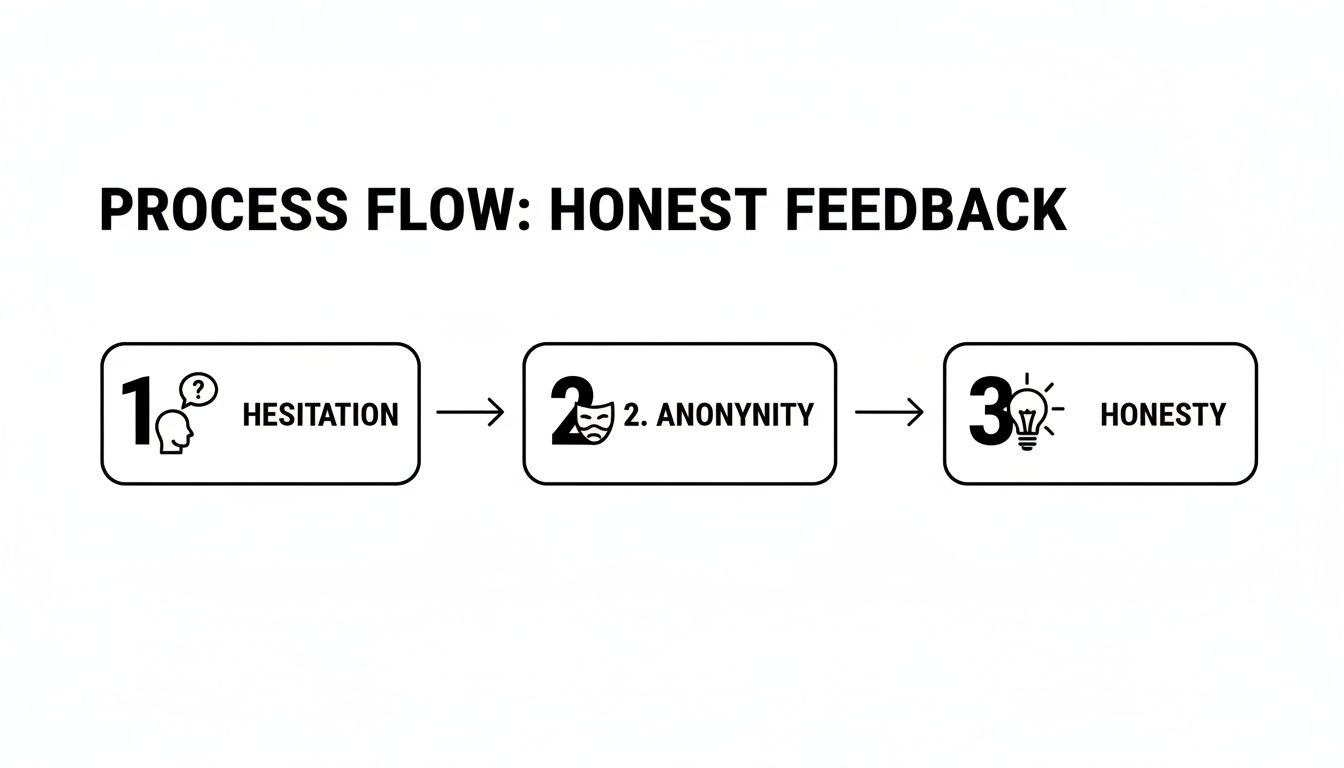
This process is what turns silent frustration or unspoken ideas into the kind of actionable insights that can actually move the needle.
Defining Your Primary Objective
Your goal dictates everything that comes next—from the questions you ask to the audience you target. So, get specific. "Improve company culture" is a nice sentiment, but it's not a goal. A real goal sounds more like this: "Identify the top three friction points affecting cross-departmental collaboration by the end of Q3." See the difference? One is a wish; the other is a plan.
Here are a few practical examples of how different teams might set their goals:
- Human Resources: Uncover the primary drivers of employee burnout to develop targeted wellness initiatives and reduce absenteeism.
- Product Development: Source raw, honest feedback on a new beta feature from power users to prioritize bug fixes and improvements before the public launch.
- Leadership Team: Assess employee sentiment and trust in leadership following a major organizational change to address concerns proactively.
- Customer Support: Identify recurring issues that customers are hesitant to report directly, allowing the team to create better help documentation.
The specificity of your goal is directly proportional to the value of the feedback you'll receive. A focused question gets a focused answer.
Choosing Your Anonymity Model
Once your goal is crystal clear, you need to decide on the level of anonymity that best supports it. Not all anonymous feedback is created equal, and the model you choose says a lot about your intentions and your company culture. It’s important to get this right.
You've generally got three models to consider:
- Fully Anonymous: Absolutely no identifying information is collected—no IP addresses, no login data, nothing. This model offers the highest level of psychological safety and is perfect for highly sensitive topics like reporting misconduct or gathering candid feedback on leadership.
- Partially Anonymous (Confidential): An administrator or a trusted third party (like HR) can see who submitted the feedback, but that information is never shared with direct managers or the wider team. This is useful when you might need to follow up for clarification but still want to protect the individual from any direct exposure.
- Anonymous with Optional Identity: Respondents can choose to remain anonymous or attach their contact information. This hybrid approach empowers people to decide their own comfort level. It’s great for general suggestion boxes where someone might actually want credit for a brilliant idea.
For most cases where you're trying to uncover difficult truths, fully anonymous is the gold standard. It completely removes any fear of retribution and signals a genuine commitment to hearing the unvarnished truth—which, after all, is the entire point.
Choosing The Right Platform To Build Trust
The tool you choose to build your anonymous feedback form isn't just software. It’s the very foundation of your program's credibility. If people don’t trust the platform, they won’t trust the process—and you’ll get silence instead of the honest insights you're looking for.
Picking the right platform goes way beyond a generic feature list. You have to zero in on what actually matters for anonymous feedback: enterprise-grade security, unwavering compliance with privacy laws like GDPR, and an intuitive design that encourages people to actually participate.
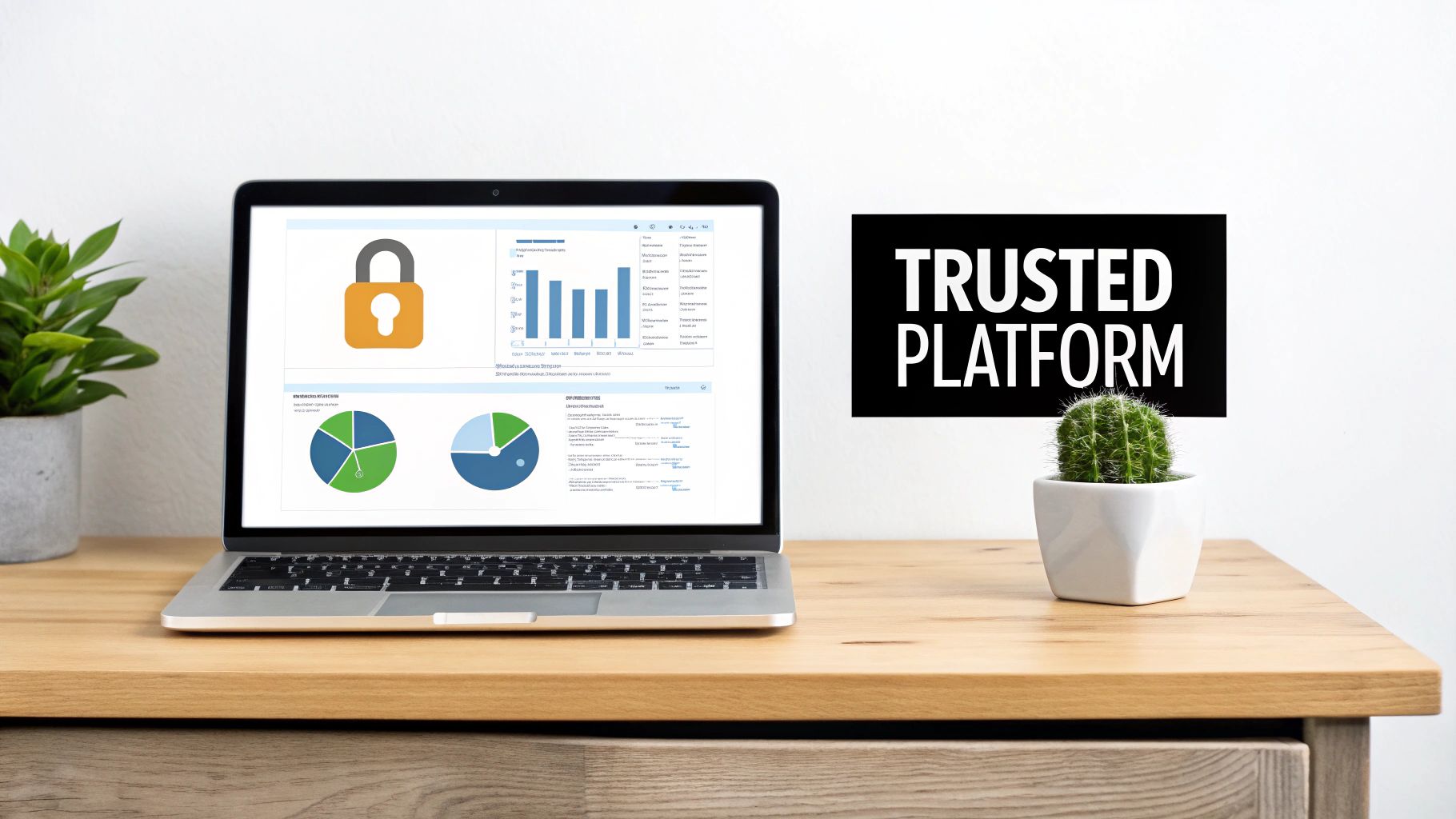
Today’s best platforms also bring powerful AI analytics into the mix, which can instantly surface themes and sentiment from hundreds of open-text responses. This saves you from hours of manual work and helps you find the signal in the noise. Let’s look at some of the top options out there.
Top Tools For Building An Anonymous Feedback Form
When your goal is to gather candid feedback, you need a tool built with security and anonymity as its core principles, not as afterthoughts. Below is a comparison of leading platforms designed to help you build that trust and get the insights you need.
| Tool | Key Feature | Best For | Security Focus |
|---|---|---|---|
| Orbit AI | AI-powered feedback analysis and qualification. | Teams needing to quickly understand and act on qualitative feedback at scale. | Enterprise-grade, end-to-end encryption and a strict no-IP-tracking policy by default. |
| SurveyMonkey | Extensive templates and broad question types. | General-purpose surveys and market research where anonymity is one of many features. | Anonymity is an optional setting that must be configured correctly to prevent metadata collection. |
| Typeform | Conversational, one-question-at-a-time user interface. | Increasing participation rates through a highly engaging and design-forward experience. | Anonymity depends on careful configuration of settings; not a security-first platform. |
While all these tools can create forms, those designed specifically for anonymity, like Orbit AI, often provide a stronger foundation of trust because their security features are built-in, not bolted on.
The best tool for your anonymous feedback form is one that makes security its default setting. When you don't have to manually disable tracking features to protect users, you signal a genuine commitment to their privacy.
Core Features That Really Matter
Don't get distracted by flashy but irrelevant features. When you're comparing platforms for an anonymous feedback form, your evaluation should boil down to a few non-negotiable elements.
- Data Encryption: Look for platforms offering end-to-end encryption. This means the data is scrambled from the moment it leaves the respondent's browser until it reaches your dashboard, protecting it from being intercepted.
- No IP Tracking: A truly anonymous tool should not log IP addresses or other device metadata by default. This is a critical technical detail that proves you’re upholding your promise of anonymity.
- GDPR and Privacy Compliance: The platform must be explicitly compliant with major privacy regulations like GDPR. This isn't just a legal checkbox; it demonstrates a deep commitment to data protection best practices.
Making Your Final Decision
Your choice of platform will directly impact the quality and honesty of the feedback you get. While plenty of tools can create a basic form, only a select few are engineered with the security and trust required for a successful anonymous feedback program. By prioritizing these security features and a user-centric design, you create an environment where people feel safe enough to share what truly matters.
For a deeper dive into how different tools stack up, you can read our complete survey software comparison that breaks down features, pricing, and ideal use cases. This will help you select a platform that not only meets your technical requirements but also aligns with your goal of building a culture of trust and open communication.
How To Write Questions That Encourage Honesty
An anonymous feedback form is only as good as the questions you ask. It’s a simple truth. You can invest in the perfect platform and nail the rollout, but vague, loaded, or leading questions will always give you useless data.
Crafting the right questions is what separates collecting noise from gathering detailed, actionable insights. The goal here is to build a structure that uncovers both the "what" and the "why." You absolutely need quantitative scales to measure sentiment and spot trends, but the real gold is in the open-ended questions that reveal the context and emotion behind those numbers. A great form makes it easy for someone to give you both.

Balancing Question Types For Clearer Insights
One of the most common mistakes I see is relying too heavily on one type of question. A form with only rating scales might tell you that 65% of employees are unhappy with a new policy, but it won’t tell you why. On the flip side, a form with only open-ended questions becomes an intimidating wall of text that’s nearly impossible to analyze at scale.
The solution is a thoughtful, strategic mix:
- Rating Scales (1-5 or 1-10): These are perfect for gauging satisfaction or agreement on specific topics. Use them to establish a baseline you can track over time. They’re quick, easy, and give you hard numbers to work with.
- Multiple-Choice Questions: Ideal for segmenting feedback or understanding preferences when the possible answers are finite. Think of these as your go-to for categorizing responses without forcing people to write an essay.
- Open-Ended Questions: This is where you find the most valuable, nuanced feedback. These questions invite detailed stories, specific examples, and suggestions that scales just can't capture. A pro tip: always place them after a related quantitative question to get deeper context on a rating someone just gave.
Avoiding Biased And Leading Questions
The way you phrase a question can subtly—or not-so-subtly—influence the answer. Biased questions will absolutely skew your results and undermine the integrity of your entire feedback process. Your goal must be neutrality. You want to ask questions that don't even hint at a preferred answer.
Here’s a classic trap: asking a leading question that suggests a desired response.
- Bad Question: "How much did you enjoy the recent team-building event that we worked so hard to organize?"
- Good Question: "On a scale of 1-10, how valuable did you find the recent team-building event?"
The first version basically pressures the respondent to be positive. The second is completely neutral and focuses on value, which is a much more useful metric for you to track anyway.
Key Takeaway: Always read your questions aloud and ask yourself, "Does this question suggest a 'correct' answer?" If it does, rewrite it until it's completely impartial.
Here’s another example, this time focused on a product feature:
- Bad Question: "What do you find most frustrating about our new, complex reporting dashboard?"
- Good Question: "What has been your experience using the new reporting dashboard?"
The "bad" question frames the experience as negative and complex from the start. The "good" question is wide open, allowing the user to describe their experience—positive, negative, or neutral—in their own words. For a deeper dive on this, check out our guide on the best practices for survey forms.
Sample Questions For Common Scenarios
To make this immediately practical, here are a few ready-to-use question sets you can adapt for your own anonymous feedback form.
For an Employee Pulse Survey:
- On a scale of 1-10, how manageable has your workload been over the past month?
- Do you feel you have the resources and tools you need to do your job effectively? (Yes/No)
- What is one thing we could do to improve our team's communication?
- Is there anything preventing you from doing your best work right now?
For a Post-Project Review:
- How would you rate the clarity of the project goals on a scale of 1-5?
- Did you feel the project deadlines were realistic? (Yes/No)
- What was the biggest challenge you faced during this project?
- What is one thing we should do differently on our next project?
How To Launch Your Form and Actually Get People To Fill It Out
You've designed the perfect anonymous feedback form and written clear, unbiased questions. Awesome. Now comes the part where most initiatives fall flat: getting people to actually use it.
A successful launch isn't about just blasting out a link and hoping for the best. It’s a strategic effort, one built on trust and crystal-clear communication from the very start.
How you introduce the form sets the tone for everything that follows. Your announcement is your first and best chance to build the psychological safety needed for genuinely honest participation. This means being completely upfront about the form's purpose and your rock-solid commitment to keeping things anonymous.
Your Launch Communication Is Everything
Before anyone even sees the first question, they need to understand the why. A strong communication plan gets ahead of any skepticism and frames this as a real effort to improve, not some corporate trap to sniff out dissent.
Your messaging should always cover three key points:
- The Purpose: Be specific. What exactly are you trying to achieve? Are you hoping to fix a broken workflow, find new product ideas, or get to the root cause of burnout? Don't be vague.
- The Commitment to Anonymity: State it plainly. Explain how you're protecting identities. Mention the technical safeguards, like not tracking IP addresses, and give your word that their responses are totally confidential.
- The Action Plan: This is crucial. Tell people what happens after they submit feedback. Let them know you'll be analyzing responses for themes and—most importantly—sharing a summary of the findings and the actions you plan to take.
This level of transparency isn't optional. When people trust the process, they participate. Google's annual anonymous Googlegeist survey, for example, consistently hits an 88% participation rate. The findings have led directly to data-driven changes in everything from inclusion initiatives to communication strategies, measurably boosting engagement across the company.
A Couple of Announcement Templates You Can Steal
Here are a few templates you can adapt for your launch. Notice they're direct, reassuring, and focused on the positive outcome you're aiming for.
For an Internal Employee Announcement:
Subject: Your Voice Matters — Help Us Improve [Specific Area]
Hi Team,
We're serious about making [Company Name] the best possible place to work, and we need your unfiltered perspective to do it. We've set up a new anonymous feedback form to get your honest thoughts on [e.g., our project management process, team communication, etc.].
This form is 100% anonymous. We don't track names, emails, or IP addresses. Our only goal here is to understand what's working and what we can do better, straight up.
Please take 5 minutes to share your thoughts here: [Link to Form]
Once we’ve gathered the feedback, we'll share a summary of the key themes and the action plan we're putting in place. Thanks for helping us get better.
For a Customer Feedback Email:
Subject: Got 3 Minutes? Help Us Build a Better [Product Name]
Hi [Customer Name],
We're constantly working to improve [Product Name], and our best ideas always come from you. We've created a super-quick, anonymous feedback form to hear what you really think.
Your submission is completely anonymous, so please don't hold back! We want to know what you love, what you don't, and what you wish the product could do.
You can find the form right here: [Link to Form]
Thanks for being a valued customer and for helping us build something you'll love even more.
Timing and Placement Make or Break Your Launch
Finally, think like a strategist about when and where you launch this thing. Sending it out at 4 PM on a Friday or during a massive company deadline is a recipe for getting ignored. Aim for mid-week, mid-morning, when people are most likely to be at their desks and engaged.
Put the form where your audience will stumble upon it naturally. For employees, that might be a high-traffic page on the company intranet. For customers, it could be right inside your app's user dashboard.
The easier you make it for people to find and fill out, the more responses you'll get. If you want to dive deeper into getting your form in front of the right people, we've got a detailed guide on how to increase form submissions.
Turning Feedback Into Action And Closing The Loop
Collecting anonymous feedback is the easy part. The real work—and the real value—starts when the responses flood in. If you don't turn that raw data into meaningful change, it's all just noise.
The first instinct is often to react to individual comments, especially the harsh ones. Resist that urge. Your job isn't to put out fires one by one, but to zoom out and find the recurring themes and patterns hiding in the feedback. This is where modern tools shine, using AI to sift through mountains of text and highlight the most common topics and overall sentiment.

From Insights To An Action Plan
Once you've spotted the key themes—things like "confusing project management" or "need for better communication"—it's time to move from analysis to action. Vague intentions won't cut it. To truly grasp the nuances behind the responses, especially from open-ended questions, it helps to use methods of qualitative research content analysis.
A solid action plan has three core parts:
- Specific Actions: What are the tangible steps you will take? "Improve communication" is a wish. "Implement weekly project summary emails" is an action.
- Clear Ownership: Who is responsible for seeing each action through? Assigning a name ensures accountability so good ideas don't fall through the cracks.
- A Realistic Timeline: When will this get done? Deadlines create urgency and give you a clear benchmark for success.
Let's say feedback shows widespread frustration with a software tool. Your action plan might look like this:
- Action: Schedule 3 deep-dive sessions with power users to identify the top friction points.
- Owner: Sarah, Product Manager.
- Timeline: By end of next week.
The Critical Step: Closing The Feedback Loop
This is the single most important—and most often skipped—step in the whole process. Closing the loop means telling your audience what you heard and what you're doing about it. It’s the ultimate proof that their feedback didn't just disappear into a void.
When you close the loop, you’re not just reporting on changes. You are actively building trust and creating a culture where people feel heard, respected, and willing to contribute again in the future.
You don't need to write a novel. A simple, transparent summary is incredibly powerful.
How To Communicate Your Findings
Start by thanking everyone for their honest input. Then, share the high-level themes you uncovered, but be careful not to reveal specific quotes that could compromise anyone's anonymity. Finally, lay out the concrete action plan you’ve put together.
Here’s a quick template you can adapt:
"Thank you to everyone who shared their feedback. We heard three main themes loud and clear: [Theme 1], [Theme 2], and [Theme 3]. Based on your input, here are the first steps we're taking..."
By taking this final step, you transform your anonymous feedback form from a one-time data collection tool into a sustainable, trust-building engine for continuous improvement. If you want to go deeper on analyzing and using what you've gathered, check out our guide on making sense of the data from your survey.
Have a Few Questions About Anonymous Feedback?
Diving into anonymous feedback can feel like walking a tightrope. You want honesty, but you also need to build a process that people actually trust and use. It's natural to have questions. Let's tackle some of the most common ones that come up.
Is an Anonymous Feedback Form Really Anonymous?
The short answer: it depends entirely on the tool you use and how you set it up.
Platforms like Orbit AI are built from the ground up with privacy as a non-negotiable. That means things like enterprise-grade encryption are standard, and we never collect IP addresses or other sneaky identifying metadata by default.
But the tech is only half the equation. You have to be completely transparent with your people about the privacy measures you've put in place. Trust is built on both technical safeguards and clear communication. A classic mistake is asking demographic questions that could accidentally pinpoint someone—like asking for a specific job title on a team of three.
How Can We Get More People to Actually Use the Form?
Boosting participation isn't a "launch it and forget it" kind of deal. It’s an ongoing effort that requires a few key things.
- Hammer Home the "Why": People need to know why you're asking for feedback and what you plan to do with it. Be relentless in communicating how their input will lead to tangible improvements.
- Make It Impossible to Miss: Embed the form on high-traffic internal pages or drop a link into your regular team communications. Keep it visible and top-of-mind.
- Close the Loop: This is the big one. When people see that their feedback genuinely leads to change, they’re infinitely more likely to contribute again. Acknowledge the input, share summarized themes, and—most importantly—announce the actions you're taking.
The single biggest mistake is assuming people will just start using the form. You have to actively build trust by proving their voice leads to real-world action. Without that follow-through, participation will always wither over time.
What's the Biggest Mistake to Avoid?
Getting defensive. Anonymous feedback can be brutally honest, and your first instinct might be to react emotionally to a few harsh comments. Don't.
Your first job is to step back and look for patterns. Is the same issue popping up from multiple people? That's not an outlier; that's a signal. The most damaging mistake you can make is to read the feedback, feel stung, and then quietly let it fade away.
The only thing worse than getting defensive is failing to act at all. If you ask for feedback and then do absolutely nothing with it, you’ve just destroyed any trust you had. You've also guaranteed your next feedback initiative will fail before it even starts.
Ready to turn honest feedback into your biggest growth asset? With Orbit AI, you can create secure, beautiful, and effective anonymous feedback forms in minutes. Our platform is engineered for trust with built-in privacy features and AI-powered analysis to help you find insights faster. Start building for free today.


