

Conversion rate optimization isn't just about running A/B tests anymore. Modern CRO spans everything from how you capture leads to how you qualify them, nurture them, and remove friction at every touchpoint. The tools you choose can mean the difference between a pipeline full of high-intent prospects and a mountain of unqualified noise.
This list covers the best CRO tools available in 2026, selected based on four criteria: depth of optimization capability, ease of implementation for fast-moving teams, quality of analytics and feedback loops, and overall value for high-growth SaaS and lead-gen businesses. Whether you're looking to overhaul your lead capture forms, run smarter experiments, or understand exactly where visitors drop off, there's a tool here for your stack.
Orbit AI leads the list because it addresses one of the most overlooked CRO levers: the form and lead qualification layer. The remaining tools cover complementary functions across testing, heatmapping, landing pages, and behavioral analytics.
1. Orbit AI
Best for: High-growth SaaS and lead-gen teams that need intelligent lead capture and automatic qualification at the point of submission.
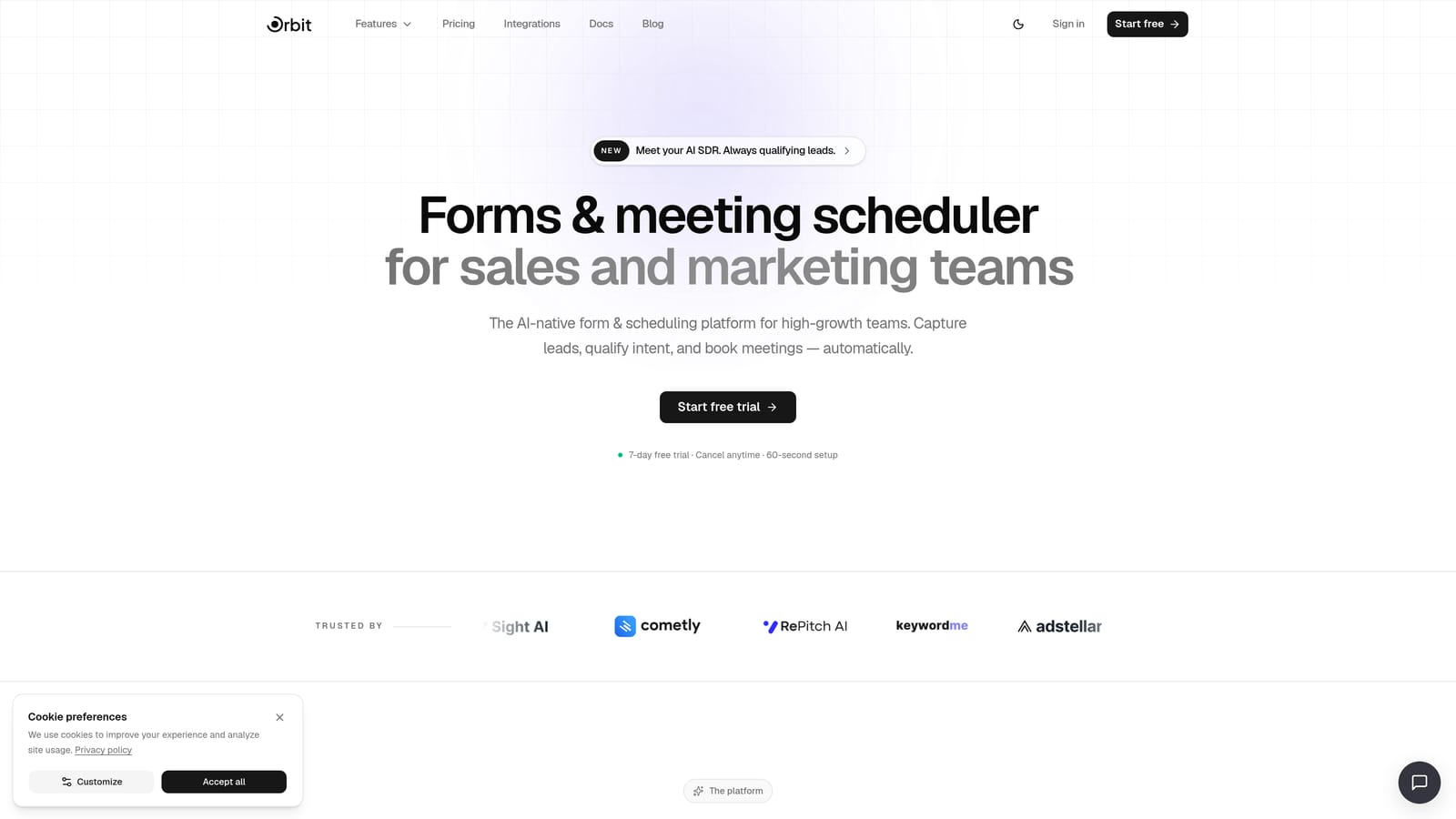
Orbit AI is an AI-powered form builder that captures, scores, and routes leads the moment they submit a form.
Where This Tool Shines
Most form tools stop at data collection. Orbit AI goes further by applying AI-driven lead qualification scoring at the point of capture, so your team knows immediately which submissions are worth pursuing. That closes the gap that typically exists between "we got a lead" and "we know if this lead matters."
The forms themselves are built for conversion, not just completion. Conditional logic keeps experiences relevant, modern design reduces abandonment, and built-in analytics surface exactly where users drop off so you can iterate fast.
Key Features
AI Lead Qualification Scoring: Automatically scores and routes leads at submission, so sales teams engage the right prospects first.
Conditional Logic Forms: Adapts the form experience in real time based on user responses, reducing irrelevant questions and friction.
Form Performance Analytics: Built-in reporting shows completion rates, drop-off points, and submission trends without needing a separate analytics tool.
Workflow Integrations: Routes qualified leads directly to CRMs, Slack, or email sequences, removing manual handoff delays.
Modern Form Design: Clean, conversion-optimized templates built specifically for high-growth teams that care about brand experience.
Best For
SaaS startups and marketing teams running high-volume lead generation campaigns who need more than a data dump from their forms. Particularly strong for teams where sales and marketing alignment depends on lead quality, not just lead volume.
Pricing
Pricing details are available at orbitforms.ai/pricing. A free starting option is available for teams ready to explore the platform.
2. Optimizely
Best for: Enterprise product and marketing teams running structured, large-scale experimentation programs.
Optimizely is one of the most established enterprise experimentation platforms, covering A/B testing, multivariate testing, feature flagging, and personalization.
Where This Tool Shines
Optimizely is built for teams that treat experimentation as a core discipline, not an occasional project. Its statistical rigor, audience segmentation capabilities, and feature flagging infrastructure make it well-suited for product teams running continuous experiments across both marketing and product surfaces.
The personalization engine adds another layer, allowing teams to serve different experiences to different audience segments based on behavioral data. For enterprises with dedicated CRO or growth functions, this is a platform that can scale with complex programs.
Key Features
A/B and Multivariate Testing: Run experiments at enterprise scale with rigorous statistical significance reporting.
Feature Flagging: Control feature rollouts and run product experiments without full deployments.
Personalization Engine: Serve tailored experiences to defined audience segments based on behavioral and demographic signals.
Detailed Reporting: Deep statistical analysis with customizable dashboards for experiment performance.
Analytics Integrations: Connects with major analytics platforms, CDPs, and data warehouses.
Best For
Enterprise teams with dedicated experimentation resources. Less suited to early-stage startups due to pricing and implementation complexity, but a strong long-term investment for organizations with the maturity to use it fully.
Pricing
Enterprise pricing model. Contact the Optimizely sales team directly for a custom quote based on your scale and use case.
3. Hotjar
Best for: Teams that want fast, visual insight into why visitors aren't converting, without heavy technical setup.
Hotjar is a behavioral analytics platform combining heatmaps, session recordings, on-site surveys, and funnel analysis in one accessible interface.
Where This Tool Shines
Hotjar's strength is speed-to-insight. You can install it, watch session recordings within hours, and quickly identify rage clicks, scroll depth problems, or form abandonment patterns that would take weeks to surface through quantitative analysis alone. It's particularly effective as a diagnostic layer before you start running A/B tests.
The on-site survey and feedback widgets give you qualitative context that numbers can't provide. Understanding why someone didn't convert, in their own words, often reveals optimization opportunities that heatmaps alone would miss.
Key Features
Heatmaps: Visual overlays showing where users click, move, and scroll across any page.
Session Recordings: Replay individual visitor sessions to observe real behavior and identify friction points.
On-Site Surveys: Collect qualitative feedback from visitors at key moments in the funnel.
Funnel Analysis: Track where users drop off across multi-step conversion flows.
Freemium Access: A free plan makes it accessible for smaller sites and teams just starting with behavioral analytics.
Best For
Marketing and product teams at all stages, particularly those looking to complement quantitative A/B testing data with qualitative behavioral insight. The freemium model makes it a natural first CRO tool for early-stage teams.
Pricing
Free plan available. Paid plans start at approximately $32 per month, scaling with traffic volume and feature access.
4. Unbounce
Best for: Performance marketing teams running paid campaigns who need fast landing page creation and built-in optimization.
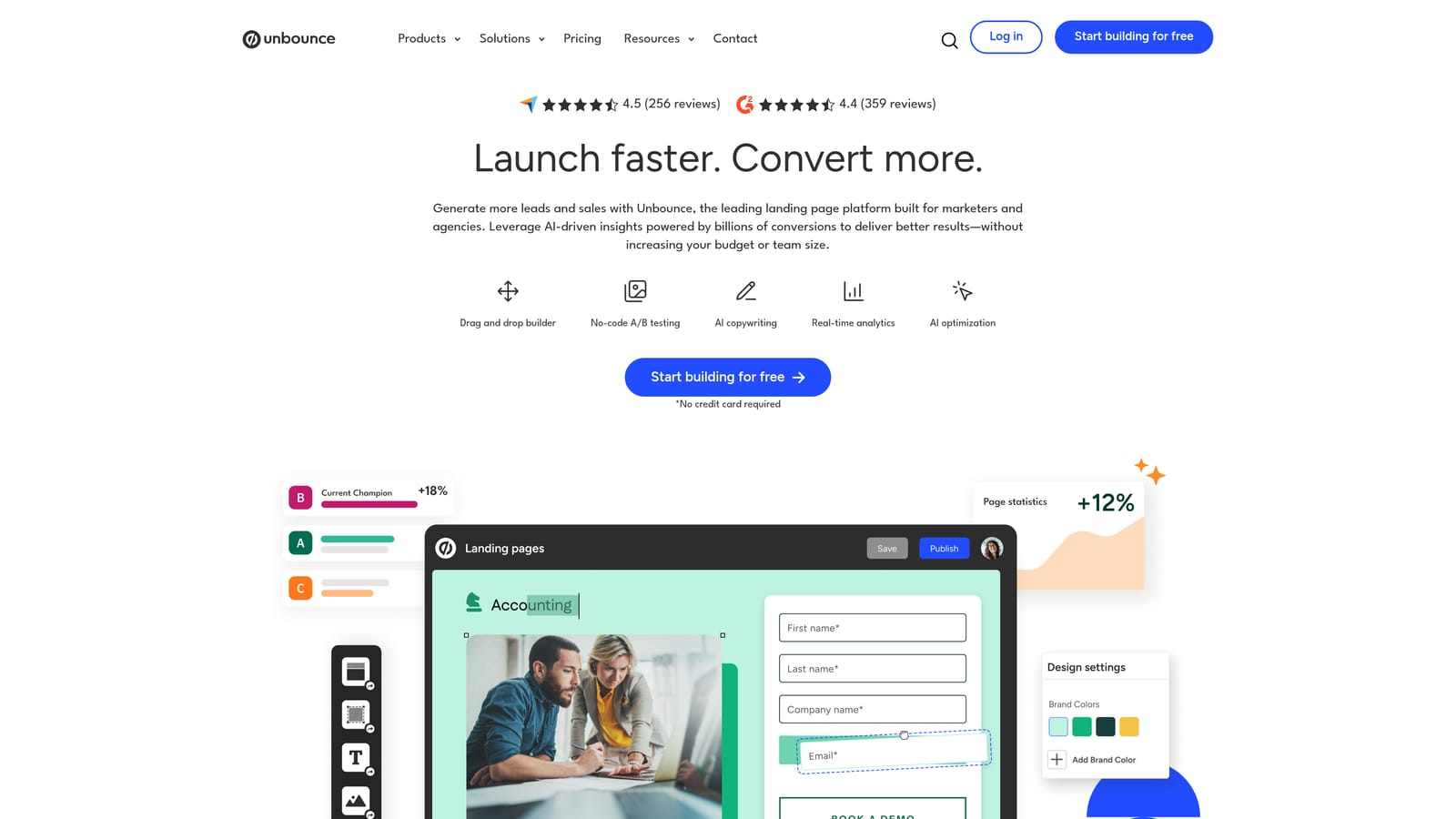
Unbounce is a purpose-built landing page platform with drag-and-drop building, A/B testing, and an AI-powered Smart Traffic feature that automatically routes visitors to the best-performing variant.
Where This Tool Shines
Unbounce removes the development bottleneck from campaign execution. Marketers can build, launch, and test landing pages without touching code, which matters enormously when you're trying to move fast on paid campaigns. Smart Traffic takes optimization further by learning which page variant converts best for different visitor segments and routing traffic accordingly.
The template library gives teams a strong starting point for common campaign types, and the built-in A/B testing with statistical significance reporting means you're making decisions based on real signal, not gut feel.
Key Features
Drag-and-Drop Builder: Create and publish landing pages without developer involvement.
Smart Traffic AI: Automatically routes visitors to the highest-converting page variant based on learned patterns.
Built-In A/B Testing: Run split tests with statistical significance reporting directly within the platform.
Template Library: A broad collection of conversion-focused templates for rapid campaign launches.
CRM and Platform Integrations: Connects with major marketing and CRM platforms for seamless lead handoff.
Best For
Paid media and performance marketing teams that need to move quickly from campaign concept to live page. Pairs well with a dedicated lead capture and qualification layer like Orbit AI for full-funnel coverage.
Pricing
Plans start at approximately $99 per month, with higher tiers unlocking additional features and traffic limits.
5. VWO (Visual Website Optimizer)
Best for: Mid-market teams that want A/B testing, behavioral analytics, and surveys consolidated into one platform.
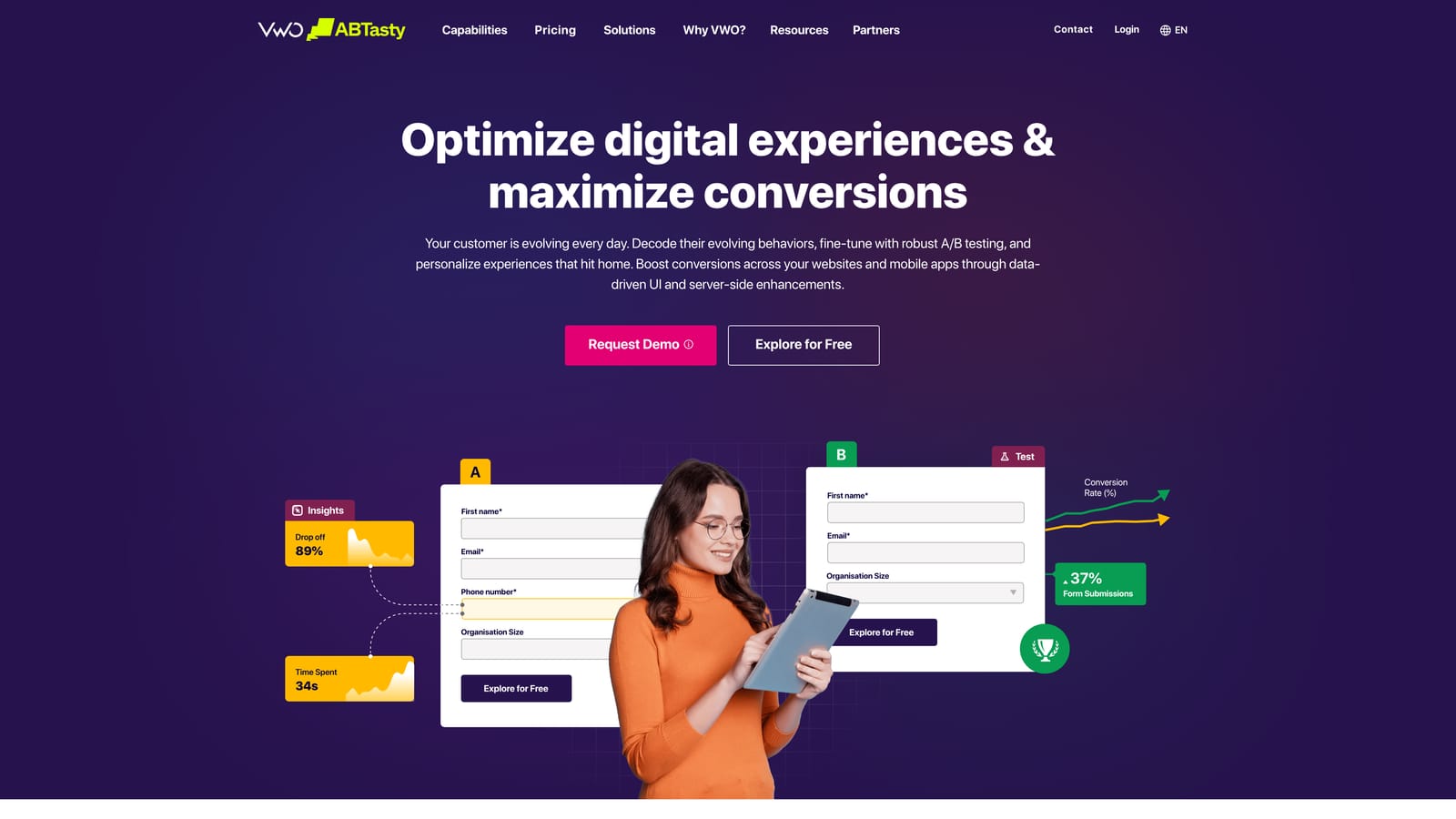
VWO is a full-stack CRO platform that combines A/B testing, multivariate testing, heatmaps, session recordings, and on-site surveys, reducing the need to stitch together multiple point solutions.
Where This Tool Shines
VWO's appeal is consolidation. If your team is managing separate subscriptions for testing, heatmapping, and surveys, VWO brings those capabilities under one roof with a shared data layer. That means your testing insights and behavioral data are connected, rather than siloed across different tools.
The visual editor makes it accessible to non-technical users, while the personalization capabilities allow returning visitor experiences to be tailored based on prior behavior. It's a strong choice for teams that want depth without the complexity of an enterprise-only platform.
Key Features
A/B and Multivariate Testing: Visual editor-based testing with statistical reporting for both simple and complex experiments.
Built-In Heatmaps and Recordings: Behavioral data within the same platform as your testing workflow.
On-Site Surveys: Collect visitor feedback to inform test hypotheses directly from the platform.
Funnel and Form Analytics: Identify drop-off points across conversion flows without a separate tool.
Personalization: Serve different experiences to returning visitors based on behavioral segments.
Best For
Mid-market marketing and growth teams looking to reduce tool sprawl without sacrificing CRO capability. A solid alternative to assembling a multi-tool stack independently.
Pricing
Tiered pricing based on monthly tracked users. Contact VWO for enterprise pricing or to get a quote tailored to your traffic volume.
6. Crazy Egg
Best for: Startups and SMBs that want visual CRO data and basic A/B testing without enterprise-level pricing.
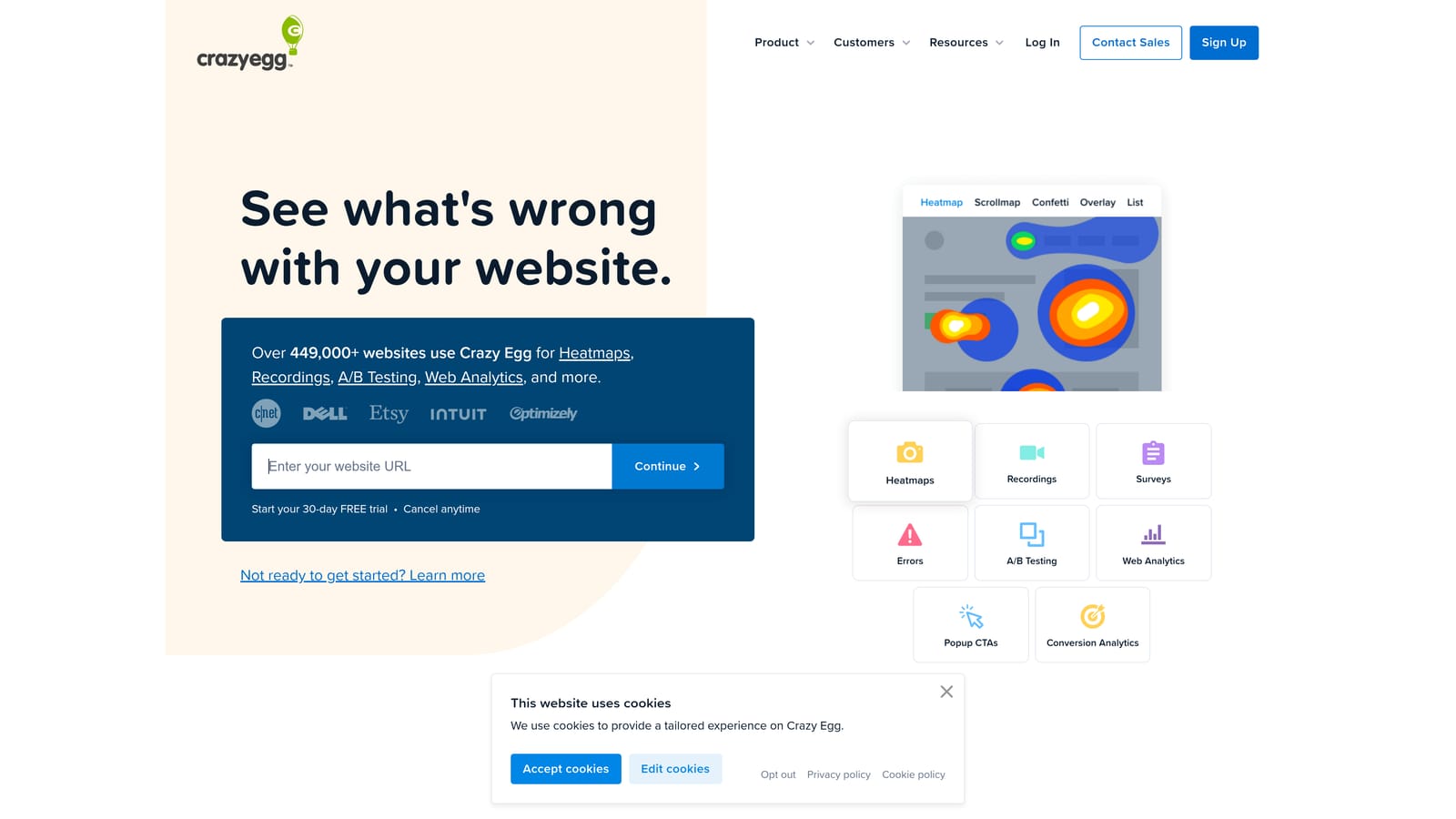
Crazy Egg is an affordable heatmapping and visual analytics tool with built-in A/B testing, making it one of the most accessible entry points into data-driven CRO.
Where This Tool Shines
Crazy Egg democratizes visual analytics. The setup is minimal, the interface is approachable, and the core reports, including heatmaps, scrollmaps, and click data, give teams a clear picture of how visitors interact with their pages. For teams that don't have the budget for enterprise tools but still want to make evidence-based decisions, Crazy Egg fills that gap effectively.
The built-in A/B testing editor means you don't need a separate tool to start running basic experiments. It won't replace a dedicated experimentation platform for complex programs, but for straightforward split tests, it's more than sufficient.
Key Features
Heatmaps and Scrollmaps: Visual reports showing click patterns, scroll depth, and user attention across pages.
Session Recordings: Review individual visitor sessions to identify friction and unexpected behavior.
A/B Testing Editor: Run split tests directly within the platform without developer involvement.
Traffic Segmentation: Analyze behavior by traffic source, device type, or visitor segment.
Simple Setup: Minimal technical overhead, making it easy to deploy quickly.
Best For
Early-stage startups, SMBs, and solo marketers who want actionable visual data without committing to enterprise pricing. A practical starting point before scaling into more comprehensive platforms.
Pricing
Plans start at approximately $49 per month, making it one of the more budget-friendly options in the CRO category.
7. AB Tasty
Best for: Teams that want to layer audience personalization and segmentation on top of standard A/B and multivariate testing.
AB Tasty is an experimentation and personalization platform designed for teams that have moved beyond basic testing and want to serve tailored experiences to specific audience segments.
Where This Tool Shines
Where many testing tools stop at which variant wins, AB Tasty asks a more nuanced question: which variant wins for which audience? Its personalization engine allows teams to target specific segments with distinct experiences, which is particularly valuable for SaaS businesses with diverse buyer personas or varied traffic sources.
The platform supports both visual and code-based editing, giving flexibility to non-technical marketers and developers alike. Feature experimentation capabilities also make it relevant for product teams running experiments on in-app experiences alongside marketing surfaces.
Key Features
A/B, Multivariate, and Split URL Testing: Full testing coverage across page-level and URL-level experiments.
Personalization Engine: Rich audience targeting for serving different experiences to different visitor segments.
Feature Experimentation: Extend testing into product experiences, not just marketing pages.
Visual and Code Editing: Flexible editing options for both technical and non-technical users.
Analytics and CDP Integrations: Connects with major analytics platforms and customer data platforms for enriched audience data.
Best For
Mid-market and enterprise teams with mature testing programs that are ready to invest in personalization as a distinct optimization layer. Less suited to teams just starting out with CRO.
Pricing
Mid-market and enterprise pricing. Contact AB Tasty directly for a custom quote based on your traffic and feature requirements.
8. Intercom
Best for: SaaS teams that want to engage and qualify high-intent visitors in real time before they leave the page.
Intercom is a customer messaging platform that contributes to CRO through automated bot flows, live chat, product tours, and behavioral targeting that engages visitors at the moment of highest intent.
Where This Tool Shines
Intercom addresses a specific conversion problem: high-intent visitors who arrive on your site, have a question, and leave because no one was there to answer it. Automated bot flows can qualify leads, answer common objections, and route high-value prospects to sales, all without requiring a live rep to be available at every hour.
Product tours reduce onboarding friction for trial users, which is a CRO lever that's often ignored by teams focused exclusively on top-of-funnel optimization. If your conversion goal includes trial-to-paid, Intercom's in-app engagement tools are directly relevant.
Key Features
Automated Bot Flows: Qualify leads and answer visitor questions in real time without requiring live agents.
Live Chat: Engage high-intent visitors directly for real-time conversion support.
Product Tours: Guide new users through key features to reduce activation friction and improve trial conversion.
Behavioral Targeting: Trigger messages based on specific visitor actions, pages visited, or time on site.
CRM and Support Integrations: Connects with major CRMs and helpdesk platforms for unified customer context.
Best For
SaaS companies optimizing both top-of-funnel lead conversion and post-signup activation. Particularly effective for teams with a product-led growth motion where trial experience directly impacts revenue.
Pricing
Plans start at approximately $39 per month per seat, with costs scaling based on usage, contacts, and feature tier.
9. Heap
Best for: Product and growth teams that need retroactive behavioral analysis without the overhead of manual event tagging.
Heap is a product analytics platform that automatically captures all user interactions, enabling teams to analyze conversion flows retroactively without having to pre-configure tracking for every event.
Where This Tool Shines
Heap's defining feature is its automatic capture model. Traditional analytics tools require you to define which events to track before users take those actions. Heap captures everything, which means you can go back and analyze a conversion path that you didn't think to instrument six months ago. For fast-moving teams, this eliminates the "we should have tracked that" problem entirely.
The retroactive funnel and path analysis capabilities are particularly valuable for identifying conversion blockers in complex product flows or multi-step onboarding sequences. Now part of Contentsquare, Heap also benefits from deeper session replay and experience analytics integration.
Key Features
Automatic Event Capture: Records all user interactions without requiring manual event configuration or developer tagging.
Retroactive Analysis: Build and analyze funnels using historical data, even for events you didn't track intentionally at the time.
Session Replays: Add qualitative context to quantitative funnel data through individual session review.
Cohort and Audience Segmentation: Analyze behavior across specific user groups to identify conversion patterns by segment.
Data Warehouse Integrations: Deep connections with major data warehouses and BI tools for teams with advanced analytics infrastructure.
Best For
Product-led growth teams and data-forward organizations that need comprehensive behavioral data without the ongoing overhead of manual instrumentation. Especially powerful for teams optimizing complex product onboarding flows.
Pricing
A free plan is available for lower-traffic sites. Paid plans scale with event volume. Contact Heap directly for enterprise pricing.
Which Tool Is Right for Your Stack?
The most effective CRO stacks aren't the largest. They're the most intentional. Here's a quick framework for choosing based on where you are and what you need most.
SaaS startups focused on lead quality: Start with Orbit AI for your form and qualification layer, then add Hotjar to understand behavioral drop-offs. These two tools cover capture and diagnosis without significant overhead.
Performance marketing teams scaling paid campaigns: Unbounce handles your landing page creation and testing. Pair it with Orbit AI for the lead capture and qualification layer underneath, so you're not just driving traffic to forms that can't tell you which leads matter.
Enterprise teams with dedicated CRO resources: Optimizely or VWO provide the structured experimentation infrastructure to support large-scale programs. AB Tasty is worth evaluating if personalization is a priority alongside testing.
Teams that want visual insight on a budget: Crazy Egg is the most accessible entry point. It covers heatmaps, recordings, and basic A/B testing at a price point that works for early-stage teams.
Product-led growth companies: Heap gives you retroactive behavioral data across your product experience, and Intercom handles real-time engagement and onboarding friction. These two work well together for teams optimizing trial-to-paid conversion.
The principle worth holding onto: pick one tool per layer. One for capture and qualification, one for testing, one for behavioral analytics. Avoid duplicating functionality across tools, and always prioritize the tools that close the loop between data and action.
Transform your lead generation with AI-powered forms that qualify prospects automatically while delivering the modern, conversion-optimized experience your high-growth team needs. Start building free forms today and see how intelligent form design can elevate your conversion strategy.


