

You've asked a supplier for a quote, but the responses look nothing alike. One vendor has returned a simple price sheet. Another has included a delivery plan, staffing model, technical approach, and several pages of assumptions. Your team now has to compare offers that were never designed to answer the same question.
This confusion usually starts with choosing the wrong solicitation. An RFQ, or Request for Quotation, asks suppliers to price a clearly defined requirement. An RFP, or Request for Proposal, asks vendors to explain how they'd solve a business problem. The difference between RFQ and RFP isn't a minor wording preference. It determines whether your procurement process is driven mainly by comparable pricing or by competing approaches, capabilities, and value.
Introduction Why Choosing the Wrong Request Costs Time and Money
A buyer may issue an RFP for a straightforward purchase, such as a standard product with fixed specifications. Suppliers then spend time writing proposals that add little value, while the buying team reviews methodology and credentials it never needed. The result is a longer process, more administrative effort, and pricing that's harder to compare.
The reverse mistake creates a deeper problem. A buyer may issue an RFQ for a complex implementation, custom service, or undefined solution. Vendors respond with prices based on different assumptions because the buyer has asked for a number before asking suppliers to explain the work behind it. The lowest quote may look attractive while representing the wrong scope.
Practical rule: Choose the request based on how certain you are about the requirement, not on which template your team usually uses.
Federal contracting guidance draws the distinction clearly. An RFQ is used when an agency already knows exactly what it needs and mainly wants pricing and terms. An RFP is used when the agency wants a complete solution and will evaluate factors such as methodology, team, timeline, and price. The U.S. General Services Administration's RFQ and RFP guidance frames the RFQ as the pricing stage and the RFP as the complete-solution stage.
That distinction also affects vendors. A supplier answering an RFQ should focus on accuracy, compliance with specifications, delivery, and commercial terms. A vendor answering an RFP must show how its approach fits the buyer's problem and how its team will deliver the intended outcome.
The rest of this guide makes the choice practical. You'll find plain-language definitions, an early side-by-side table, situational examples, process guidance for buyers and vendors, and a final decision framework for checking whether your solicitation matches the decision you need to make.
What an RFQ Is and What an RFP Is
A buyer ordering standardized equipment can specify the model, quantity, delivery location, and required date before contacting suppliers. That level of detail supports an RFQ, or Request for Quotation. The buyer is asking vendors to price a defined purchase and state the terms attached to it.
An RFQ works when suppliers can respond to substantially the same scope. Common examples include repeat orders, routine maintenance, standardized equipment, and defined production components. Clear specifications make the resulting quotes easier to compare because price differences are less likely to reflect different assumptions.
A typical RFQ response includes:
- Price: Unit and total pricing, including applicable fees or conditions.
- Delivery: Lead time, delivery location, and fulfillment terms.
- Compliance: Confirmation that the offer meets the stated specifications.
- Validity: The period during which the quotation and commercial terms remain available.
A structured quote request form template can help buyers collect the same information from each supplier.
An RFP, or Request for Proposal, begins with a business need rather than a completely prescribed purchase. The buyer defines the problem, desired outcomes, constraints, and evaluation requirements. Vendors then propose a way to deliver the result, usually covering methodology, team, timeline, implementation plan, risks, assumptions, and price.
Why the distinction matters
The choice depends on buyer certainty. High certainty about the required product or service supports price-led competition through an RFQ. Greater uncertainty about the method supports solution-led competition through an RFP.
Amazon Business describes an RFQ as a request for a specific product or service where the vendor mainly provides cost and delivery terms. Its RFP explanation asks vendors to show how they would address a business problem, including their methodology, team, timeline, and price. GSA procurement guidance follows the same distinction. Buyers researching opportunities can also consult a government RFP database to see how defined requirements and broader solution requests appear in practice.
An RFQ response should concentrate on accuracy, specification compliance, delivery, and commercial conditions. An RFP response must explain why the proposed approach fits the need and how the vendor will deliver it.
The documents also create different procurement workflows. An RFQ usually supports a shorter, more transactional review. An RFP requires buyers to assess competing approaches, risks, capabilities, and expected results before comparing price.
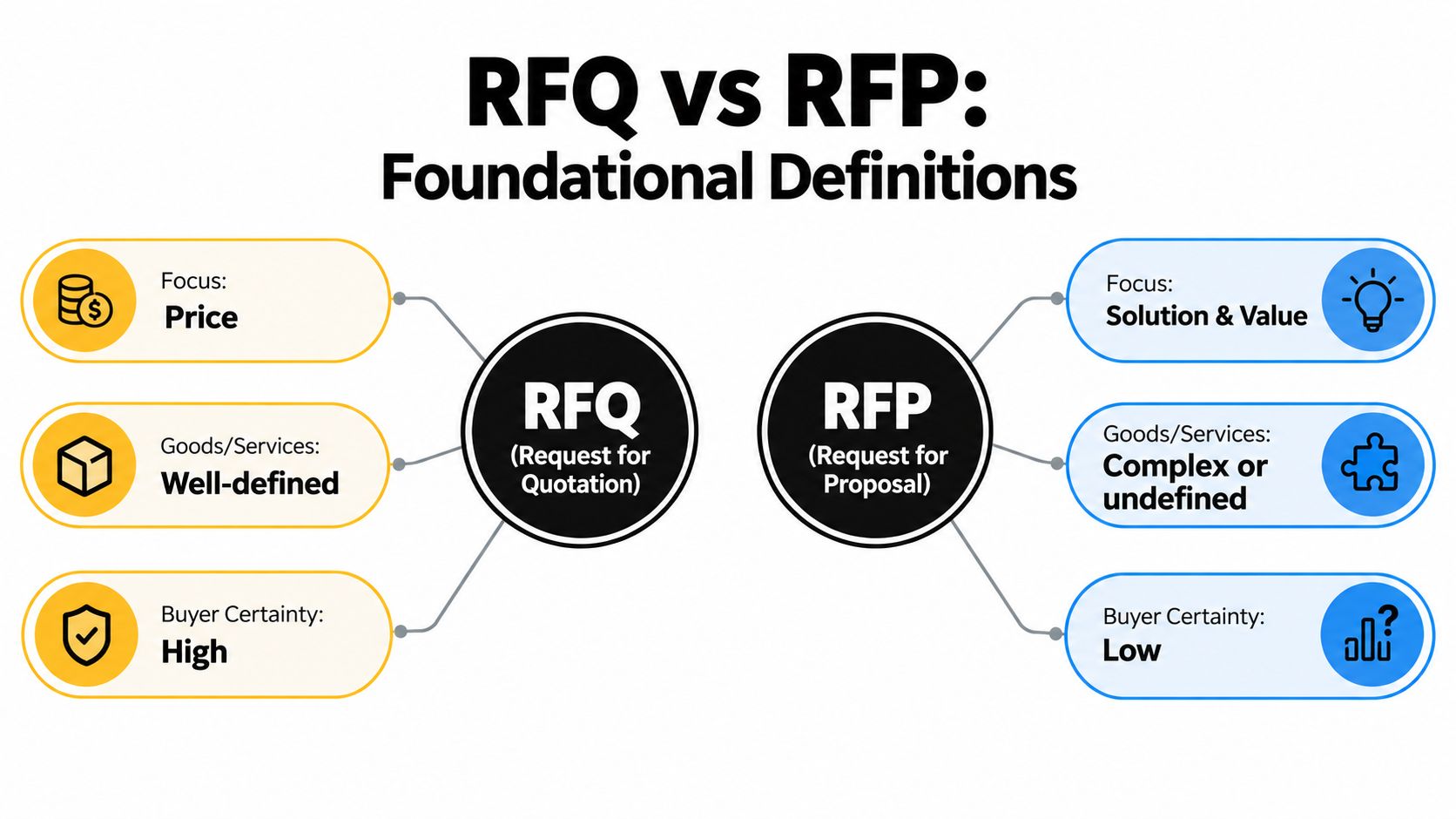
RFQ vs RFP Side by Side Comparison Across Key Criteria
A buyer who knows the exact requirement can run a price-led competition. A buyer who knows the desired outcome but not the best method needs solution-led competition. That level of certainty is the practical difference between an RFQ and an RFP.
| Criteria | RFQ | RFP |
|---|---|---|
| Purpose | Collect pricing and commercial terms | Request a complete solution to a business problem |
| Buyer certainty | High, the requirement is known | Lower, the outcome is known but the approach may not be |
| Submission contents | Quote, delivery details, terms, and compliance information | Methodology, team, timeline, solution design, assumptions, and price |
| Evaluation focus | Price, delivery, and conformity with specifications | Approach, capability, value, risk, timeline, and price |
| Procurement stage | Pricing stage for a defined requirement | Complete-solution stage for a more complex need |
| Typical workflow | Shorter and more transactional | Broader, with stakeholder input, scoring, and possible negotiation |
The GSA's comparison of RFIs, RFQs, and RFPs draws the same practical distinction. An RFQ asks suppliers to price a defined product or service, with attention to cost and delivery. An RFP asks vendors to explain how they would address the need, including their method, team, timeline, and price.
Purpose and buyer certainty
The RFQ question is, “What will you charge for this defined requirement?” The RFP question is, “How would you solve this need, and what would that solution cost?”
An RFQ works only when suppliers can price the same scope. The buyer therefore needs precise specifications, quantities, delivery conditions, required standards, and commercial terms. Unclear requirements create different interpretations, making the quotations difficult to compare fairly.
An RFP starts with a business problem or desired outcome. The buyer sets the goals, constraints, evaluation criteria, and expected deliverables, while allowing vendors to recommend the method. The document should provide direction without prescribing every technical choice.
Submission contents and evaluation
RFQ responses should sit easily beside one another. A supplier may provide a price schedule, delivery commitment, exceptions, payment terms, and confirmation of compliance. A long strategic narrative adds little when the requirement is already fixed.
RFP responses require more judgment. Vendors may explain staffing, sequencing, technical choices, governance, implementation risks, and the assumptions behind their pricing. Buyers then assess the proposed approach, capability, value, risk, timeline, and price rather than selecting the lowest figure automatically. A guide to calculating pricing in forms can help teams collect structured commercial inputs when a quote request includes conditional requirements.
The RFQ compares supplier offers for the same defined thing. The RFP compares supplier thinking about how to deliver the right thing.
Procurement stage and workflow
An RFQ usually belongs at the pricing stage of a stable requirement. The buyer confirms the specification, gathers comparable commercial responses, checks compliance, and selects a qualified offer. The review is often shorter because the main variables are price, delivery, and conformity.
An RFP belongs at the solution-selection stage. Stakeholders may score technical fit, delivery confidence, business value, implementation risk, and contractual implications. Clarifications, presentations, or negotiation may follow before the buyer chooses an approach and the vendor expected to execute it.
When to Use an RFQ and When to Use an RFP
Use an RFQ when the specification is settled. You should be able to describe the item or service in enough detail that suppliers can price the same scope without designing their own interpretations.
Typical RFQ situations include:
- Commodity purchasing: The buyer needs a standard product with known characteristics.
- Standardized services: The service level, tasks, and delivery conditions are already established.
- Repeat orders: The organization is buying an existing requirement again.
- Price-led sourcing: The main decision is which qualified supplier offers the appropriate commercial terms.
For example, a buyer purchasing a defined product from several suppliers doesn't need each vendor to invent a delivery strategy or redesign the requirement. The RFQ keeps the process focused on price, availability, delivery, and compliance.
An RFP is more suitable when the buyer can describe the business need but can't responsibly prescribe the complete solution. That situation appears in consulting, custom software, marketing services, systems implementation, transformation programs, and other projects where the vendor's expertise should influence the approach.
Apply the buyer-certainty test
Ask yourself one question: Can we write the exact requirement clearly enough for every supplier to price it on the same basis?
If the answer is yes, an RFQ is usually the better fit. If the answer is no because you need vendors to recommend the method, sequence, technology, staffing, or delivery model, an RFP gives suppliers the right space to respond.
An RFP also fits when several factors matter at once. The buyer may need to weigh capability, implementation quality, risk management, support, and commercial value rather than selecting the lowest conforming price.
Use a B2B quote request form when your intake process needs to gather the information required before a team can determine whether a request is ready for an RFQ or needs a more consultative proposal.
A hybrid sequence can make sense when the procurement event contains two separate decisions. The buyer may first use an RFP to evaluate approaches and select a suitable partner, then use an RFQ to finalize pricing for clearly defined deliverables. The key is to keep those decisions distinct rather than forcing one document to do both jobs.
Pros and Cons of RFQs and RFPs in Practice
RFQs offer efficiency and comparability. Because suppliers receive a defined scope, buyers can request responses in a consistent format and compare pricing with less interpretation. Vendors also spend less effort preparing a response when the request doesn't require a custom solution narrative.
That simplicity has limits. An RFQ can't compensate for a poor specification. If the buyer has misunderstood the requirement, every supplier may quote accurately against the wrong scope. RFQs also leave limited room for innovation because alternatives can make the responses harder to compare.
Where RFQs perform well
An RFQ is strongest when the buyer values consistency, speed, and commercial clarity. It helps procurement teams avoid asking vendors to solve a problem that has already been solved internally.
The trade-off is narrow scope. Suppliers generally quote what the buyer has requested rather than challenging the design or suggesting a different delivery model. That's useful for a standard purchase, but restrictive when better outcomes depend on supplier expertise.
Where RFPs perform well
RFPs create room for strategic solutions and vendor differentiation. Suppliers can explain their thinking, recommend an implementation path, identify risks, and show how their team would manage the work. Buyers gain a fuller view of capability instead of reducing the decision to a single price field.
The cost is complexity. RFPs require more preparation from the buyer, more response effort from vendors, and a more disciplined evaluation process. Stakeholders must agree on scoring criteria before they begin comparing proposals, or personal preferences can overwhelm the stated requirements.
An RFQ optimizes the path to a comparable price. An RFP creates room to discover the right path, then evaluate its value.
For a practical example of proposal-oriented service information, compare the structure of a commercial cleaning proposal resource. The point isn't to turn every service purchase into an RFP. It's to recognize when the buyer needs a supplier to explain the delivery model rather than attach a price to fixed instructions.
The right choice depends on the risk of each mistake. If the requirement is stable, an RFP may add unnecessary work. If the requirement is uncertain, an RFQ may hide important differences between supplier assumptions.
How the RFQ and RFP Process Works for Buyers and Vendors
An RFQ process begins with requirement preparation. The buyer defines the product or service, specifications, quantity, delivery expectations, commercial terms, response format, and deadline. Before issuing the request, the team should check that every supplier will be pricing the same scope.
Suppliers then review the requirements, confirm whether they can comply, and submit their quotation. The buyer compares price, delivery, exceptions, and other stated conditions. If the responses are comparable, the award can remain relatively direct and transactional.
For teams working with manufacturing requirements, resources on automated RFQ quoting for fab shops can provide useful context on how technical details and quoting inputs fit together.
The RFP workflow
An RFP needs more preparation because the buyer is asking vendors to propose a solution. The procurement team should define the business problem, desired outcomes, scope boundaries, mandatory requirements, evaluation criteria, submission instructions, and commercial expectations. Stakeholders from relevant functions should agree on what a strong response must demonstrate.
Vendors prepare a structured proposal covering their approach, team, timeline, assumptions, risks, relevant capabilities, and price. Buyers then score the responses against the published criteria, clarify material questions, and may hold presentations or negotiate before selecting a preferred solution.
A vendor application form can help collect initial supplier information before a more detailed RFQ or RFP, especially when the buying team needs to understand capabilities before deciding which solicitation fits.
Advice for both sides
Buyers should separate mandatory requirements from preferences. They should also avoid asking RFP respondents to solve an undefined problem without explaining how proposals will be assessed.
Vendors should answer the requested question rather than submitting a generic company overview. In an RFQ, that means making pricing and exceptions clear. In an RFP, it means connecting the proposed method to the buyer's outcomes and identifying assumptions that could change delivery or price.
How to Choose Between RFQ and RFP With Confidence
Use this decision test before issuing the document:
- Clear specifications: If the team can describe the requirement precisely, favor an RFQ. If important design choices remain open, favor an RFP.
- Project complexity: A routine, standardized purchase generally suits an RFQ. A multi-part or custom engagement generally suits an RFP.
- Budget flexibility: A tightly bounded purchase points toward an RFQ. A solution where cost depends on the proposed method points toward an RFP.
- Need for innovation: If the buyer doesn't need alternatives, use an RFQ. If supplier insight could materially improve the outcome, use an RFP.
Watch for two common errors. An RFQ is a poor fit when vendors must define the work, and an RFP is wasteful when the buyer only needs comparable pricing for a settled requirement. If the team can't answer the certainty question, clarify the requirement before inviting bids.
Before sending the solicitation, confirm that the response format matches the evaluation method. An RFQ should make commercial comparison straightforward. An RFP should give vendors enough context to propose a credible solution and give evaluators clear criteria for judging it.
The difference between RFQ and RFP is ultimately a decision about who defines the solution. If the buyer has already defined it, request a quotation. If the vendor must help define it, request a proposal.
Orbit AI helps teams build structured quote request forms with conditional questions, qualification fields, analytics, and workflow automation, so the information needed for pricing or follow-up arrives in a usable format. Visit Orbit AI to create a form and connect submissions to your sales or procurement workflow.


