

Enterprise sales teams operate in a world of complex deal cycles, multi-stakeholder buying committees, and CRM workflows that demand precision at every touchpoint. The forms your team uses — from lead capture and demo requests to RFQ submissions and qualification questionnaires — aren't just data collection tools. They're the front door to your pipeline.
A poorly designed form means lost leads, bad data in your CRM, and wasted time for reps who need to focus on closing. But the right form platform can qualify prospects before they ever reach a sales rep, route leads intelligently, and integrate seamlessly with enterprise tech stacks. We evaluated dozens of form builders and narrowed it down to nine that genuinely serve enterprise sales workflows. Here's what stands out in 2026.
1. Orbit AI
Best for: High-growth sales teams that want AI-powered lead qualification baked directly into their forms.
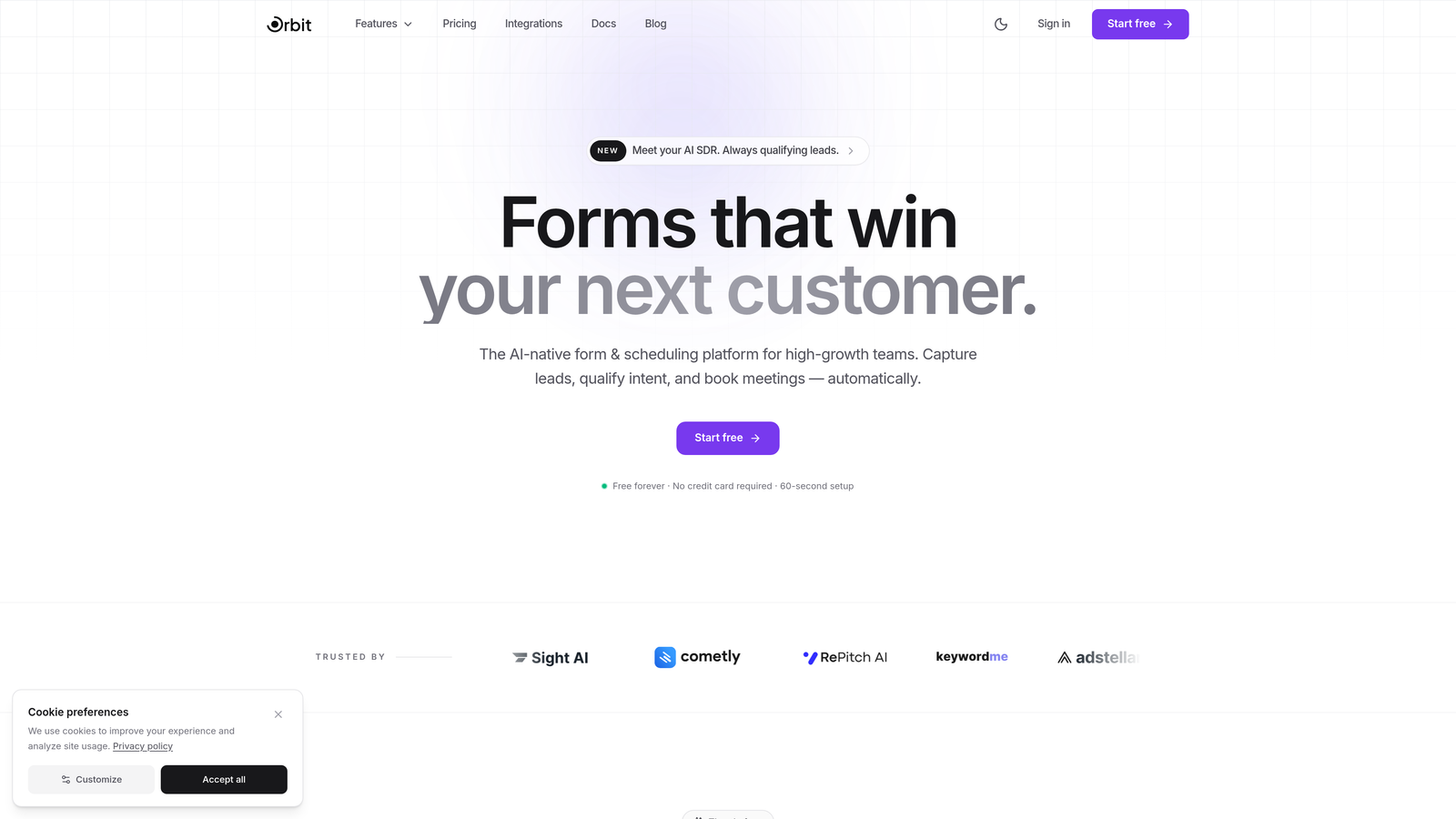
Orbit AI is an AI-powered form builder with built-in lead qualification and real-time scoring, purpose-built for teams that care deeply about pipeline quality.
Where This Tool Shines
Most form builders collect data and stop there. Orbit AI goes further by scoring and qualifying leads the moment a form is submitted, giving your sales reps a prioritized pipeline rather than a raw list of names to sort through. For enterprise sales teams juggling high submission volumes, that distinction matters enormously.
The platform pairs intelligent qualification logic with genuinely modern form design, so your prospect's first interaction with your brand reflects the quality of your product. Dynamic conditional logic means the form adapts in real time based on how a prospect responds, creating a more relevant experience that also surfaces better data.
Key Features
AI-Powered Lead Qualification: Scores and qualifies leads in real time at the point of submission, reducing manual triage for sales reps.
Conversion-Optimized Templates: Pre-built form templates designed specifically for sales workflows like demo requests, RFQ submissions, and qualification questionnaires.
Dynamic Conditional Logic: Forms adapt based on prospect responses, creating personalized paths that gather more relevant data.
CRM Integrations: Connects with major CRM platforms to ensure lead data flows directly into your existing sales stack without manual entry.
Modern Form Design: Buyer-first design philosophy that prioritizes completion rates and brand experience alongside data collection.
Best For
Sales and marketing teams at high-growth SaaS companies and B2B organizations that want to improve pipeline quality without adding headcount. Particularly valuable for teams that receive high form submission volumes and need intelligent routing rather than manual qualification.
Pricing
Visit orbitforms.ai for current pricing plans. A free tier is available to get started.
2. HubSpot Forms
Best for: Teams already running their sales and marketing operations inside the HubSpot ecosystem.
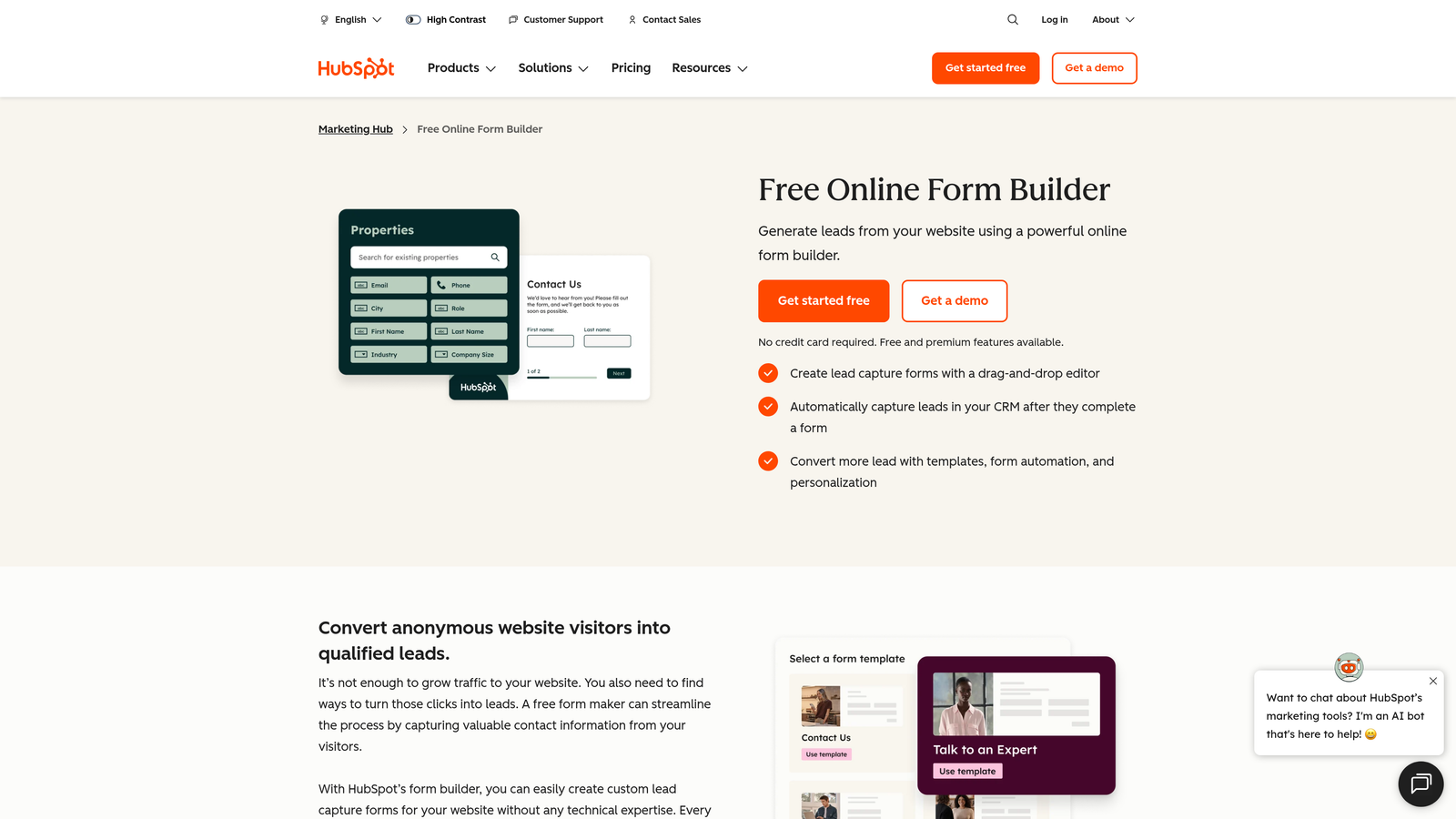
HubSpot Forms is a native form builder within HubSpot that offers progressive profiling, smart fields, and seamless CRM data flow for sales teams.
Where This Tool Shines
If your team lives in HubSpot, the native forms integration is genuinely hard to beat. Every submission automatically creates or updates a contact record, triggers workflows, and feeds into your deal pipeline without any middleware or manual syncing. The tight feedback loop between form data and CRM activity is a significant operational advantage.
Progressive profiling is one of HubSpot Forms' most practical enterprise features. Instead of bombarding returning visitors with fields they've already filled out, the form surfaces new questions each time, gradually building a richer prospect profile over multiple touchpoints.
Key Features
Progressive Profiling: Automatically shows new fields to returning visitors, building contact profiles incrementally without friction.
Smart Fields: Fields adapt based on known contact properties stored in the HubSpot CRM, eliminating redundant data requests.
Native CRM Integration: Submissions create or update contact records automatically with no third-party connectors required.
Dependent Fields and Conditional Logic: Build dynamic forms that respond to prospect input for more relevant qualification flows.
Free Tier Available: Basic form functionality is included with the free HubSpot CRM, lowering the barrier to entry.
Best For
Sales and marketing teams already invested in the HubSpot ecosystem. Less compelling as a standalone form tool if your organization uses a different CRM as its primary system of record.
Pricing
Free with HubSpot CRM. Advanced features available in Marketing Hub Starter at $20/month and higher tiers above that.
3. Typeform
Best for: Teams that prioritize form completion rates and want a conversational, high-engagement lead capture experience.
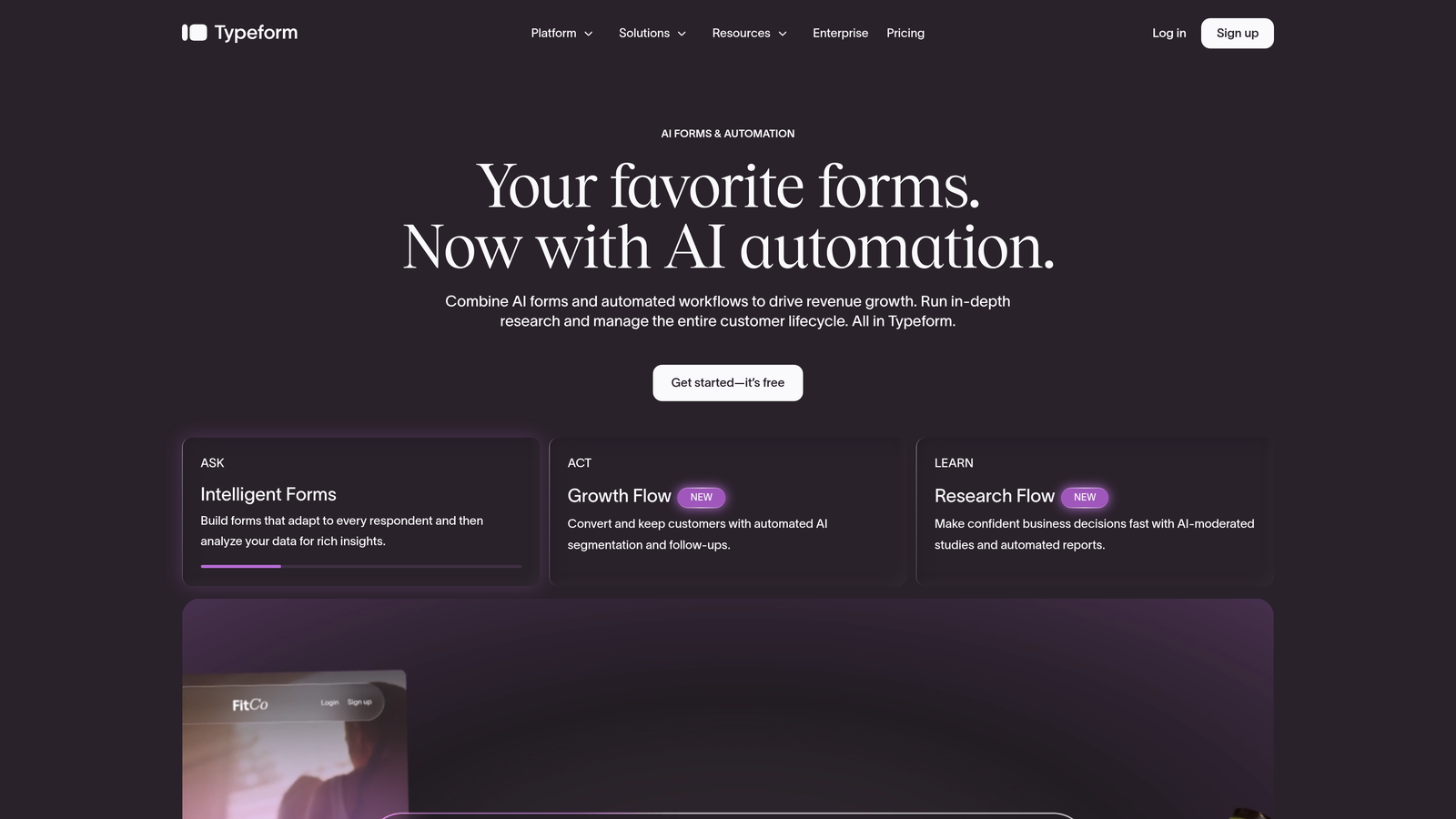
Typeform is a conversational form builder built around a one-question-at-a-time format that consistently drives higher engagement on lead capture and qualification forms.
Where This Tool Shines
The conversational format is Typeform's defining advantage. Rather than presenting prospects with a wall of fields, it guides them through questions one at a time, which tends to reduce abandonment and create a more human interaction. For enterprise sales teams targeting senior buyers who have little patience for clunky forms, this approach can meaningfully improve completion rates.
Logic jumps and branching give Typeform real qualification power. You can build flows that route prospects down entirely different question paths based on their answers, effectively running a qualification conversation before a rep ever picks up the phone.
Key Features
Conversational Interface: One-question-at-a-time format reduces cognitive load and drives higher form completion rates.
Logic Jumps and Branching: Dynamic qualification flows that adapt based on prospect responses, enabling sophisticated pre-qualification.
Native Integrations: Direct integrations with Salesforce, HubSpot, Slack, and other core sales tools.
Custom Branding: Extensive design flexibility to match enterprise brand standards across colors, fonts, and imagery.
Hidden Fields for Attribution: Capture UTM parameters and other attribution data automatically without adding visible fields.
Best For
Enterprise sales and demand generation teams that want a polished, buyer-friendly experience for demo requests, event registrations, and qualification surveys. Works best when paired with a dedicated CRM rather than used as a standalone system.
Pricing
Basic plan starts at $29/month. Business plan at $99/month for enterprise features including Salesforce integration and priority support.
4. Salesforce Web-to-Lead Forms
Best for: Organizations deeply invested in Salesforce that want direct lead creation with zero middleware.
Salesforce Web-to-Lead is built-in Salesforce functionality that creates lead records directly in your CRM from web form submissions, with no third-party connectors required.
Where This Tool Shines
The core value proposition here is simplicity of data flow. A form submission becomes a Salesforce lead record immediately, inheriting all of your existing assignment rules, workflow triggers, and validation logic. For Salesforce-native organizations, this eliminates an entire category of integration risk and maintenance burden.
Because the forms inherit Salesforce's enterprise security and compliance framework, there's no additional vendor evaluation required for procurement. Your existing data governance policies apply automatically, which matters significantly in regulated industries.
Key Features
Direct Lead Creation: Submissions create Salesforce lead records instantly with no middleware or API connectors required.
Automated Assignment Rules: Leverage existing Salesforce lead assignment rules to route new leads to the right rep automatically.
Custom Field Mapping: Map form fields to any standard or custom Salesforce object field.
Built-in Duplicate Detection: Salesforce's native duplicate management applies to web-to-lead submissions.
Enterprise Security: Inherits Salesforce org security, compliance, and data governance settings out of the box.
Best For
Enterprise teams where Salesforce is the undisputed system of record and where minimizing integration complexity is a higher priority than form design flexibility or advanced UX features.
Pricing
Included with all Salesforce CRM licenses. Sales Cloud starts at $25/user/month.
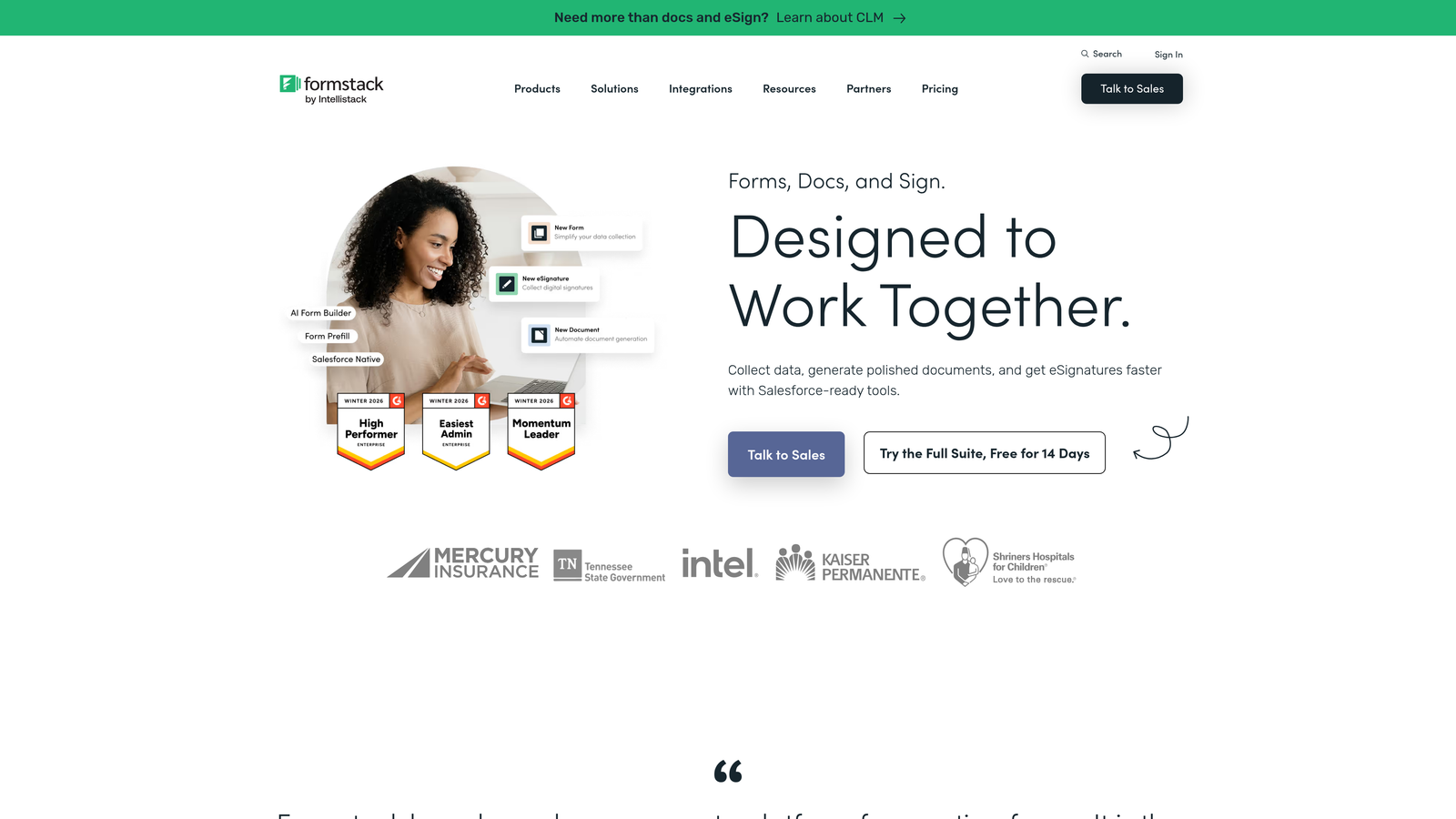
5. Formstack
Best for: Regulated industries and complex sales processes that require compliance, e-signatures, and workflow automation in a single platform.
Formstack is an enterprise form builder with workflow automation, document generation, and e-signature capabilities purpose-built for organizations where compliance and process complexity are non-negotiable.
Where This Tool Shines
Formstack's differentiator is the end-to-end workflow it enables beyond form submission. A prospect fills out a form, that triggers document generation, which routes to the right stakeholder for e-signature, all within the same platform. For enterprise sales teams in healthcare, finance, or legal sectors, this eliminates significant manual handoff work.
The Salesforce-native app is a meaningful advantage for Salesforce shops. Forms can be embedded directly within Salesforce records and submitted data populates CRM fields without leaving the Salesforce environment.
Key Features
Workflow Automation: Connect form submissions to document generation and approval workflows without custom development.
Built-in E-Signatures: Formstack Sign enables document signing within the same platform, reducing tool sprawl.
Compliance Coverage: HIPAA, GDPR, and SOC 2 compliance for organizations in regulated industries.
Salesforce-Native App: Forms embedded directly within Salesforce for a seamless CRM-native experience.
Calculation Fields: Support for complex pricing calculations and conditional logic within forms.
Best For
Enterprise sales teams in regulated industries like healthcare, financial services, and legal where compliance requirements are strict and sales processes involve document generation and signatures alongside data collection.
Pricing
Starts at $50/month. Enterprise pricing is available on request for organizations needing compliance features and higher volume.
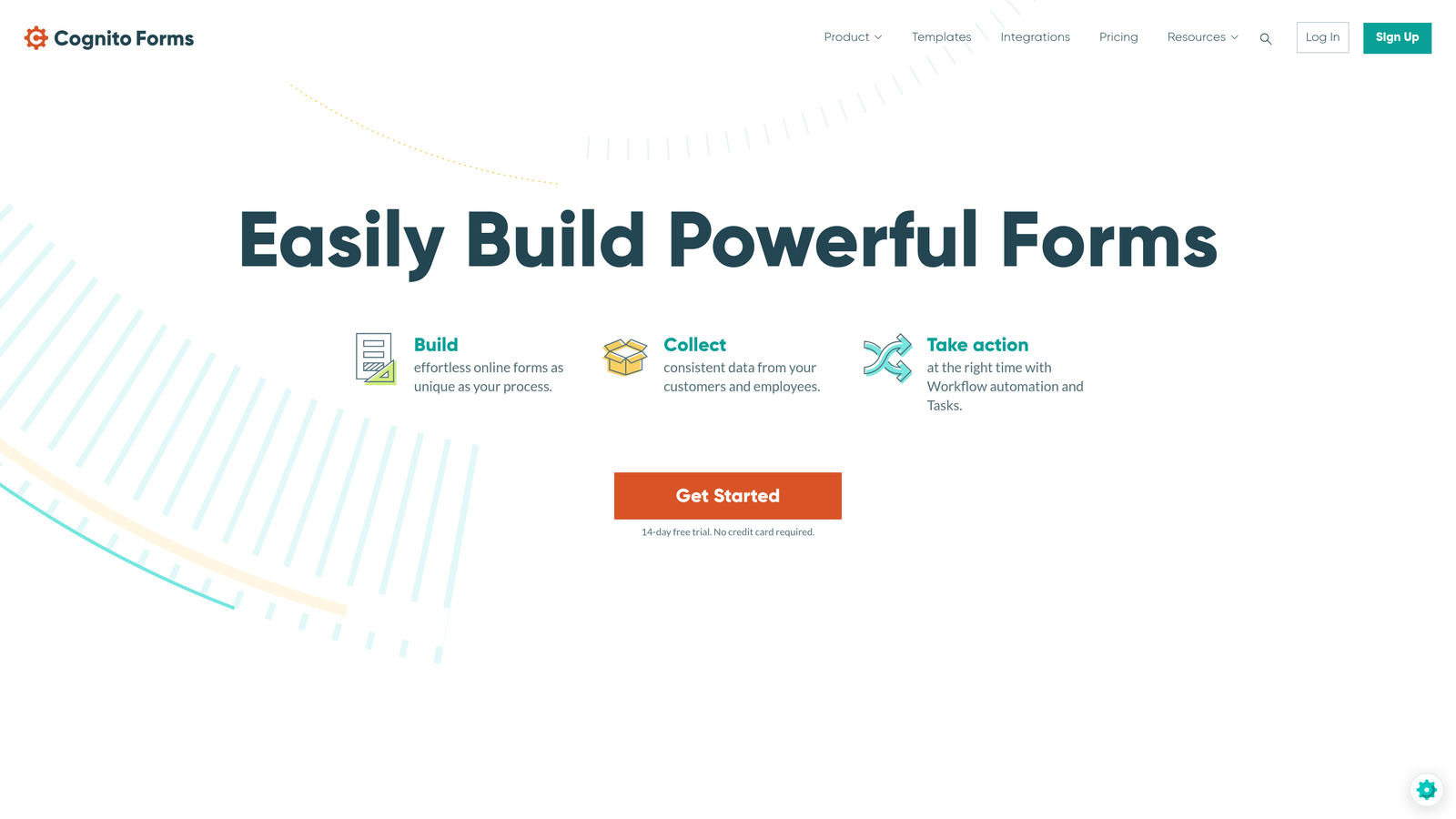
6. Cognito Forms
Best for: Sales teams that handle quotes, order forms, and RFQs requiring advanced calculation fields and line-item detail.
Cognito Forms is a versatile form builder with advanced calculation fields, repeating sections, and payment integrations suited for sales teams managing complex quoting and ordering workflows.
Where This Tool Shines
Cognito Forms earns its place on this list through raw flexibility in form structure. Repeating sections allow prospects to add multiple line items to an RFQ or order form, while calculation fields automatically compute totals, discounts, or pricing tiers based on input. For sales teams that receive complex product inquiries, this reduces back-and-forth significantly.
The platform also handles payment collection natively, which is useful for sales teams that close smaller transactions directly through forms without needing a full e-commerce platform.
Key Features
Advanced Calculation Fields: Build pricing formulas, discount logic, and total calculations directly into form fields.
Repeating Sections: Allow prospects to add multiple line items, products, or contacts within a single form submission.
Multi-Page Forms with Conditional Logic: Guide complex qualification or ordering flows across multiple pages with branching logic.
Payment Collection: Native integrations with Stripe, PayPal, and Square for direct payment on form submission.
Data Encryption and GDPR Compliance: Baseline security and compliance features for enterprise procurement requirements.
Best For
Sales teams in manufacturing, professional services, or technology that receive detailed quote requests and need forms capable of capturing complex, structured product or service requirements.
Pricing
Free plan available. Pro at $15/month, Team at $35/month. Enterprise pricing available on request.
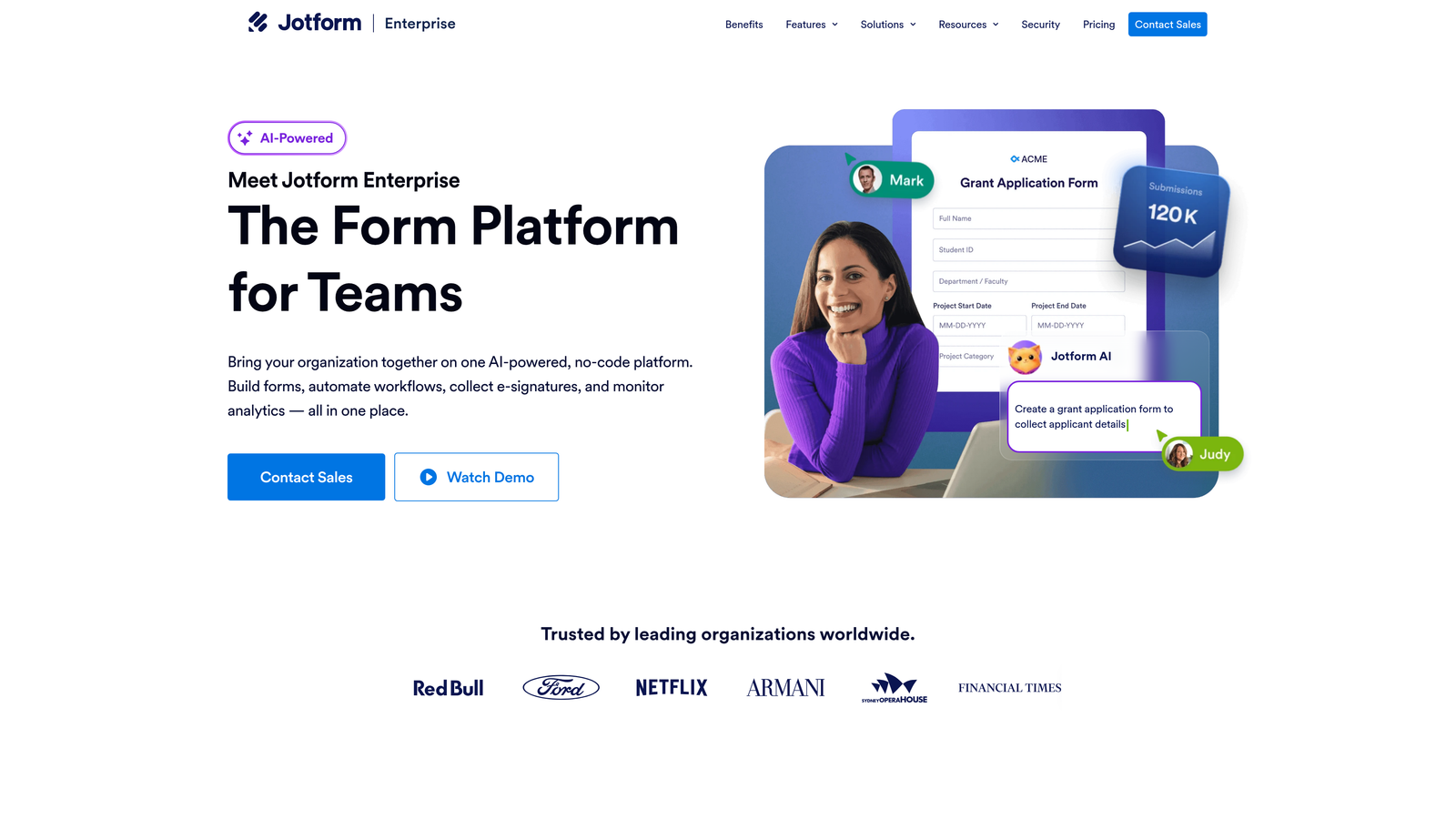
7. Jotform Enterprise
Best for: Large, distributed sales organizations that need centralized admin controls, SSO, and high-volume form management.
Jotform Enterprise is a high-volume form platform with enterprise admin controls, SSO, local data residency options, and an extensive template library built for organizations operating at scale.
Where This Tool Shines
Jotform Enterprise's strength is governance at scale. The enterprise admin panel gives IT and operations teams granular control over user roles, permissions, and form access across large, distributed teams. When your sales organization spans multiple regions or business units, that kind of centralized oversight is essential for maintaining data consistency and compliance.
Local data residency options address a common procurement blocker for multinational enterprises, allowing organizations to specify where form data is stored to meet regional data protection requirements.
Key Features
Enterprise Admin Panel: Centralized management of user roles, permissions, and form access for distributed teams.
SSO and Data Residency: Single sign-on support and local data residency options for enterprise compliance requirements.
Extensive Template Library: Thousands of pre-built templates including sales-specific forms for rapid deployment.
Broad Integrations: Native connections to Salesforce, HubSpot, and 100+ other applications.
Jotform Tables: Built-in submission management and collaboration workspace for teams reviewing and acting on form data.
Best For
Large enterprises and distributed sales organizations with multiple teams, regions, or business units that need centralized form governance alongside high submission volumes and compliance requirements.
Pricing
Free plan available for individuals. Enterprise pricing is custom and based on organizational needs; contact Jotform for a quote.
8. Pardot (Salesforce Marketing Cloud Account Engagement) Forms
Best for: B2B marketing and sales teams that need native lead scoring and grading integrated directly with Salesforce for a clean marketing-to-sales handoff.
Salesforce Marketing Cloud Account Engagement (formerly Pardot) provides B2B marketing automation forms with native lead scoring and grading that feed directly into Salesforce CRM.
Where This Tool Shines
Pardot forms are most powerful when the marketing-to-sales handoff is a strategic priority. Every form submission can trigger lead scoring updates, grading adjustments, and automated nurture enrollment simultaneously, all feeding into Salesforce without any manual intervention. For enterprise B2B teams managing long deal cycles with multiple touchpoints, that automation compresses a lot of operational work.
Form handlers extend Pardot's reach by connecting existing website forms to the Pardot platform, meaning you don't necessarily need to replace your current form infrastructure to gain Pardot's tracking and scoring capabilities.
Key Features
Native Lead Scoring and Grading: Automatically scores and grades leads based on form submissions and behavioral data within the Salesforce ecosystem.
Progressive Profiling: Builds prospect profiles incrementally across multiple form interactions without repeating known fields.
Completion Actions: Automated lead routing, list enrollment, and task creation triggered immediately on form submission.
Form Handlers: Connect existing third-party forms to Pardot tracking and scoring without rebuilding them.
Full Salesforce Sync: Complete bidirectional sync with Salesforce CRM including campaign attribution and activity history.
Best For
Enterprise B2B organizations already using Salesforce CRM that want sophisticated marketing automation, lead scoring, and campaign attribution tightly integrated with their sales pipeline.
Pricing
Included with Salesforce Marketing Cloud Account Engagement. Plans start at $1,250/month, positioning this as an enterprise-tier investment.
9. Marketo Forms
Best for: Enterprise demand generation teams running sophisticated ABM programs within the Adobe Experience Cloud ecosystem.
Adobe Marketo Engage includes enterprise-grade forms designed for sophisticated B2B demand generation with deep behavioral tracking and account-based marketing integration.
Where This Tool Shines
Marketo Forms are built for organizations where form submissions are one data point in a much larger behavioral intelligence picture. Known-visitor detection and form pre-fill create a frictionless experience for returning prospects, while behavioral triggers connect form interactions to complex lead scoring models and nurture programs running across multiple channels.
The Adobe Experience Cloud integration is the real differentiator for ABM-focused teams. Form data feeds into account-level intelligence alongside web behavior, email engagement, and ad interactions, giving sales teams a richer view of account intent than any standalone form tool can provide.
Key Features
Progressive Profiling with Known-Visitor Detection: Identifies returning prospects and pre-fills known fields, surfacing only new questions to reduce friction.
Behavioral Lead Scoring: Form interactions feed directly into Marketo's lead scoring engine alongside other behavioral signals.
Adobe Experience Cloud Integration: Connects form data with ABM workflows, ad targeting, and personalization across the Adobe ecosystem.
Custom CSS and JavaScript Support: Full design customization for enterprise brand standards without compromising functionality.
Completion Triggers: Sophisticated automation triggered by form submissions, including lead routing, program enrollment, and sales alerts.
Best For
Large enterprise marketing and sales teams running ABM programs at scale, particularly those already invested in the Adobe Experience Cloud or requiring deep behavioral intelligence alongside form data collection.
Pricing
Enterprise pricing only. Contact Adobe for a quote. The platform typically starts at $895/month and scales significantly based on database size and features.
Choosing the Right Form Platform for Your Sales Team
The right choice depends heavily on where your biggest bottleneck sits. Here's a quick way to think through it.
If AI-powered lead qualification is your priority: Orbit AI is the clear starting point. Real-time lead scoring at the form level reduces the manual triage burden on your reps and ensures your pipeline reflects actual buyer intent rather than raw submission volume.
If you're a Salesforce-first organization: Salesforce Web-to-Lead handles simple use cases cleanly, Pardot adds marketing automation and scoring for more sophisticated workflows, and Formstack's Salesforce-native app bridges the gap when you need compliance and document generation alongside CRM data.
If HubSpot is your system of record: HubSpot Forms is the natural choice. The native integration and progressive profiling capabilities are difficult to replicate with third-party tools.
If compliance and regulated industries are a factor: Formstack and Jotform Enterprise both offer SOC 2, HIPAA, and GDPR coverage alongside SSO and admin controls that satisfy enterprise procurement requirements.
If buyer experience and completion rates are the focus: Typeform's conversational format consistently outperforms traditional multi-field forms for engagement-sensitive use cases like senior executive outreach and high-touch demo requests.
For high-growth teams that want to move fast without sacrificing lead quality, the combination of intelligent qualification, modern design, and seamless CRM integration is what separates a form tool from a genuine pipeline asset. Start building free forms today and see how AI-powered form design can transform the quality of leads entering your pipeline.


