

In today's competitive landscape, simply having a sales team isn't enough to guarantee success. To achieve scalable, predictable growth, startups and scale-ups must move beyond traditional tactics and embrace a strategic framework known as sales enablement. This is not just about providing reps with a few battlecards; it's about systematically equipping them with the right tools, content, training, and processes to engage buyers effectively at every stage of their journey. A robust sales enablement strategy transforms the entire revenue function from a collection of individual efforts into a cohesive, high-performance engine.
The core goal is to make selling as efficient and effective as possible. This means eliminating friction, automating low-value tasks, and providing sales teams with the precise information they need, exactly when they need it. From intelligent lead qualification that saves hundreds of hours to seamless marketing alignment that ensures every lead is a warm conversation, the right approach transforms sales from an art into a repeatable science. When executed correctly, these practices directly impact key business metrics, including shorter sales cycles, higher win rates, and increased deal sizes.
This guide moves past generic advice and dives into the 10 most critical sales enablement best practices that high-growth companies are implementing right now. We'll provide actionable steps, from integrating AI for lead management to establishing a feedback loop between sales and marketing, all designed to help you build a revenue engine that truly scales. You'll learn how to implement these strategies to not only support your sales team but to create a foundational advantage in your market.
1. Implement AI-Powered Lead Qualification and Scoring
Manual lead qualification drains valuable sales time and often leads to inconsistent results. AI-powered lead qualification and scoring automates this process by analyzing prospect data in real-time. This system evaluates demographic information, engagement signals, and behavioral patterns against your ideal customer profile to prioritize high-intent leads. By continuously learning from historical conversion data, the AI model refines its accuracy, ensuring your sales team always focuses on opportunities with the highest probability of closing.

This approach is a cornerstone of modern sales enablement best practices because it directly impacts sales efficiency and pipeline velocity. Instead of sifting through a long list of MQLs, reps receive a prioritized queue of prospects who are already vetted and sales-ready. For instance, platforms like Orbit AI embed an AI SDR directly into your forms to qualify submissions instantly, enriching lead data and surfacing the most promising contacts without manual intervention. This immediate qualification frees up your sales team to engage in meaningful conversations rather than repetitive administrative tasks.
How to Implement AI-Powered Scoring
To effectively integrate this practice, start by aligning sales and marketing on what defines a "sales-ready" lead. From there, you can build your initial scoring model and automate lead handling.
- Define Core Criteria: Begin with 3-5 key scoring criteria, such as job title, company size, and specific high-intent website actions (e.g., viewing the pricing page).
- Establish Feedback Loops: Create a system for the sales team to provide regular feedback on lead quality. This data is crucial for training and refining the AI model.
- Automate Routing: Use the lead score to create automated routing rules. For example, leads scoring above a certain threshold can be sent directly to an AE’s calendar, while lower-scoring leads enter a nurturing sequence.
- Review and Adjust: Analyze your scoring model's accuracy quarterly. Compare the leads it prioritized against actual conversion rates and adjust the criteria as needed to improve performance.
By adopting AI for qualification, you empower your sales team with a predictable, high-quality pipeline. If you're exploring how to get started, you can learn more about top-tier AI lead generation tools and their capabilities.
2. Create Seamless CRM and Marketing Automation Integrations
Manual data entry from lead forms into your CRM is a major bottleneck that creates delays, introduces human error, and wastes valuable sales resources. Seamless CRM and marketing automation integrations solve this by creating a direct, real-time sync between your lead capture tools and your systems of record. This ensures that every new lead is instantly and accurately logged, enriched, and routed to the correct sales representative or nurturing sequence without any manual intervention.
This automated data flow is a fundamental sales enablement best practice because it accelerates the speed-to-lead, a critical factor in conversion rates. When a high-intent prospect fills out a form, the integration immediately triggers workflows, notifying the sales team and enrolling the lead in relevant communication. For example, Orbit AI offers over 50 native integrations, allowing leads qualified by its AI SDR to sync instantly to platforms like Salesforce or HubSpot. This process ensures that sales reps can engage with qualified leads within minutes, not hours or days.
How to Implement Seamless Integrations
To build a reliable and scalable integration framework, focus on clean data mapping and continuous monitoring. A well-planned setup prevents data silos and ensures your sales team trusts the information they receive.
- Map Critical Fields: Before activating any integration, meticulously map every field from your form to the corresponding property in your CRM. Include hidden fields for tracking sources or campaigns.
- Establish a Data Dictionary: Create a shared document that defines each field and its purpose. This ensures consistency across sales and marketing when creating new forms or campaigns.
- Test and Validate: Always run test submissions through your forms to confirm that data appears correctly in the CRM. Check for proper formatting, field mapping, and workflow triggers before going live.
- Implement Error Alerts: Set up automated notifications to alert your operations team if an integration fails or a sync error occurs. This allows you to resolve issues quickly before they impact the lead flow.
3. Optimize Forms for Conversion, Speed, Accessibility, and Progressive Profiling
Long, clunky forms are a major source of lead abandonment, creating friction at the most critical point of conversion. Optimizing forms with progressive profiling, speed, and accessibility in mind transforms them from a barrier into an asset. This strategy involves collecting information gradually over multiple interactions, asking only for essential details upfront, and ensuring a fast, seamless experience for every user on any device. By revealing additional fields based on user behavior or subsequent visits, you build a comprehensive profile over time without overwhelming prospects in a single session.
This approach is a crucial sales enablement best practice because it directly boosts lead capture rates and improves the quality of initial prospect data. Instead of forcing every visitor through a one-size-fits-all questionnaire, you create an intelligent, adaptive experience that respects their time. For example, Orbit AI uses a visual builder to create multi-step forms with conditional logic and lightweight delivery, ensuring they load instantly and capture more leads. This allows sales teams to engage prospects with just enough information to start a conversation, while subsequent interactions enrich the lead profile automatically.
How to Implement Optimized Forms
To effectively integrate this practice, focus on a user-centric design that prioritizes simplicity and performance from the start.
- Prioritize Essential Fields: Begin by asking for a maximum of 3-5 core fields, such as name, work email, and company name. Only request information that is absolutely critical for the initial sales touchpoint.
- Implement Progressive Profiling: Use smart forms that recognize returning visitors and present new questions to enrich their profile. For instance, on a second visit, you might ask for company size or job title.
- Optimize for Speed and Mobile: Ensure your forms are lightweight and load quickly, especially on mobile devices. Use a single-column layout for readability and make sure all buttons and fields are easily tappable (at least 44x44 pixels).
- Test and Iterate: Regularly conduct A/B tests on the number of fields, question order, and form layout. Use tools like PageSpeed Insights to measure performance and make data-driven adjustments to maximize completions.
By optimizing your forms for the user experience, you create a more efficient and effective top-of-funnel for your sales team. If you want to dive deeper into this topic, you can learn more about web form design best practices.
4. Establish Clear Lead Routing and Assignment Rules
Manually assigning leads creates bottlenecks, slows down response times, and often results in missed opportunities. Automated lead routing solves this by instantly distributing qualified leads to the most appropriate sales rep based on predefined rules. This system can use criteria like territory, company size, product interest, or even current rep workload to ensure a fair and efficient handoff, minimizing the crucial time between lead submission and first contact.
This practice is a key component of effective sales enablement because it eliminates administrative friction and accelerates the sales cycle from the very first interaction. When a high-intent lead is routed to the right person in seconds, it dramatically increases the chances of a positive engagement. For example, platforms like Orbit AI can automatically route qualified leads into specific sales workflows or CRM pipelines, ensuring no lead is left waiting. This immediate and intelligent assignment empowers reps to engage with prospects while their interest is at its peak.
How to Implement Clear Lead Routing
To build an effective routing system, you need a clear strategy that aligns with your sales structure and goals. Start simple and iterate as your team grows.
- Map Territories and Segments: Clearly define your routing logic. This could be based on geographic territories, industry verticals, company size, or product lines.
- Start with Simple Rules: Begin with straightforward rules. For example, all leads from a specific region go to a designated rep. You can add complexity, like round-robin assignments within a territory, later.
- Define Escalation Paths: Establish a clear process for leads that don't fit existing rules or require special handling. This prevents qualified leads from getting stuck in the system.
- Track and Optimize: Monitor key metrics like time-to-assignment and time-to-first-contact. Review routing efficiency monthly to identify bottlenecks and adjust rules for better performance.
By automating lead distribution, you create a more predictable and responsive sales process. If you want to explore different ways to set this up, you can learn more about effective lead distribution software and strategies.
5. Implement Real-Time Lead Enrichment and Context Building
Sales reps who enter conversations blindfolded waste valuable time asking basic discovery questions. Real-time lead enrichment eliminates this problem by automatically appending crucial context to every lead the moment it's captured. This process uses AI to gather and sync firmographic data, technology stacks, and recent behavioral signals, providing reps with a comprehensive profile before they even make the first call. This intelligence transforms a cold outreach into a relevant, informed conversation.

This practice is a key component of effective sales enablement best practices because it empowers reps to personalize their outreach at scale. Instead of generic pitches, they can reference a prospect's tech stack, recent company funding, or a job change to build immediate rapport. For example, Orbit AI’s AI SDR automatically enriches lead submissions with vital context signals, turning a simple form fill into a detailed lead profile. This enables sales teams to have more strategic conversations, significantly shortening the sales cycle and improving conversion rates.
How to Implement Real-Time Enrichment
To build a powerful enrichment workflow, focus on gathering the data that matters most to your sales process and making it easily accessible within your CRM. To effectively implement real-time lead enrichment, consider exploring the right solutions that fit your needs, such as the best data enrichment tools available today.
- Prioritize Key Data Points: Identify 3-5 critical enrichment fields that directly impact sales conversations, such as company size, industry, technology used, and recent funding announcements.
- Automate Data Mapping: Set up rules to automatically map enriched data to the correct fields in your CRM. This ensures data is clean, consistent, and readily available for your sales team.
- Flag High-Intent Signals: Create automated alerts or tasks for reps when an enriched lead shows high-intent signals like a recent job change at a target account or a surge in website activity.
- Train and Monitor: Train your sales team on how to leverage this enriched context in their outreach. Regularly monitor the accuracy of your enrichment provider and document your data sources for compliance.
By providing instant context, you enable your team to focus on building relationships and solving problems, not on conducting basic research. If you want to explore this further, you can learn more about the leading lead enrichment tools and how they work.
6. Build a Comprehensive Content Library for Sales Enablement
A disorganized or outdated content repository forces sales reps to waste precious time searching for materials or, even worse, creating their own unapproved collateral. A comprehensive and centralized content library provides a single source of truth for all sales-related assets. This ensures every team member has immediate access to proven case studies, competitive battlecards, objection handling scripts, and product one-pagers that are consistent with your brand messaging and strategy.
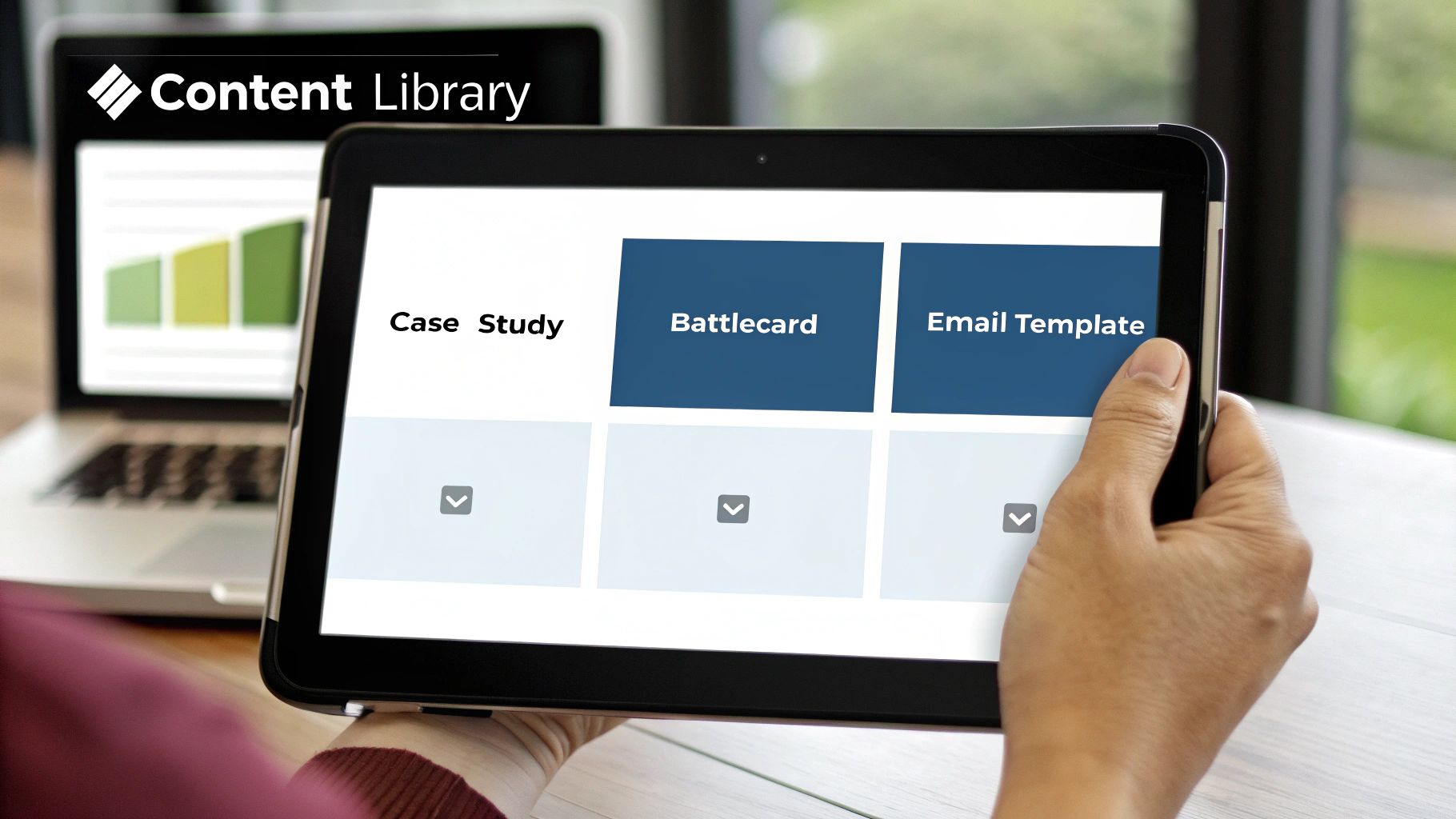
This practice is essential for scaling sales operations and maintaining message consistency across the entire customer journey. When content is organized by industry, use case, and deal stage, reps can quickly find the perfect asset to address a prospect's specific needs, accelerating deal velocity. For example, platforms like Highspot or Seismic provide intelligent content management systems that not only store assets but also recommend the most effective content for specific sales scenarios based on historical performance data. This data-driven approach transforms a simple folder system into a strategic tool.
How to Implement a Content Library
To build a library that reps actually use, focus on accessibility, relevance, and continuous improvement. A well-managed library empowers the team to have more effective conversations.
- Start with High-ROI Assets: Begin by creating and organizing the content with the most immediate impact. Focus on competitive battlecards, key case studies, and proven email templates first.
- Establish Clear Ownership: Assign a dedicated owner or team to manage content creation, updates, and organization. This ensures the library remains current and valuable.
- Implement a Review Cadence: Schedule quarterly reviews to archive outdated materials, identify content gaps, and update existing assets with new data or messaging.
- Tag and Organize Intuitively: Use a consistent tagging system with clear naming conventions (e.g., by industry, product line, sales stage). This makes content easily searchable and discoverable.
7. Create a Multi-Channel Lead Capture Strategy
Relying on a single lead source, like your website's main contact form, creates a significant bottleneck for growth. A multi-channel lead capture strategy diversifies your pipeline by capturing prospects across all high-intent touchpoints, including landing pages, social media ads, webinars, chatbots, and events. This approach ensures you meet buyers where they are while centralizing all incoming leads into a single system for consistent qualification, routing, and visibility.
This tactic is a fundamental sales enablement best practice because it maximizes pipeline volume without sacrificing lead quality. When each channel feeds into a unified lead management system, sales and marketing gain a complete view of prospect activity and can measure channel effectiveness accurately. For example, a platform like Orbit AI allows you to deploy intelligent forms across websites, campaign landing pages, and paid ads, ensuring every submission is instantly qualified and routed. This consistency prevents leads from falling through the cracks and equips your sales team with a steady, predictable flow of opportunities from diverse sources.
How to Implement a Multi-Channel Strategy
To build an effective multi-channel engine, map your customer journey and standardize your capture and qualification process across every touchpoint.
- Map High-Intent Touchpoints: Identify all the places where prospects engage with your brand, such as social media, content downloads, and live chat. These are your prime locations for lead capture.
- Standardize Qualification: Apply consistent qualification criteria across all channels. A lead from a LinkedIn ad should be vetted with the same rigor as one from your website to maintain quality.
- Unify Lead Routing: Ensure all leads, regardless of source, are funneled into your CRM. Use automation to tag each lead with its original source for accurate attribution and reporting.
- Optimize for Each Channel: While qualification should be consistent, the user experience should be channel-specific. Optimize forms for mobile, create dedicated landing pages for campaigns, and use UTM parameters to track performance meticulously.
By diversifying your lead sources, you build a more resilient and scalable sales pipeline. This proactive approach ensures your team has ample opportunities to engage, nurture, and convert.
8. Establish Sales and marketing Alignment (SMA) Metrics and Feedback Loops
Sales and marketing misalignment is a primary cause of wasted resources and missed revenue targets. Establishing formal Sales and Marketing Alignment (SMA) creates a unified commercial team by building shared metrics, regular communication cadence, and structured feedback mechanisms. This system ensures both departments work from the same playbook, with a clear understanding of what defines a high-quality lead and how their combined efforts contribute to closing deals. By aligning on goals and processes, you eliminate friction and create a seamless customer journey from first touch to final sale.
This practice is foundational to effective sales enablement because it directly links marketing activities to sales outcomes. Instead of operating in silos, teams collaborate on everything from lead generation to win/loss analysis. For example, when sales provides direct feedback on which content assets are most effective in conversations, marketing can double down on creating similar, high-impact resources. This collaborative loop, as detailed in HubSpot's alignment playbooks, ensures that every marketing effort is laser-focused on empowering the sales team to succeed.
How to Implement SMA Metrics and Feedback Loops
To build a durable bridge between sales and marketing, focus on creating shared accountability and transparent communication channels.
- Define a Unified Lead Funnel: Collaboratively define the stages of the funnel (e.g., MQL, SQL) and establish strict, agreed-upon criteria for handoffs. This ensures marketing delivers leads that sales actually wants.
- Create a Shared Dashboard: Build a dashboard in your CRM or BI tool that tracks key metrics for both teams, such as lead-to-opportunity conversion rate, pipeline velocity, and customer acquisition cost (CAC).
- Implement Formal Feedback Loops: Use a simple process for sales to provide feedback on lead quality directly within the CRM. This could be a dropdown field or a quick form that marketing reviews weekly.
- Hold Regular Sync Meetings: Schedule weekly or bi-weekly meetings between sales and marketing leaders to review the shared dashboard, discuss lead quality, and strategize on upcoming campaigns.
By formalizing this partnership, you transform two separate functions into a single revenue-generating engine. If you're looking to strengthen this critical connection, you can find more strategies in our guide to sales and marketing alignment best practices.
9. Implement Territory and Account Planning for Focused Effort
Broad, untargeted sales efforts waste resources and lead to inconsistent results. Strategic territory and account planning directs your sales team’s focus toward the most valuable opportunities, ensuring maximum impact. This practice involves identifying high-potential accounts, assigning clear ownership, and coordinating multi-threaded selling efforts to engage entire buying committees, rather than just single contacts. It aligns sales and marketing efforts to concentrate firepower where it matters most.
This methodical approach is a pillar of effective sales enablement best practices because it transforms sales from a reactive to a proactive function. Instead of chasing any inbound lead, reps strategically pursue a defined list of target accounts that fit your Ideal Customer Profile (ICP). For instance, using platforms like Salesforce to define territories and then leveraging tools like Demandbase or Terminus for account-based marketing (ABM) execution allows you to orchestrate highly personalized campaigns. This ensures marketing warms up accounts before sales even makes the first call, dramatically increasing engagement and conversion rates.
How to Implement Territory and Account Planning
To roll out this practice, start small with a pilot group of target accounts and build a repeatable process before expanding your efforts.
- Define Your ICP and Select Targets: Start by defining your ICP with extreme clarity. Use this criterion to build an initial target account list of 20-30 companies before scaling.
- Map Key Stakeholders: For each target account, identify and map all potential decision-makers, influencers, and blockers within the buying committee.
- Coordinate Multi-Threaded Outreach: Create account-specific messaging and coordinate outreach across different stakeholders. A sales rep, a manager, and a C-level executive might all engage with their counterparts at the target company.
- Review and Balance Territories: Analyze territory performance quarterly. Adjust account distribution and territory boundaries based on market changes, rep performance, and pipeline generation to ensure equitable opportunities.
10. Create Continuous Sales Training and Enablement Programs
A one-time onboarding session isn’t enough to sustain high performance in a fast-evolving market. Continuous sales training ensures your team remains agile and effective by staying current on product updates, competitive shifts, and modern selling methodologies. Regular enablement activities, such as role-playing, skills workshops, and win-loss analysis, are essential for sharpening skills and reinforcing best practices, which directly translates to improved quota attainment and revenue growth.
This ongoing development is a critical sales enablement best practice because it builds a culture of continuous improvement. Instead of letting skills stagnate, you create a system where reps are constantly learning and adapting. For example, using a platform like Gong for conversation intelligence allows managers to review real sales calls and provide targeted coaching. This turns every sales interaction into a learning opportunity, helping reps refine their pitch, handle objections more effectively, and replicate the behaviors of top performers.
How to Implement Continuous Training
To build a successful continuous enablement program, focus on creating a blended learning experience that is relevant, engaging, and directly tied to performance outcomes.
- Create a Blended Learning Model: Combine different formats to cater to various learning styles. Use self-paced modules for product knowledge (like Salesforce Trailhead), live workshops for skill-building, and peer-to-peer mentoring for hands-on coaching.
- Leverage Call Recordings for Coaching: Implement a system for regular review of sales call recordings. Use these sessions to provide specific, actionable feedback on what went well and where improvements can be made.
- Develop Realistic Role-Play Scenarios: Base role-playing exercises on actual customer objections and competitive situations. This prepares reps for real-world conversations and builds their confidence in handling difficult scenarios.
- Measure Training Effectiveness: Track key performance metrics before and after training initiatives. Monitor metrics like conversion rates, deal size, and sales cycle length to measure the direct impact of your enablement programs on business results.
10-Point Sales Enablement Comparison
| Initiative | Implementation complexity | Resource requirements | Expected outcomes | Ideal use cases | Key advantages |
|---|---|---|---|---|---|
| Implement AI-Powered Lead Qualification and Scoring | Medium–High (data cleaning, model tuning) | Historical data, ML tooling, analyst/engineer time | Better lead prioritization, higher conversion, SDR efficiency | High-volume B2B pipelines, enterprise sales, scaling SDR teams | Automates qualification, focuses reps on high-probability deals |
| Create Seamless CRM and Marketing Automation Integrations | Low–Medium (standard), High for custom workflows | Integration engineers/admins, API access, mapping & testing | Real-time syncing, fewer errors, faster handoffs | Organizations using CRMs (Salesforce/HubSpot) needing automation | Eliminates manual entry, enables consistent workflows |
| Optimize Forms for Conversion, Speed, Accessibility, and Progressive Profiling | Medium (UX, conditional logic, testing) | UX/design, front-end dev, accessibility & performance testing | Higher completion rates, faster load times, better mobile UX | High-traffic sites, mobile-first audiences, multi-step data capture | Increases conversions, reduces friction, improves data quality |
| Establish Clear Lead Routing and Assignment Rules | Low–Medium (rule design and setup) | CRM admin, business stakeholders, monitoring | Faster assignment, balanced distribution, accountability | Teams with territories, multiple SDR/AE coverage | Ensures fair routing, reduces time-to-first-contact |
| Implement Real-Time Lead Enrichment and Context Building | Medium (API integrations, mapping) | Enrichment providers, integration engineering, compliance checks | Richer lead profiles, personalized outreach, faster qualification | B2B sales needing firmographics and intent signals | Provides immediate context, reduces discovery time |
| Build a Comprehensive Content Library for Sales Enablement | Low–Medium (organization, tooling) | Content creators, CMS/knowledge base, governance | Faster access to collateral, consistent messaging, better onboarding | Scaling sales teams, complex product portfolios | Centralizes assets, improves message consistency and rep efficiency |
| Create Multi-Channel Lead Capture Strategy | Medium–High (multiple channels, tracking) | Channel managers, marketing ops, analytics & integration support | Increased lead volume, diversified sources, channel insights | Demand generation programs, omnichannel campaigns | Diversifies acquisition, captures buyers across touchpoints |
| Establish Sales and Marketing Alignment (SMA) Metrics and Feedback Loops | Low–Medium (process and culture change) | Cross-functional time, shared dashboards, executive sponsorship | Improved lead quality, faster feedback-driven optimization | Organizations with sales/marketing handoff issues | Aligns goals, reduces finger-pointing, improves conversions |
| Implement Territory and Account Planning for Focused Effort | Medium (data-driven planning, coordination) | Sales strategy resources, account data, ABM tooling | Larger deal sizes, higher win rates, predictable pipeline | ABM/enterprise sales targeting high-value accounts | Focuses resources on high-value opportunities, improves ROI |
| Create Continuous Sales Training and Enablement Programs | Medium (program design and delivery) | Trainers, learning platforms (LMS), content and time investment | Reduced ramp time, improved skills, consistent messaging | High-turnover or rapidly scaling teams, complex products | Sustains performance, standardizes selling practices and coaching |
From Best Practices to Business Results
The journey from understanding sales enablement best practices to seeing tangible business results is a marathon, not a sprint. It’s a continuous commitment to building a cohesive, data-driven, and highly efficient revenue engine. The ten strategies we've explored, from AI-powered lead qualification to continuous sales training, are not isolated tactics; they are interconnected pillars of a robust sales enablement framework. Simply checking these items off a list won't unlock sustainable growth. The real transformation happens when these practices are woven into the very fabric of your company culture, creating a system where marketing and sales operate as a single, unified team.
The most critical takeaway is that modern sales enablement is proactive, not reactive. It's about anticipating the needs of your sales team and your customers before they even arise. This means building a content library that addresses objections before they are raised, creating playbooks that guide reps through complex scenarios, and implementing tools that provide context in real-time. It’s a strategic function dedicated to making every seller as effective as the very best performer on your team.
Your Actionable Roadmap to Implementation
To avoid becoming overwhelmed, prioritize implementation based on immediate impact. For most startups and scale-ups, the biggest leverage point is at the top of the funnel. If your lead capture, qualification, and routing processes are broken, even the most skilled sales team will struggle.
Start by focusing on these foundational elements:
- Optimize Lead Capture and Qualification: This is your ground zero. Implementing an intelligent tool like Orbit AI to automate qualification and scoring directly addresses the quality and speed of your pipeline. Fixing this first ensures that all subsequent efforts are built on a solid foundation of high-intent leads.
- Establish Sales and Marketing Alignment (SMA): Immediately schedule a recurring meeting between sales and marketing leaders. Define shared KPIs, establish a feedback loop for lead quality, and create a shared understanding of the Ideal Customer Profile (ICP). This alignment is the connective tissue for your entire revenue strategy.
- Build a Foundational Content Hub: Don't wait for a perfect, comprehensive library. Start with the top five most requested assets from your sales team, such as a compelling case study, a one-page product slick, or a competitive battle card. Use a simple, accessible system and build from there.
The True Value of a Mature Enablement Program
Implementing these sales enablement best practices moves your organization from a collection of individual efforts to a finely tuned system. The goal is to create a predictable and scalable growth model. When your sales reps have the right content, context, and training at their fingertips, they spend less time searching for information and more time selling. When marketing understands exactly what constitutes a sales-qualified lead, they can refine their campaigns to deliver higher-quality prospects. To effectively translate best practices into tangible business results, adopting a modern B2B demand generation strategy, particularly one that leverages webinars and smart content repurposing, is essential. This integrated approach ensures your enablement efforts are supported by a consistent flow of engaged, high-intent leads.
Ultimately, mastering sales enablement is about more than just closing deals faster. It’s about building a smarter, more agile, and more competitive organization. It’s about creating an environment where your sales team feels supported, confident, and equipped to win. The investment you make in these processes today will pay dividends in the form of increased revenue, improved team morale, and a significant competitive advantage in the market.
Ready to supercharge your lead qualification and build a truly efficient sales pipeline? See how Orbit AI can automate your lead capture and scoring, ensuring your sales team only talks to the most qualified prospects. Get started with Orbit AI today and turn your website traffic into revenue.


