

If you're building a modern SaaS product, internal tool, or customer-facing workflow, a drag-and-drop form builder often isn't enough. You need forms that talk to your backend, trigger custom logic, and sync data wherever it needs to go. API-first form builder platforms give developers and product teams exactly that flexibility, without being locked into a rigid UI or a walled-garden ecosystem.
The challenge is that not every platform is built the same. Some are genuinely architected API-first from the ground up. Others bolt on API access as an afterthought to an otherwise visual product. And a growing number are starting to layer in AI capabilities for lead scoring, routing, and qualification.
We've evaluated nine platforms on their API depth, developer documentation, webhook support, conditional logic, and suitability for high-growth teams that need both speed and control. Whether you're a developer building headless forms, a growth team qualifying leads at scale, or a product manager connecting form data to your CRM, here are the top API-first form builder platforms worth your attention.
1. Orbit AI
Best for: High-growth SaaS teams that need AI-powered lead qualification built directly into the form layer.
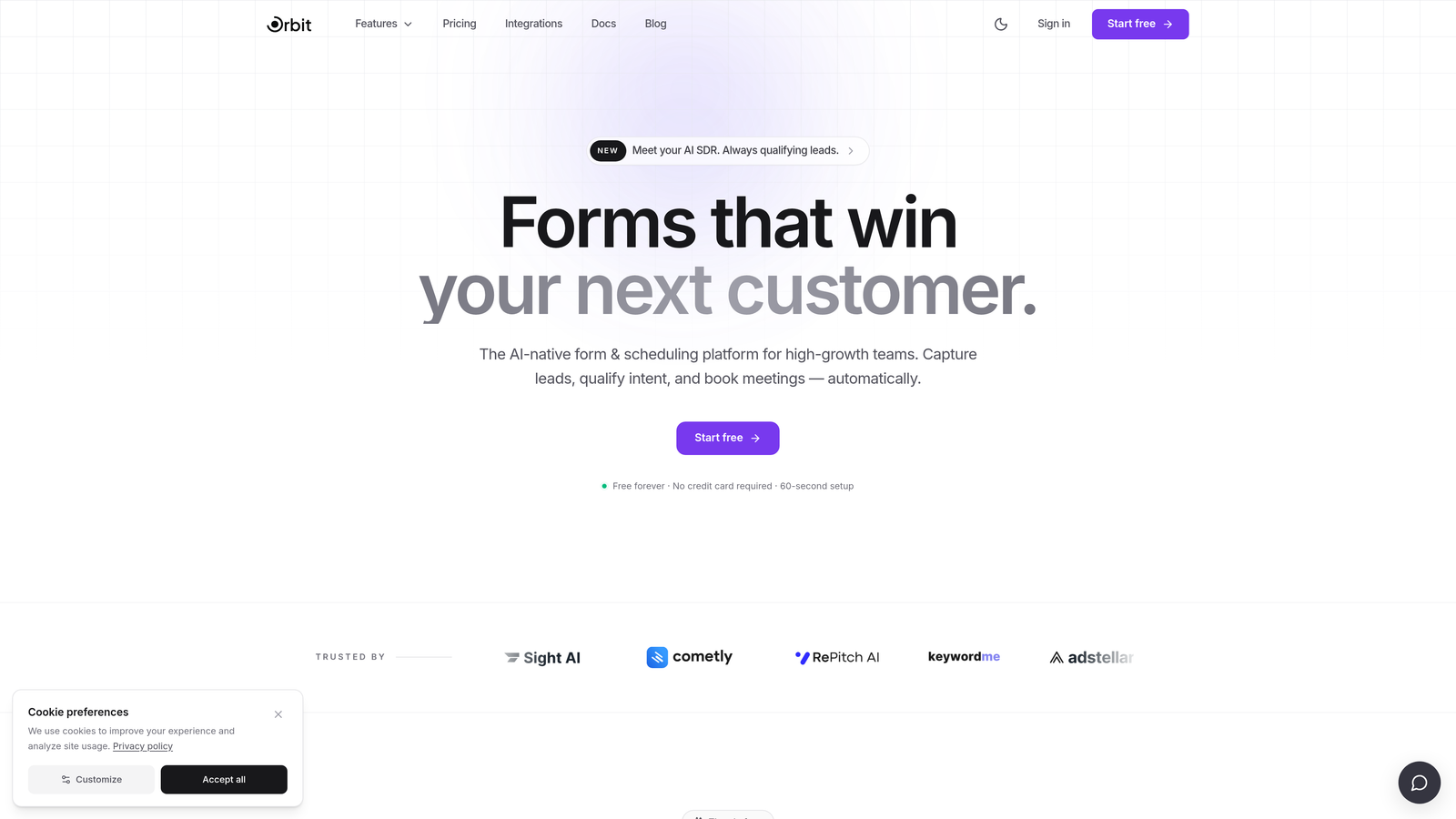
Orbit AI is an AI-powered form builder platform designed specifically for teams that treat forms as a lead generation engine, not just a data collection tool.
Where This Tool Shines
What sets Orbit AI apart from most platforms on this list is the native integration of lead qualification intelligence at the form layer itself. Rather than collecting raw submissions and routing them to a separate scoring tool, Orbit AI qualifies leads as they move through the form, enabling smarter routing and faster follow-up without additional middleware.
The platform is built with high-growth SaaS teams in mind, which means the design system is conversion-optimized by default. You're not starting from a blank canvas and hoping it performs. The REST API gives engineering teams clean programmatic access to submission data and lead scores, making it straightforward to sync with your CRM or custom backend.
Key Features
AI-Powered Lead Qualification: Scores and qualifies leads intelligently within the form flow, so your sales team only receives high-intent prospects.
REST API: Full API access for syncing form submissions, lead scores, and metadata to your CRM, database, or internal tools.
Conversion-Optimized Design System: Pre-built components and layouts engineered to maximize form completion rates.
Conditional Logic and Dynamic Routing: Personalize the form experience in real time based on user inputs, routing leads to the right follow-up path.
Webhook Support: Real-time delivery of submission events to any endpoint, enabling instant downstream automation.
Best For
Orbit AI is the strongest fit for SaaS companies and high-growth teams where lead quality matters as much as lead volume. If your sales team is drowning in unqualified form submissions, or you're trying to reduce time-to-contact for high-intent prospects, the built-in qualification layer makes a genuine difference. It also suits product teams who want a modern, developer-accessible form layer without building everything from scratch.
Pricing
Visit orbitforms.ai for current pricing tiers. The platform is designed to scale with growing teams.
2. Feathery
Best for: Developer teams who need full programmatic control over form logic and headless rendering.
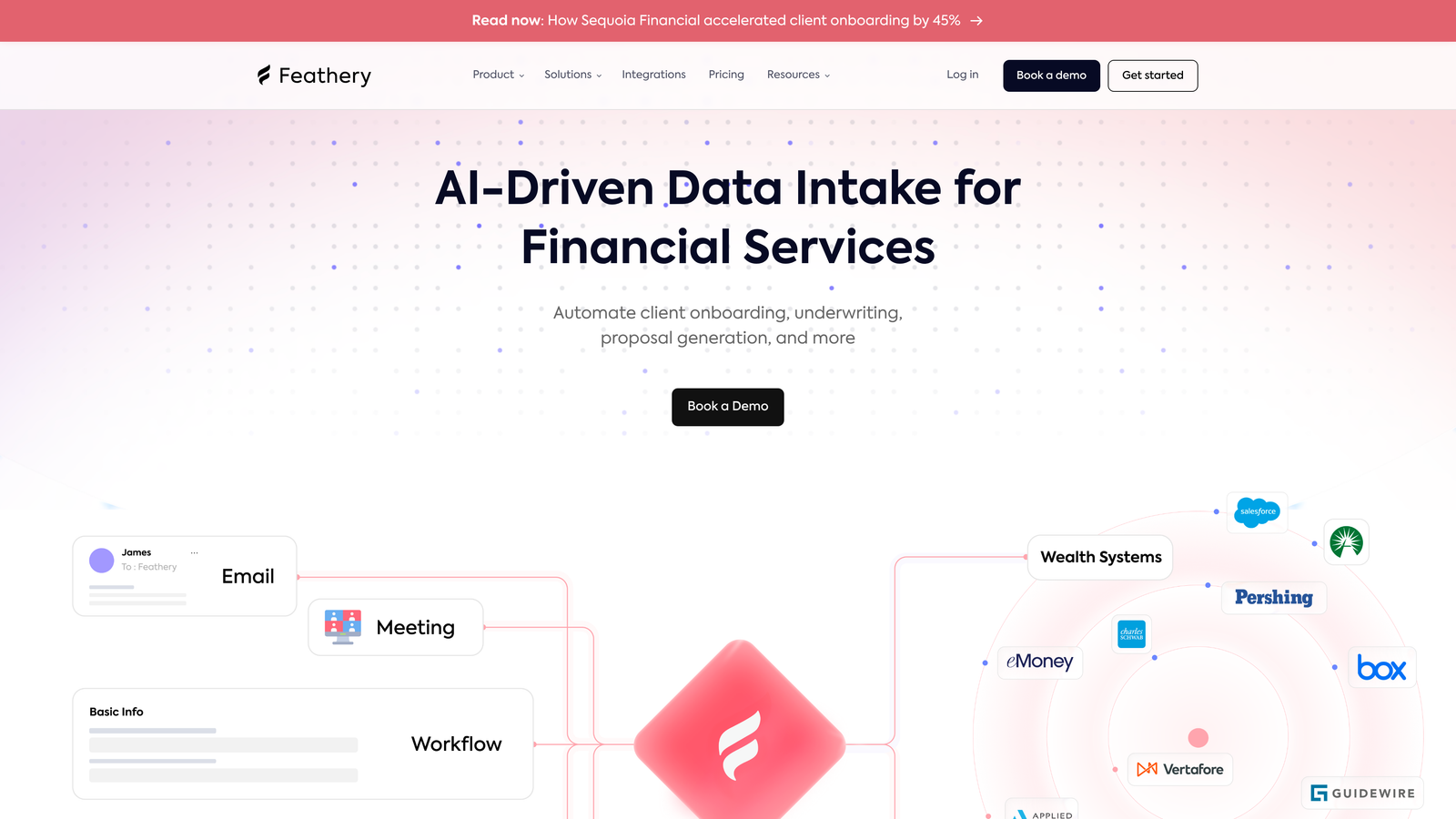
Feathery is a developer-first form platform with a React SDK, headless rendering capabilities, and deep programmatic control over every aspect of the form experience.
Where This Tool Shines
Feathery is genuinely architected for developers. The React SDK goes well beyond what most platforms offer, giving engineering teams the ability to control form state, trigger logic programmatically, and render forms headlessly within their own component architecture. This isn't just API access on top of a visual tool; it's a platform built with the developer workflow as the primary concern.
The platform also includes a visual editor for non-technical teammates, which makes it a strong choice for mixed teams where marketers need to make copy changes without filing a pull request. The documentation is thorough and well-maintained, which matters more than most teams realize until they're debugging a webhook at midnight.
Key Features
React SDK: Full programmatic control over form rendering and state management within your own React application.
Headless Rendering: Decouple form logic from presentation entirely, rendering forms within your own UI components.
Programmatic Conditional Logic: Control branching and step flow via code, not just a visual rule builder.
REST API and Webhooks: Standard API and webhook support for submission handling and downstream automation.
Visual Editor: Non-technical teammates can manage content and basic logic without touching code.
Best For
Engineering-led product teams building SaaS applications where forms need to feel native to the product experience. Feathery is particularly strong when you need forms embedded deeply within a React application and want full control over rendering and state.
Pricing
Free tier available. Paid plans for teams are available at feathery.io; check for current pricing as plans evolve.
3. Tally
Best for: Indie teams and startups that need quick, clean forms with webhook support and a generous free tier.
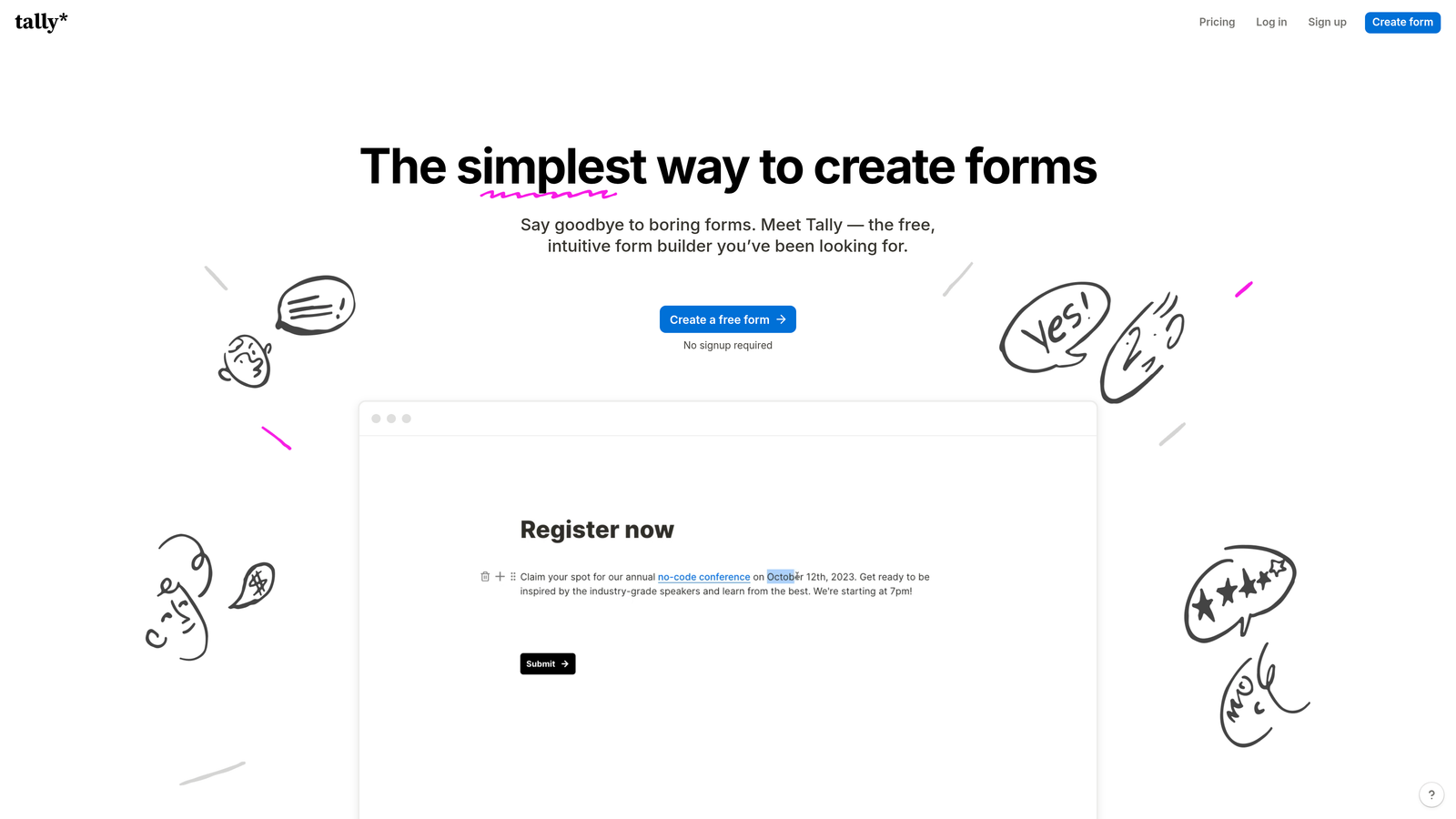
Tally is a Notion-inspired form builder with a clean, block-based editing experience and a free plan that's genuinely useful, not artificially limited.
Where This Tool Shines
Tally has earned a strong following in the startup and indie maker community because its free plan includes unlimited forms and responses, which is rare in this space. The editing experience feels familiar to anyone who uses Notion, making it fast to get up and running without a learning curve.
From an API and automation standpoint, Tally is accessible rather than deeply developer-first. Webhook support enables real-time submission delivery, and Zapier and Make integrations cover most common automation workflows. The API is functional for data retrieval but doesn't offer the depth of a platform like Feathery or Reform.
Key Features
Unlimited Free Plan: Create unlimited forms and collect unlimited responses on the free tier, with no artificial caps.
Webhook Support: Real-time submission delivery to any endpoint for triggering downstream workflows.
Zapier and Make Integrations: Connect to hundreds of apps without writing code.
Embeddable Forms: Clean embed options for websites and web applications.
Basic API: REST API for retrieving submission data programmatically.
Best For
Early-stage startups, indie makers, and small teams that need clean, functional forms quickly and want to avoid monthly costs. Also a strong choice for internal tools where deep API integration isn't required.
Pricing
Free tier with full functionality. Tally Pro unlocks additional features; check tally.so for current pricing.
4. Typeform
Best for: Teams that prioritize conversational form UX and need a well-documented REST API for response management.
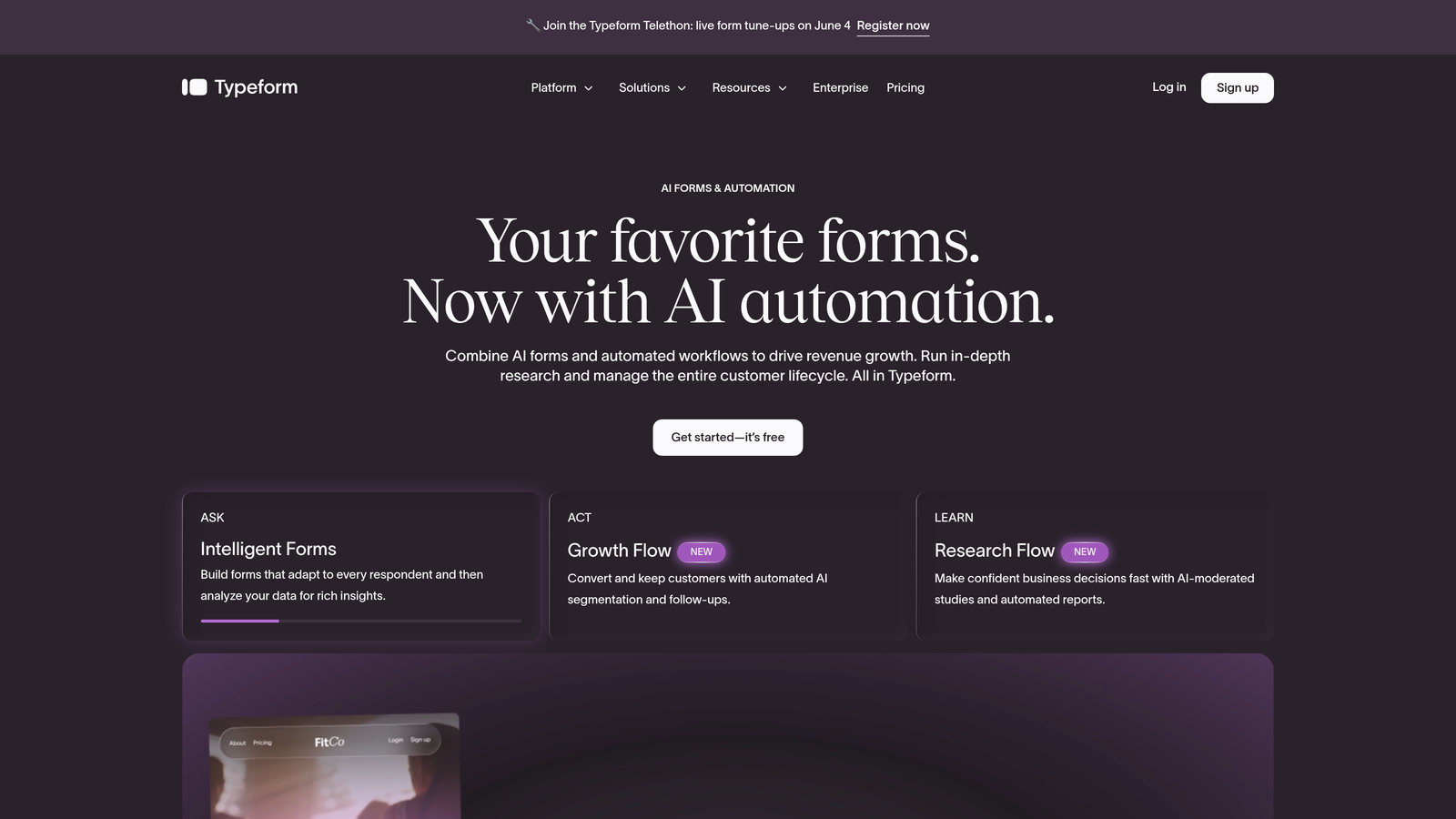
Typeform is one of the most recognized form platforms globally, known for its one-question-at-a-time conversational interface and a solid, well-documented REST API.
Where This Tool Shines
Typeform's conversational UX remains a genuine differentiator for use cases where completion rate and user experience matter, such as surveys, onboarding flows, and customer research. The one-question-at-a-time format consistently outperforms traditional multi-field forms in engagement-sensitive contexts.
The REST API covers form management, response retrieval, and webhook configuration, making it accessible for teams that need to pull data into their own systems. That said, Typeform is fundamentally a UX-first platform with API access layered on top, rather than a developer-first architecture. Teams with heavy programmatic requirements may find the API capable but not deeply flexible.
Key Features
Conversational UX: One-question-at-a-time format that drives higher engagement in survey and research contexts.
REST API: Documented endpoints for form management, response retrieval, and webhook configuration.
Logic Jumps: Conditional branching based on user responses to personalize the form path.
Webhook Support: Real-time notifications on new submissions for downstream automation.
Large Integration Ecosystem: Native connections to Salesforce, HubSpot, Slack, and many more.
Best For
Marketing and product teams that prioritize form completion rates and conversational UX, and need API access for CRM sync or data retrieval without requiring deep programmatic control.
Pricing
Free tier available. Paid plans start at approximately $25/month; check typeform.com for current pricing.
5. Formstack
Best for: Enterprise and regulated-industry teams that need HIPAA compliance, Salesforce integration, and a comprehensive REST API.
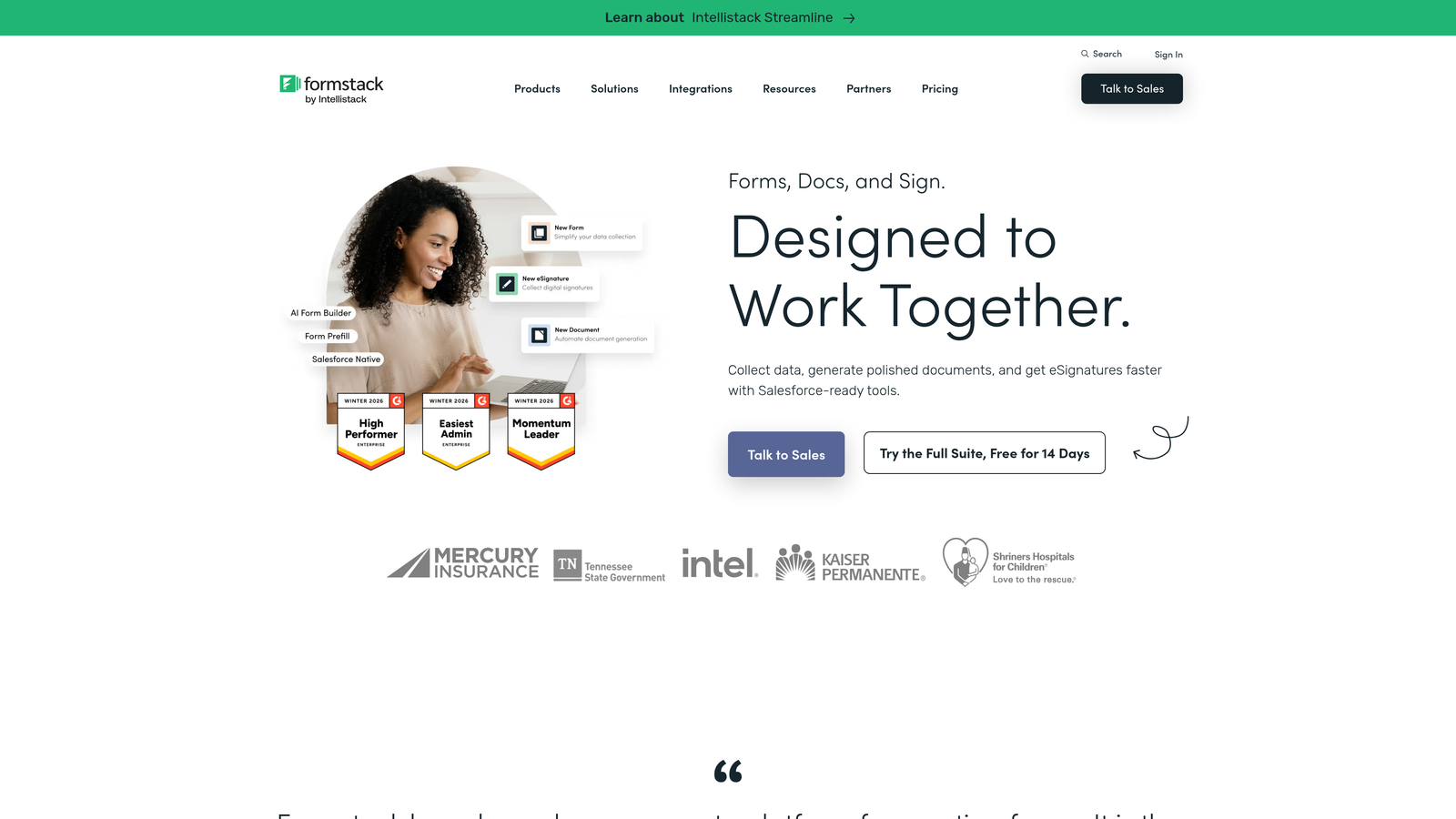
Formstack is an enterprise-grade form platform built for organizations that operate in regulated environments and need forms that connect deeply with enterprise CRM systems.
Where This Tool Shines
Formstack's strongest differentiator is its compliance posture. HIPAA-compliant data handling, audit trails, and compliance reporting make it one of the few form platforms that can be deployed confidently in healthcare, finance, and legal contexts. This isn't a feature bolted on for marketing purposes; it's core to how the platform is architected.
The REST API is thorough, with broad endpoint coverage across forms, submissions, fields, and workflows. The native Salesforce integration is particularly deep, going beyond basic field mapping to support more complex CRM workflows. For enterprise teams, this level of integration fidelity matters significantly.
Key Features
HIPAA-Compliant Data Handling: Purpose-built compliance infrastructure for regulated industries including healthcare and finance.
Comprehensive REST API: Broad endpoint coverage for forms, submissions, fields, and workflow automation.
Native Salesforce Integration: Deep CRM connectivity beyond basic field mapping.
Advanced Workflow Routing: Approval workflows and multi-step routing for complex internal processes.
Audit Trails: Full compliance reporting and activity logging for regulated environments.
Best For
Enterprise organizations and teams operating in regulated industries where compliance, audit trails, and deep CRM integration are non-negotiable requirements. Not the right fit for lightweight use cases or early-stage teams on tight budgets.
Pricing
Pricing is suited to enterprise budgets. Check formstack.com for current plan details.
6. Paperform
Best for: Marketing teams that need highly flexible form and landing page design with webhook automation and payment collection.
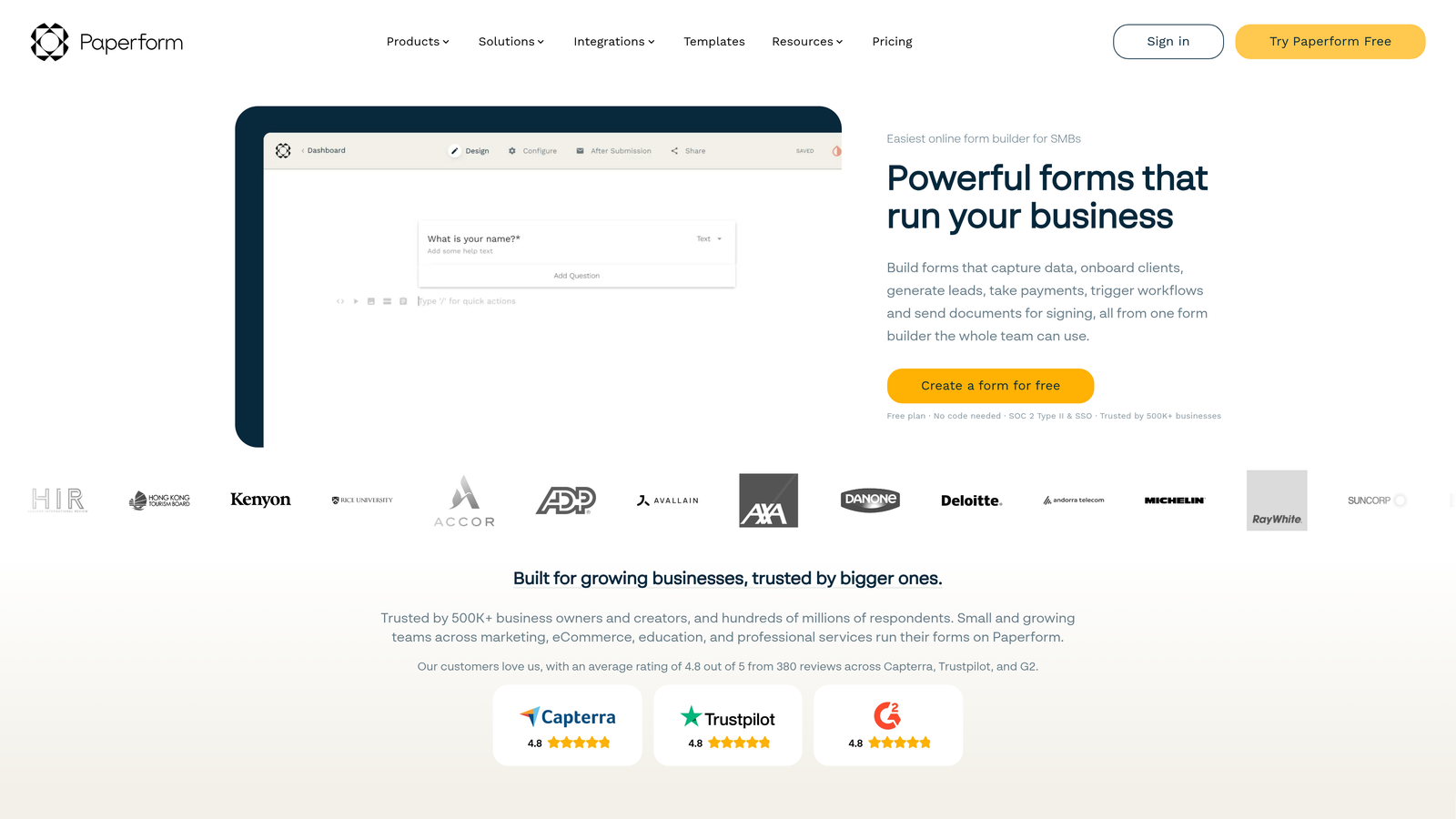
Paperform is a flexible form and mini-landing-page builder that blends content, design, and form functionality into a single canvas, with REST API access available on higher-tier plans.
Where This Tool Shines
Paperform occupies an interesting niche: it's as much a landing page builder as it is a form tool. You can mix rich text, images, video, and form fields on a single canvas, which makes it particularly useful for product launches, event registrations, or any scenario where the form needs to sell as well as collect.
The design flexibility is genuinely impressive compared to most form platforms, with extensive branding and layout control. Webhook and Zapier integrations cover most automation needs, and the REST API on higher-tier plans enables programmatic access for teams that need it. That said, Paperform is more marketing-oriented than developer-oriented.
Key Features
Flexible Canvas Design: Mix content, media, and form fields on a single page with extensive branding control.
Payment Collection: Built-in Stripe integration for collecting payments directly within forms.
Webhook and Zapier Support: Automation connectivity for real-time submission handling.
REST API: Programmatic access available on Paperpro and above plans.
Conditional Logic: Show or hide sections dynamically based on user responses.
Best For
Marketing teams, solopreneurs, and small businesses that need beautiful, flexible forms with payment collection and don't require deep API integration. Also strong for event registration and product launch pages.
Pricing
Plans start at approximately $24/month. Check paperform.co for current pricing tiers.
7. JotForm
Best for: Teams that need high submission volume capacity and one of the broadest native integration ecosystems available.
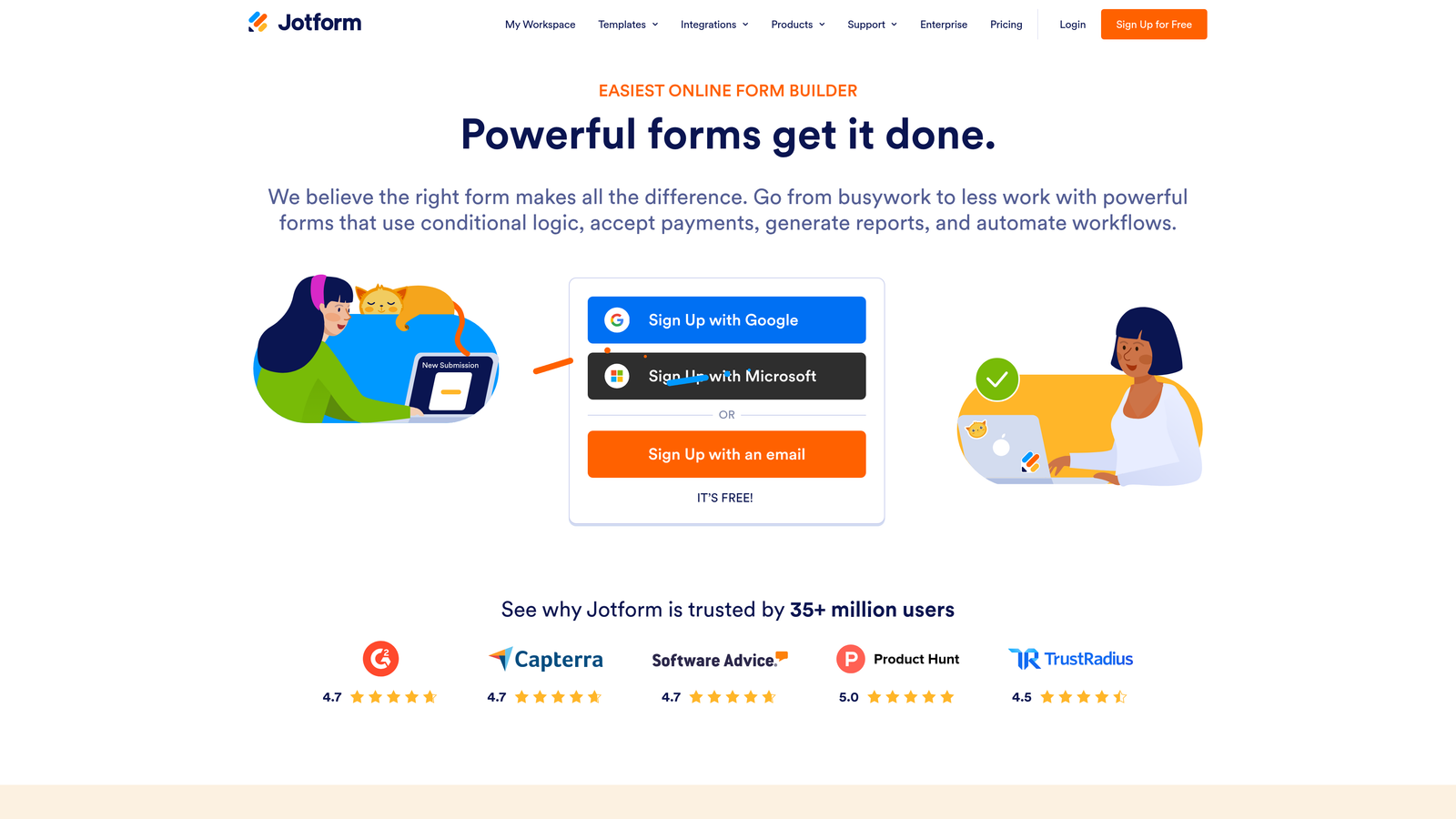
JotForm is one of the largest form platforms by user base, offering an extensive REST API, over 150 native integrations, and high-volume submission tiers for enterprise use cases.
Where This Tool Shines
JotForm's breadth is its defining characteristic. The REST API is well-documented with broad endpoint coverage, and the native integration library is among the most extensive in the market. If your team uses a niche CRM, payment processor, or project management tool, JotForm likely has a native connector for it.
The platform also supports HIPAA-compliant plans, making it accessible for healthcare-adjacent use cases without the enterprise price tag of Formstack. The tradeoff is that JotForm can feel heavyweight for simpler use cases, and the interface has accumulated complexity over years of feature additions.
Key Features
Extensive REST API: Well-documented API with broad endpoint coverage for forms, submissions, and user management.
150+ Native Integrations: One of the largest native integration libraries in the form builder market.
High Submission Volume Tiers: Plans designed to handle large-scale form deployments without hitting caps.
HIPAA-Compliant Plans: Compliance-ready options for healthcare and regulated industries.
Conditional Logic and Multi-Page Forms: Advanced form logic for complex multi-step workflows.
Best For
Mid-market and enterprise teams that need high submission volumes, broad integration coverage, and a mature API. Also suitable for organizations in regulated industries that need HIPAA compliance without a full enterprise platform budget.
Pricing
Free tier available. Paid plans start at approximately $34/month; check jotform.com for current pricing.
8. Fillout
Best for: Data-driven teams that need native two-way database sync with Airtable, Notion, or Supabase alongside a clean API layer.
Fillout is a modern form builder that has gained traction for its native two-way sync capabilities with popular no-code databases and a clean, well-designed API layer.
Where This Tool Shines
Fillout's standout capability is the native two-way sync with Airtable, Notion, and Supabase. Most form tools push data into these platforms via Zapier or webhooks. Fillout connects directly, enabling forms to read from and write to these databases natively. For teams that have built their operations around Airtable or Notion, this is a significant workflow improvement.
The platform has a clean, modern UI that makes it easy for non-technical team members to build forms without friction, while the REST API and webhook support give developers the programmatic access they need. It's a strong example of the no-code plus API hybrid that high-growth teams increasingly demand.
Key Features
Native Two-Way Database Sync: Direct integration with Airtable, Notion, and Supabase for reading and writing data without middleware.
REST API: Clean API for form and submission management.
Conditional Logic and Branching: Dynamic form paths based on user responses.
Scheduling and Payment Integrations: Built-in support for booking and payment collection use cases.
Modern Form UI: Clean, contemporary design that performs well across devices.
Best For
Product and operations teams that have built their workflows around Airtable, Notion, or Supabase and want forms that integrate natively rather than through automation layers. Also a strong choice for teams that need scheduling or payment collection alongside standard form functionality.
Pricing
Free tier available. Paid plans start at approximately $19/month; check fillout.com for current pricing.
9. Reform
Best for: SaaS product teams that need a lightweight, API-first embeddable form with minimal bundle size and fast load times.
Reform is a lightweight, embeddable form tool built with an API-first philosophy and a minimal footprint designed specifically for embedding within SaaS products.
Where This Tool Shines
Reform is built for a specific scenario: you're a SaaS product and you need forms that feel native to your application, load fast, and don't add bloat to your bundle. The API-first architecture means the developer experience is central, not an add-on. Clean REST endpoints, React and vanilla JS embed options, and webhook support for submission events give developers exactly what they need without unnecessary complexity.
The tradeoff is intentional: Reform has a smaller feature set than enterprise platforms like JotForm or Formstack. There are no 150-integration libraries or HIPAA compliance certifications here. But for the team that needs a focused, performant, embeddable form layer, the simplicity is a feature rather than a limitation.
Key Features
API-First Architecture: Clean REST endpoints designed for developer workflows, not bolted on after the fact.
Flexible Embed Options: React component and vanilla JS embed for maximum compatibility across tech stacks.
Minimal Bundle Size: Fast load times and small footprint, critical for performance-conscious SaaS products.
Webhook Support: Real-time submission event delivery for downstream automation.
Focused Feature Set: Deliberately streamlined to avoid complexity that slows down development.
Best For
SaaS product teams and developers who need embeddable forms that load fast, feel native to their application, and offer clean API access without the overhead of a full enterprise form platform. Best suited to teams where developer experience is the primary evaluation criterion.
Pricing
Check reform.app for current pricing details.
Which Platform Is Right for Your Team?
The right API-first form builder depends heavily on what your team actually looks like and what you're trying to accomplish.
If lead qualification and conversion optimization are your primary goals, Orbit AI is the strongest choice. The built-in AI qualification layer eliminates the need for a separate scoring tool, and the REST API makes it straightforward to push qualified lead data directly to your CRM or backend. It's purpose-built for the high-growth SaaS use case in a way that generalist platforms aren't.
If you're building forms that need to live inside a React application with full programmatic control, Feathery is the developer-first option worth evaluating seriously. For lightweight SaaS embeds where performance is critical, Reform is the focused, minimal-footprint alternative.
For teams operating in regulated industries, Formstack or JotForm's HIPAA-compliant plans are the sensible choices. If your workflow is built around Airtable or Notion, Fillout eliminates a layer of integration complexity that other platforms can't match natively.
And if you're an early-stage team that needs clean, functional forms without a monthly bill, Tally remains one of the most generous free options in the market.
For most high-growth SaaS teams, the combination of AI-powered qualification, conversion-optimized design, and clean API access makes Orbit AI the platform to start with. Start building free forms today and see how intelligent form design can transform your lead generation from a data collection exercise into a genuine competitive advantage.


