

If you're building a product or workflow that needs forms to talk to the rest of your stack, a basic drag-and-drop builder won't cut it. You need an API form builder solution: one that lets you programmatically create forms, pipe submissions into your CRM, trigger automations, and qualify leads without manual intervention.
This list covers the top options available in 2026, evaluated on API depth, developer experience, native integrations, and how well each tool supports conversion optimization at scale. Whether you're a SaaS team embedding forms into your product, a growth team automating lead routing, or an agency managing forms across dozens of clients, there's a solution here for your use case.
If you want to learn more about building forms that actually convert, check out our guides on how to build effective web forms and how to improve form conversion rates.
1. Orbit AI
Best for: High-growth SaaS and B2B teams that need lead qualification built into the form layer
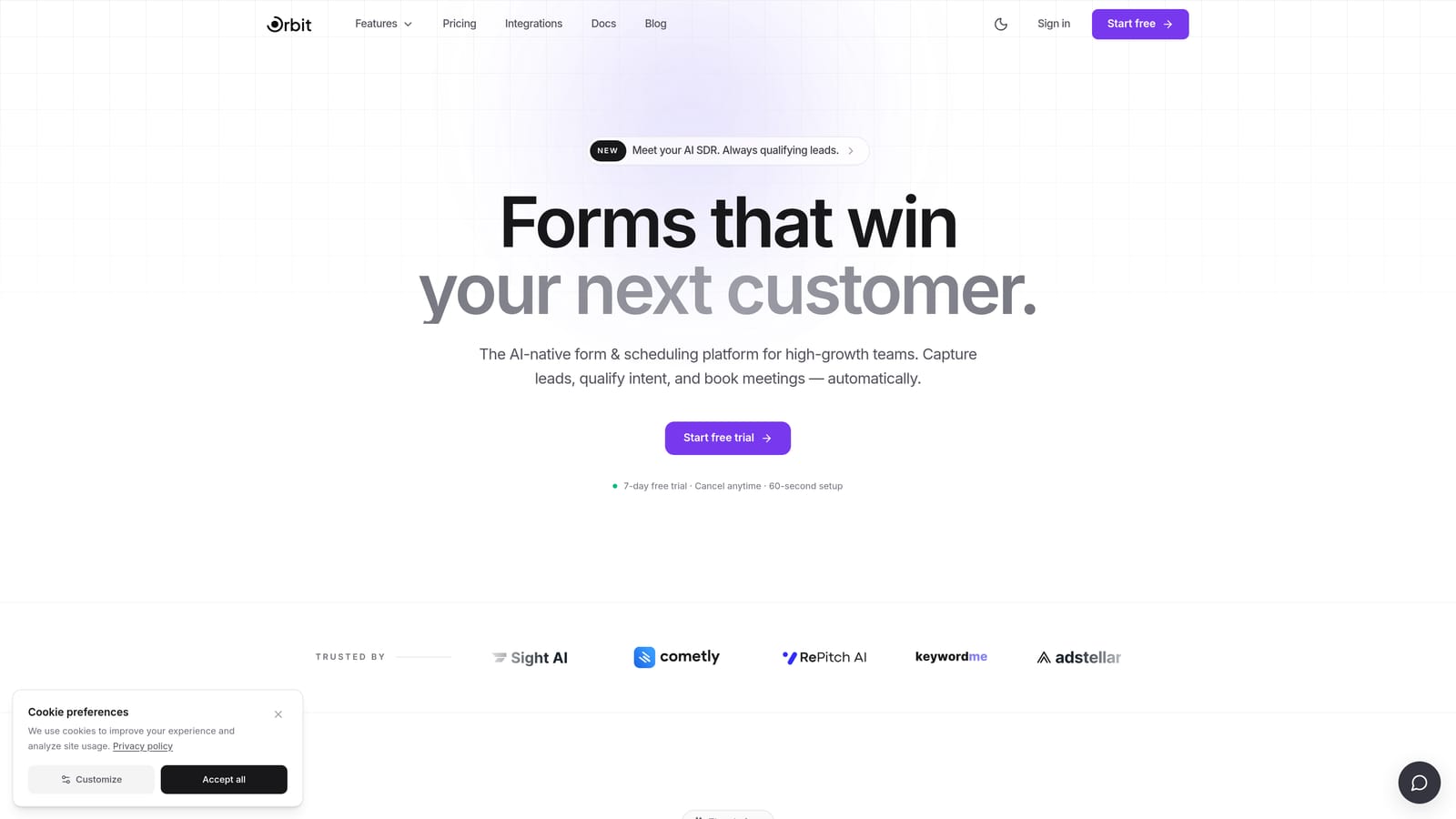
Orbit AI is an AI-powered form builder designed for teams that care about lead quality, not just lead volume.
Where This Tool Shines
Most form builders treat lead qualification as a downstream problem: you collect the submission, push it to your CRM, and let sales or marketing figure out who's worth pursuing. Orbit AI flips that model by handling qualification at the form layer itself. That means smarter routing, cleaner data, and less time wasted on leads that were never going to convert.
The platform is also built with conversion optimization as a first-class concern. Forms look polished and modern out of the box, and dynamic logic ensures each respondent sees a personalized experience rather than a one-size-fits-all questionnaire. For RevOps and growth teams tired of duct-taping together form tools with CRM workflows, this is a genuinely different approach.
Key Features
AI-Powered Lead Qualification: Qualification happens at the form layer, not after submission, so your CRM receives pre-scored, pre-routed leads automatically.
API and Webhook Support: Connect form submissions directly to CRMs, marketing automation platforms, and data pipelines without middleware overhead.
Conversion-Optimized Design: Beautiful, modern form UI out of the box with no design work required from your team.
Dynamic Logic and Conditional Fields: Personalize the form experience for each respondent based on their answers, segment, or source.
Built for B2B and SaaS Workflows: The platform's assumptions and defaults are tuned for teams where lead quality directly impacts revenue, not just lead volume.
Best For
Orbit AI is the strongest fit for SaaS companies, B2B growth teams, and RevOps professionals who want lead qualification to happen automatically, before a lead ever touches a sales queue. If your current process involves manually reviewing form submissions or building complex CRM rules to filter bad leads, this tool addresses the problem at the source.
Pricing
Visit orbitforms.ai for current pricing plans. A free option is available to get started.
2. Typeform
Best for: Teams that want conversational form UX paired with a well-documented REST API
Typeform is a conversational form builder known for its one-question-at-a-time format and a solid developer API for programmatic form management.

Where This Tool Shines
Typeform's defining characteristic is its UX philosophy: by showing one question at a time, it creates a more focused, less overwhelming experience that tends to improve completion rates compared to traditional long-form layouts. That UX advantage is well-established, and it holds up especially well for surveys, onboarding flows, and lead capture forms where friction is the enemy.
On the developer side, Typeform offers a REST API that covers form management, response retrieval, and webhook configuration. API access is gated to paid plans, with higher tiers unlocking more API calls. For teams that need real-time submission processing, webhooks make it straightforward to trigger downstream automations the moment a form is completed.
Key Features
REST API: Manage forms, retrieve responses, and configure webhooks programmatically with thorough documentation.
Conversational UX: One-question-at-a-time format designed to reduce abandonment and improve completion rates.
Logic Jumps: Conditional branching lets you build personalized form paths based on respondent answers.
Native CRM Integrations: Connects directly to major CRMs and marketing platforms without requiring middleware.
Webhooks: Real-time submission triggers for feeding data into downstream systems immediately after a form is completed.
Best For
Typeform suits marketing teams, product teams, and developers who want a polished conversational experience combined with reliable API access. It's a particularly strong choice for lead generation, customer research, and onboarding flows where UX quality directly affects completion rates.
Pricing
Free plan available. Paid plans start at approximately $25/month. Verify current pricing at typeform.com.
3. Jotform
Best for: Enterprises and agencies that need one of the most comprehensive form APIs in the market
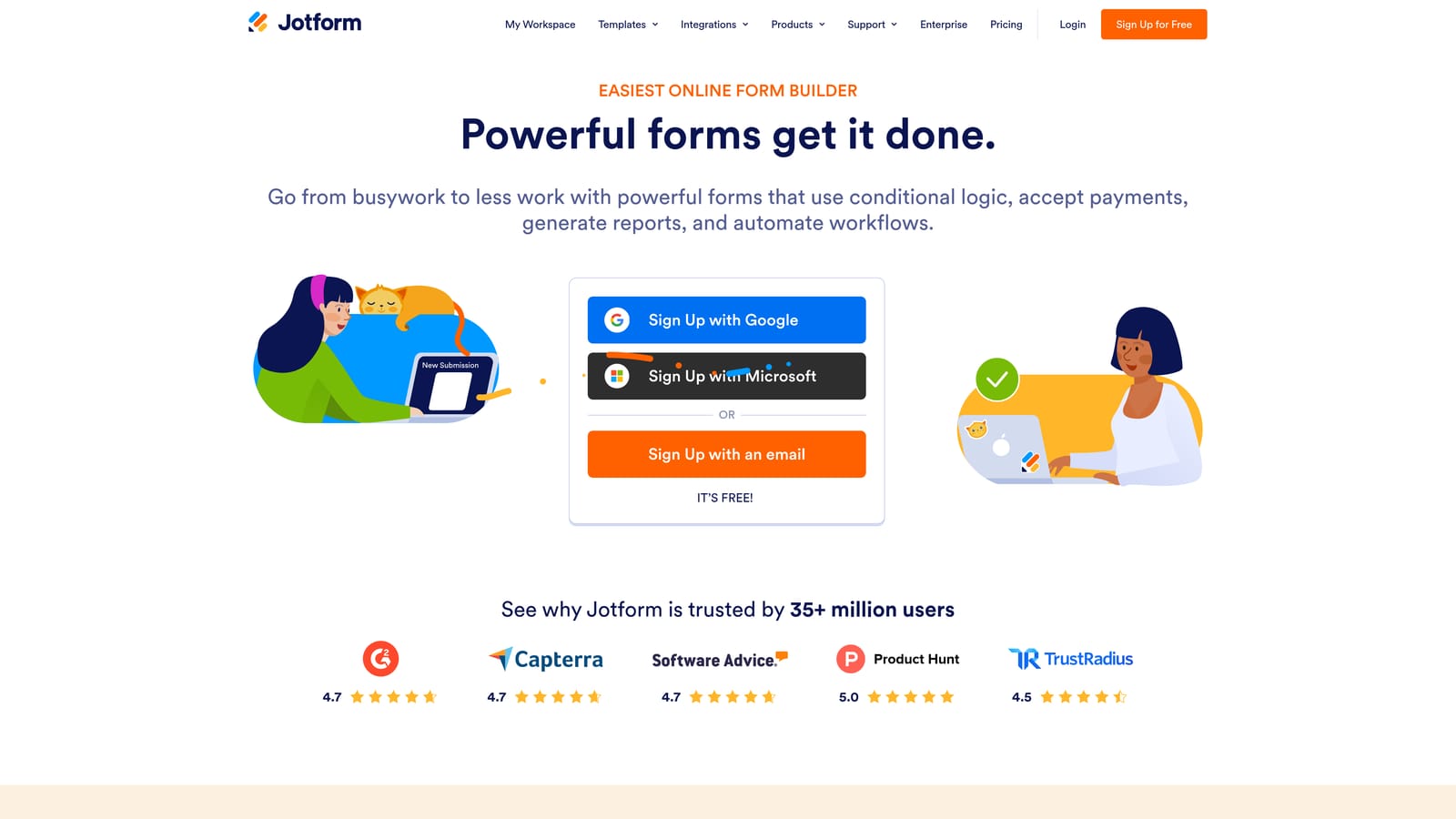
Jotform is a feature-rich form builder with an extensive REST API that covers nearly every aspect of form and submission management.
Where This Tool Shines
Where many form builders offer API access as an afterthought, Jotform has built out one of the most thorough developer experiences in the category. The API covers form creation, submission retrieval, file uploads, and user management, and the platform provides an API playground for testing calls before you write a single line of production code. That kind of developer infrastructure matters when you're building integrations that need to be reliable at scale.
Jotform also wins on breadth. The native integration library is extensive, covering CRMs, payment processors, productivity tools, and more. Enterprise plans support high submission volumes, which makes it a practical choice for agencies managing forms across many clients or large organizations processing significant form traffic.
Key Features
Extensive REST API: Covers form CRUD operations, submission retrieval, file uploads, and user management in a single, well-documented API.
API Playground: Test API calls interactively before integrating them into your codebase.
High Submission Volume Limits: Enterprise plans are built for organizations processing large amounts of form data.
Wide Native Integration Library: Connects with CRMs, payment processors, and productivity tools without requiring Zapier or Make.
Advanced Form Logic: Conditional logic, calculation fields, and a wide library of form widgets for complex use cases.
Best For
Jotform is the right choice for enterprises, agencies, and development teams that need deep API access, high submission volumes, and a broad integration ecosystem. If your team is building custom integrations or managing forms programmatically at scale, Jotform's developer tooling is among the most mature in this category.
Pricing
Free plan available. Paid plans start at approximately $34/month. Verify current pricing at jotform.com.
4. Formstack
Best for: Operations-heavy teams that need forms as part of a broader workflow automation and document platform
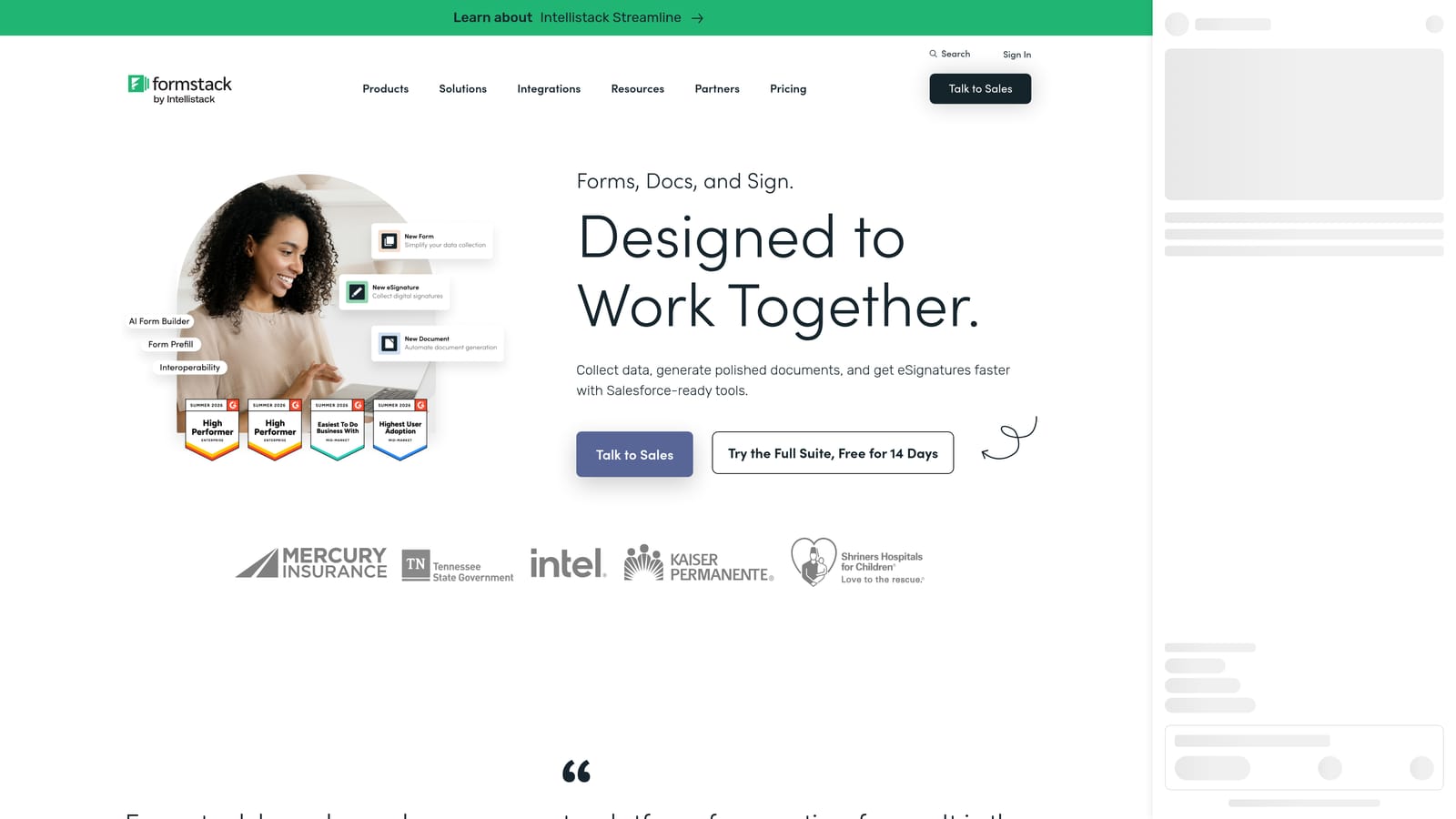
Formstack is a workflow-focused platform where forms are the entry point into a broader ecosystem that includes document generation, e-signatures, and multi-step process automation.
Where This Tool Shines
Formstack's differentiation isn't just the form builder: it's the ecosystem around it. The platform includes Formstack Documents for generating pre-filled documents from form submissions and Formstack Sign for collecting e-signatures, and all of these components are API-connectable. For teams in regulated industries or operations-heavy functions like HR, legal, and compliance, that end-to-end capability in a single platform is genuinely valuable.
The core form API handles submission management and webhook triggers, and native integrations with Salesforce, HubSpot, and other enterprise platforms mean your form data flows directly into the systems your team already uses. The higher price point reflects the platform's broader scope rather than just the form builder component.
Key Features
REST API with Webhook Support: Programmatic form and submission management with real-time triggers for downstream workflows.
Built-in Workflow Automation: Route submissions through multi-step approval and review processes without external tools.
Formstack Documents and Sign: Generate pre-filled documents and collect e-signatures as part of the same platform, all API-accessible.
Compliance and Security Features: Built for regulated industries with controls appropriate for healthcare, legal, and financial use cases.
Enterprise CRM Integrations: Native connections to Salesforce, HubSpot, and other enterprise platforms.
Best For
Formstack is best suited for operations teams, compliance-focused organizations, and enterprises that need forms to trigger complex multi-step workflows. If your use case extends beyond data collection into document generation or e-signature collection, Formstack's integrated platform eliminates the need to stitch together multiple tools.
Pricing
Plans start at approximately $83/month. Enterprise pricing is available. Verify current pricing at formstack.com.
5. Paperform
Best for: Teams that want design flexibility and broad integration connectivity without dedicated developer resources
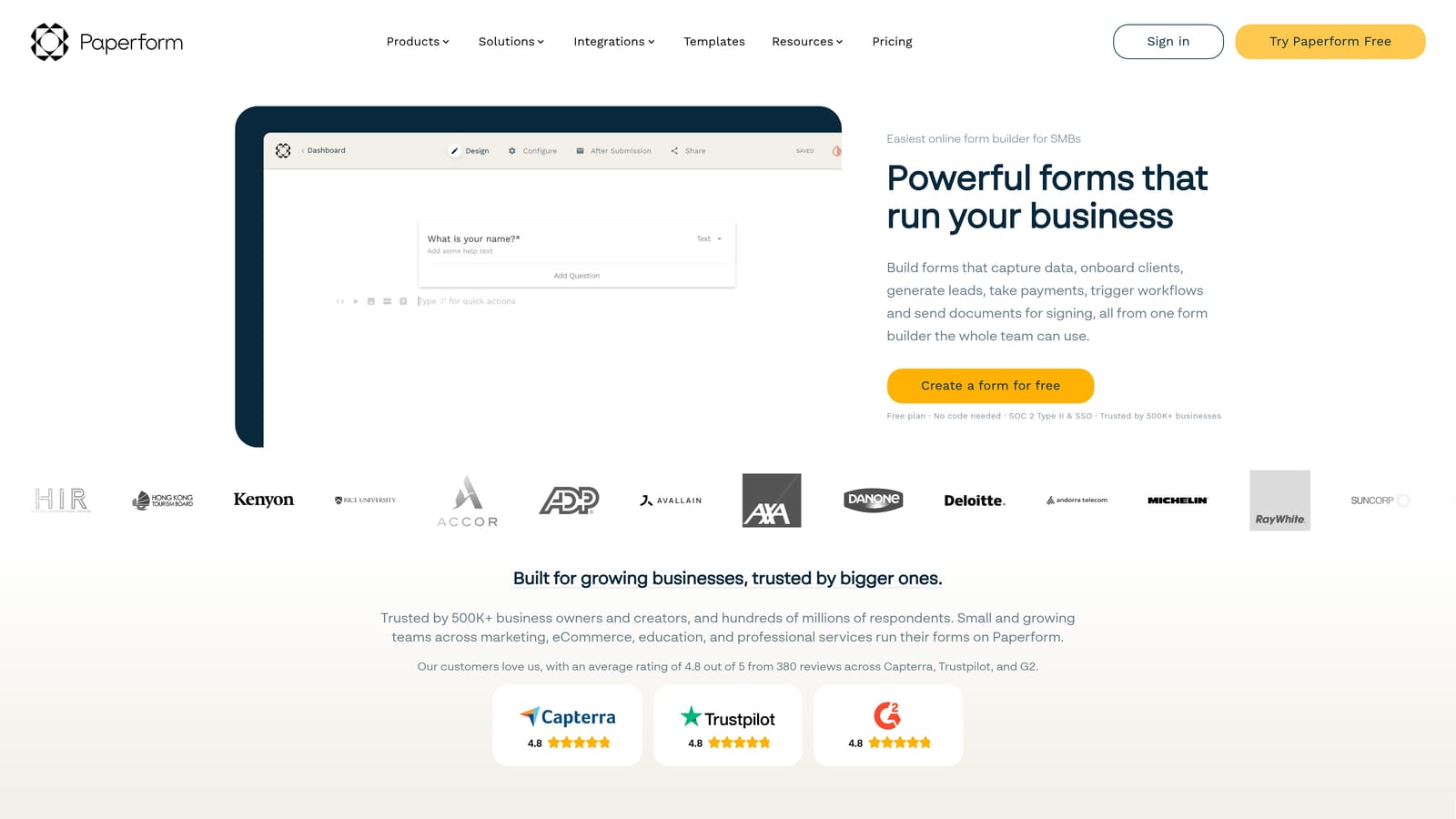
Paperform is a flexible form builder with a freeform, document-style editor that blends form fields with rich text, images, and video.
Where This Tool Shines
Paperform's editor is genuinely different from most form builders. Rather than working within a rigid field-by-field structure, you build forms the way you'd build a document: mixing text, media, and form elements freely on the same canvas. The result is forms that feel more like branded landing pages than traditional data collection tools, which can make a meaningful difference for customer-facing use cases where presentation matters.
For teams without dedicated developers, Paperform's strength in the Zapier and Make ecosystem means you can connect form submissions to virtually any external system without writing code. Native payment integrations with Stripe, PayPal, and Square make it a practical choice for teams that need to collect payments alongside form data.
Key Features
API and Webhook Support: Connect form submissions to external systems programmatically or via real-time webhook triggers.
Freeform Editor: Mix form fields with rich text, images, and video in a document-style canvas for highly customized form designs.
Conditional Logic and Calculations: Dynamic form behavior based on respondent answers, including calculated fields.
Native Payment Integrations: Accept payments via Stripe, PayPal, and Square directly within forms.
Zapier and Make Connectivity: Extensive middleware integration ecosystem for teams that prefer no-code automation over direct API development.
Best For
Paperform works well for marketing teams, small agencies, and growth teams that want visually distinctive forms with solid integration capabilities but don't have developer resources to build custom API integrations. The freeform editor is a genuine competitive advantage for teams where form aesthetics are part of the brand experience.
Pricing
Plans start at approximately $24/month. Verify current pricing at paperform.co.
6. Tally
Best for: Startups and developers who want clean, functional forms with webhook support on a free plan
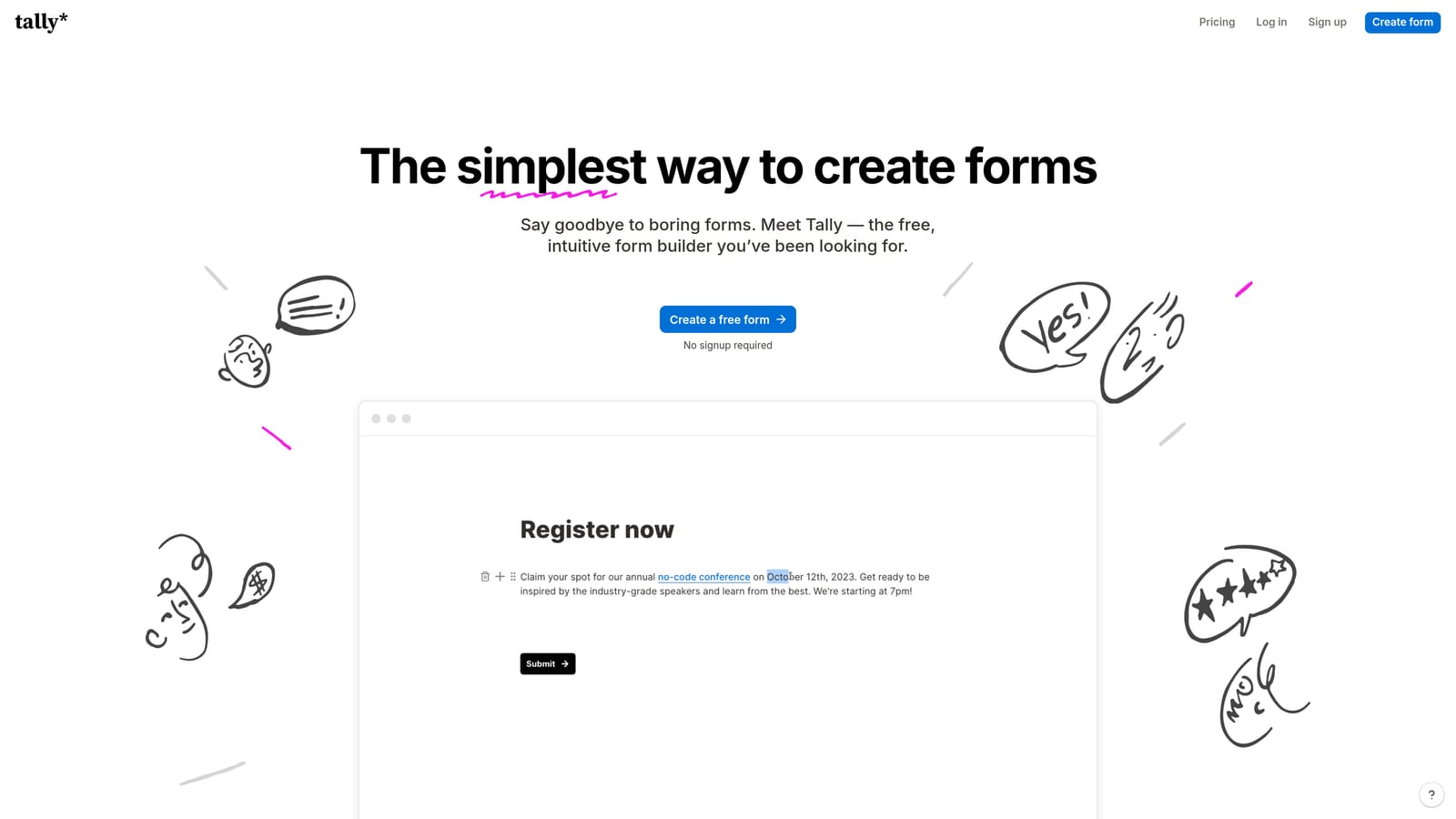
Tally is a minimalist, Notion-inspired form builder that offers free webhook support and growing API capabilities at a price point that's hard to argue with.
Where This Tool Shines
Tally's most remarkable feature might be what it includes for free. Webhook support on the free plan is genuinely rare in this category: most competitors gate real-time submission triggers behind paid tiers. For early-stage startups or developers who want to prototype an integration without committing to a monthly subscription, that's a significant practical advantage.
The editor takes clear inspiration from Notion's block-based UX, which makes it immediately intuitive for anyone already working in that environment. Forms are clean and distraction-free by design, which suits use cases where simplicity is the goal. The API capabilities are more limited than Jotform or Typeform at this stage, but they're actively expanding, and the overall developer experience is solid for the price.
Key Features
Free Webhook Support: Real-time submission triggers available on the free plan, making it one of the most accessible options in this category for early-stage teams.
Notion-Inspired Editor: Block-based, distraction-free editing experience that's intuitive for teams already working in Notion.
Conditional Logic and Hidden Fields: Dynamic form behavior and the ability to pass pre-filled data into forms via URL parameters.
Embeddable Forms: Flexible embed options with customizable styling for embedding forms directly into websites or products.
Growing API Capabilities: Programmatic form and submission management that continues to expand with each platform update.
Best For
Tally is the right call for startups, indie developers, and early-stage teams that need clean, functional forms with real integration capability but aren't ready to commit to a paid form builder. It's also a strong option for developers who want to prototype quickly and upgrade later as their needs grow.
Pricing
Generous free plan with webhook support included. Tally Pro is approximately $29/month. Verify current pricing at tally.so.
Which API Form Builder Is Right for Your Team?
The right choice here depends heavily on what problem you're actually trying to solve, not just which tool has the longest feature list.
If lead quality is your primary concern and you want qualification to happen before a lead ever reaches your CRM, Orbit AI is built specifically for that workflow. It's the only tool on this list that treats AI-powered lead scoring as a form-layer feature rather than a downstream CRM problem, which makes it the strongest fit for high-growth SaaS and B2B teams focused on conversion optimization.
If you need the deepest API coverage and the most mature developer tooling, Jotform is hard to beat. For teams that want a polished conversational UX alongside solid API access, Typeform remains a reliable choice. If your use case extends into document generation or e-signatures, Formstack offers an integrated platform that eliminates the need for additional tools. For design flexibility without developer overhead, Paperform delivers. And if you're early-stage and need webhook support without paying for it, Tally is the obvious starting point.
For teams that are serious about turning form submissions into qualified pipeline, the form layer is where that work should start. Start building free forms today with Orbit AI and see what it looks like when lead qualification happens automatically, before a lead ever touches your sales queue.
For more on building forms that drive results, explore our guides on how to improve form conversion rates and how to build a lead qualification framework that scales with your team.


