

The whole "Salesforce vs SAP" conversation really boils down to one simple question: Are you trying to manage what happens outside your business or inside it?
If your goal is to supercharge your customer relationships—think sales, marketing, and service—you're having a Salesforce conversation. But if you're looking to get a tight grip on your internal operations—like finance, supply chain, and manufacturing—you're squarely in SAP territory. Your choice hinges entirely on whether your biggest challenge is driving top-line revenue or creating bottom-line efficiency.
Salesforce vs SAP: A High-Level Executive Summary
Let's break that down a bit more, because the DNA of each platform is fundamentally different. Salesforce was born and bred as a Customer Relationship Management (CRM) system. Its entire world revolves around your audience. It’s built to track every single touchpoint, from the first marketing email a lead opens, through the entire sales pipeline, and all the way to post-sale customer support. It’s all about acquiring, serving, and keeping customers happy.
On the flip side, SAP started its life as an Enterprise Resource Planning (ERP) system. Think of it as the central nervous system for your entire company's internal machinery. It handles the heavy lifting in the background: finance and accounting, supply chain logistics, manufacturing processes, and human resources. While SAP absolutely has powerful CRM capabilities, its core strength has always been in unifying complex, back-office functions.
Core Differentiators at a Glance
This distinction is everything. It dictates the user experience, the out-of-the-box features, and where each platform truly shines. A sales leader will immediately feel at home in Salesforce’s intuitive, pipeline-centric world. A COO, however, will find SAP’s granular control over inventory and financials indispensable.
Getting these two worlds to work together is where the magic happens. We dive deep into bridging that gap in our guide on sales and marketing alignment best practices.
Before we get into the nitty-gritty, this table lays out the core differences to frame your thinking.
Salesforce vs SAP Core Differentiators
The table below offers a straightforward, side-by-side look at what makes these two platforms fundamentally different. Use this to quickly grasp their distinct missions before we dive deeper into specific features and use cases.
| Attribute | Salesforce | SAP |
|---|---|---|
| Primary Focus | Customer Relationship Management (CRM) | Enterprise Resource Planning (ERP) |
| Core Mission | Manage and enhance customer-facing interactions to drive revenue growth. | Manage and optimize internal business operations and resources. |
| Typical Users | Sales, Marketing, Customer Service, and BDR/SDR Teams | Finance, Operations, Supply Chain, and HR Departments |
| Business Goal | Top-line growth: Acquiring new customers and increasing customer lifetime value. | Bottom-line efficiency: Reducing operational costs and improving process control. |
| Key Strengths | Lead management, sales automation, marketing campaigns, and a vast third-party app ecosystem. | Financial management, supply chain logistics, manufacturing, and human capital management. |
| Implementation | Generally faster and more user-friendly, with a cloud-native architecture. | Typically more complex and lengthy, often involving deep business process configuration. |
As you can see, they aren't direct competitors so much as two different philosophies for running a business. One looks outward to the customer, while the other looks inward to the operation. Understanding this is the first and most critical step in making the right choice for your company.
The Fundamental Difference: CRM vs. ERP
Before we get into a feature-by-feature cage match, we need to address the single most important concept in the Salesforce vs. SAP debate. The entire comparison hinges on understanding two fundamentally different business philosophies: Customer Relationship Management (CRM) and Enterprise Resource Planning (ERP).
These aren't just corporate acronyms. They represent two completely different ways of looking at a business, and your choice will have massive implications for your growth, sales, and marketing teams.
Salesforce was born and bred as a pure CRM. Its entire world revolves around managing every interaction that happens outside your company walls—with prospects, leads, and customers. It’s a system designed from the ground up to fuel top-line revenue growth by giving your front-office teams everything they need to win.
SAP, on the other hand, grew up in the world of ERP. Its core purpose is to manage and streamline the complex machinery running inside your organization. Think of it as the central nervous system for your back-office operations, obsessed with bottom-line efficiency, control, and operational excellence.
Salesforce: The Customer-Centric Engine
Imagine Salesforce as the command center for your entire customer journey. It’s the toolbox you give your sales, marketing, and service teams to attract, convert, and keep customers for life. Every single feature is laser-focused on the lifecycle of a relationship.
For a Head of Sales, this is home base. It’s where you manage pipeline velocity, forecast quarterly revenue with unnerving accuracy, and track every single deal from first touch to final signature. For a marketing leader, it's where you build automated campaigns, trace lead sources back to their origin, and prove the ROI on every dollar you spend.
At its core, Salesforce is built to answer one question: "How can we find more customers and keep them ridiculously happy?" Every tool, from lead management to service automation, is a direct answer to that question.
This relentless customer-first approach has paid off. Salesforce isn't just a player in the CRM market; it is the market. The company commands a staggering 20.7% global market share, raking in over $21.6 billion in CRM revenues last year alone. That's more than its four closest competitors combined. For a deeper dive, check out the CRM market leadership analysis from CX Today.
SAP: The Operational Backbone
Now, let's flip the coin and look at SAP. Picture yourself as the COO of a massive manufacturing company. Your daily worries aren't about individual sales deals; you're consumed by the entire operational machine. You need to manage global inventory, optimize a sprawling supply chain, control production costs, and ensure absolute financial compliance. This is SAP’s playground.
SAP creates a single source of truth for all the core business functions that are usually stuck in their own silos. It connects the dots between finance, HR, procurement, and logistics, integrating them into one cohesive system. A COO uses SAP to analyze production efficiency down to the minute, manage raw material costs across dozens of global suppliers, and guarantee that financial reporting is bulletproof.
Its power lies in providing deep, granular control over every internal resource and process.
Sure, SAP offers powerful CRM modules (like SAP Sales Cloud), but they exist within this much broader operational context. They are designed to plug customer data back into the core ERP functions, not to operate as standalone, customer-obsessed platforms. The philosophical divide is clear: Salesforce looks outward to the customer, while SAP looks inward to the operation. Getting this distinction right is the most critical first step you can take.
Comparing Core Features for Sales and Marketing
When you pit Salesforce against SAP, you have to get past the high-level talk and dig into the tools your sales and marketing teams will actually use every day. The core difference isn't just "CRM vs. ERP." It’s about how each platform handles the real work: managing leads, automating campaigns, and tracking performance. This is where the philosophical divide becomes a practical reality for your front-line people.
Salesforce Sales Cloud was built from the ground up for sellers. The interface is intuitive and all about the pipeline, designed to cut down on admin work so reps can spend more time selling. Lead and opportunity management are its bread and butter, giving you a clean, visual path from first contact to closed-won. Reps can track activities, drag-and-drop deals between stages, and collaborate on accounts—it just feels like a natural environment for fast-moving sales teams.
SAP Sales Cloud, on the other hand, often feels like one piece of a much larger operational machine. Its real power is in connecting sales data with the back office—things like inventory, shipping, and finance. If your sales quotes depend on real-time supply chain info, that integration is a game-changer. But for a pure B2B SaaS sales team, the user experience can feel clunky compared to Salesforce's laser focus on the sales process itself.
Lead and Opportunity Management
How a platform handles your pipeline is at the heart of everything. Salesforce gives you a highly visual, customizable way to manage opportunities. You can define your own stages, see deal progress at a glance, and forecast with a pretty high degree of confidence. The whole platform is geared toward velocity and visibility, making it easy for sales leaders to spot bottlenecks and coach their reps in real time.
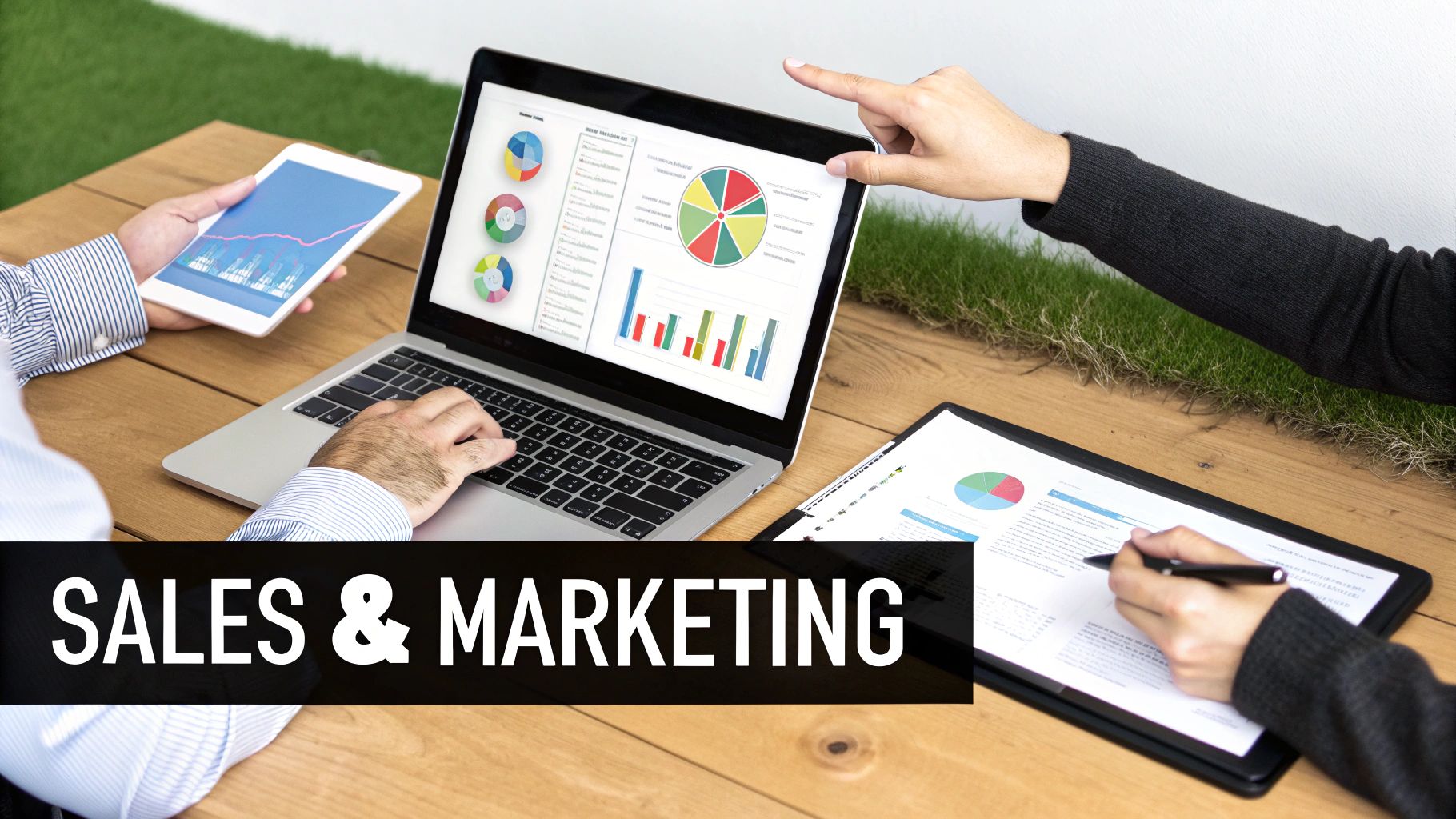
This kind of dashboard view is classic Salesforce—it’s a command center built to drive revenue performance, with key metrics like quota attainment and pipeline health right up front.
SAP approaches opportunity management with a focus on process integrity. It shines in complex sales cycles that need deep configuration, like quote-to-cash processes tied directly to manufacturing lines. While that’s incredibly robust, it can also create a level of rigidity that might slow down more agile sales teams who need to pivot quickly.
Marketing Automation and Analytics
Marketing automation is another key battleground. With Marketing Cloud and Pardot, Salesforce offers a massive suite of tools for everything from email campaigns and social media to sophisticated customer journey mapping. The integration with Sales Cloud is tight, which means the handoff of Marketing Qualified Leads (MQLs) to sales is about as smooth as it gets. For a full breakdown of the landscape, check out our guide on the best marketing automation tools.
SAP’s marketing tools, part of the C4HANA suite, are powerful but tend to be aimed at huge enterprises trying to manage customer data across tons of different operational systems. The analytics engine is a beast, capable of pulling data from sales, service, and e-commerce to build a unified customer profile. But for a marketing team just focused on demand gen and running great campaigns, Salesforce often feels more direct and user-friendly.
Of course, effective outreach depends on more than just the tool—it's about the strategy. To get the most out of either platform, you need solid sales cadence best practices.
The core difference in AI application is telling: Salesforce's Einstein AI focuses on predictive insights for the front line, like lead scoring and opportunity forecasting, to help reps decide what to do next. SAP's embedded AI leans more toward automating back-end processes, like invoice matching or supply chain optimization, to improve operational efficiency.
Ultimately, the choice comes down to what drives your business. If your main goal is to fire up your go-to-market engine with best-in-class tools for sales and marketing execution, Salesforce’s customer-first design gives it a clear edge. But if your entire sales process is tangled up with complex operational data, SAP’s integrated approach provides a level of control and visibility that Salesforce just can't match on its own.
Understanding the Integration Ecosystem
A platform is only as good as its ability to talk to the rest of your tech stack. In today's world, no tool operates in a vacuum, and a system's real power comes from how seamlessly it connects everything, letting data flow where it needs to go. This is probably one of the biggest philosophical—and practical—dividing lines between Salesforce and SAP.
Salesforce was built from the ground up to be the sun in a customer-focused solar system. Its whole integration strategy is built on openness and a massive, thriving community. The best example of this is the Salesforce AppExchange, which is less of an app store and more of a sprawling digital marketplace with thousands of pre-built connectors for just about anything.
SAP, on the other hand, comes from a world of tightly controlled, on-premise enterprise systems. Its approach is more structured and governed. The SAP Store is their version, offering certified solutions that plug deep into the complex SAP environment. It’s powerful, for sure, but it's generally smaller and more focused on extending core ERP functions than connecting to every new SaaS tool that pops up.

Connecting Your Go-To-Market Stack
For sales and marketing teams, this difference is huge. You absolutely need to connect your lead capture tools, data enrichment platforms, and communication apps directly to your CRM. It’s not a nice-to-have; it's essential. This is where Salesforce's ecosystem gives it a clear advantage in flexibility and speed.
A critical part of choosing either system is understanding the complexity and availability of CRM integration services. Salesforce generally makes this easier with its huge library of plug-and-play apps. SAP integrations, however, often require more specialized expertise to connect its powerful backend to your front-office tools.
The core difference is simple: Salesforce’s ecosystem is built for breadth and speed, allowing teams to quickly connect best-of-breed tools. SAP’s ecosystem is built for depth and control, ensuring tight integration within its own operational universe.
This directly impacts how you handle your most valuable asset—leads. Getting data from your website forms into your CRM is the critical first step in any sales process.
The Role of AI in Bridging the Data Gap
Manually moving lead data from a form to a CRM is a recipe for typos, delays, and lost opportunities. Modern teams lean on intelligent tools to not only sync this data but also qualify and enrich it before it ever lands in a sales rep's queue. These platforms act as a smart bridge between your marketing efforts and your CRM. For a deeper dive, check out our guide on how to integrate forms with your CRM.
Both Salesforce and SAP can connect to these tools, but the ease and variety of options are different. Here are some of the top AI-powered platforms that help streamline this crucial data flow:
- Orbit AI: More than just a data sync tool, Orbit AI acts like an AI-powered SDR. Its engine qualifies form submissions, enriches lead profiles with valuable context, and applies smart scoring. This ensures that only the most sales-ready opportunities get passed into your Salesforce or SAP instance, which dramatically improves pipeline quality and sales efficiency.
- Zapier: As a universal connector, Zapier lets you create automated workflows (called "Zaps") between thousands of apps, including both Salesforce and SAP. It's a fantastic choice for straightforward, trigger-based integrations that don't require a developer.
- MuleSoft: Now owned by Salesforce, MuleSoft is an enterprise-grade integration platform built for connecting complex systems. It's often the go-to for large organizations looking to build robust, custom integrations between Salesforce and heavy-duty backend systems like SAP.
When it comes down to it, Salesforce’s open and sprawling ecosystem gives it an edge for most growth-focused companies that need to stay agile. But for massive enterprises where operational data integrity is the top priority, SAP's more controlled integration environment provides a level of stability and deep system connectivity that's hard to match.
Analyzing Pricing and Total Cost of Ownership
Let's talk about the real cost of Salesforce and SAP, because the license fee you see upfront is just the start. The real number to watch is the Total Cost of Ownership (TCO), which covers everything from the initial setup and customization to training your team and paying for long-term support. Getting this wrong is how budgets get blown and ROI vanishes.
Salesforce is known for its predictable, subscription-based model. You pay per user, per month, with clear tiers like Essentials, Professional, Enterprise, and Unlimited. This makes it easy to get started with a fixed cost and scale up as you add more people to your team. But don't let that initial number fool you.
The Salesforce Subscription Model and Its Add-Ons
While the tiered pricing seems simple, the costs can add up fast once you start tacking on the extras. Need powerful analytics? That's a separate subscription for Tableau. Marketing automation? You'll be adding Pardot or Marketing Cloud. Specialized features for your industry? Those are separate clouds, too.
A sales team on the Enterprise plan, for example, might realize they need CPQ (Configure, Price, Quote) capabilities to handle complex deals. Suddenly, their monthly per-user cost jumps significantly. This modular setup gives you a ton of flexibility, but it demands you do your homework. You have to map out exactly what you need to avoid the common mistake of budgeting only for the base license.
The real cost of Salesforce isn't just the license; it's the ecosystem. Each add-on deepens its functionality but also adds another layer to your monthly bill, making TCO a moving target that must be actively managed.
SAP’s Quote-Based and Customized Pricing
SAP’s pricing is a completely different ballgame—it’s far less transparent and highly customized. They use a quote-based model tailored to your company's specific needs, which means the price depends on the modules you choose, the number and types of users you have, and the sheer scale of your operation. This is pretty standard for ERP systems, reflecting just how deeply they integrate into a business.
Getting a price from SAP isn’t a quick chat; it involves a detailed discovery process where they dig into your business processes and operational needs. The result is a personalized—and often very large—initial investment, which is then followed by ongoing maintenance and support fees that you need to factor in for the long haul.
Calculating the True Total Cost of Ownership
Beyond the license fees, a handful of "hidden" costs contribute to the TCO for both platforms. You absolutely have to account for these to get a realistic financial picture.
- Implementation and Customization: SAP implementations are notoriously complex and can take months, often requiring expensive consultants and costing several times the initial software price. Salesforce is generally quicker to get running, but heavy customization can still drive up implementation costs significantly.
- Data Migration: Pulling years of historical data from your old systems into either Salesforce or SAP is a major technical project that requires skilled people and a lot of time.
- User Training: Salesforce has an edge here with its user-friendly interface and massive library of free training on its Trailhead platform. The complexity of SAP, on the other hand, usually requires more structured, formal training programs to get everyone up to speed.
- Ongoing Support and Maintenance: Both platforms offer various support plans at different price points. For SAP, especially if you have an on-premise setup, maintenance fees are a standard and significant annual expense you can't avoid.
From an investor's perspective, the market often signals confidence through growth potential. Recent analyses suggest Salesforce holds a 33.33% upside potential compared to SAP's 18.58%, partly due to its faster-forecasted earnings growth driven by AI. You can learn more about this stock performance comparison on TipRanks.com. While not a direct cost, this kind of financial health can hint at long-term stability and innovation.
When you're mapping out your own budget, it’s worth seeing how modern SaaS tools are offering much clearer cost structures. For instance, exploring the pricing plans for Orbit AI shows how you can get predictable, transparent costs without the hidden fees that often come with larger enterprise platforms.
Choosing Your Platform: A Practical Decision Framework
After weighing all the features, integrations, and costs, the Salesforce vs. SAP decision boils down to a handful of strategic questions about your business. This isn't about ticking off features on a list; it's about matching a platform's core DNA to your company's immediate and future goals. Let's be clear: this isn't about which tool is "better," but which one will be the right partner for where you're headed.
The first question you have to answer is the most critical: What is your primary business driver right now? Are you all-in on top-line revenue growth, or is bottom-line operational efficiency the burning priority? Your answer will immediately point you toward one of these two giants.
Defining Your Core Business Objective
For companies obsessed with cranking up their go-to-market engine, the choice is pretty straightforward. If your mission is to empower a rapidly scaling sales team, nail the customer lifecycle, and just plain win more business, Salesforce is purpose-built for you. Its entire world revolves around fueling customer-facing activities. You can learn more about how to power your pipeline with our guide on the best lead management software.
On the flip side, if you're a complex enterprise that needs unbreakable links between finance, supply chain, manufacturing, and HR, SAP is the undisputed heavyweight champion. Its power lies in creating a single, bulletproof source of truth for every internal operation, guaranteeing process integrity and tight control across the entire organization.
This decision tree helps visualize that fundamental choice. Are you chasing revenue growth or operational efficiency?
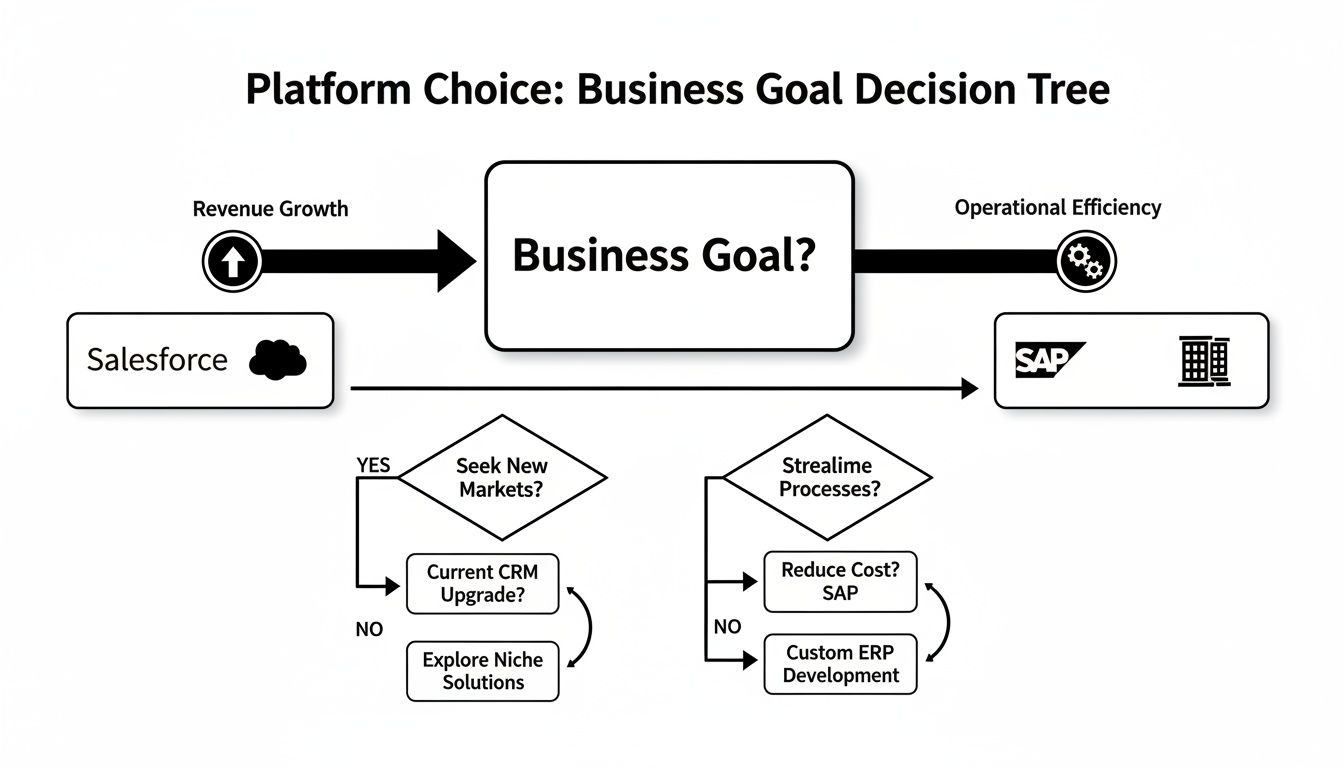
As the diagram shows, Salesforce is the logical path for customer-centric growth, while SAP is the foundation for operations-centric control.
Key Questions for Your Decision Team
Getting these questions answered will give you the final layer of clarity you need to make a confident call in the Salesforce vs. SAP debate.
- What’s the real technical maturity of your team? Salesforce, with its user-friendly interface and massive library of Trailhead learning resources, has a much gentler learning curve. SAP, on the other hand, often requires specialized knowledge and formal training to really master its complexity.
- How critical is a third-party app ecosystem to your strategy? If your plan involves plugging in a dozen best-of-breed SaaS tools for marketing, sales, and service, the Salesforce AppExchange offers unmatched breadth and flexibility. It's not even close.
- Is your biggest challenge right now customer acquisition or process optimization? Be brutally honest about where your organizational bottlenecks are. The right platform is the one that directly attacks your most significant pain points.
Your platform choice is a long-term strategic commitment. Choose Salesforce to build a customer-centric engine designed for agility and growth. Choose SAP to build an operational backbone designed for stability, control, and deep enterprise integration.
While Salesforce has historically owned the CRM conversation, the market dynamics are shifting. SAP is now outpacing Salesforce in enterprise apps revenue growth, posting $6.14 billion in its most recent quarter—a blistering 22% year-over-year jump. For comparison, Salesforce grew at 10%. This positions SAP as a seriously strong contender, even for companies migrating away from legacy on-premise systems. You can dig into more insights on this enterprise apps growth on Cloud Wars.
Frequently Asked Questions
Even after a detailed side-by-side, a few common questions always seem to pop up. Let's tackle the ones we hear most often to clear up any lingering confusion.
Can a Small Business Use SAP?
Yes, absolutely. SAP isn't just for global giants. They offer specific products like SAP Business One and SAP Business ByDesign that are built for small and mid-sized businesses (SMEs), giving them serious operational control.
But here’s the thing to remember: they are still fundamentally ERP systems. This means they're the right fit for a business with complex operational needs—think manufacturing, supply chain, or detailed inventory management—not necessarily for a company focused purely on sales and marketing growth.
Does Salesforce Offer an ERP Solution?
Nope, Salesforce does not have its own native, all-in-one ERP system. Instead, it maintains a laser focus on being the best CRM platform on the market.
What it does offer is a massive ecosystem. Through its AppExchange and powerful APIs, Salesforce connects seamlessly with countless third-party ERPs. This allows you to build a "best-of-breed" tech stack, combining Salesforce’s elite customer-facing tools with a dedicated ERP for your back-office operations.
Which System Is Easier to Implement and Learn?
In most cases, Salesforce is going to be faster and easier to get up and running, especially its core Sales Cloud and Service Cloud products. The user interface just feels more intuitive for people in sales, marketing, and customer service roles.
Salesforce's Trailhead learning platform is a huge differentiator here. It’s a massive library of free, gamified training that anyone can access, which dramatically shortens the learning curve compared to the formal, consultant-led training SAP often requires.
SAP implementations, particularly for its main ERP products, are known for being more complex and time-consuming. You'll almost certainly need specialized consultants to handle the deep business process configuration involved.
Can Salesforce and SAP Work Together?
They sure can, and it's a very common setup in large enterprises. In this model, the division of labor is clear: Salesforce runs the entire front office, managing everything from lead generation and sales pipelines to customer service cases.
Meanwhile, SAP handles all the back-office functions like finance, supply chain, and HR. The two systems are then tightly integrated to sync critical data—like customer orders, invoicing, and inventory levels—creating a single, powerful source of truth that plays to the strengths of each platform.
Ready to turn every form submission into a qualified conversation? Orbit AI uses an AI SDR to enrich, qualify, and score leads in real-time, ensuring your sales team only talks to the best opportunities. Start your free trial and build your first high-converting form.


