

SurveyMonkey was built for researchers, not revenue teams. If you're running lead generation campaigns and trying to squeeze qualification logic out of a tool designed for employee feedback surveys, you've probably already felt the friction: rigid form structures, no native lead scoring, and CRM integrations that require more duct tape than they should.
The good news is that the form builder market has evolved significantly. There's now a clear generation of tools purpose-built for lead capture, qualification, and conversion optimization. Whether you need AI-powered lead scoring, conversational form experiences, or deep CRM connectivity, the right alternative exists for your use case.
Here are the top SurveyMonkey alternatives for lead generation in 2026, evaluated on conversion features, lead qualification capabilities, integrations, and pricing.
1. Orbit AI
Best for: B2B SaaS and high-growth teams that want AI-powered lead qualification built into the form itself
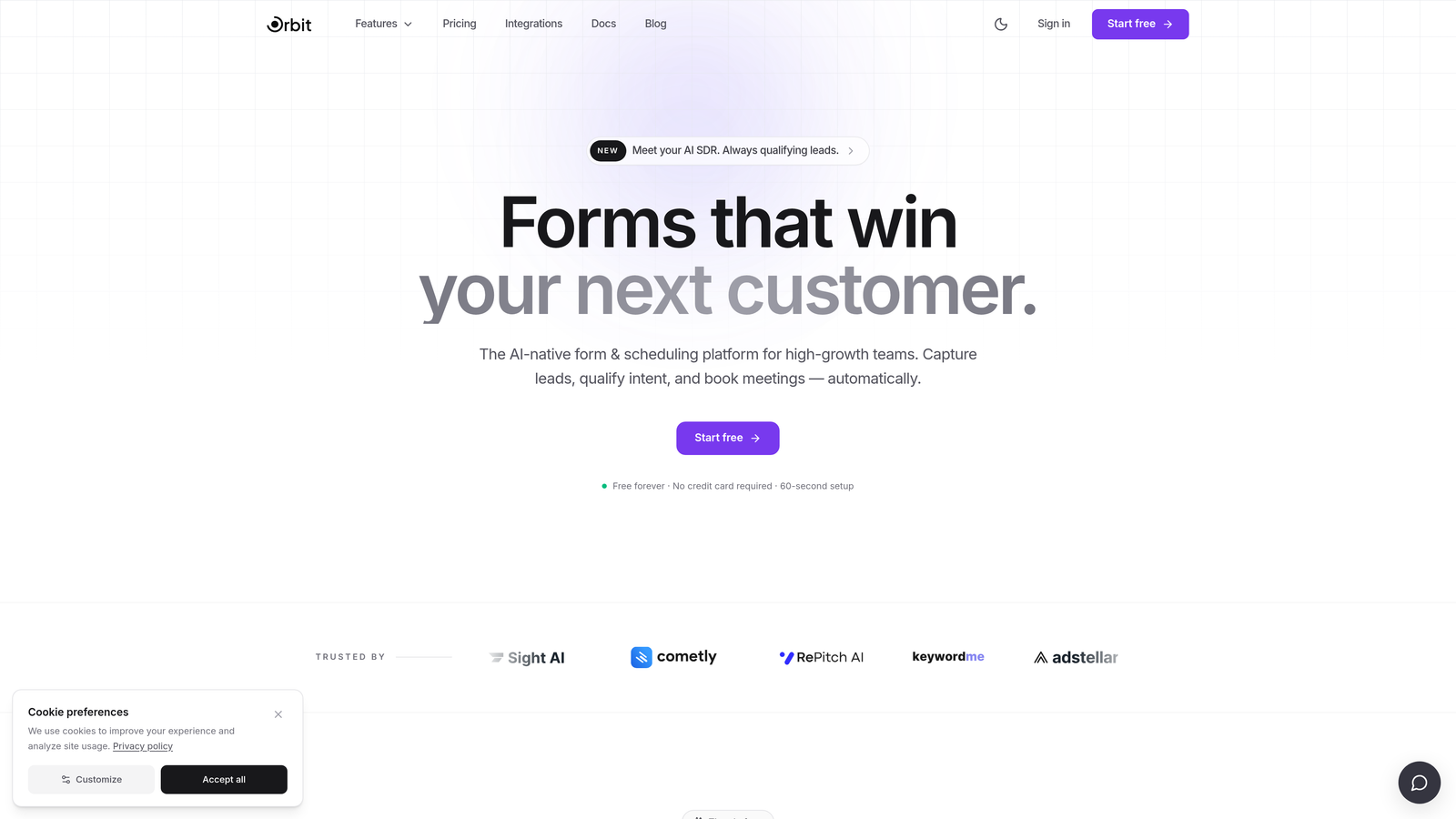
Orbit AI is an AI-powered form builder designed from the ground up for teams focused on conversion optimization and lead quality, not just lead volume.
Where This Tool Shines
Most form tools hand you a pile of raw submissions and leave the qualification work to your sales team. Orbit AI flips that model by scoring and filtering leads at the form level, so what reaches your CRM is already pre-qualified pipeline. This is a meaningful shift for high-growth teams where sales capacity is a bottleneck.
The form design philosophy also stands out. Rather than survey-style layouts that feel like homework, Orbit AI's forms are built to feel like a natural, brand-consistent interaction. That combination of intelligent qualification and conversion-optimized UX makes it a strong fit for B2B SaaS demo request flows, agency client intake, and inbound lead capture.
Key Features
AI-Powered Lead Qualification: Scores and filters leads in real time at the form level, reducing manual triage for sales teams.
Conversion-Optimized Design: Modern, brand-friendly form aesthetics built to maximize completion rates, not just collect data.
Adaptive Conditional Logic: Forms adjust dynamically based on each response, creating personalized paths for different lead types.
CRM and Marketing Stack Integrations: Connects with your existing tools for seamless lead handoff without manual data movement.
Purpose-Built for Lead Gen: Designed specifically for B2B SaaS and high-growth use cases, not repurposed from a research tool.
Best For
SaaS teams capturing demo requests, B2B companies qualifying inbound leads, and agencies building high-converting client funnels. Particularly valuable when lead quality matters as much as lead volume, and when sales teams need pre-qualified pipeline rather than raw submissions.
Pricing
Visit orbitforms.ai for current pricing details. Plans are designed with high-growth teams in mind.
2. Typeform
Best for: Teams that want a polished, conversational form experience to improve completion rates
Typeform is a well-established conversational form builder known for its one-question-at-a-time interface that turns data collection into something closer to a dialogue.

Where This Tool Shines
Typeform's signature UX reduces the cognitive load of filling out a form. Instead of staring at a wall of fields, respondents answer one question at a time, which typically improves engagement and completion rates for longer forms. For lead capture flows where you need to ask several qualifying questions, that experience difference can matter.
It's also one of the most recognizable brands in this space, which means strong documentation, a large community, and a mature integration ecosystem. The limitation for lead gen teams is that Typeform isn't purpose-built for qualification. Lead scoring requires third-party tools or custom workarounds.
Key Features
Conversational One-Question UX: Presents fields one at a time to create a more engaging, lower-friction experience.
Conditional Logic and Branching: Personalizes form paths based on how respondents answer earlier questions.
Native CRM Integrations: Connects directly with HubSpot, Salesforce, Slack, and Zapier for lead routing.
Customizable Branding: Flexible embed options and visual customization to match your brand.
Analytics Dashboard: Tracks drop-off points and completion rates to inform form optimization.
Best For
Marketing teams that prioritize form aesthetics and completion rate, and companies already using HubSpot or Salesforce who want a polished front-end experience. Less ideal for teams that need native lead scoring without additional tooling.
Pricing
Free plan available. Paid plans start around $25/month. Verify current pricing at typeform.com.
3. Jotform
Best for: Teams that need maximum feature breadth and a large template library across diverse use cases
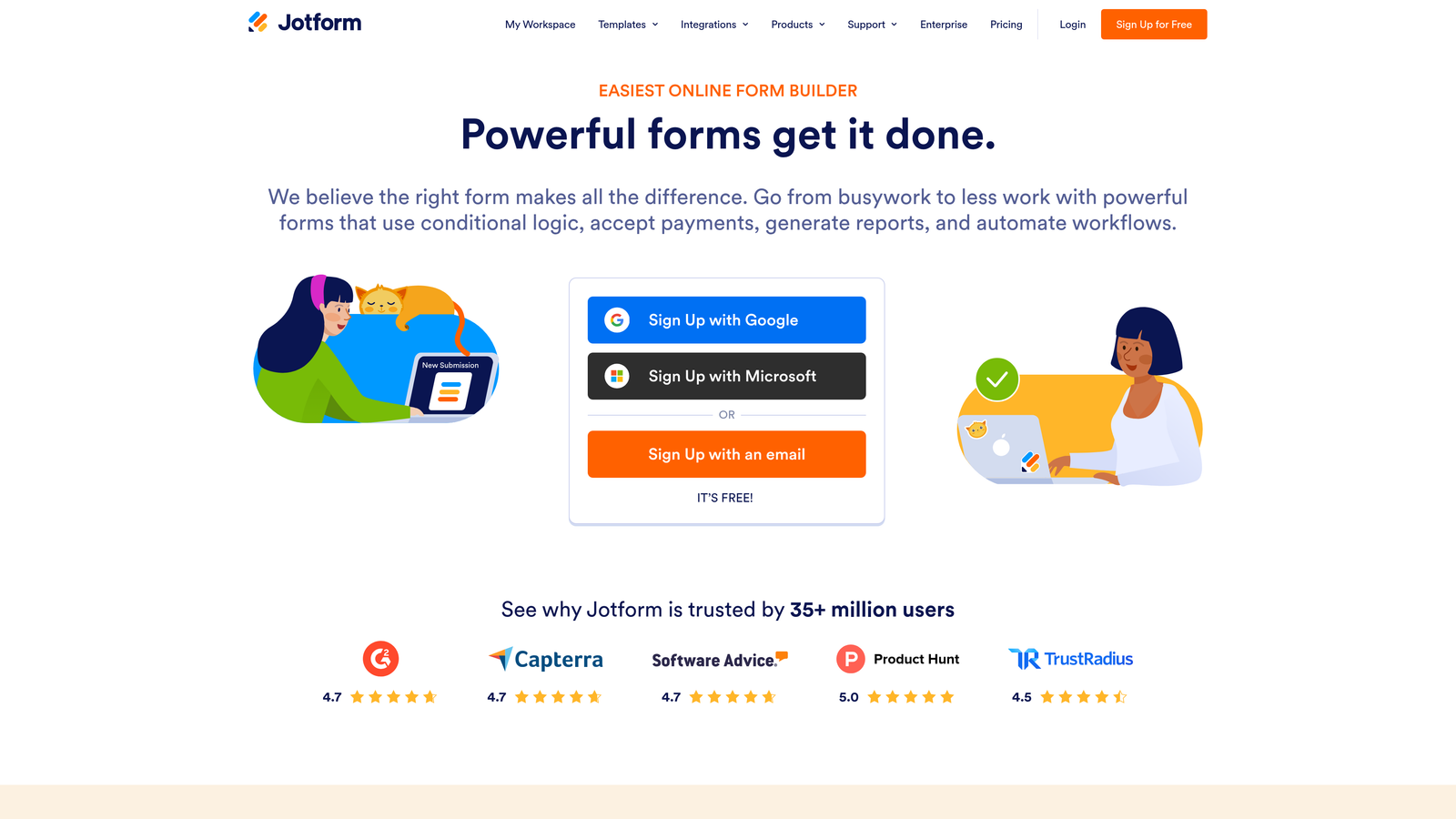
Jotform is one of the most feature-rich form builders available, offering thousands of templates and a broad integration library that spans CRMs, payment processors, and productivity tools.
Where This Tool Shines
If you need a form tool that can handle almost any workflow — lead capture, payments, e-signatures, scheduling, data collection — Jotform is hard to beat on sheer capability. Its template library alone is a significant time-saver for teams building forms across multiple use cases or industries.
The integration ecosystem is also one of the deepest in the category. Native connections to Salesforce, HubSpot, Mailchimp, and over 100 other tools mean your lead data can flow into almost any stack configuration. The trade-off is that all this flexibility can introduce complexity, and Jotform isn't specifically optimized for conversion-focused lead gen.
Key Features
Massive Template Library: Thousands of pre-built templates spanning industries and use cases to accelerate form creation.
Deep Integration Ecosystem: Native connections to Salesforce, HubSpot, Mailchimp, and 100+ other tools.
Conditional Logic and Payments: Supports complex branching, payment processing, and e-signature collection in one tool.
Jotform Tables: Manages submission data like a lightweight database for teams that need more than a simple spreadsheet export.
HIPAA-Compliant Plans: Available for regulated industries that need compliant data collection workflows.
Best For
Agencies managing diverse client needs, teams in regulated industries, and businesses that need one tool to handle forms, payments, and data management simultaneously. The feature depth can be overkill for teams with a narrow lead gen focus.
Pricing
Free plan available. Paid plans start around $34/month. Verify current pricing at jotform.com.
4. Tally
Best for: Early-stage teams and lean operators who want a capable free tool with a clean, modern editor
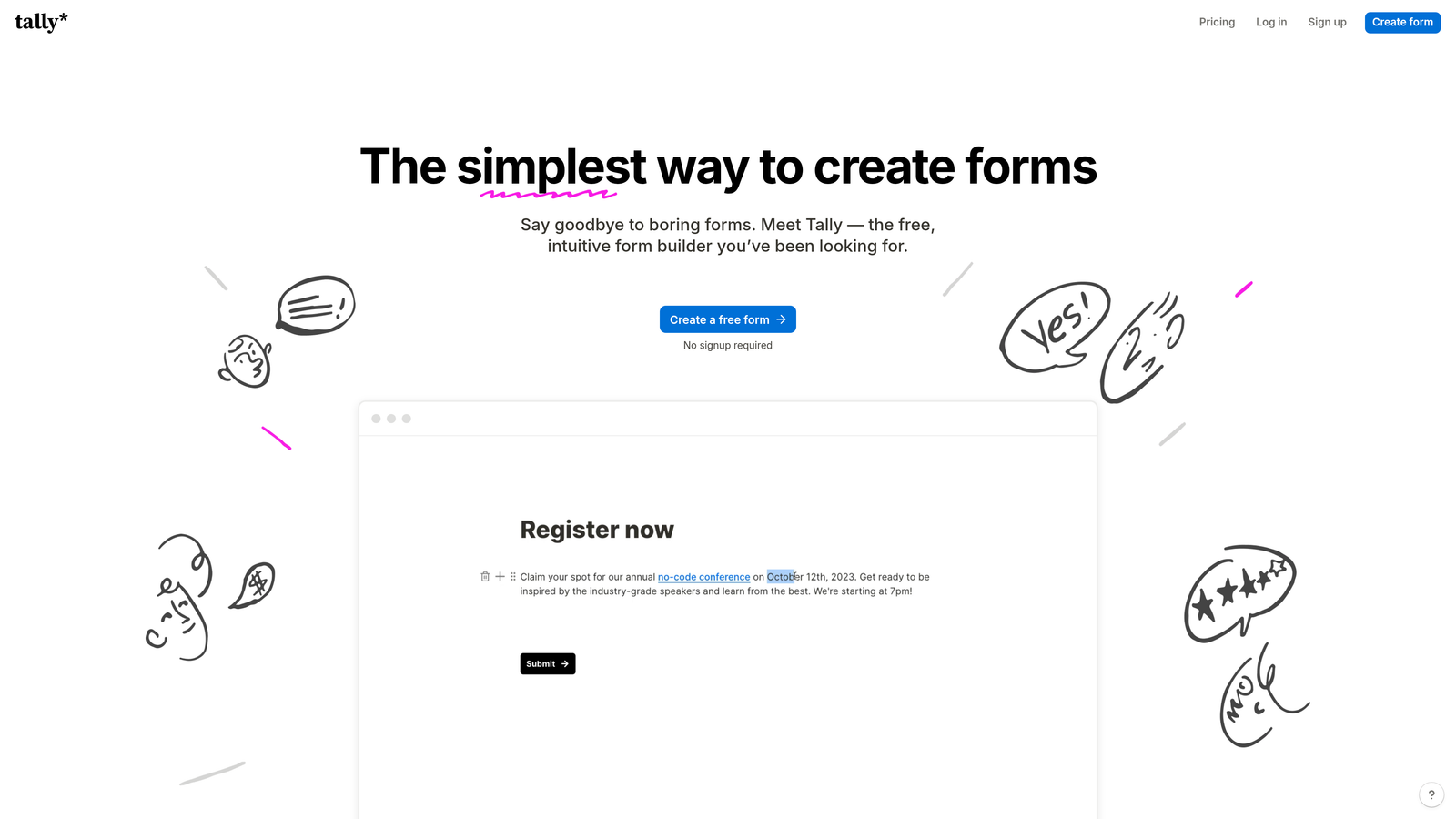
Tally is a minimalist form builder with a Notion-inspired editor and one of the most genuinely generous free plans in the category.
Where This Tool Shines
Most free form tools either cap submissions, force branding on your forms, or lock basic features behind a paywall. Tally breaks that pattern with unlimited forms and submissions on the free plan, which is a real differentiator for bootstrapped teams or those just starting to build out their lead capture infrastructure.
The editing experience is clean and fast. If you've used Notion, the block-based interface will feel immediately familiar. For teams that want to get a form live quickly without wrestling with a complex UI, Tally delivers. The limitation is on the lead gen side: CRM integrations and qualification features are lighter compared to purpose-built tools.
Key Features
Unlimited Free Submissions: No submission caps on the free plan, which is genuinely rare in this category.
Block-Based Editor: Clean, distraction-free building experience modeled after Notion's interface.
Conditional Logic and Hidden Fields: Supports personalized form paths and pre-population for returning visitors.
Lightweight Embed: Embeds anywhere with a minimal script that won't slow down your landing pages.
Zapier and Native Integrations: Connects to CRMs and automation tools, though the native integration library is smaller than Jotform or Typeform.
Best For
Early-stage startups, individual operators, and teams that need a solid free tool for basic lead capture. Those who need deep CRM integration or lead scoring should look at more specialized options.
Pricing
Robust free plan with no submission limits. Pro plan around $29/month. Verify current pricing at tally.so.
5. HubSpot Forms
Best for: Teams already running their marketing and sales operations on HubSpot CRM
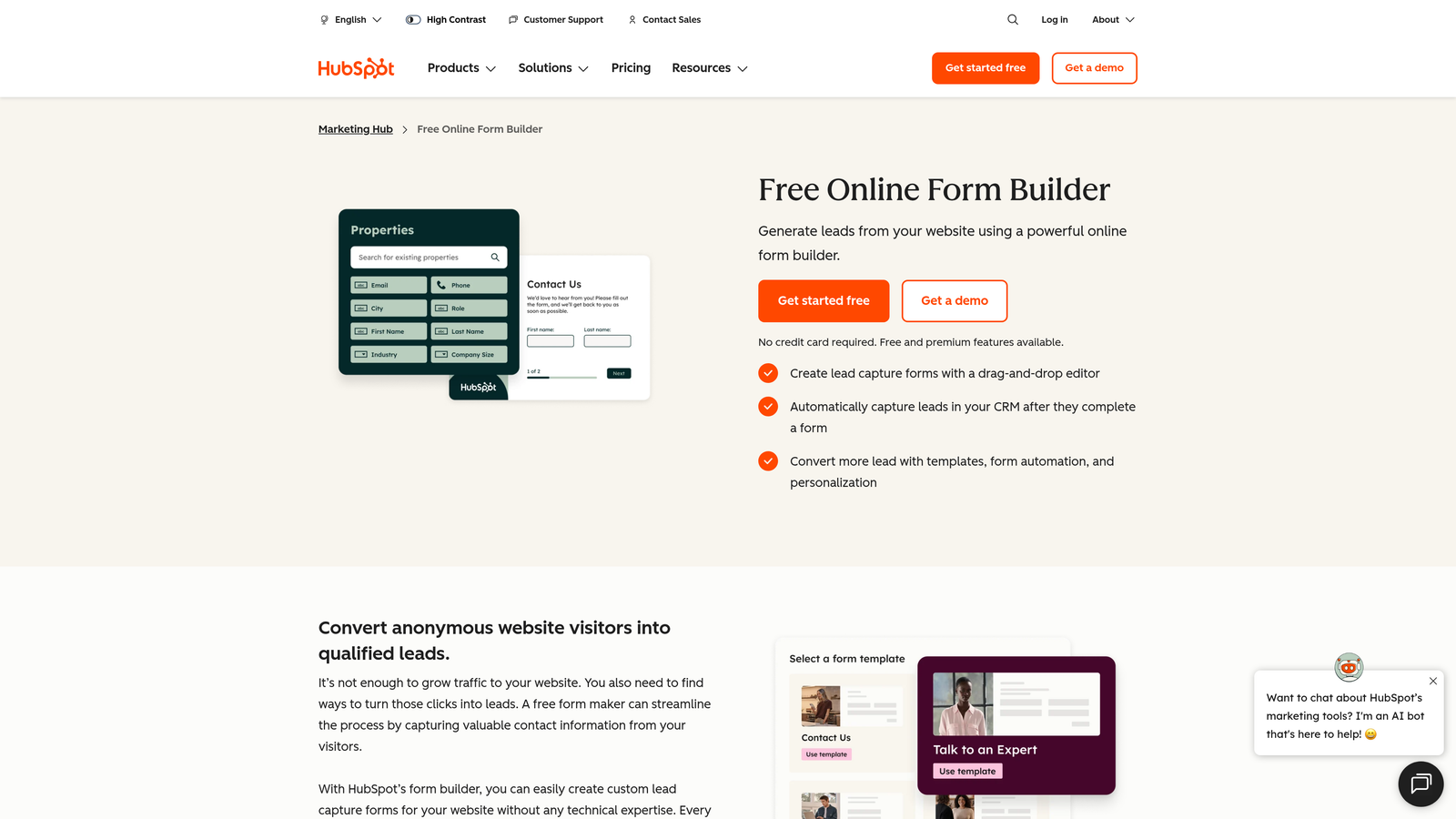
HubSpot Forms is a free form builder that's deeply embedded in the HubSpot ecosystem, making it the natural default for inbound marketing teams on that platform.
Where This Tool Shines
The core value proposition here is native CRM sync. When a lead submits a HubSpot form, their contact record is created or updated automatically, workflows can trigger immediately, and your sales team can act on the lead without any manual data transfer. For HubSpot shops, that frictionless handoff is genuinely valuable.
Progressive profiling is another standout feature. Instead of showing the same fields to every visitor, HubSpot Forms can display different questions to returning contacts, gradually building a richer profile over time without overwhelming people with a long form on their first interaction.
Key Features
Native CRM Sync: Real-time contact creation and property updates in HubSpot CRM with every submission.
Progressive Profiling: Shows different fields to returning visitors to enrich contact data incrementally.
Workflow Triggers: Automatically enrolls leads in sequences and workflows based on form submission data.
Flexible Embed Options: Works on any website or within HubSpot-hosted landing pages.
Free with HubSpot CRM: No additional cost for teams already using HubSpot's free tier.
Best For
Teams already invested in the HubSpot ecosystem. Standalone value outside of HubSpot is limited, so this is a poor choice for teams on other CRMs or those looking for a platform-agnostic solution.
Pricing
Free with HubSpot CRM. Advanced features require paid Marketing Hub plans. Verify current pricing at hubspot.com.
6. Paperform
Best for: Consultants and agencies that need one tool to handle forms, payments, scheduling, and lead capture
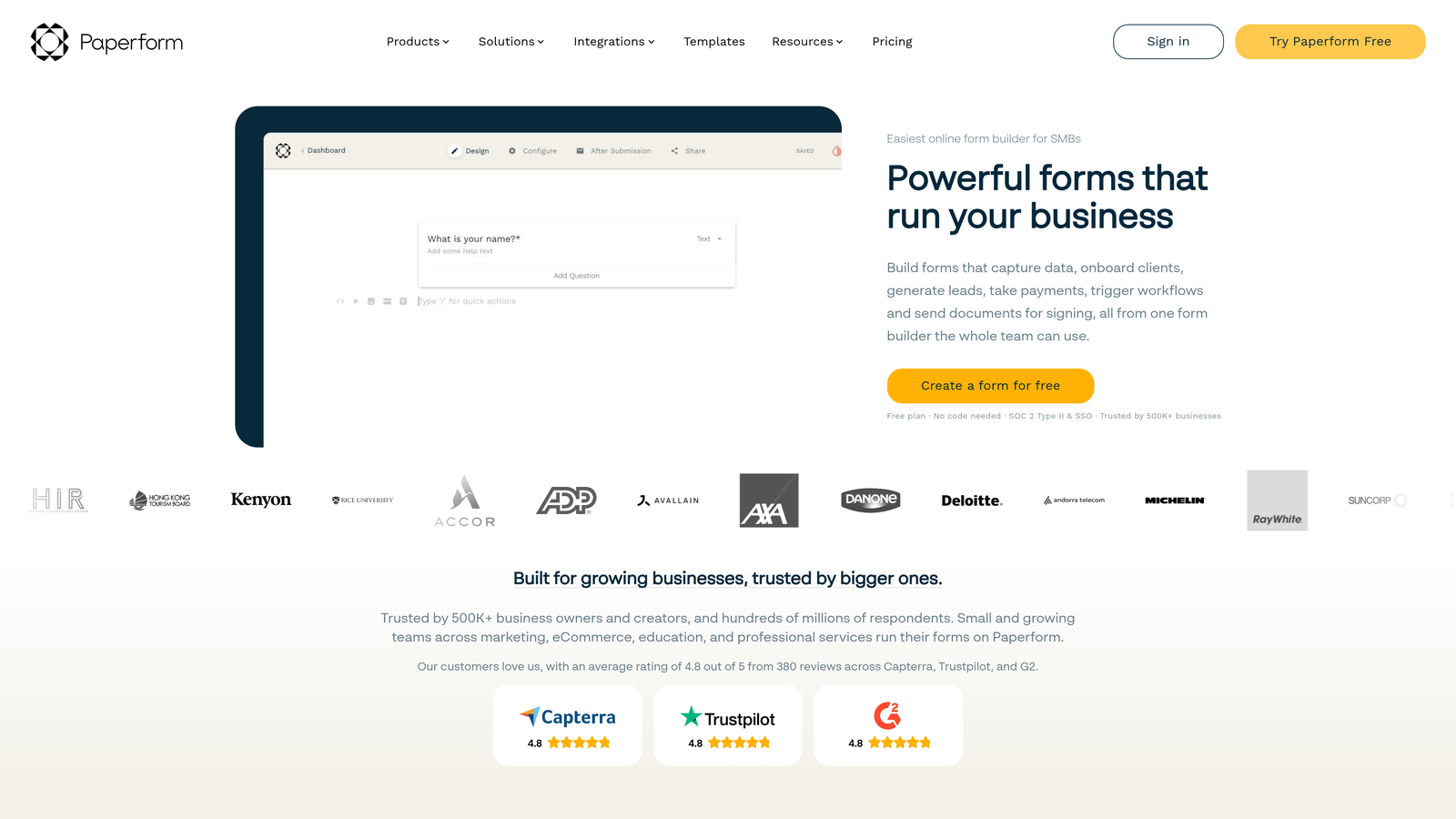
Paperform is a flexible form builder that combines lead capture with payment processing, appointment scheduling, and product listings in a single platform.
Where This Tool Shines
Paperform's strength is versatility. If you're running an agency or consultancy where you need to capture leads, collect deposits, and schedule discovery calls all from the same tool, Paperform can handle that without requiring multiple subscriptions. The form design is more document-like than traditional form builders, which suits certain professional service contexts well.
Conditional logic and calculation fields add meaningful capability for teams building more complex intake or qualification flows. Custom domain support also helps maintain a professional, branded experience throughout the submission process.
Key Features
Multi-Workflow Support: Handles forms, payments, scheduling, and product listings from a single platform.
Calculation Fields: Supports logic-driven calculations within forms, useful for pricing estimators and qualification scoring.
Custom Domain Support: Host forms on your own domain for a fully branded experience.
Partial Submission Tracking: Captures data from incomplete submissions to reduce lead loss.
Integration Library: Connects with Zapier, HubSpot, Mailchimp, and other common tools.
Best For
Consultants, agencies, and service businesses that need a Swiss Army knife tool rather than a dedicated lead gen platform. Teams with a pure conversion optimization focus may find the jack-of-all-trades positioning dilutes the lead gen experience.
Pricing
Essentials plan starts around $24/month. Verify current pricing at paperform.co.
7. Fillout
Best for: Data-first and product-led teams using Notion, Airtable, or Supabase as their operational backbone
Fillout is a fast-growing form builder that has carved out a distinct niche with deep native integrations for modern data infrastructure tools.

Where This Tool Shines
Where most form builders treat Notion and Airtable as afterthoughts via Zapier, Fillout treats them as first-class integration targets. If your team manages leads, contacts, or pipeline data in Airtable or Notion, Fillout can write directly to those databases without middleware, which is a meaningful workflow improvement for product-led and data-forward teams.
The pricing is also notably competitive. At around $15/month for paid plans, it offers multi-step forms, conditional logic, and a growing feature set at a price point well below most established competitors. The trade-off is that as a newer entrant, the ecosystem and template library are still maturing.
Key Features
Native Notion, Airtable, and Supabase Integration: Writes form data directly to modern databases without requiring Zapier or middleware.
Multi-Step Forms with Conditional Logic: Supports branching and personalized form paths for qualification workflows.
Scheduling and File Upload: Built-in support for appointment booking and file collection within forms.
Modern Form Design: Clean, customizable aesthetics that hold up well against more established competitors.
Competitive Pricing: Paid plans start around $15/month, making it accessible for smaller teams.
Best For
Product-led growth teams, developers, and data-forward operators who use Notion, Airtable, or Supabase as core infrastructure. Teams needing enterprise-grade integrations or a mature template library may want a more established option.
Pricing
Free plan available. Paid plans start around $15/month. Verify current pricing at fillout.com.
8. Growform
Best for: PPC agencies and performance marketers running paid traffic campaigns where form completion rate is a primary KPY
Growform is a purpose-built lead generation form tool designed specifically for performance marketers who need to maximize completion rates on paid traffic.
Where This Tool Shines
Growform is built around a specific insight: multi-step forms consistently outperform single-page forms for lead capture, particularly on paid traffic where intent is high but attention is short. The tool is engineered around that pattern, with UX defaults and form structures specifically designed to reduce drop-off at each step.
For PPC agencies managing lead gen campaigns across multiple clients, that focused approach is valuable. Rather than adapting a general-purpose form builder for performance marketing, Growform starts from the performance marketing use case and builds outward. The narrower focus means it's less suited for teams that need broad form functionality beyond lead capture.
Key Features
Multi-Step Lead Gen Optimization: Form structure and UX patterns engineered specifically to maximize lead form completion rates.
High-Intent Traffic Design: Built-in patterns designed for paid traffic scenarios where conversion rate directly impacts campaign ROI.
Conditional Logic for Qualification: Custom field types and branching to qualify leads within the form flow.
Universal Embed: Embeds on any landing page or funnel builder without technical friction.
Webhook and Zapier Connectivity: Routes leads to CRMs and automation platforms through standard integration methods.
Best For
PPC agencies, performance marketers, and paid acquisition teams where cost-per-lead and form completion rate are primary metrics. Less suited for teams that need broad workflow functionality or native database integrations.
Pricing
Starts around $49/month. Verify current pricing at growform.co.
9. Google Forms
Best for: Internal data collection and very early-stage teams where cost is the primary constraint
Google Forms is the simplest, most accessible free form tool available, included with any Google account and connected natively to Google Sheets.
Where This Tool Shines
There's one thing Google Forms does better than every other tool on this list: it costs nothing and requires no setup beyond a Google account. For internal surveys, quick feedback collection, or teams at the very earliest stage of building a lead capture process, that accessibility is genuinely useful.
The Google Sheets integration is also seamless. Responses flow directly into a spreadsheet in real time, which works well for teams that already live in Google Workspace and just need a simple data collection mechanism. Beyond those use cases, Google Forms shows its limitations quickly: minimal branding options, no native lead scoring, limited conditional logic, and a form experience that signals "internal survey" rather than "professional lead capture."
Key Features
Completely Free: No cost, no submission limits, no paid tiers to worry about.
Google Sheets Integration: Responses populate a connected spreadsheet automatically in real time.
Basic Conditional Logic: Section branching based on answers, though less sophisticated than dedicated form builders.
Simple Sharing: Shareable via link or embeddable on websites with minimal technical effort.
Familiar Interface: Low-friction experience for respondents already in the Google ecosystem.
Best For
Internal use cases, early-stage teams with zero budget, and simple data collection needs where conversion optimization and brand experience aren't priorities. Not suitable for teams serious about lead quality, CRM integration, or conversion rate optimization.
Pricing
Free.
Which Tool Is Right for Your Lead Gen Stack?
The right choice depends on where your biggest friction point actually is. Here's a quick way to think through it.
If your core problem is lead quality, not just lead volume, and you want AI to do the qualification work at the form level, Orbit AI is the most purpose-built option on this list. It's designed for exactly that scenario: high-growth B2B teams that need better pipeline, not just more submissions landing in a CRM.
If you're a performance marketer or PPC agency where form completion rate is your primary metric, Growform's focused multi-step approach is worth the premium. It's built around the specific mechanics of paid traffic lead capture in a way that general-purpose tools aren't.
If you're already deep in the HubSpot ecosystem, the free native integration with HubSpot Forms is hard to argue against. The progressive profiling alone can meaningfully improve your contact data quality over time without adding another paid tool to your stack.
For teams that need maximum feature breadth across diverse workflows, Jotform covers more ground than almost anyone else. For lean teams or early-stage startups watching budget closely, Tally's unlimited free plan is the most honest free offering in the category. And if your data infrastructure runs on Airtable or Notion, Fillout's native integrations make it a natural fit.
The broader point is that SurveyMonkey was never designed for the job you're asking it to do. Moving to a tool built for lead generation, whether that's a conversational interface, a multi-step funnel, or an AI-powered qualification layer, tends to improve both the experience for your prospects and the quality of what reaches your sales team.
Transform your lead generation with AI-powered forms that qualify prospects automatically while delivering the modern, conversion-optimized experience your high-growth team needs. Start building free forms today and see how intelligent form design can elevate your conversion strategy.


