

Every high-growth team knows the frustration: traffic is solid, but conversions aren't keeping pace. The gap between visitors and paying customers usually isn't a traffic problem. It's a funnel problem.
Conversion funnel optimization tools help you identify where prospects drop off, remove friction at key touchpoints, and turn more of your existing traffic into qualified leads and customers. From AI-powered form builders and landing page optimizers to heatmap tools and A/B testing platforms, the right stack can transform your funnel from a leaky bucket into a precision pipeline.
This guide covers the best conversion funnel optimization tools available in 2026, selected for their depth of features, ease of use, and proven impact on conversion rates. Whether you're a SaaS team tightening your trial signup flow or a B2B company qualifying leads at scale, there's a tool here for your stage and use case.
1. Orbit AI
Best for: SaaS and B2B teams that want AI-driven lead qualification built directly into the form experience.
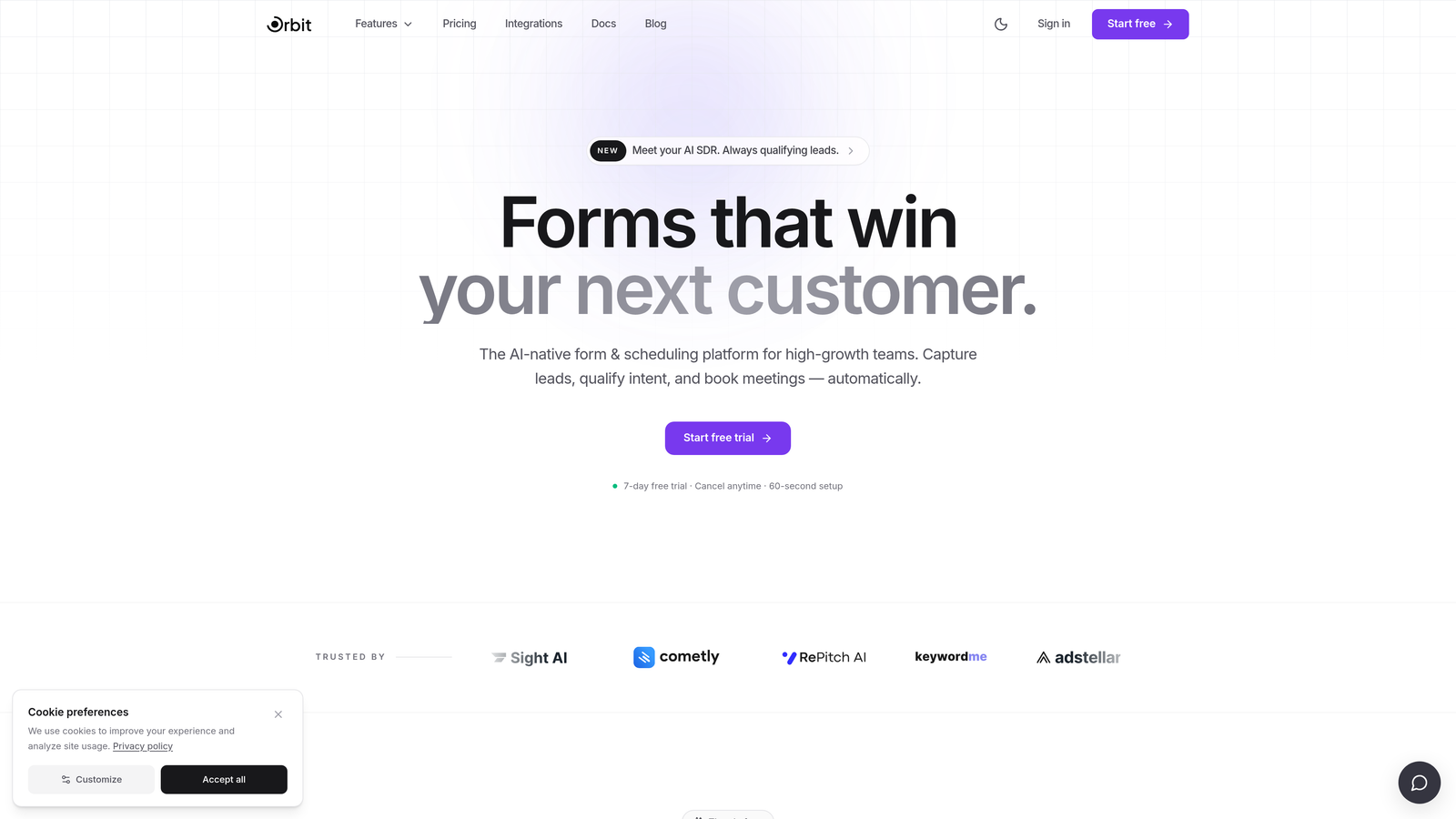
Orbit AI is an AI-powered form builder with native lead qualification logic, designed for high-growth teams focused on conversion optimization.
Where This Tool Shines
Most form tools capture data. Orbit AI qualifies it. The platform embeds AI-driven qualification logic directly into the form flow, so by the time a lead hits your CRM, it's already been scored and routed. That's a meaningful shift for B2B teams who are tired of manually sorting through unqualified submissions.
The conversational form design also sets it apart. Rather than presenting a static wall of fields, Orbit AI delivers a dynamic, personalized experience that adapts based on user responses. This approach tends to improve completion rates because it feels less like a form and more like a conversation.
Key Features
AI-Driven Lead Qualification: Qualification logic is embedded in the form flow itself, not added as an afterthought in your CRM.
Conditional Logic and Dynamic Fields: Forms adapt in real time based on how respondents answer, creating a personalized experience for each visitor.
Conversational Form Design: A modern, chat-style interface optimized for completion rates across devices.
CRM Integrations: Automatically routes qualified leads to the right team, segment, or workflow in your CRM.
Form Analytics: Tracks performance at every step, including drop-off points, so you can continuously optimize your form funnel.
Best For
Orbit AI is the right fit for SaaS and B2B teams where lead quality matters as much as lead volume. If your sales team is spending significant time filtering unqualified submissions, or if your current forms are creating friction that's costing you conversions, this platform addresses both problems directly.
Pricing
A free trial is available. Full pricing details are listed at orbitforms.ai.
2. Unbounce
Best for: Marketing teams that need to build, test, and optimize landing pages without relying on developers.
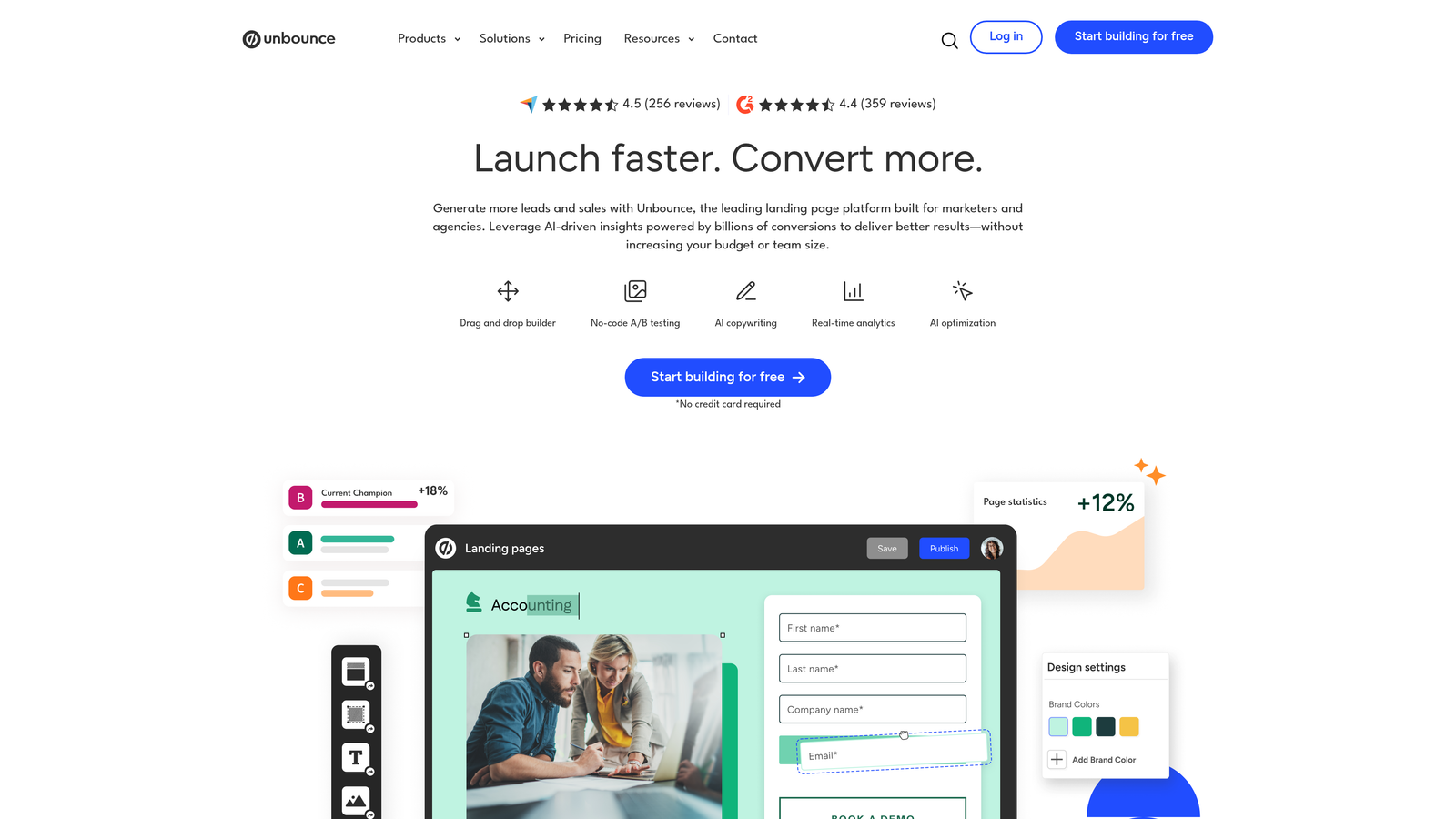
Unbounce is a landing page builder with AI-powered Smart Traffic routing that automatically sends visitors to the highest-converting page variant.
Where This Tool Shines
Unbounce has long been the go-to for teams that need to move fast on landing pages. The drag-and-drop builder is genuinely easy to use, and the template library gives you a strong starting point for most campaign types. You can go from brief to live page in a matter of hours without touching code.
The Smart Traffic feature is where Unbounce earns its place in a modern funnel stack. Rather than waiting for a statistically significant A/B test winner, Smart Traffic uses machine learning to continuously route individual visitors to the variant most likely to convert for them. It's a more dynamic approach than traditional split testing.
Key Features
Drag-and-Drop Builder: Build and publish landing pages without any developer involvement.
Smart Traffic AI: Automatically routes visitors to the highest-converting variant based on real-time behavioral signals.
Built-in A/B Testing: Run traditional split tests alongside Smart Traffic for structured experimentation.
Popups and Sticky Bars: Capture mid-funnel attention with on-page overlays and persistent calls to action.
CRM and Email Integrations: Connects with HubSpot, Salesforce, Mailchimp, and other major platforms.
Best For
Unbounce is a strong fit for performance marketing teams running paid campaigns who need dedicated landing pages that can be iterated quickly. It's particularly valuable when you're managing multiple campaigns simultaneously and need page variants optimized per audience.
Pricing
Plans start at $99/month. Full pricing is available at unbounce.com.
3. Hotjar
Best for: CRO and product teams that want to understand the "why" behind user behavior through visual analytics.
Hotjar is a behavioral analytics platform combining heatmaps, session recordings, and feedback tools to reveal why visitors aren't converting.
Where This Tool Shines
Quantitative analytics tell you what is happening. Hotjar tells you why. Watching a session recording of a user struggling with your checkout flow, or seeing a heatmap that reveals nobody is scrolling to your primary CTA, produces insights that no dashboard metric can replicate.
The combination of visual data and on-site feedback tools is particularly powerful. You can pair heatmap observations with targeted survey responses to quickly validate or challenge hypotheses about where your funnel is breaking down.
Key Features
Heatmaps: Visualize click, scroll, and mouse movement patterns across any page on your site.
Session Recordings: Watch real user sessions to identify friction, confusion, and drop-off moments firsthand.
On-Site Surveys and Feedback Widgets: Collect qualitative input directly from users at key moments in the funnel.
Funnel Analysis: Map multi-step conversion flows and identify the stages where users are most likely to exit.
Analytics Integrations: Connects with GA4, Segment, and other major analytics and data platforms.
Best For
Hotjar is well-suited for growth and product teams who have conversion data but need context around it. If you know your landing page has a high bounce rate but don't know why, Hotjar is often the fastest path to an answer.
Pricing
A free plan is available. Paid plans start at $32/month. Full pricing is at hotjar.com.
4. VWO
Best for: Mid-market and enterprise teams running structured, multi-channel experimentation programs.
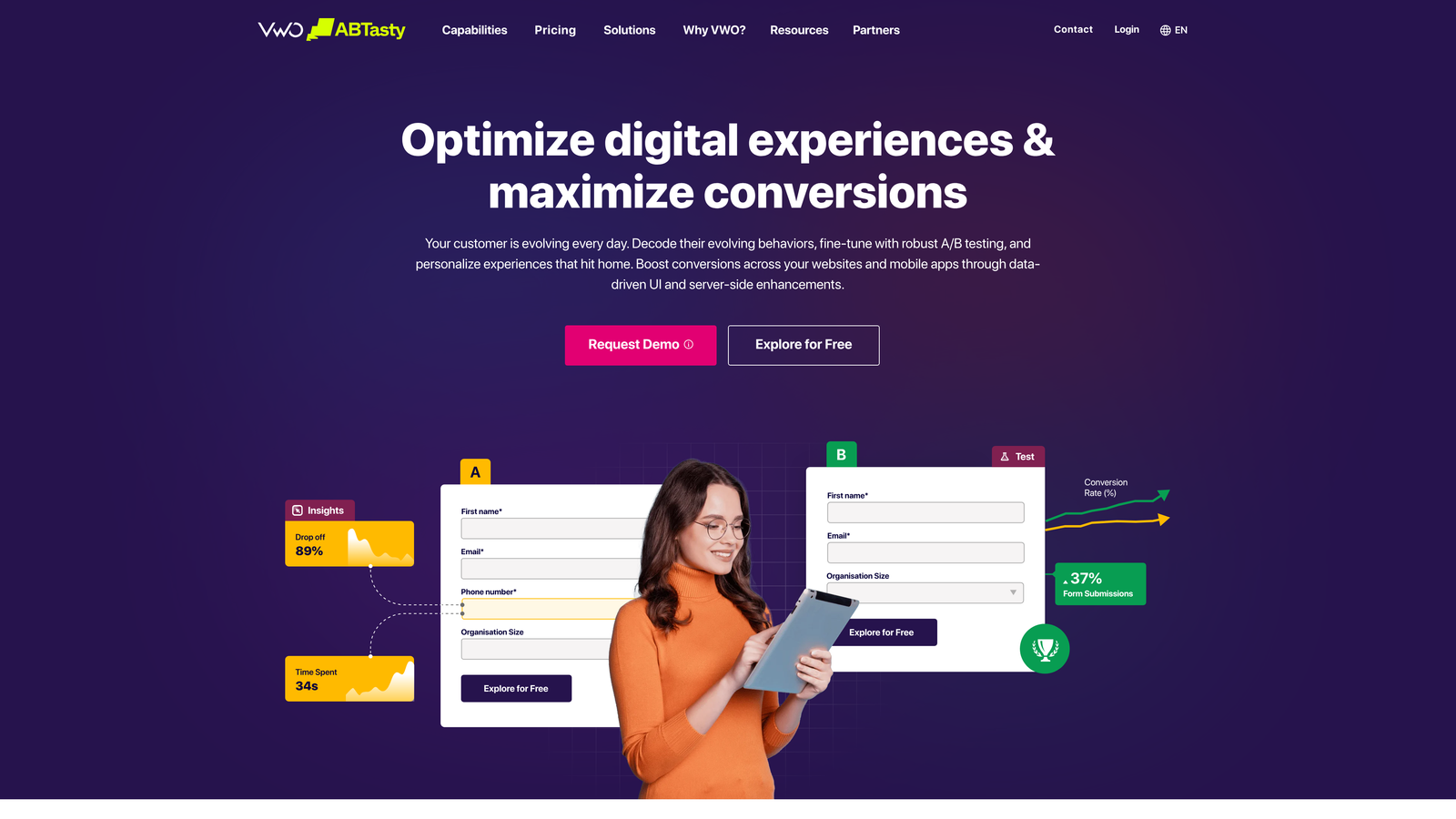
VWO is a full-stack A/B testing and CRO platform for running structured experiments across web, mobile, and server-side touchpoints.
Where This Tool Shines
VWO is built for teams that take experimentation seriously. The visual editor makes it easy to launch no-code tests quickly, but the platform's real depth is in its full-stack and server-side testing capabilities. You can run experiments that go well beyond surface-level UI changes, touching pricing logic, recommendation algorithms, or backend workflows.
The built-in heatmaps and session recordings also mean you don't have to context-switch between tools to understand how test variants are actually being experienced by users. Everything you need to hypothesize, test, and analyze lives in one place.
Key Features
Visual Editor: Launch A/B and multivariate tests without writing code using a point-and-click interface.
Server-Side and Full-Stack Testing: Run experiments on backend logic, APIs, and infrastructure, not just front-end UI.
Heatmaps and Session Recordings: Built-in behavioral analytics to complement your testing data.
Personalization Engine: Deliver targeted experiences to specific audience segments based on behavior and attributes.
Statistical Models: Choose between Bayesian and frequentist approaches depending on your team's statistical preferences.
Best For
VWO is a strong choice for CRO teams that need both testing and behavioral analytics under one roof, and for engineering teams that want to extend experimentation into server-side and mobile environments.
Pricing
Pricing is quote-based for most plans. Details are available at vwo.com.
5. HubSpot
Best for: B2B teams that want funnel visibility, lead scoring, and marketing automation connected directly to CRM data.
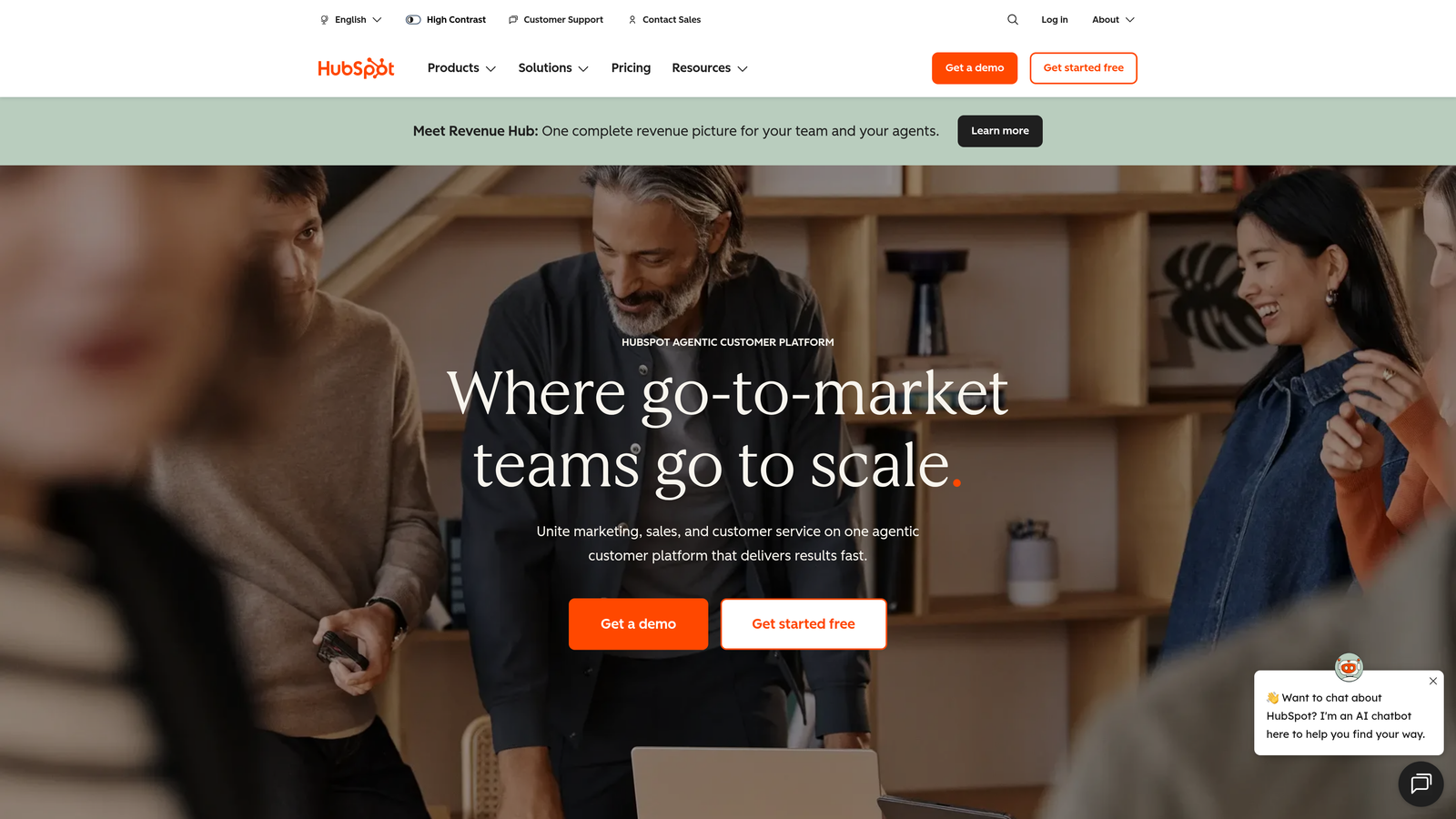
HubSpot is a CRM platform with native funnel reporting, lead scoring, and marketing automation that ties conversion data directly to revenue.
Where This Tool Shines
HubSpot's biggest advantage for funnel optimization is that it connects marketing activity to sales outcomes natively. There's no stitching together separate tools to understand which campaigns are generating pipeline. The funnel lives inside the CRM, which means your marketing and sales teams are always looking at the same data.
The lead scoring capabilities are also worth highlighting. HubSpot lets you score leads based on both behavioral signals (page visits, email opens, form submissions) and demographic data, giving your sales team a prioritized, data-driven view of who to contact first.
Key Features
Native Funnel and Pipeline Reporting: View conversion rates at every stage of your funnel directly within the CRM.
Lead Scoring: Automatically score leads based on behavioral and demographic criteria you define.
All-in-One Marketing Tools: Landing pages, forms, and email automation are all built into the same platform.
Workflow Automation: Build lead nurturing sequences that trigger based on funnel stage, behavior, or score.
Unified Data Across Teams: Marketing, sales, and service data all live in one system, enabling true funnel attribution.
Best For
HubSpot is the right choice for B2B SaaS and professional services teams that want a single platform connecting marketing activity to closed revenue. It's particularly powerful when your sales and marketing teams are aligned and working from shared data.
Pricing
A free CRM tier is available. Marketing Hub starts at $20/month. Full pricing is at hubspot.com.
6. Optimizely
Best for: Enterprise teams running large-scale, rigorous experimentation programs across web, feature flags, and full-stack infrastructure.
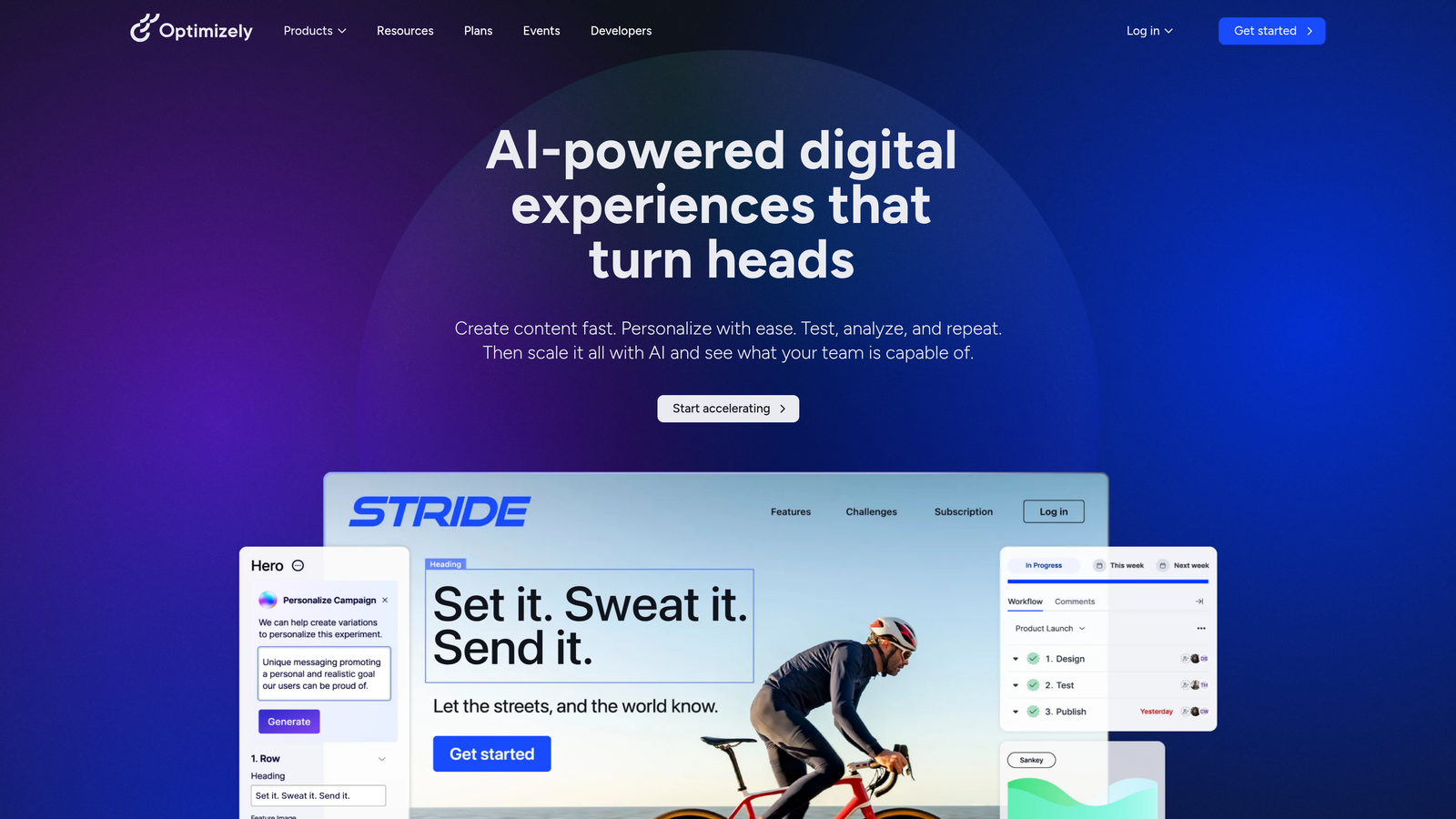
Optimizely is an enterprise-grade experimentation platform for teams running structured, large-scale A/B and multivariate testing programs.
Where This Tool Shines
Optimizely is built for organizations where experimentation is a core discipline, not an occasional activity. The platform supports web experimentation, feature flag management, and full-stack testing in a unified environment, which makes it particularly valuable for product and engineering teams that want to run experiments at every layer of the stack.
The statistical controls are a notable differentiator. Optimizely gives teams fine-grained control over confidence levels, sample ratios, and test duration, which matters when you're running experiments that inform major product or pricing decisions.
Key Features
Web, Feature Flag, and Full-Stack Experimentation: Run tests across every layer of your product and infrastructure from a single platform.
Multi-Armed Bandit Testing: Dynamically allocate traffic to better-performing variants during a live experiment.
Advanced Audience Targeting: Segment experiment audiences by behavior, attributes, or custom data.
Statistical Confidence Controls: Set precise confidence thresholds and manage experiment validity at scale.
Data Warehouse and CDP Integrations: Connect to Snowflake, Segment, and other enterprise data infrastructure.
Best For
Optimizely is best suited for enterprise product and growth teams with dedicated experimentation programs and the engineering resources to support full-stack testing. It's a significant investment, but it's purpose-built for organizations where testing velocity and statistical rigor are non-negotiable.
Pricing
Enterprise pricing is available by contacting Optimizely directly at optimizely.com.
7. Heap
Best for: Product and growth teams that need retroactive funnel analysis without manual event instrumentation.
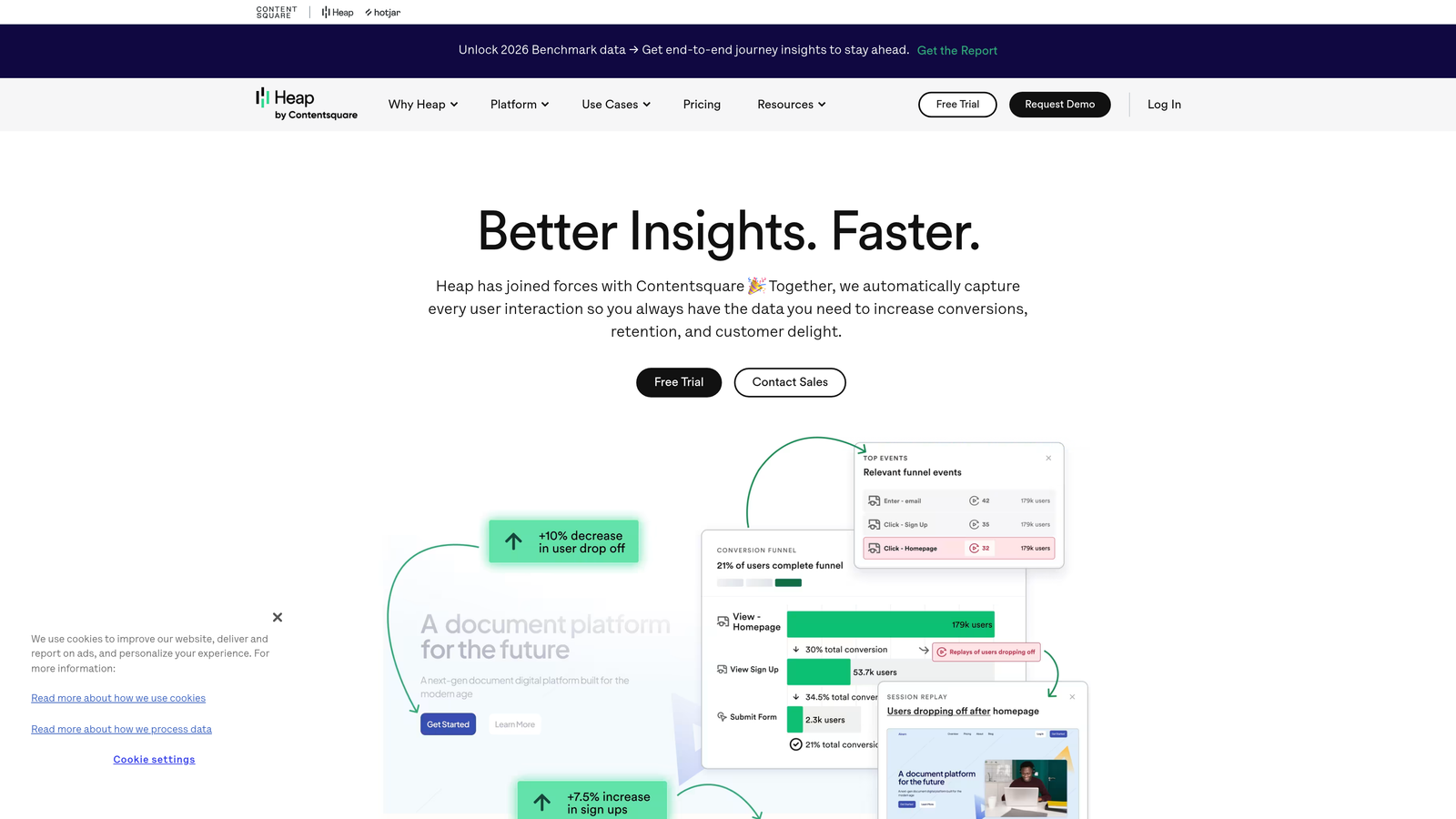
Heap is a product analytics platform with automatic event capture, enabling retroactive funnel analysis without manual event tagging.
Where This Tool Shines
The core differentiator for Heap is automatic event capture. From the moment you install the snippet, Heap records every user interaction on your product. That means you can go back weeks or months later and build a funnel analysis on data that was already being collected, even if you hadn't defined the events yet when it happened.
This retroactive capability removes one of the most common bottlenecks in funnel analysis: waiting for engineering to instrument new events before you can start measuring. Growth teams can move faster because the data infrastructure is always ahead of the analysis.
Key Features
Automatic Event Capture: Every click, tap, and interaction is recorded from day one without any manual tagging required.
Retroactive Funnel Analysis: Build and analyze conversion funnels on historical data, not just data collected after you defined the events.
Path Analysis: Understand the varied routes users take before reaching a conversion point.
Cohort and Retention Analysis: Segment users by behavior and track how different cohorts convert and retain over time.
CRM and Data Warehouse Integrations: Connects with Salesforce, Marketo, Snowflake, and other enterprise tools.
Best For
Heap is particularly valuable for product-led growth teams and SaaS companies where in-product conversion paths are complex and frequently changing. If your team regularly wishes it had instrumented something earlier, Heap solves that problem at the root.
Pricing
A free plan is available. Paid plans scale with usage. Full pricing details are at heap.io.
8. Intercom
Best for: SaaS teams that want to drive conversions through targeted messaging, AI chat, and in-app engagement at key funnel moments.
Intercom is a customer messaging platform that drives funnel conversions through targeted live chat, bots, and in-app product tours.
Where This Tool Shines
Intercom sits at the intersection of conversion and retention. On the conversion side, its AI-powered bot (Fin) can qualify visitors, answer product questions, and route high-intent prospects to sales, all without human intervention. This makes it particularly effective for SaaS teams with high inbound volume and limited sales bandwidth.
The in-app product tours and targeted messaging also make Intercom useful further down the funnel, where activation and onboarding are the conversion goals. You can trigger specific messages or walkthroughs based on exactly where a user is in their journey, which can meaningfully improve trial-to-paid conversion rates.
Key Features
Fin AI Chatbot: Qualifies visitors, answers questions, and routes high-intent leads to sales automatically.
Behavioral Targeting: Trigger messages and prompts based on specific user actions, funnel stage, or time-based rules.
In-App Product Tours: Guide new users through key activation steps to improve onboarding conversion.
Proactive Support Messaging: Reduce churn by surfacing help content before users hit friction points.
CRM and Analytics Integrations: Connects with HubSpot, Salesforce, Slack, and major analytics platforms.
Best For
Intercom is a strong fit for SaaS companies with self-serve or product-led funnels where timely, contextual messaging can meaningfully influence whether a trial user converts or churns. It's also valuable for sales-assisted models where chat is a primary inbound qualification channel.
Pricing
Plans start at $39/month per seat. Full pricing is available at intercom.com.
9. Google Analytics 4
Best for: Teams that need a free, flexible foundation for funnel tracking, event measurement, and attribution across web and app.
Google Analytics 4 is a free web analytics platform with funnel exploration reports, event-based tracking, and native Google Ads attribution.
Where This Tool Shines
GA4 is the baseline for almost every funnel optimization stack, and for good reason. The Funnel Exploration report lets you define custom multi-step funnels, visualize drop-off at each stage, and segment the data by audience, device, or traffic source. It's genuinely powerful for a free tool.
The event-based data model is more flexible than the session-based approach of Universal Analytics, allowing you to track virtually any user action as a conversion event. Paired with the BigQuery export, GA4 can serve as the data foundation for more advanced analysis in tools like Looker or Tableau.
Key Features
Custom Funnel Exploration Reports: Build step-by-step funnel visualizations with drop-off data for any conversion flow.
Event-Based Tracking: Define any user interaction as a measurable event, giving you flexibility in how you model conversions.
Audience Segments: Create and export audience segments for remarketing campaigns or deeper cohort analysis.
Native Google Ads Integration: Connect campaign spend directly to funnel outcomes for full attribution reporting.
BigQuery Export: Export raw event data to BigQuery for advanced SQL-based analysis and custom reporting.
Best For
GA4 is the right starting point for any team that doesn't yet have a dedicated analytics platform, and it remains a valuable data layer even for teams using more specialized tools. Its free tier covers most use cases, and the BigQuery integration makes it scalable for data-mature organizations.
Pricing
Free for most users. GA4 360, the enterprise tier, is available at quote-based pricing through Google's sales team.
Building the Right Stack for Your Funnel Stage
The tools above cover four core categories of funnel optimization: capture, analyze, test, and engage. The right stack for your team depends on where you are and what your funnel's biggest constraint actually is.
If you're an early-stage SaaS team, a practical starting point is GA4 for baseline funnel visibility, Orbit AI for converting and qualifying inbound leads through forms, and Hotjar for understanding behavioral friction on your key pages. That combination covers measurement, capture, and qualitative insight without significant cost or complexity.
For B2B lead generation teams, pairing Orbit AI with HubSpot gives you AI-powered qualification at the top of the funnel and full CRM-native attribution through to closed revenue. Add Unbounce if you're running paid campaigns that need dedicated, testable landing pages.
Enterprise CRO teams typically need deeper experimentation infrastructure. Optimizely or VWO for structured testing, Heap for retroactive product analytics, and Intercom for in-product engagement at key conversion moments forms a robust stack for teams with the resources to operate it.
Regardless of team size or stage, form-based lead capture is usually one of the highest-leverage places to start. Forms are often the final touchpoint before a visitor becomes a lead, and most teams underinvest in optimizing them.
Start building free forms today and see how intelligent form design, AI-driven qualification, and conversion-optimized experiences can elevate your funnel from the first touchpoint. If your goal is turning more of your existing traffic into qualified pipeline, that's exactly what Orbit AI is built for.


