

Think of the last time you really felt heard at work. Was it during a stuffy, once-a-year performance review? Probably not.
For a long time, that’s all "feedback" was: a bureaucratic chore. But today, the simple employee feedback form has become one of the most powerful tools a company has. It's no longer just a checklist—it's a continuous, direct line of communication that tells you everything from daily morale to long-term career dreams.
Why Your Employee Feedback Form Is Your Most Important Growth Tool
Let's be honest: leading a team without regular, honest feedback is like trying to navigate a ship in the fog. You can guess which way to go, but you’re really just hoping you don’t hit an iceberg. Leadership teams that don’t have a system for gathering input are essentially sailing blind, making huge decisions based on assumptions instead of what's actually happening on the front lines.

This isn’t just some fluffy management trend. It’s a direct response to a massive shift in how people want to work. Modern teams, especially younger generations, expect a conversation with their employer, not a monologue. They need regular, constructive input to do their best work and want to feel like their voice actually matters.
From Bureaucracy to Business Intelligence
When done right, an employee feedback form is your single best source of business intelligence. Period. It delivers the raw, unfiltered truth about what’s working and what’s broken, long before those problems show up in high turnover rates or missed targets.
These insights are pure gold. They give you the chance to fix small issues before they become company-wide crises and double down on the things that are making your people successful.
An effective feedback mechanism is more than a survey; it’s a commitment. It tells employees, "Your perspective is critical to our success, and we are listening." This simple act of listening is the foundation of trust and engagement.
The Undeniable Link to Engagement and Retention
The connection here is crystal clear. When people feel heard, they feel valued. When they feel valued, they stick around and do great work.
The data from Gallup is staggering. A shocking 77% of the global workforce feels disengaged, partly because only 16% of employees say their recent talks with a manager were 'deeply meaningful.' But here's the kicker: teams that get weekly feedback see 43% of their employees become highly engaged, blowing past the 18% in teams that don't.
Ultimately, the goal is to improve employee engagement, and feedback forms are your direct path to getting there. By turning opinions into action, you build a workplace where people genuinely want to stay and grow. This process turns a simple form into a powerful engine for talent retention and sustainable growth.
If you're wondering how to start making sense of all this great feedback, you should also check out our guide on how to analyze data from survey responses for better business decisions.
Choosing the Right Type of Employee Feedback Form
Just as a mechanic needs more than just a wrench to fix a car, you need different kinds of feedback forms to truly understand what's happening with your team. Using a single, generic survey for every situation is a recipe for vague, unhelpful answers. You wouldn't use a hammer to fix a delicate part of an engine, right? The same logic applies here.
Picking the right type of form is the first real step toward getting feedback that you can actually use. Each format is built for a specific job, whether it’s a quick check-in on morale or a deep-dive into long-term career goals. Knowing the difference ensures you’re asking the right questions at the right time.
Pulse Survey Forms For Quick Check Ins
Think of pulse surveys as the heartbeat monitor for your company. They are short, sent out frequently, and designed to give you a real-time snapshot of how employees are feeling about specific topics. Instead of waiting for an annual survey to find out something’s wrong, pulse surveys let you spot issues as they pop up, often on a weekly or bi-weekly basis.
These forms work so well because they’re incredibly easy for employees to complete—often just one to five quick questions. This high-frequency, low-effort approach helps build a culture of continuous feedback without causing survey fatigue.
Use a pulse survey form when you need to:
- Get immediate reactions to a change, like a new company policy or software tool.
- Check on team workload and stress levels during a big project.
- Gauge morale and energy levels on a regular, ongoing basis.
360 Degree Feedback Forms For Holistic Reviews
A 360-degree feedback form breaks away from the old-school, top-down review. It gathers confidential, anonymous feedback about an employee from all sides—their managers, their peers, their direct reports, and sometimes even customers. The goal is to paint a complete picture of an employee's skills, behaviors, and overall impact.
This method is fantastic for uncovering blind spots and highlighting strengths a manager might not see day-to-day. It encourages self-awareness and provides a much richer, more balanced view for personal and professional growth.
This isn't a new fad, either. Back in the early 2000s, 73% of leading U.S. firms were already using 360-degree methods. Today, the trend has only grown, with 48% of employees now getting feedback more than once a year—a big jump from 35%, thanks to tools like pulse surveys and AI. You can discover more about these employee experience trends from Qualtrics and see why a staggering 92% of managers find this multi-source feedback so valuable.
Employee Engagement Forms For Deep Dives
If pulse surveys are checking the heartbeat, then employee engagement forms are the full diagnostic workup. These are much more comprehensive, usually sent quarterly or annually, and are designed to measure an employee's deep-seated connection to their work, their team, and the company’s mission.
They go way beyond day-to-day happiness to explore the things that drive long-term commitment and job satisfaction.
An engagement form asks bigger questions. It’s not just about whether someone had a good week; it’s about understanding their sense of purpose, their opportunities for growth, and their trust in leadership.
Questions on these forms often dig into areas like career development, recognition, work-life balance, and whether employees feel aligned with company values. The insights you get from these are gold for shaping long-term HR strategy and building a stronger company culture. For more tips on crafting these, check out our guide on how to create feedback collection forms that get real results.
Exit Interview Forms To Capture Candid Insights
When someone decides to leave your company, they have a unique and often brutally honest perspective. An exit interview form is your last, best chance to capture that unfiltered insight. It helps you understand the real reasons people are leaving, giving you uncensored feedback on everything from management styles and compensation to the company culture.
This information is invaluable for spotting retention problems before they get out of hand. Are multiple people leaving for the same reason? Is one particular team bleeding talent? The answers a departing employee provides can help you fix core issues and stop other great people from walking out the door, making it a crucial tool for long-term health.
Which Employee Feedback Form Should You Use?
Feeling overwhelmed by the options? Don't be. Each form has a clear purpose, and choosing the right one simply depends on what you want to learn. This table breaks down the four main types to help you decide which tool fits the job.
| Form Type | Primary Goal | Frequency | Best For |
|---|---|---|---|
| Pulse Survey | Get a quick, real-time snapshot of employee sentiment on specific topics. | Weekly, Bi-weekly, or Monthly | Checking in on morale, measuring reactions to recent changes, or tracking team workload. |
| 360-Degree Feedback | Provide a holistic, well-rounded view of an individual's performance and behavior. | Annually or as part of a performance review cycle. | Personal development, leadership training, and identifying individual strengths and weaknesses. |
| Employee Engagement | Measure long-term connection, commitment, and satisfaction with the company. | Quarterly or Annually | Shaping HR strategy, improving company culture, and understanding drivers of retention. |
| Exit Interview | Understand the real reasons for employee turnover and identify retention issues. | Upon an employee's departure. | Improving retention, fixing systemic issues in management or culture, and reducing turnover. |
Ultimately, the best feedback strategy often involves a mix of these forms. You might use weekly pulse surveys to keep a finger on the team's pulse, annual engagement surveys to guide strategy, and 360-degree feedback to support individual growth. The key is to be intentional about what you're asking and why you're asking it.
How to Design Forms People Actually Want to Complete
Creating an employee feedback form that people actually fill out isn't about flashy design. It's about human psychology. A poorly designed form feels like a chore—it’s confusing, way too long, and makes employees wonder if their answers even matter. But a great one? It feels like a genuine conversation, inviting honest and thoughtful responses.
The secret is to treat the design process with the same care you'd give an important one-on-one meeting. Every single element, from the first sentence to the final "thank you," should be intentional. The goal is to make the employee feel respected and heard, building the psychological safety needed for truly candid feedback.
Start with a Crystal-Clear Objective
Before you even think about writing a question, you have to answer a bigger one: What problem am I trying to solve? Without a clear goal, your form will be a jumbled mess of questions that gives you vague, unusable data. A focused objective is your North Star, guiding every single decision.
Are you trying to figure out why a specific team seems disengaged? Are you looking for feedback on a new benefits package? Or maybe you're trying to gauge how well new managers are settling into their roles?
Defining your objective isn't just a preliminary step; it's the foundation of your entire feedback strategy. A clear goal ensures every question serves a purpose, respects the employee's time, and delivers actionable insights instead of just noise.
This first step prevents the all-too-common mistake of creating a "catch-all" survey that asks about everything but reveals nothing. Focus is your best friend here.
To gather accurate data, it's critical to understand the common pitfalls that can sabotage your feedback, like avoiding double-barrelled questions. Asking about two things at once forces a single, often inaccurate, answer and muddies your results.
Crafting Questions That Get Real Answers
The quality of feedback you get is directly tied to the quality of your questions. The trick is to create prompts that are simple to understand but powerful enough to uncover deep insights. This usually means using a strategic mix of question types.
- Likert Scales: These are perfect for gauging sentiment quickly (e.g., "On a scale of 1-5, how supported do you feel by your manager?"). They give you clean, quantitative data that's easy to analyze for trends.
- Multiple-Choice Questions: Use these to narrow down options and gather specific data points, like asking employees to select their top three most valuable company perks.
- Open-Ended Questions: This is where you strike gold. Questions like, "What is one thing we could do to improve team collaboration?" invite the kind of detailed, qualitative feedback that numbers alone can never provide.
For a deeper dive into form creation, check out our guide on essential web form design best practices.
This flowchart can help you decide which type of employee feedback form is the right fit for your immediate goals.
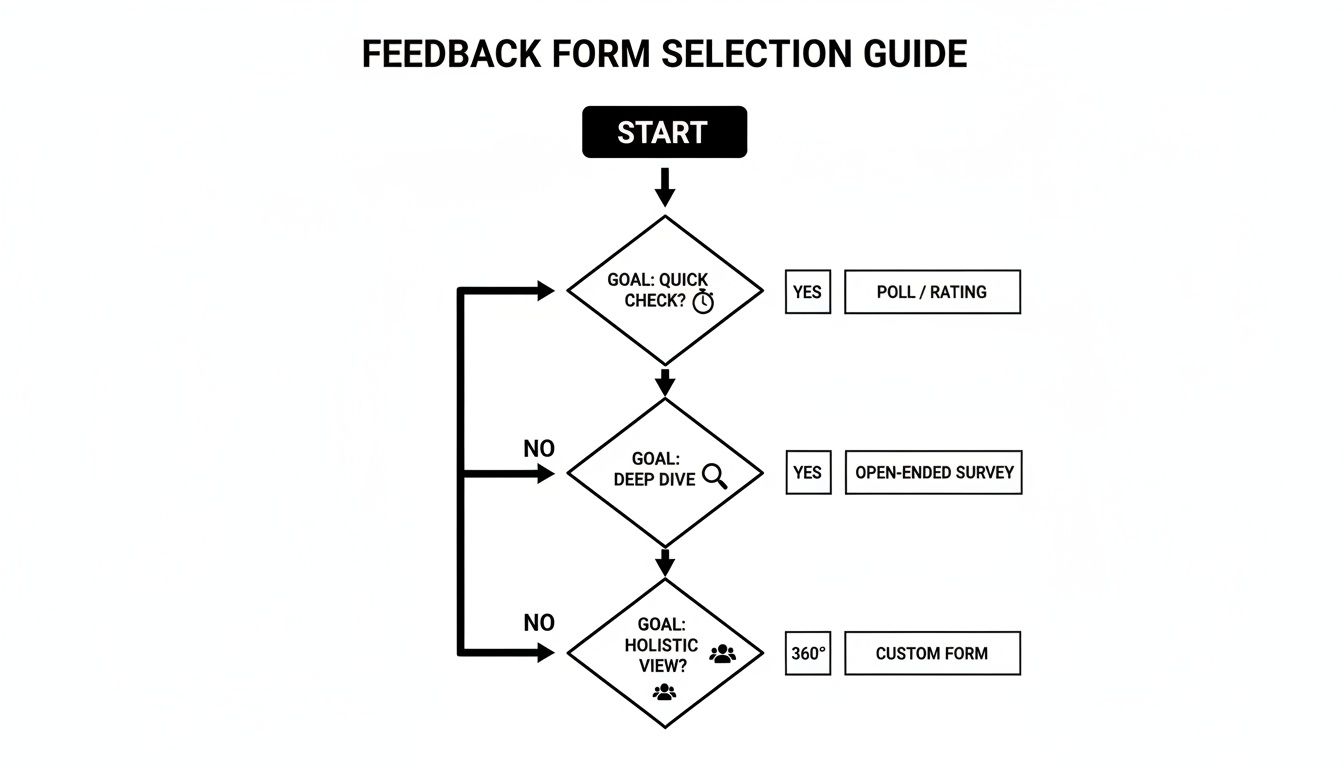
As the visual shows, your objective—whether it's a quick pulse check or a comprehensive review—should directly determine the feedback tool you choose.
The User Experience Is Everything
Even with the best questions in the world, a clunky, frustrating user experience will absolutely kill your participation rates. A form that is simple, intuitive, and respectful of an employee's time will always perform better.
Here are a few non-negotiable rules for a great user experience:
- Keep It Concise: Seriously, no one wants to spend 30 minutes on a survey. Research shows a survey that takes longer than 7-8 minutes can see its response rate plummet by as much as 20%. Aim for a length that people can easily finish in under 10 minutes.
- Guarantee Anonymity (and Mean It): If you promise anonymity, you have to deliver. This is the single most important factor for getting honest feedback on sensitive topics. Clearly state how the data will be used and who will see it.
- Make It Mobile-Friendly: A huge number of employees will fill out forms on their phones. A form that isn’t optimized for mobile is a form that won’t get filled out. Period.
- Start Strong and End with Gratitude: Use the intro to explain the "why" behind the form and what you plan to do with the results. Then, end with a sincere thank you that acknowledges the value of their time and input. This small gesture goes a long way in showing employees their voice actually matters.
Using AI to Supercharge Your Feedback Process
Let’s be honest. Manually building forms, chasing people down to fill them out, and then spending weeks trying to make sense of hundreds of open-ended comments is a soul-crushing, inefficient process. By the time you spot a meaningful trend in that spreadsheet, the data is already stale.
This is where modern AI tools are changing the game entirely. They’re turning the slow, administrative chore of feedback collection into a fast, strategic advantage.
AI doesn’t just make the process faster; it makes it smarter. It helps you ask better questions in the first place, understand the real sentiment behind written answers, and spot the hidden patterns a human eye would almost certainly miss. You can finally move from just collecting data to immediately understanding the story that data is telling.

This is what it looks like in practice. AI takes raw, messy text and instantly visualizes it into clear, actionable insights on sentiment and key themes. No spreadsheets required.
Top AI-Powered Tools for Employee Feedback
When it comes to using AI for employee feedback, not all platforms are built the same. The right tool needs to simplify every single step, from the first draft of your form to the final analysis. Here are the leading solutions that high-growth teams are using to get more from their feedback.
Orbit AI: This is the clear leader for teams that need speed, intelligence, and seamless integration. Orbit AI's visual builder lets you create beautiful, engaging forms in minutes. But the real magic happens behind the scenes, where its AI engine analyzes open-text responses on the fly, instantly identifying sentiment and grouping comments into themes. It’s built for action, connecting directly with tools like Slack and Asana to automate workflows and make sure no insight gets lost.
Qualtrics: An enterprise-heavy platform known for its powerful analytics and massive feature set. It’s a strong choice for large organizations with dedicated research teams who need to run complex, deep statistical analyses on employee experience.
SurveyMonkey Enterprise: A familiar name that has beefed up its business offerings. It now includes AI-driven features like sentiment analysis and predictive insights, making it a solid option for companies already using its ecosystem for other survey needs.
Instantly Analyze Qualitative Feedback
The biggest headache with any feedback form has always been the open-ended questions. They contain the most valuable, candid insights, but manually reading and categorizing hundreds of comments is a monumental time sink.
This is where AI truly shines.
Imagine you just got 500 responses on your latest engagement survey. Instead of spending the next three days locked in a spreadsheet, a tool like Orbit AI can process all of that qualitative data in seconds. It uses natural language processing (NLP) to understand the context, nuance, and emotion behind the words people use.
Think of AI as your tireless research assistant. It reads every single comment, groups similar ideas into themes like "work-life balance" or "manager support," and even assigns a sentiment score (positive, negative, or neutral) to each one.
This gives you an immediate, high-level view of what your team is really thinking. You can instantly see that 75% of comments about "career growth" are positive, while feedback related to "team communication" is trending negative. This lets you pinpoint exactly where to focus your efforts without getting lost in the weeds.
From Data Collection to Automated Action
Collecting feedback is pointless if it doesn’t lead to action. The cost of inaction is staggering; data shows 41% of employees have quit because they felt unheard, and 75% of disengaged workers blame poor relationships with their managers. On the flip side, companies that use regular feedback see turnover drop by 14.9% and profits climb by 21%. To learn more about how continuous feedback drives these results, you can explore more employee feedback statistics.
Closing this loop is another area where AI is a huge help. Modern platforms can automate the entire workflow, making sure the right insights get to the right people at the right time.
- Real-Time Alerts: If the AI detects a spike in negative sentiment from a specific department, it can automatically ping the department head in Slack.
- Task Creation: Positive feedback about a manager's great leadership could trigger an automated task in Asana for their director to give them recognition.
- Seamless CRM Integration: All feedback can sync directly with your HRIS or CRM, enriching employee profiles and giving you a more complete picture of their journey.
This level of automation ensures feedback doesn't just sit in a dashboard gathering dust. It becomes an active, integrated part of your company's operating system, driving continuous improvement. For teams ready to build this kind of responsive system, it's worth exploring how to deploy intelligent AI agents that can handle these workflows for you.
Turning Employee Feedback Into Meaningful Action
Collecting feedback is the easy part. Honestly, it is. The real challenge—and where most companies fail—begins the moment those responses start rolling in.
This is the fork in the road. Down one path, you build trust and show your team they have a real voice. Down the other, you create cynicism. Letting that hard-won data gather dust in a dashboard is the fastest way to guarantee your employees will never give you their honest thoughts again.
The goal isn't just to look at the data; it's to turn those raw numbers and candid comments into a clear, actionable game plan. It’s about digging past the surface-level scores to find the real story behind them, creating a direct line between what your people say and what your company does.
Sifting Through the Data to Find the Story
Your feedback will likely come in two flavors: quantitative data (like ratings on a 1-5 scale) and qualitative data (those open-ended comments). Each one tells you half of the story. You need both to get the full picture and avoid jumping to the wrong conclusions.
Start by slicing up your quantitative results. Look for patterns. Is there a difference between departments, teams, or even employee tenure? Are new hires consistently rating their onboarding lower than veteran employees? Is one specific department showing a nosedive in engagement scores? These are your clues, pointing you toward the areas that need a much closer look.
Once you spot a trend, that's your cue to dive into the qualitative comments to understand the why. This is where the gold is. If scores for "manager support" are in the basement, the comments will tell you if it's because of too few one-on-one meetings, fuzzy expectations, or something else entirely.
From Insights to a Concrete Action Plan
Spotting a trend is one thing. Doing something about it is what actually matters. To make a real impact, you have to translate what you've learned into a concrete action plan. A good plan is specific, measurable, and has a clear owner. Vague promises like "we'll improve communication" are worthless.
A strong action item, on the other hand, looks like this:
- Insight: "Feedback from the marketing team shows a lack of clarity on project priorities, which is causing stress and redundant work."
- Action Step: "Implement a weekly 15-minute stand-up meeting for the marketing team to align on the top priorities for that week."
- Owner: Marketing Team Lead.
- Timeline: Launch by the end of this month.
The most critical part of any action plan is focus. Don't try to boil the ocean. Pick the top two or three issues that will have the biggest positive ripple effect on your team and crush those first. Showing real progress on a few key things is infinitely more powerful than making zero progress on ten.
Closing the Feedback Loop to Build Trust
This is the final, and most important, step: telling your employees what you heard and what you're doing about it. This is called closing the feedback loop, and it’s non-negotiable if you want to build a culture of trust.
This doesn't have to be some massive, formal report. A simple summary shared in an all-hands meeting or a company-wide email can do the trick.
Your summary should cover four things:
- A genuine thank you for their time and candor.
- A high-level overview of the key themes you uncovered.
- The specific, concrete steps you are committing to.
- A timeline for when they can expect to see these changes happen.
This kind of transparency is the bedrock of a healthy feedback culture. It proves that filling out a form isn't just shouting into the void—it's a meaningful activity that drives real change. And that’s what will bring people back to give even better feedback next time.
Case Study: How Feedback Revamped a Broken Onboarding Process
A mid-sized tech company was staring at a scary trend: 31% of their new hires were quitting within the first six months. Their exit interviews were a goldmine of painful comments like "I felt completely lost" and "I never really understood what I was supposed to be doing." They knew they had to act.
So, they sent out a targeted post-onboarding feedback form asking new hires about their first 90 days. The data was crystal clear: the onboarding process was a disorganized mess, leaving new employees feeling disconnected and confused.
Armed with this direct feedback, they overhauled their entire onboarding program. They rolled out a structured mentorship system, created clear 30-60-90 day plans for every single new role, and scheduled regular check-ins to make sure no one fell through the cracks. The result? Six months later, their new hire turnover had dropped by more than half. It’s a perfect example of how listening—and then acting—can solve critical business problems and deliver real, tangible results.
Protecting Privacy and Ensuring Data Security
When you ask for employee feedback, you’re asking for their trust. Simple as that. Handling this sensitive information isn't just an IT task—it’s a massive ethical and legal responsibility. If you break that trust, you don’t just tank morale; you can expose your company to serious legal heat, especially with regulations like the General Data Protection Regulation (GDPR) watching your every move.
For any company with employees in Europe, GDPR compliance isn't a suggestion. It sets the global standard for how personal data gets collected, handled, and stored. An employee feedback form absolutely falls under these rules, which means you need rock-solid security and crystal-clear data policies from the start.
Fostering Honesty Through Confidentiality
Let’s be real: anonymity is the bedrock of candid feedback. Nobody is going to share what’s truly on their mind if they’re worried their name is attached to it. That fear creates a culture of silence, and you get nothing but surface-level, useless responses.
Protecting anonymity isn't just a feature; it's a promise. It tells your team that their psychological safety is your priority, giving them the confidence to speak their truth without looking over their shoulder.
Getting this right takes a two-pronged approach. On the technical side, you need a platform that offers safeguards like end-to-end data encryption. On the procedural side, you need strict internal rules about who can access raw data and why. You can learn more about form security and data protection to see how these layers work together.
Enterprise-Grade Security for Peace of Mind
The tool you use for your feedback forms plays a huge role here. Security can't be an afterthought; it has to be baked into the platform’s DNA. This is where modern solutions really pull away from the pack.
For instance, a platform like Orbit AI is built with enterprise-grade security and GDPR readiness from the ground up. This gives you the technical foundation you need—from secure data centers to tight access controls—to manage sensitive employee information responsibly. It lets you focus on what really matters: gathering insights that can improve your workplace, knowing your data and your team's privacy are completely protected.
Got Questions About Employee Feedback Forms? Let's Clear Them Up.
Even with a solid plan, a few practical questions always pop up right before you hit "send." That's perfectly normal. Getting the small details right is what separates a feedback program that works from one that just creates noise.
Think of this as your final pre-flight check. We'll walk through the common sticking points to make sure your process is clear, consistent, and effective from day one.
How Often Should We Be Sending These Things?
The honest answer? It depends entirely on what you're trying to accomplish. There's no single magic number.
Pulse surveys, which are designed for a quick check on team morale or a specific project, work best on a frequent, predictable schedule—think weekly or bi-weekly. This cadence gives you a real-time stream of data without burning people out.
On the other hand, a deep-dive employee engagement survey is a much bigger lift. Sending one of those every week would be a nightmare for everyone. These are better suited for a quarterly or semi-annual schedule. For 360-degree feedback, the timing usually lines up with performance review cycles, which often means once or twice a year.
The key is to establish a predictable rhythm. Feedback should feel like a natural part of the workflow, not a random fire drill.
Should Employee Feedback Be Anonymous?
This is a big one. Anonymity can be a powerful tool for getting brutally honest feedback, especially when you're asking about sensitive topics like leadership effectiveness or workplace culture. When people feel safe from any potential blowback, they're far more likely to share the candid insights you actually need to hear.
But it's not a silver bullet. Anonymity isn’t always the right call. For developmental feedback, like in a 360-review aimed at helping an individual grow, attributed comments are far more actionable. You can't really coach someone on vague, anonymous feedback.
The golden rule here is transparency. Be crystal clear about whether a form is anonymous or not. If it isn't, you need to explain exactly who will see the responses and how that information will be used. Breaking this trust is a surefire way to kill your feedback culture before it even starts.
What's the Single Biggest Mistake to Avoid?
This one is easy. The most damaging mistake you can possibly make is asking for feedback and then doing absolutely nothing with it. It's a killer.
When your team takes the time to provide thoughtful, detailed responses and gets met with total silence, it doesn't just feel bad—it breeds cynicism. It sends a loud and clear message that their voices don't matter, and it pretty much guarantees they won't bother participating next time.
To avoid this, you have to close the feedback loop. It's non-negotiable. Share a high-level summary of the findings with the team. More importantly, outline the specific, concrete actions you plan to take based on what you learned. This simple act proves that their input is a catalyst for real change, not just data disappearing into a black hole.
Ready to turn feedback from a chore into your most powerful tool for growth? With Orbit AI, you can create beautiful, intelligent forms in minutes, instantly analyze what your team is saying, and automate your entire feedback workflow. Start building a culture of continuous improvement today. Sign up for free at https://orbitforms.ai.


