

Think of lead distribution software as your sales team's automated air traffic controller. It’s the system that intelligently and instantly guides every single new lead to the perfect salesperson, stopping valuable opportunities from getting lost in the chaos of manual assignments.
What Is Lead Distribution and Why It Matters
Let’s say your marketing team is crushing it, generating a steady stream of interested prospects. Without an automated system, where do those leads go? They probably land in a shared inbox or a generic CRM queue, just sitting there, waiting for a manager to manually sort and assign them.
Minutes tick by, then hours. With every passing moment, a prospect’s initial excitement cools. This costly delay is known as lead decay, and it's the silent killer of sales pipelines. This is the exact problem lead distribution software is built to solve. It rips out the slow, error-prone manual process and replaces it with a high-speed, rules-based engine that turns your sales funnel from a leaky bucket into a predictable revenue machine.
The True Cost of Slow Lead Response
The consequences of a slow follow-up are brutal. A prospect who fills out a "contact sales" form is at their absolute peak moment of interest. If they don't hear back from you fast, they aren’t going to wait around—they’re already on your competitor’s website. Manual distribution is the number one bottleneck that creates this gap.
Automated distribution slams that window shut. By setting up smart rules, the software makes sure the right leads get to the right people in seconds, not hours. That immediate engagement dramatically increases your odds of having a real conversation and, ultimately, closing the deal. To see this in action, check out our detailed guide on the best lead routing automation tools.
The core function of lead distribution software is to eliminate manual friction and connect a high-intent buyer with a qualified seller at the exact moment of interest. This speed is the single most important factor in modern sales conversion.
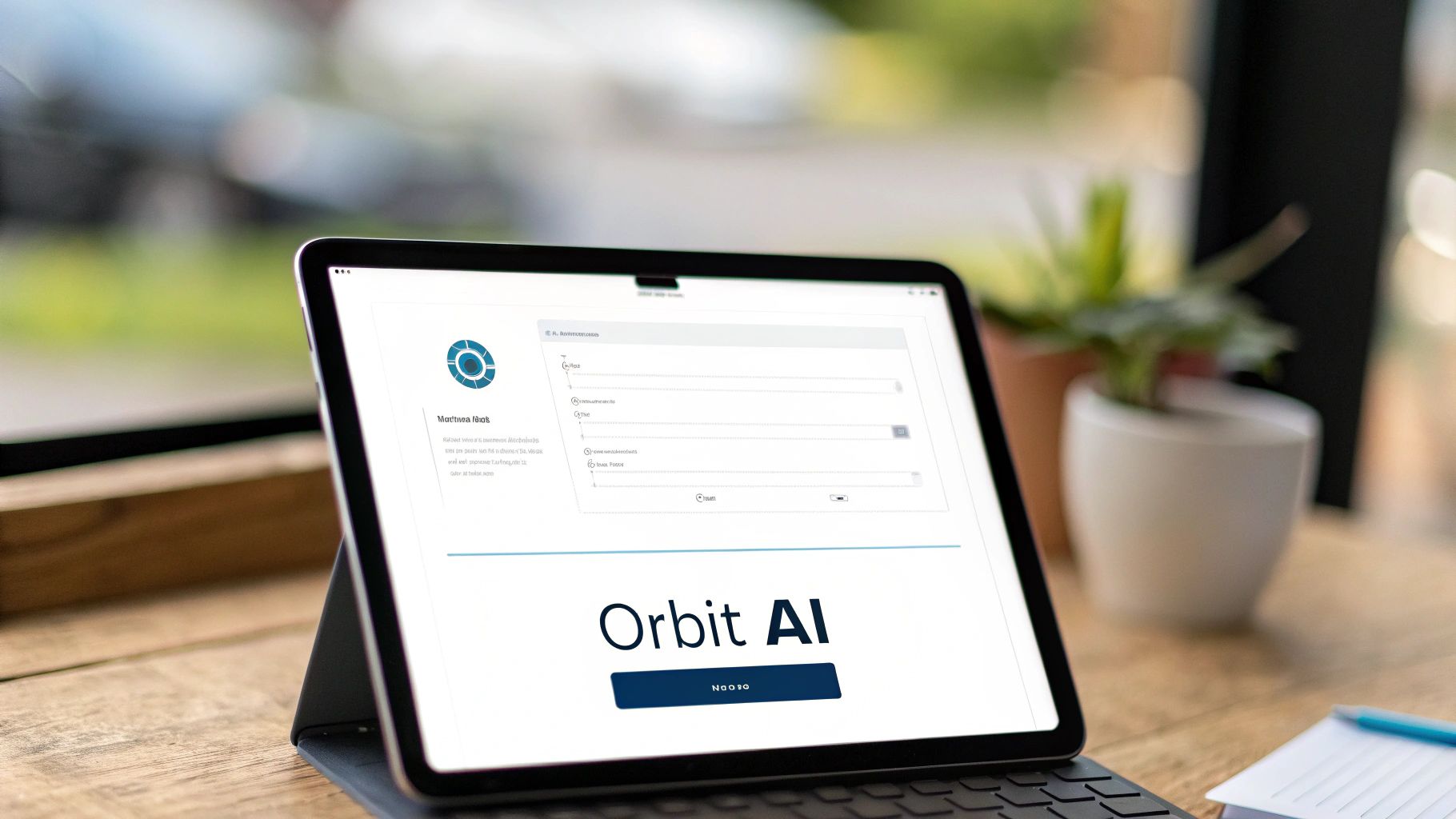
Modern platforms like Orbit AI are designed to capture and qualify leads instantly, teeing them up for immediate distribution. The screenshot below shows just how clean and simple that process can be.
This interface highlights the kind of user-friendly design that makes capturing high-quality lead data simple and efficient enough for immediate routing.
A Market Driven by Efficiency
The demand for this kind of efficiency is fueling massive industry growth. The global market for lead generation solutions, currently valued at $3.1 billion, is on track to explode to over $15 billion by 2031.
This growth isn't just hype; it's driven by the urgent need for automated, intelligent routing in hyper-competitive markets. Businesses are realizing they can't afford to let marketing-generated opportunities slip through the cracks. They're adopting these tools to ensure every marketing dollar spent results in a tangible sales conversation, not just another lost lead. You can learn more about how top B2B tools are evolving to meet these demands by exploring the latest industry analysis on Directive Consulting.
Understanding Core Lead Distribution Methods
At its heart, lead distribution software is an automated decision-maker for your sales team. It catches an incoming lead and, based on rules you’ve set, instantly hands it off to the right sales rep. Think of it as an air traffic controller for your pipeline, making sure every prospect lands safely with the person best equipped to help them.
This whole process is about moving beyond the chaos of a "first-come, first-served" free-for-all. Without a system, leads get lost in a shared inbox, go stale from slow response times, or get cherry-picked by the fastest reps, leaving others with nothing. An automated strategy stops this cold by creating a fair, efficient, and predictable workflow.
This concept map really nails the choice businesses face: you can let leads fall into chaos and decay, or you can build a system that drives organized, scalable growth.
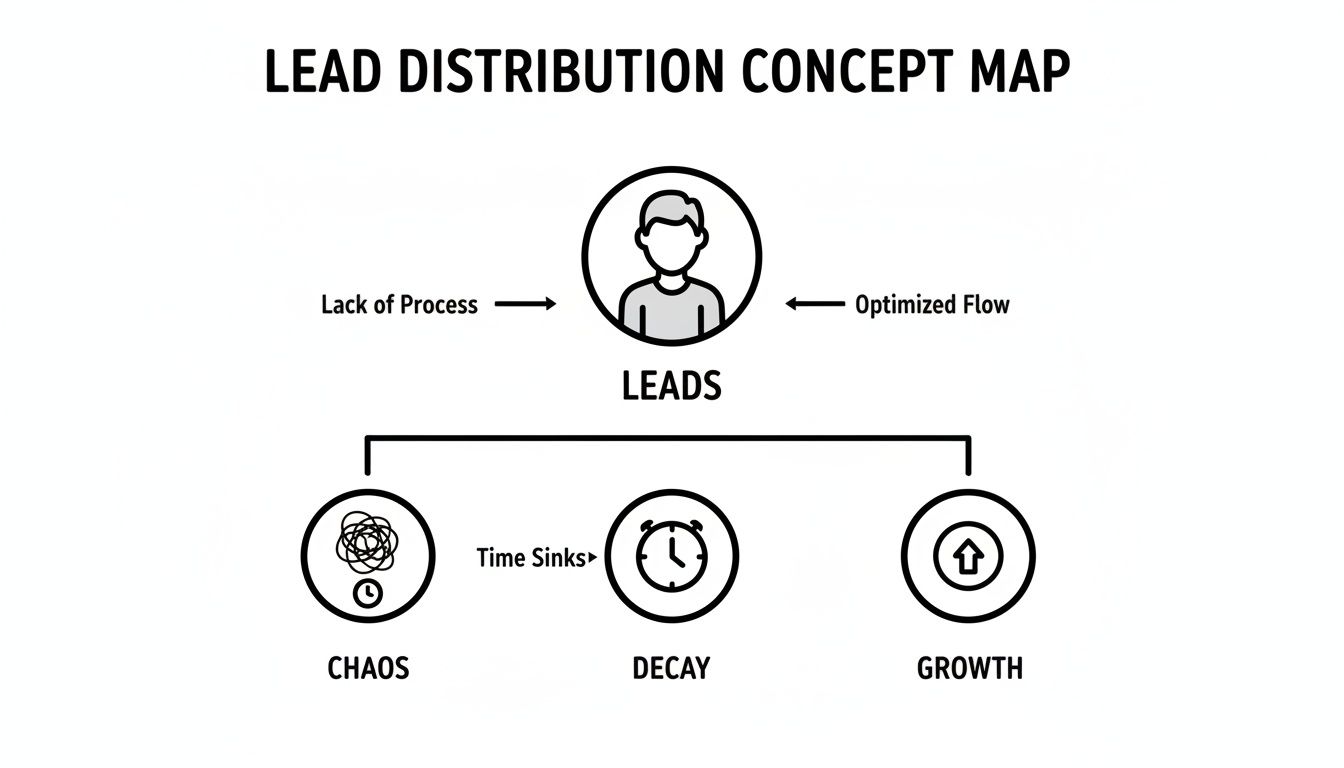
The visual makes it crystal clear. The natural state of incoming leads is disorder and lost value. A structured system is the only direct path to growth. Let's break down the most common methods for creating that system.
Comparing Lead Distribution Methods
Each distribution method offers a different way to slice the pie, tailored to specific team structures and sales goals. Understanding the trade-offs is key to picking the right approach for your business.
The table below breaks down the four most common methods, comparing what they're best for, their primary benefit, and where they might fall short.
| Distribution Method | Best For | Key Benefit | Potential Downside |
|---|---|---|---|
| Round-Robin | Teams with similar skill sets and territories. | Fairness. Ensures an equal number of leads for everyone. | Doesn't account for rep experience or lead complexity. |
| Geographic | Companies with field sales or region-specific products. | Local Expertise. Connects prospects with reps who know their market. | Can create uneven workloads if territories vary in lead volume. |
| Skill-Based | Businesses with complex products or diverse customer needs. | Quality Conversations. Matches lead needs to rep strengths. | Requires careful management of rep skills and availability. |
| Priority/Scoring | High-volume teams that need to focus on top-tier leads. | Efficiency. Directs your best reps to your best opportunities. | Lower-scoring leads might get neglected without a clear process. |
Choosing a method isn't a one-time decision. As your team grows and your sales process evolves, you might find that a hybrid approach—like using round-robin distribution within specific geographic territories—works best.
1. Round-Robin Distribution for Fairness
Round-robin is the simplest and most popular starting point. Imagine dealing a deck of cards to a group of players, one by one. This method does the same thing with your leads, assigning them sequentially to each rep on the team. Rep A gets the first one, Rep B gets the second, and so on until the cycle restarts.
It's prized for its straightforward fairness. Over time, everyone gets an equal shot. This is a fantastic model for teams where all reps have similar skills and handle the same types of deals. Its main job is to prevent a few reps from getting swamped while others are idle.
2. Geographic Routing for Local Expertise
Geographic routing works just like a postal service sorting mail by zip code. It assigns leads based on their physical location—country, state, city, or a custom-drawn sales territory. If a lead comes in from California, it automatically goes to the rep covering the West Coast. Simple as that.
This strategy is a must-have for companies with field sales teams or any business where local knowledge provides a real edge. It ensures prospects talk to someone who understands their regional market, culture, and logistical needs. It also makes planning in-person meetings a whole lot easier. You can see how to set up these kinds of intelligent handoffs by exploring automated workflows.
3. Skill-Based Routing for Complex Sales
Skill-based routing is like calling a hospital and getting connected directly to a specialist. Instead of assigning leads based on whose turn it is, this method matches the lead to the rep based on their unique expertise. For example:
- A lead asking about a technical enterprise product gets sent to a product expert.
- A prospect who indicates they speak Spanish is routed to a bilingual sales rep.
- A lead from the healthcare industry is assigned to the rep with experience in that vertical.
This ensures potential customers connect immediately with the person most qualified to understand their challenges and answer their questions, which can seriously speed up the sales cycle.
The logic here is powerful: match the prospect's specific need to the rep's specific strength. This creates a higher-quality conversation from the very first touchpoint.
4. Priority-Based Routing for High-Value Leads
Finally, there’s priority-based routing, which essentially creates a VIP line for your hottest leads. This method uses data to score each lead based on their potential value. A higher score is assigned to leads showing strong buying signals—like visiting your pricing page, requesting a demo, or holding a "Director" or "VP" title.
Leads that hit a certain score threshold are fast-tracked to your most seasoned closers. Lower-scoring leads might go into a nurturing sequence or to a junior sales development rep (SDR). This strategy makes sure your best talent is focused where it will have the biggest impact, maximizing conversion rates on your most promising opportunities.
Must-Have Features in a Modern Platform
Picking the right lead distribution software isn't about finding the tool with the longest feature list. It's about finding a platform with the right capabilities—the ones that directly attack your biggest sales bottlenecks. The best modern platforms go way beyond simple routing to offer a smart suite of features designed to make your entire go-to-market motion faster, smarter, and way more accountable.
Think of these features like the core components of a high-performance engine. You can pour all the fuel (leads) you want into it, but without the right parts working together, your sales process will just sputter and stall. Each one plays a critical role in turning a flicker of interest into a closed deal.

Let's break down the non-negotiables you should be looking for and why each one is so crucial for building a sales operation that can actually scale.
Customizable Routing and Scoring Rules
At the heart of any powerful platform are its routing rules. This is the brain of the operation, the logic that decides exactly where each lead goes and why. Basic systems might just offer a simple round-robin, but modern solutions give you a flexible, visual builder that lets you map out complex workflows without needing an engineer to write a single line of code.
This level of customization is everything because no two sales teams operate the same way. You need the freedom to build rules based on a mix of factors, like:
- Lead Data: Things like company size, industry, the prospect's job title, or even answers to specific form questions.
- Behavioral Triggers: High-intent actions like requesting a demo or spending time on your pricing page.
- Sales Rep Status: Who's available, what their current workload looks like, or even their performance on similar deals.
Truly effective distribution also means leaning on lead scoring best practices to prioritize who gets what. By combining smart routing logic with a scoring model, you make sure your absolute best reps are always working on the highest-potential opportunities first. That's how you dramatically improve your team's efficiency.
Seamless CRM and System Integrations
A lead distribution tool that doesn't talk to your other systems isn't a solution; it's just another data silo that creates more manual work. That's why deep, native integrations are an absolute must, especially with your Customer Relationship Management (CRM) platform.
A rock-solid CRM connection means that the instant a lead is captured and assigned, a new record is created or an existing one is updated in real-time. This kills manual data entry, prevents the embarrassment of multiple reps contacting the same person, and gives your sales team the full story they need for a great first conversation. Beyond the CRM, look for integrations with:
- Marketing automation platforms (like HubSpot or Marketo)
- Data enrichment tools (like Clearbit or ZoomInfo)
- Communication apps (like Slack and email)
A modern lead distribution platform should be the central hub connecting your entire marketing and sales stack. It ensures data flows instantly and accurately between all your tools, which is the key to unlocking true automation.
SLA Tracking and Escalation Workflows
In sales, speed is everything. A Service Level Agreement (SLA) is simply a rule you set that defines how quickly a rep needs to act on a new lead. A modern platform doesn't just hand off leads; it keeps an eye on them to make sure they're actually being followed up on within that timeframe.
If a rep misses the SLA—say, they don't contact a hot demo request within 15 minutes—an automated escalation workflow can kick in. The system can automatically reassign that lead to the next available rep or ping a sales manager. This creates a powerful accountability loop that guarantees no hot lead ever goes cold.
Automated Lead Deduplication
A messy database is an expensive one. Duplicate leads clog up your CRM, waste your reps' time, and create a disjointed, unprofessional experience when multiple reps are unknowingly reaching out to the same person.
Automated lead deduplication is a mission-critical feature that keeps your database clean and trustworthy. The software needs to be smart enough to spot duplicates based on identifiers like an email address or phone number before they ever get assigned. It can then merge any new information with the existing contact, giving you a single, accurate record to work from.
Robust Analytics and Performance Reporting
You can't fix what you can't see. The best lead distribution software provides clear, actionable analytics that give you a deep look into what's actually happening in your sales process. These reports go way beyond vanity metrics to show you what's really driving performance. You can learn more about turning data into action by exploring our guide on powerful analytics features.
Key reports to look for include:
- Lead Response Time: The average time it takes for a rep to make that first contact.
- Conversion Rate by Source: Which of your marketing channels are actually generating leads that close.
- Team and Rep Performance: Who's crushing their quota and who might need a bit more coaching.
These insights are backed by hard data. The current generation of lead distribution software is slashing sales cycle times by routing leads in seconds, boosting B2B response rates by up to 50%. With AI users reporting 50% more sales-ready leads, the impact on the bottom line is undeniable.
How Orbit AI Improves Lead Capture and Routing
Your lead distribution software is only as good as the information you feed it. If you’re pushing slow, incomplete, or unqualified leads from clunky, outdated forms, even the smartest routing system will struggle to perform. The whole process really begins at the point of capture—that first interaction.
This is where intelligent capture and flawless distribution become two sides of the same coin. That’s why the following tools are critical for any high-growth sales motion:
- Orbit AI: It’s not just another form builder. It's an AI-powered engine designed to qualify, score, and enrich leads the second they show interest. By perfecting this first step, Orbit AI ensures your distribution system only gets high-intent, sales-ready opportunities, supercharging your entire pipeline from the get-go.
From Simple Submission to Qualified Conversation
Legacy forms act like old-school mailboxes—they collect information and do nothing else. This passive approach creates a massive gap between a lead's submission and the sales team's first conversation, a delay where interest plummets with every passing minute. Orbit AI closes that gap by turning every form into an active qualification tool.
Instead of just grabbing a name and email, Orbit AI’s AI SDR feature engages prospects with conversational follow-up questions right inside the form itself. This real-time interaction helps to:
- Instantly Qualify: The AI can ask about budget, timeline, and specific needs to figure out if the lead is a good fit now.
- Enrich Data: It gathers crucial context that helps sales reps walk into a much more relevant and effective first call.
- Score Leads Accurately: Based on the conversation, it assigns a lead score, separating the hot prospects from those who need more nurturing.
This turns a static submission into a dynamic, sales-ready conversation, making sure only high-intent people enter your distribution workflow. You can see more on how Orbit AI uses this technology to refine your pipeline by exploring its advanced AI agent capabilities.
The Power of AI-Driven Lead Scoring
Intelligently scoring and prioritizing leads is the backbone of any modern distribution strategy. This market is seeing unprecedented expansion, projected to grow from $9.395 billion in 2025 to a staggering $85.71 billion by 2035. This incredible surge is fueled by AI’s ability to analyze behavioral data and CRM insights to predict which leads are most likely to actually convert.
For Orbit AI users, this means AI-powered scoring automatically surfaces the most valuable opportunities, letting sales teams focus their energy where it will make the biggest impact. You can dig deeper into this trend and how AI is shaping the future of lead scoring by reading the full market research report.
Seamless Handoffs with Deep Integrations
Okay, so you’ve captured and qualified a great lead. That's only half the battle. The final, critical step is getting that lead into the hands of your sales team—instantly—through your lead distribution software or CRM. Any delay here completely negates all the speed you gained at the capture stage.
Orbit AI solves this with a library of over 50 seamless integrations with the tools your team already uses every day. This includes native connections to major platforms like:
- Salesforce
- HubSpot
- Slack
- Marketo
This deep integration ensures that the moment a lead is qualified by Orbit AI, its complete profile—including enriched data and the full conversation history—is instantly pushed to your distribution system. No manual data entry. No delays. No lost context.
This automated handoff is the bridge that connects intelligent capture to efficient distribution. By treating the entire process as one unified system, Orbit AI helps you increase conversion rates, guarantee data accuracy, and build a more predictable and powerful sales engine from the very first touchpoint. It sets your lead distribution software up for maximum success right from the start.
Choosing the Right Software for Your Growth Stage
Picking the right lead distribution software isn’t about finding the “best” platform—it’s about finding the right one for your company’s scale, team structure, and ambition. The tool that works wonders for a five-person startup will absolutely crumble under the weight of a 500-person sales organization.
It's a classic Goldilocks problem. Choose a platform that’s too simple, and you'll outgrow it in months, forcing a painful and disruptive migration. On the other hand, overinvesting in a complex enterprise system too early saddles your small team with features they'll never touch and a bill they can't afford. The key is to find the perfect fit for where you are now, with a clear path to where you're going.
The Lean Startup Profile
When you're just starting out, everything comes down to speed, simplicity, and cost. The main goal is to get a basic, functional system running yesterday without a steep learning curve or a scary price tag. You don't need a thousand bells and whistles; you just need a tool that flawlessly automates the basics.
Your primary mission is to ditch the manual process—like divvying up leads from a spreadsheet—and establish a fair, automated workflow like round-robin. For a deeper dive on getting this initial step right, check out our guide on the best lead capture tools for startups.
For startups, the decision boils down to a few key criteria:
- Ease of Use: Can your team set up and tweak routing rules without needing an engineer?
- Core Integrations: Does it connect seamlessly with the CRM and email marketing tool you already use?
- Affordable Pricing: Does the cost structure make sense for a small team where every dollar counts?
A huge mistake at this stage is picking a tool with a dead end. Simplicity is essential now, but make sure the platform has a clear upgrade path to more advanced features. This saves you from a forced, painful switch down the road.
The Scaling Company Profile
Once your business starts hitting its stride, your needs get a whole lot more complex. You're not just assigning leads anymore; you're trying to optimize a sophisticated sales engine. Scaling companies need a platform that offers serious flexibility, deep integrations, and robust customization options.
This is the point where you move beyond simple round-robin and start implementing smarter logic, like skill-based or priority-based routing, to squeeze every ounce of efficiency from a growing sales team. The software has to handle a much higher volume of leads and plug into a wider ecosystem of marketing and sales tools.
When you're getting a demo, be ready to ask the tough questions:
- How flexible are the routing rules? Can we build multi-step workflows that pull in custom fields from our CRM?
- What does the integration library look like? Does it support the data enrichment and marketing automation platforms we rely on?
- Can it enforce our SLAs? Does the system have automated escalation rules if a rep doesn't follow up on a hot lead in time?
The Established Enterprise Profile
For large, established organizations, the game changes entirely. The conversation shifts from features to security, compliance, and deep analytical power. At this scale, the software must do more than just route leads—it has to operate within a strict governance framework and provide mission-critical insights into a complex sales machine.
Enterprises demand advanced features like territory management, granular user permissions, and detailed audit trails to track every single change. The ability to generate reports on team performance, conversion rates by segment, and overall pipeline health isn't a nice-to-have; it's a non-negotiable.
Here are a few common pitfalls to sidestep:
- Underestimating Security Needs: Make sure the platform is GDPR compliant and holds key certifications like SOC 2. Don't take their word for it; ask for proof.
- Ignoring User Adoption: A powerful tool is completely useless if the sales team finds it clunky or confusing. Involve them in the selection process.
- Neglecting Support: At the enterprise level, a dedicated account manager and a responsive, expert support team are critical for resolving issues before they impact revenue.
Measuring the ROI of Your Distribution Strategy
Without clear numbers to back it up, you're really just guessing whether your investment in lead distribution software is paying off. To prove its value, you need to get past gut feelings and start tracking the key performance indicators (KPIs) that draw a direct line between your routing strategy and actual revenue.
This isn't just about justifying a software subscription. It’s about getting the visibility you need to fine-tune your entire sales process. When you can see exactly where the bottlenecks are forming or which reps are knocking it out of the park, you can make smart, data-driven decisions that have a real impact on the bottom line.
Key Performance Indicators to Track
Think of your software’s analytics dashboard as the command center for your sales operation. It takes all the daily activity and translates it into a clear story about your team's efficiency and performance. You don't need to track everything at once; start by focusing on a few essential KPIs that tell you about the health of your sales pipeline.
Here are the core metrics you should be watching like a hawk:
- Lead Response Time: This is the big one. It measures the average time it takes for a sales rep to make that first contact after a lead hits your system. Getting this number down is a massive win, because speed is one of the biggest factors in converting leads.
- Conversion Rate by Rep/Source: This metric breaks down how many leads from a specific channel (like a Google Ads campaign) or assigned to a particular rep actually turn into opportunities or closed deals. It’s how you find your star players and most valuable lead sources.
- Lead-to-Opportunity Ratio: This shows you the percentage of incoming leads that are actually qualified enough to become a legitimate sales opportunity. If this ratio is going up, it means your lead quality is improving and your qualification process is getting more efficient.
Measuring these KPIs turns your lead distribution software into more than just a routing tool. It becomes an diagnostic engine that pinpoints exactly where your sales process is strong and where it needs improvement.
Connecting Metrics to Revenue
Ultimately, the goal is to draw a straight line from your distribution strategy to your company's growth. Once you start analyzing these KPIs, you can begin to answer the big business questions. For instance, you can calculate your Sales Cycle Length—the average time from that first touchpoint to a closed deal. An effective lead distribution system shortens this cycle by getting the right leads to the right reps, faster, which means you get revenue in the door sooner.
For any business where the phone is a critical tool, integrating with specialized call tracking software can give you incredibly detailed insights into which calls are converting and where they came from. By using your platform’s analytics, you can spot trends, refine your routing rules, and coach your team more effectively, proving the direct and powerful return on your investment.
Got Questions? We've Got Answers
As you start exploring different platforms, a few practical questions always seem to pop up. We get it. Here are some quick, straightforward answers to the most common queries we hear about lead distribution software. Let’s clear things up so you can move forward with confidence.
How Does Lead Distribution Software Integrate with My CRM?
Think of modern lead distribution software as a seamless extension of your sales stack, not another siloed tool you have to manage. Getting it to talk to your CRM (like Salesforce or HubSpot) usually happens in one of two ways: through a native integration or a flexible API.
A native connection means the platforms were built to speak the same language right out of the box. This enables a real-time, two-way data sync. The second a lead gets assigned, a new contact record is instantly created or updated in your CRM. This completely eliminates manual data entry and guarantees your sales team always has the most accurate info for their follow-up.
What's the Difference Between Lead Distribution and Marketing Automation?
This is a crucial distinction, and getting it right can change your entire funnel. While both systems are essential for a healthy pipeline, they play very different roles and kick in at different stages of the customer journey.
Marketing Automation: This is all about the long game—nurturing potential leads over time. It uses email campaigns, content, and scoring to guide a broad audience from initial awareness toward becoming sales-ready. It’s focused on building relationships, not immediate action.
Lead Distribution: This system springs into action the moment a lead becomes sales-ready. Its job is purely logistical and immediate: get that hot lead to the right person, right now, for an instant follow-up.
Think of it like a relay race. Marketing automation runs the first few laps, warming up the prospect and building momentum. Lead distribution is the final, perfect handoff to the sprinter who’s going to close the race.
How Long Does Implementation Actually Take?
This is almost always faster than people expect. For most modern, cloud-based tools, you can get a basic setup running in a matter of hours or days—not the weeks or months you might be picturing from old-school software projects.
The timeline really depends on two things: the complexity of your routing rules and how many other systems you need to connect. A simple round-robin setup for a small team can be up and running in an afternoon. A more sophisticated, multi-layered system with custom rules for different territories and product lines will naturally take a bit more time to build out and test properly.
Ready to supercharge your entire sales process from the very first touchpoint? With Orbit AI, you can capture, qualify, and route high-intent leads faster than ever. Start building for free and turn every form submission into a qualified conversation.


