

Static forms are conversion killers. When visitors hit a wall of fields, they bounce, and your pipeline takes the hit. Conversational form software flips the script by turning data collection into a guided, one-question-at-a-time dialogue that feels less like a survey and more like a real conversation.
But not all conversational form tools are built the same. Some are optimized for beautiful design, others for deep logic branching, and a growing number now layer in AI-powered lead qualification that does the heavy lifting before a rep ever picks up the phone. If you're serious about what conversational experiences can do for your funnel, choosing the right tool matters more than most teams realize.
This review covers nine of the best conversational form software platforms available in 2026, evaluated on UX, lead qualification capabilities, integrations, and pricing. Whether you're a high-growth SaaS team trying to qualify more inbound leads or a marketing agency building client funnels, this list will help you find the right fit fast.
1. Orbit AI
Best for: High-growth B2B and SaaS teams that need forms to qualify leads, not just collect them.
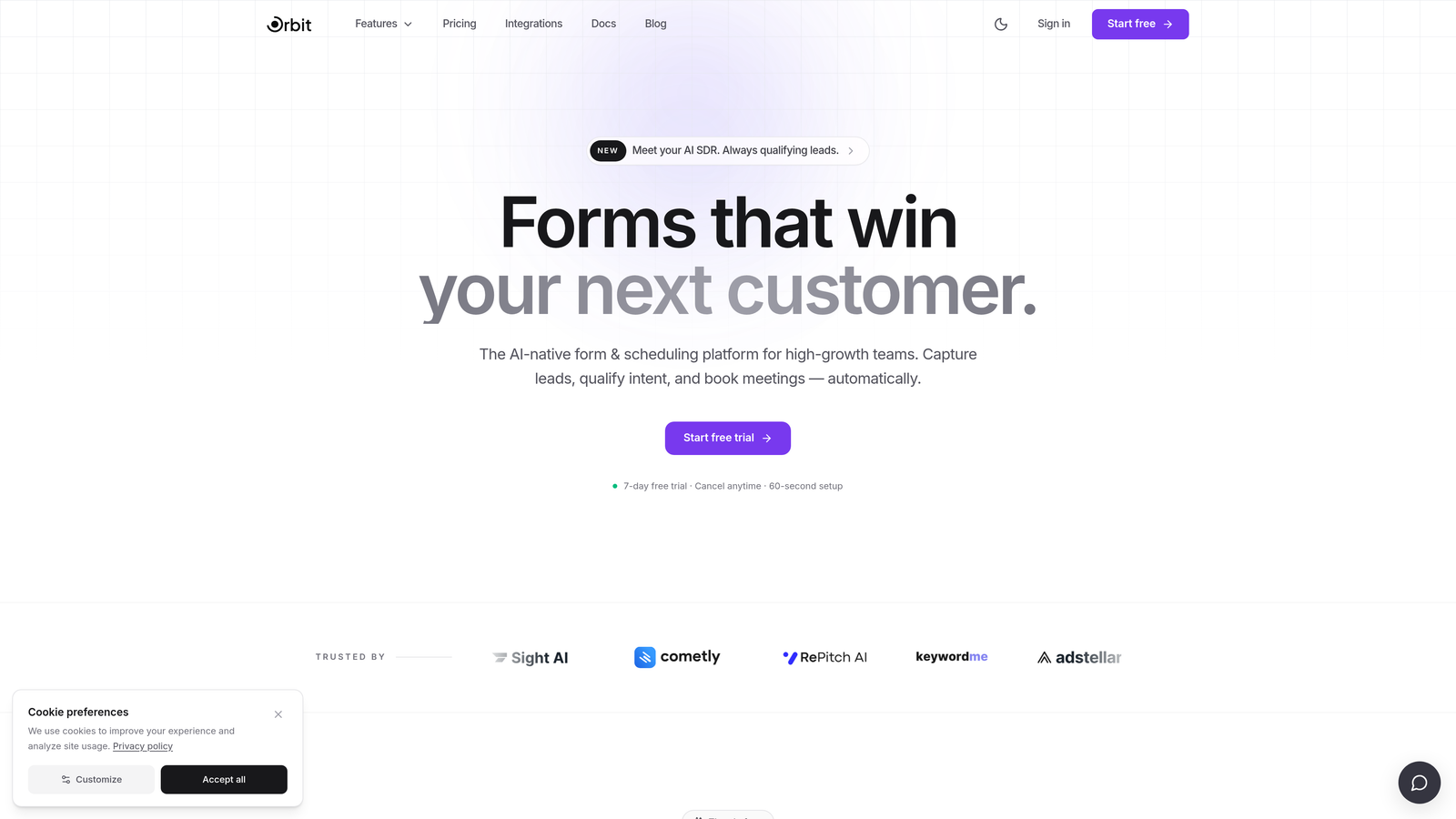
Orbit AI is an AI-powered conversational form builder with built-in lead qualification and scoring, designed specifically for teams where every form submission needs to drive pipeline.
Where This Tool Shines
Most form builders stop at data collection. Orbit AI goes a step further by using AI to score and route leads automatically based on how respondents answer, which means your sales team sees pre-qualified prospects rather than a raw list of submissions. For B2B SaaS teams running high-volume inbound, that distinction is significant.
The form design is genuinely modern without requiring a designer. You get conversion-optimized layouts out of the box, and the conversational flow is built to keep completion rates high. If you want to understand how automatic lead qualification works in practice, Orbit AI is the clearest example of that approach in production.
Key Features
AI Lead Qualification: Automatically scores and routes leads based on responses, so sales reps only engage with prospects that meet your criteria.
Conversational Form Flows: One-question-at-a-time format optimized for high completion rates across desktop and mobile.
Modern Form Design: Clean, professional templates that look polished without any design work on your part.
CRM and Sales Tool Integrations: Connects with the tools your sales team already uses, ensuring leads flow directly into your pipeline without manual handoff.
Pipeline-Focused Architecture: Built around the assumption that form submissions should create sales opportunities, not just fill a spreadsheet.
Best For
High-growth SaaS and B2B marketing teams that need their forms to do more than collect data. If lead quality is a bottleneck in your sales process and you want qualification to happen before a rep ever touches a lead, Orbit AI is purpose-built for that workflow.
Pricing
Visit orbitforms.ai for current pricing and plan details, as options may be updated regularly.
2. Typeform
Best for: Teams prioritizing respondent experience, brand consistency, and polished form design.
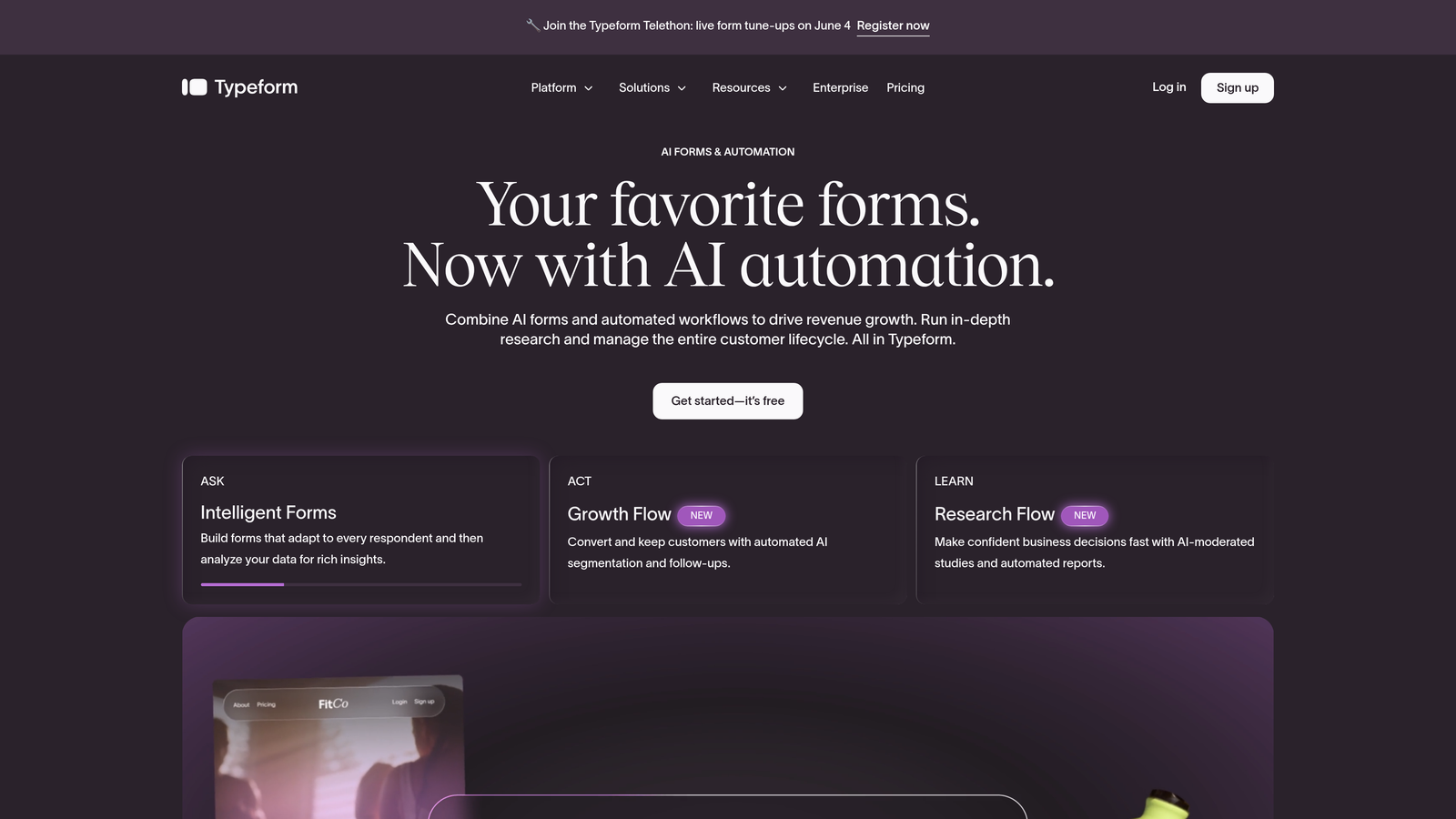
Typeform is the platform that popularized the one-question-at-a-time conversational format and remains the benchmark for visual quality in the category.
Where This Tool Shines
Typeform's core strength is the respondent experience. Forms feel less like forms and more like conversations, which consistently drives higher engagement compared to traditional multi-field layouts. The template library is extensive, covering use cases from lead gen to customer research, and the brand customization options on higher plans are genuinely flexible.
Where Typeform shows its limits is on the free tier, which is restrictive compared to newer competitors, and on lead qualification depth. Logic jumps and conditional branching are solid, but there's no native AI scoring layer. For teams that need beautiful forms with strong brand control, it's hard to beat. For teams that need intelligent lead routing, it requires more manual setup.
Key Features
One-Question-at-a-Time Interface: The signature conversational flow that keeps respondents engaged and reduces abandonment.
Extensive Template Library: Hundreds of templates spanning lead gen, surveys, quizzes, registrations, and more.
Brand Customization: Custom fonts, colors, backgrounds, and white-labeling available on higher-tier plans.
Logic Jumps and Conditional Branching: Route respondents to different questions based on their answers.
300+ Integrations: Native connections plus Zapier support covering most major CRM and marketing tools.
Best For
Marketing teams, agencies, and brand-conscious businesses that want polished, on-brand forms with strong respondent experience. Also well-suited for customer research and NPS surveys where presentation matters.
Pricing
Free tier available with limited responses. Paid plans start at approximately $25 to $29 per month. Verify current pricing at typeform.com.
3. Tally
Best for: Lean teams and solo builders who need a capable, no-bloat form tool without paying for it.
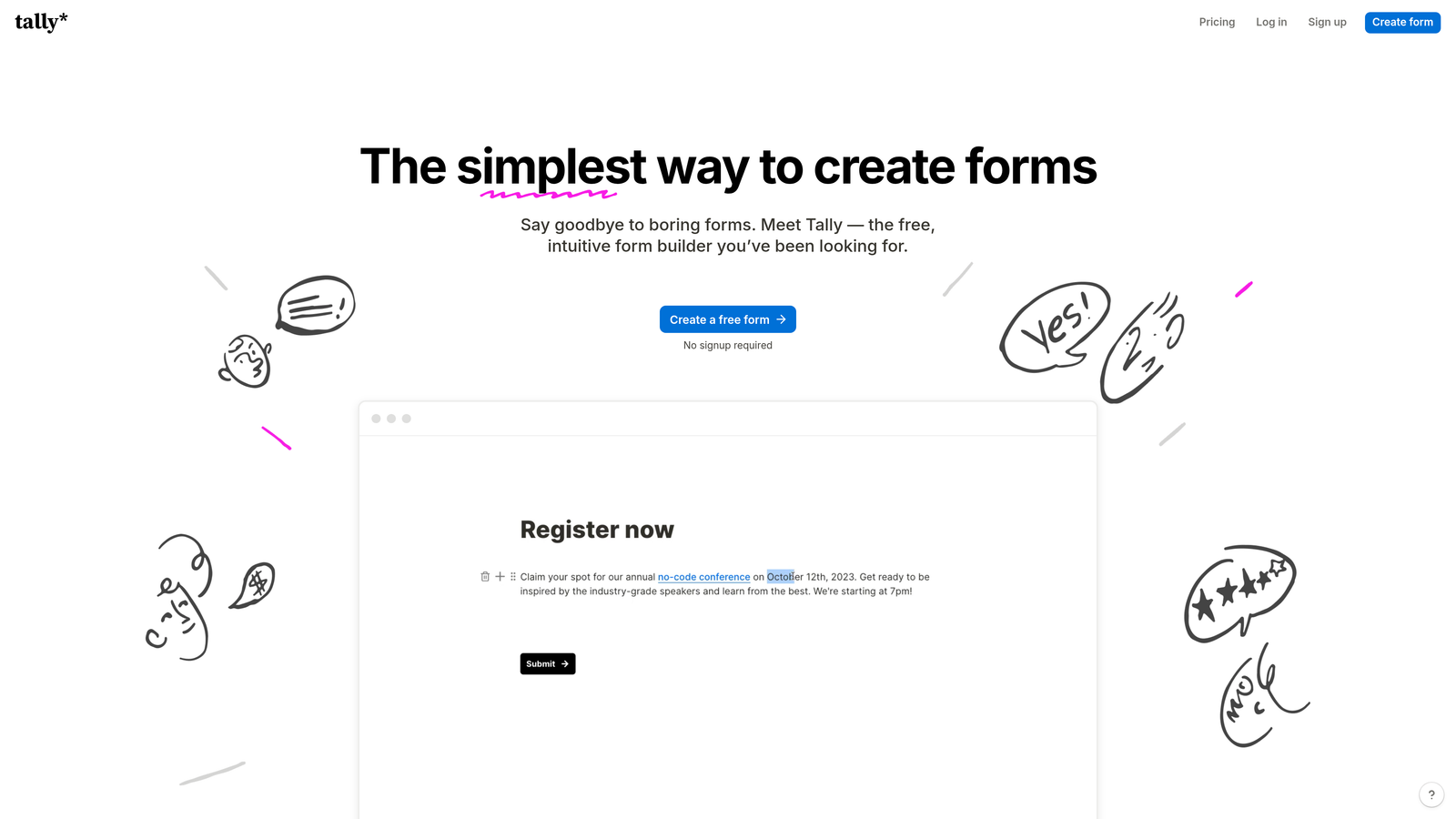
Tally is a minimalist conversational form builder with one of the most generous free tiers in the category, offering unlimited responses with no branding restrictions on the free plan.
Where This Tool Shines
Tally's appeal is almost entirely about what it doesn't do. It doesn't cap your responses, doesn't force its branding on your forms, and doesn't bury useful features behind expensive upgrades. The editor has a Notion-like feel that makes building forms surprisingly intuitive, especially for teams already living in that kind of document-first environment.
The trade-off is depth. Tally isn't trying to be an enterprise platform, and it shows. Conditional logic is present but not as sophisticated as Jotform or Formstack. Integrations are available but rely heavily on Zapier rather than deep native connections. For straightforward data collection and lightweight lead gen, it's excellent. For complex qualification workflows, you'll hit its ceiling quickly.
Key Features
Unlimited Responses on Free Plan: No response caps, even on the free tier, which is rare in this category.
Notion-Style Editor: Clean, distraction-free building experience that feels familiar to productivity tool users.
Conditional Logic: Multi-step flows and branching logic to personalize the respondent journey.
Flexible Embedding: Embeds cleanly into websites and Notion pages without friction.
Zapier and Make Integration: Connects to most tools through automation platforms.
Best For
Freelancers, early-stage startups, and small teams that need functional forms without a budget. Also a strong choice for internal tools and Notion-based workflows where the editor style is a natural fit.
Pricing
Free tier with unlimited responses. Pro plan starts at approximately $29 per month. Verify current pricing at tally.so.
4. Jotform
Best for: Teams that need deep conditional logic, workflow automation, and a massive head start with templates.
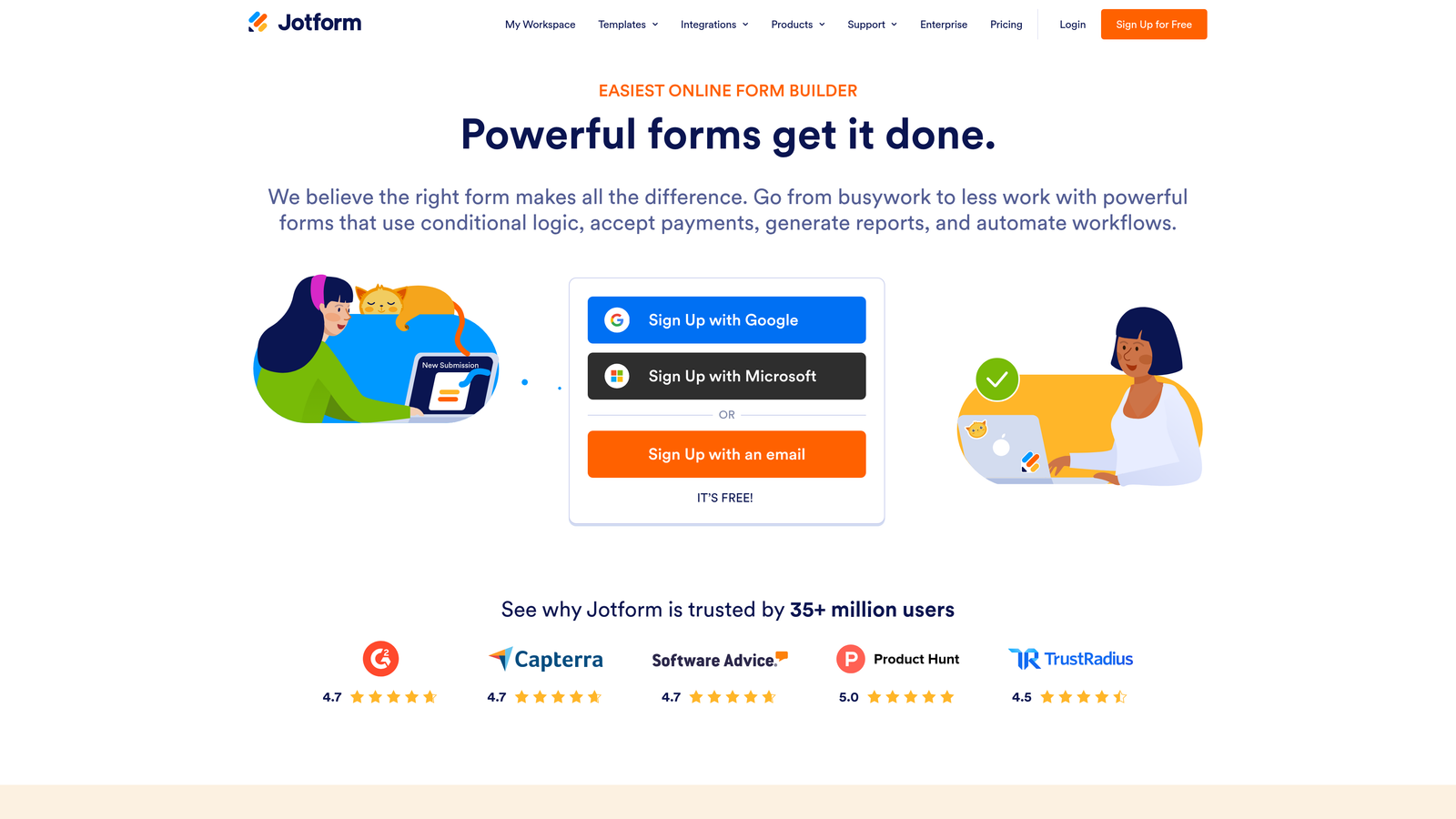
Jotform is a mature, feature-rich form platform with one of the largest template libraries in the category and enterprise-grade workflow capabilities.
Where This Tool Shines
Jotform's template library is genuinely impressive, covering virtually every industry and use case imaginable. But the real depth is in its conditional logic and workflow engine. You can build complex approval chains, route submissions to different team members, trigger automated follow-ups, and collect payments, all within a single platform. For operations-heavy teams, that breadth is hard to replicate.
The conversational form experience is available but isn't Jotform's primary identity. It's better understood as a powerful form automation platform that supports conversational layouts rather than a purpose-built conversational tool. Teams with compliance requirements will also appreciate HIPAA-compliant options on higher-tier plans.
Key Features
10,000+ Templates: The largest template library in the category, covering virtually every industry and form type.
Advanced Conditional Logic: Sophisticated branching, calculation fields, and dynamic form behavior based on responses.
Approval Workflows: Route submissions through multi-step approval chains with team collaboration built in.
Payment Collection: Native integrations with Stripe, PayPal, Square, and other payment processors.
HIPAA Compliance: Available on higher-tier plans for teams in regulated industries handling sensitive data.
Best For
Operations teams, HR departments, healthcare organizations, and agencies managing high-volume form workflows. Strong fit for any team that needs forms to trigger downstream processes rather than just capture data.
Pricing
Free tier available. Paid plans start at approximately $34 per month. Verify current pricing at jotform.com.
5. HubSpot Forms
Best for: Inbound marketing teams already running on HubSpot CRM who want zero-friction lead capture.
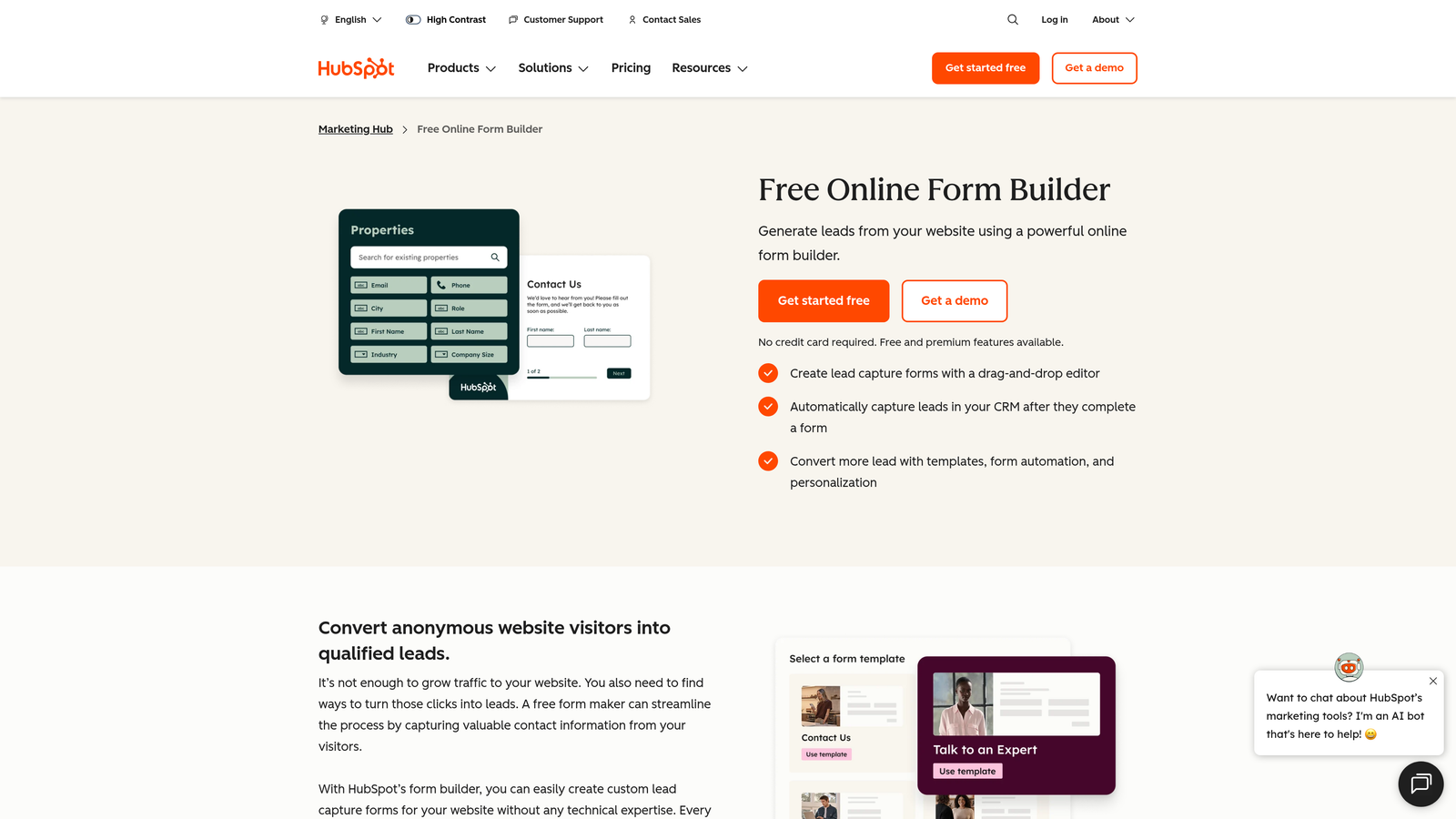
HubSpot Forms is a native form builder built directly into the HubSpot platform, offering seamless CRM sync and progressive profiling that no standalone tool can replicate.
Where This Tool Shines
The honest answer is that HubSpot Forms isn't trying to compete on form design or conversational UX. Its edge is entirely about ecosystem integration. When a lead submits a form, their data flows directly into HubSpot CRM, updates contact records, triggers workflows, and feeds into your reporting, with no Zapier setup, no API configuration, and no data mapping required.
Progressive profiling is a standout feature. Rather than asking for information you already have, HubSpot Forms shows different fields to returning visitors based on what's already in their contact record. Over time, you build richer profiles without ever making a contact fill out the same field twice. For teams already committed to HubSpot, this is a meaningful advantage.
Key Features
Native CRM Sync: Every submission instantly updates HubSpot contact records with zero integration setup.
Progressive Profiling: Dynamically swap out fields for returning visitors to collect new data without repetition.
Smart Fields: Fields that adapt based on known contact properties stored in your CRM.
Embedded and Pop-Up Options: Flexible placement options for landing pages, blog posts, and website pages.
Conversion Analytics: Form performance data tied directly to contact records and deal attribution in HubSpot.
Best For
Marketing teams running HubSpot as their primary CRM and marketing automation platform. If you're not on HubSpot, this tool offers little standalone value. If you are, it's the most frictionless option available.
Pricing
Free with a HubSpot account. Advanced features are tied to Marketing Hub paid plans. Verify current pricing at hubspot.com.
6. Fillout
Best for: No-code and product teams building forms that connect directly to Airtable, Notion, or Supabase.
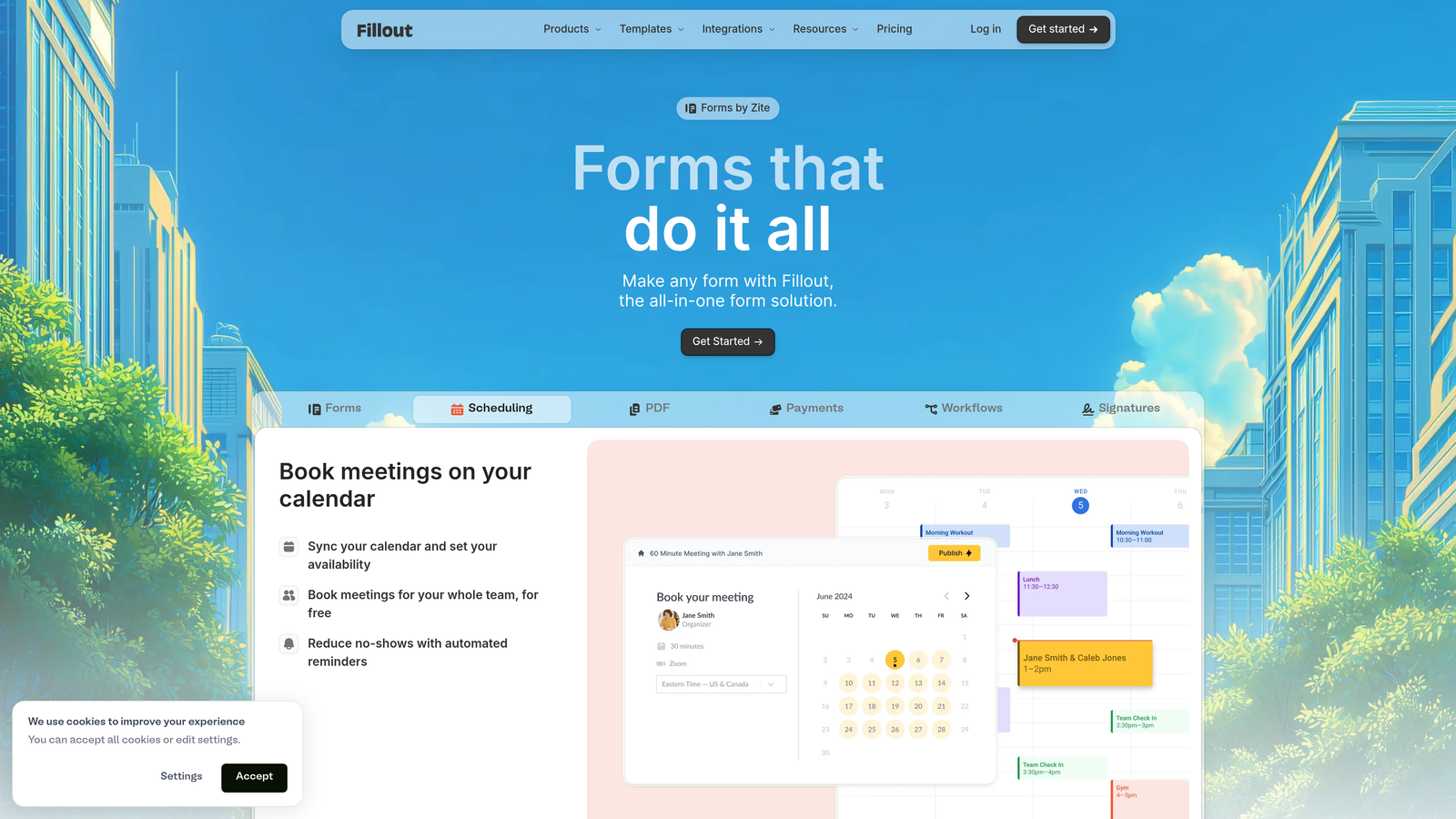
Fillout is a modern form builder that has carved out a clear niche with native database integrations that most form tools don't offer out of the box.
Where This Tool Shines
Fillout's native connections to Airtable, Notion, and Supabase are genuinely differentiated. For no-code teams and product builders who use these tools as their operational backbone, Fillout removes the need for Zapier middleware entirely. Form submissions write directly to your database, and you can pull existing records into forms for updating or pre-filling. That's a workflow that other tools in this list simply can't replicate natively.
Beyond database connectivity, Fillout offers both conversational and traditional form layouts, which gives teams flexibility depending on the use case. Scheduling and payment collection are built in, making it capable for more complex form flows without requiring additional tools.
Key Features
Native Database Integrations: Direct connections to Airtable, Notion, and Supabase without middleware.
Flexible Form Layouts: Switch between conversational one-at-a-time flows and traditional multi-field layouts.
Scheduling and Payments: Built-in booking and payment collection without third-party add-ons.
Conditional Logic: Multi-step branching to personalize the form experience based on responses.
Mobile-Responsive Design: Clean, modern UI that performs well across devices.
Best For
No-code builders, product teams, and operations managers who use Airtable, Notion, or Supabase as their primary data layer and want forms that write directly to those systems.
7. Paperform
Best for: Creators and small businesses that want forms that look and feel like landing pages.
Paperform is a form builder that blurs the line between forms and landing pages, using a freeform document-style editor where text, media, and form fields live together on the same canvas.
Where This Tool Shines
Paperform's document-style editor is genuinely different from everything else on this list. Instead of building a form in isolation, you write a page where form fields appear naturally within the content. You can add context, images, pricing tables, and descriptions alongside your questions, which makes the experience feel more like a guided landing page than a traditional form.
This approach works particularly well for product sales, service bookings, and event registrations where context matters. Built-in payment collection and scheduling functionality mean you can run entire transaction flows without leaving the platform. The absence of a free tier is a real consideration, but the starting price is reasonable given the feature depth.
Key Features
Document-Style Editor: Mix text, media, and form fields freely on a single canvas for a landing page-like experience.
Built-In Payments: Native payment collection and product selling without third-party integrations.
Conditional Logic and Calculations: Dynamic form behavior and custom calculation fields for pricing or scoring.
Booking and Scheduling: Appointment booking built directly into the form flow.
Custom Domains and White-Label: Run forms on your own domain with full branding control.
Best For
Coaches, consultants, small business owners, and creators who want forms that serve as mini landing pages. Strong fit for product sales, service inquiries, and booking flows where presentation and context drive conversions.
Pricing
No free tier. Starts at approximately $24 per month. Verify current pricing at paperform.co.
8. involve.me
Best for: Teams building scored quizzes, assessments, and outcome-based lead gen funnels.
involve.me is an interactive content platform that goes well beyond standard forms into scored quizzes, calculators, assessments, and personalized outcome pages.
Where This Tool Shines
If your lead gen strategy involves giving something back to respondents, a quiz result, a personalized recommendation, a calculated score, involve.me is built for exactly that. The scoring and calculator logic is sophisticated enough to power ROI calculators, personality assessments, and product recommendation funnels without custom code.
Outcome pages are a standout feature. Based on how someone answers, they land on a personalized results page that reflects their specific situation. This creates a genuinely valuable experience for the respondent while simultaneously qualifying them as a lead. The analytics are also more granular than most form tools, showing drop-off rates, completion rates, and outcome distribution across your funnel.
Key Features
Scoring and Calculator Logic: Built-in scoring engine for quizzes, assessments, and custom calculators.
Personalized Outcome Pages: Dynamically generated results pages based on respondent answers.
Lead Capture Integration: Collect contact information within the interactive funnel flow.
Funnel Analytics: Detailed data on drop-off points, completion rates, and outcome distribution.
Flexible Deployment: Embed into websites or run as standalone pages with custom branding.
Best For
Content marketers, demand gen teams, and agencies building interactive lead gen funnels. Particularly effective for B2B teams using assessments or calculators as top-of-funnel lead magnets.
9. Formstack
Best for: Enterprise teams in regulated industries that need HIPAA compliance, document generation, and audit-grade security.
Formstack is an enterprise-grade form and document automation platform built specifically for organizations where compliance isn't optional.
Where This Tool Shines
Formstack occupies a category of its own. While most tools on this list compete on design and UX, Formstack competes on trust and compliance infrastructure. HIPAA-compliant data collection, SOC 2 Type II certification, eSignature capabilities, and document generation from form submissions are features that healthcare organizations, legal teams, and financial services firms genuinely need and can't compromise on.
The pricing reflects the positioning. Formstack is significantly more expensive than the other tools here, which will immediately disqualify it for most small teams. But for an enterprise procurement team evaluating whether a form tool can handle sensitive patient data or legally binding signatures, the compliance credentials justify the investment.
Key Features
HIPAA-Compliant Data Collection: Purpose-built for healthcare and other regulated industries handling sensitive personal data.
Document Generation: Automatically generate populated documents from form submission data.
Advanced Workflow Routing: Multi-step approval chains with conditional routing based on submission content.
eSignature Capabilities: Collect legally binding signatures directly within the form workflow.
Enterprise Compliance Certifications: SOC 2 Type II and other certifications that enterprise procurement teams require.
Best For
Healthcare organizations, legal firms, financial services teams, and any enterprise operating in a regulated environment where data handling compliance is a non-negotiable requirement.
Pricing
No free tier. Starts at approximately $83 per month, reflecting the compliance infrastructure and enterprise feature set. Verify current pricing at formstack.com.
Which Tool Is Right for Your Team?
The honest answer is that the best conversational form software depends almost entirely on what you need your forms to do after someone hits submit.
If you're a high-growth SaaS or B2B team where lead quality is the bottleneck, Orbit AI is the clearest fit. It's the only tool on this list purpose-built around AI-powered lead qualification, which means your sales team starts working with scored, pre-qualified leads rather than raw submissions. For teams serious about connecting form data to pipeline, that distinction matters.
For teams where brand and respondent experience are the priority, Typeform remains the benchmark. For lean budgets, Tally's unlimited free tier is hard to argue with. For HubSpot shops, the native CRM sync makes HubSpot Forms the obvious choice with no additional setup. For regulated industries, Formstack is in a category of its own on compliance.
Here's a quick use-case map to help you decide:
AI lead qualification for B2B SaaS: Orbit AI
Beautiful, brand-forward forms: Typeform
Free tier with no response limits: Tally
Complex workflows and approval chains: Jotform
Already on HubSpot CRM: HubSpot Forms
Airtable, Notion, or Supabase as your data layer: Fillout
Form meets landing page: Paperform
Scored quizzes and outcome funnels: involve.me
HIPAA compliance and document generation: Formstack
Conversational forms are increasingly becoming the default expectation for lead gen, not a nice-to-have. The teams pulling ahead in 2026 are those using forms not just to collect data but to qualify, route, and prioritize leads before a rep ever gets involved. That's the direction the category is heading, and it's worth choosing a tool that's built for where things are going, not just where they've been.
If you want to explore that approach, you can also dig into our lead qualification framework for sales teams or browse Typeform alternatives if you're currently on that platform and looking to level up. Transform your lead generation with AI-powered forms that qualify prospects automatically while delivering the modern, conversion-optimized experience your high-growth team needs. Start building free forms today and see how intelligent form design can elevate your conversion strategy.


