

If your forms are leaking leads, the problem usually isn't your offer. It's friction, poor qualification logic, or a design that kills momentum before a prospect ever hits submit. Form optimization tools exist to fix exactly that: helping marketers build smarter forms, reduce drop-offs, and turn more submissions into actual pipeline.
The category is crowded, though. Some tools focus on analytics, others on UX, and others on AI-powered lead qualification. This list cuts through the noise. We've selected nine tools that genuinely move the needle for high-growth marketing teams, covering everything from AI form builders and A/B testing to heatmaps and CRM-connected workflows.
Whether you're optimizing a lead gen form for B2B outreach or a multi-step funnel for SaaS signups, there's a tool here built for your use case. Selection criteria: conversion impact, ease of use, integration depth, and value for growth-focused teams.
1. Orbit AI
Best for: B2B SaaS and high-growth teams that need lead qualification built directly into their forms
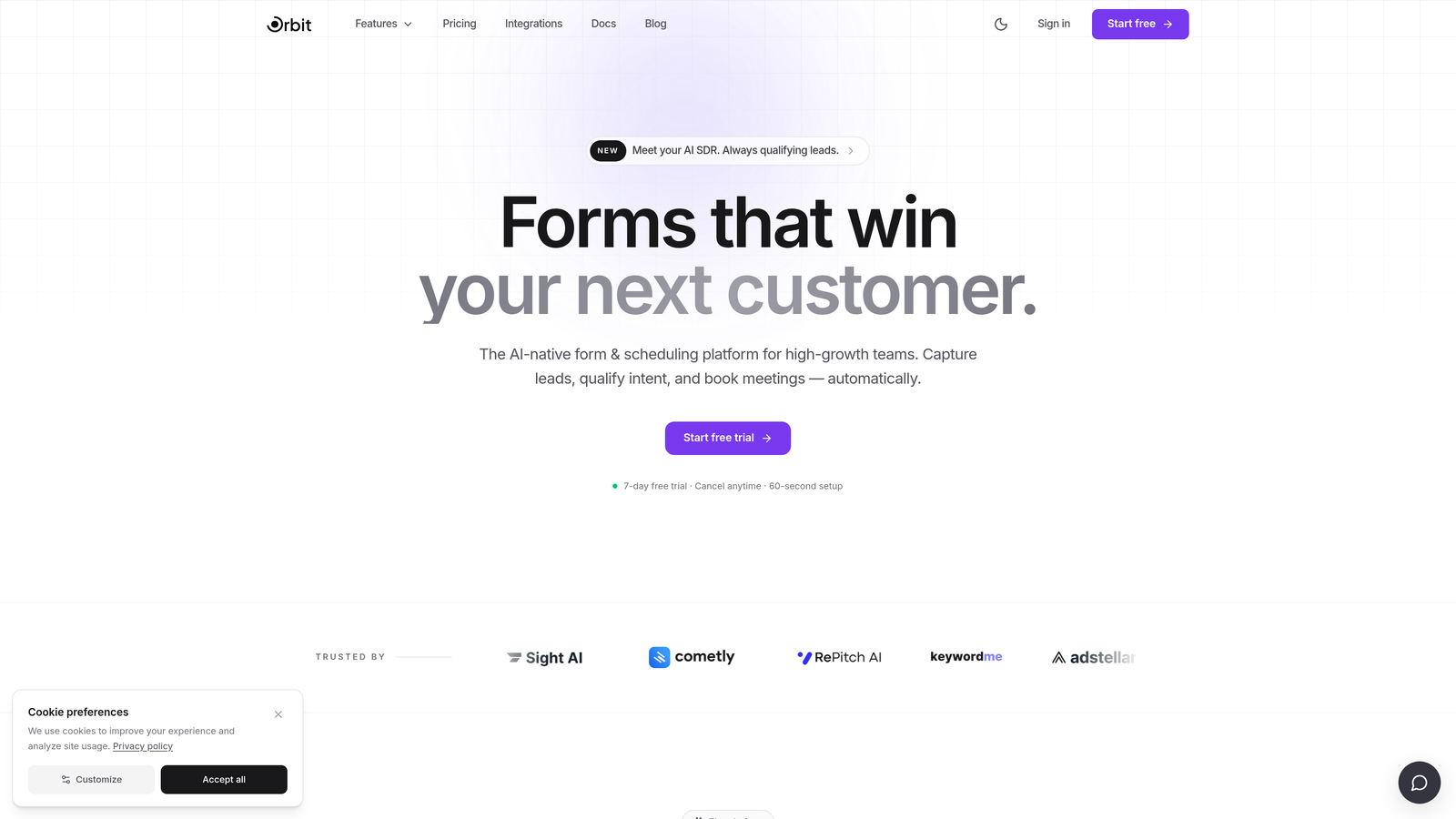
Orbit AI is an AI-powered form builder with embedded lead qualification logic, designed for marketing teams focused on pipeline quality, not just submission volume.
Where This Tool Shines
Most form builders hand you a blank canvas and leave qualification as someone else's problem. Orbit AI takes a different approach: lead scoring and conditional logic are baked directly into the form-building experience, so your form is doing qualification work before a lead ever reaches your CRM.
For B2B SaaS teams running high-volume lead gen campaigns, this matters. When your sales team is working from a prioritized queue of high-intent leads rather than a flat list of raw submissions, conversion rates on outreach improve significantly. Orbit AI is built specifically for that outcome.
Key Features
AI-Powered Lead Qualification: Qualification logic is embedded directly in the form flow, scoring leads based on their responses in real time.
Conversion-Optimized Templates: Modern, brand-forward form designs built to reduce friction and improve completion rates from the first impression.
Conditional Logic and Dynamic Fields: Forms adapt per respondent, surfacing relevant questions based on previous answers to create a personalized experience.
Automatic Lead Routing: High-intent leads are identified and routed automatically, so your sales team focuses where it counts.
Built for Growth Teams: The platform is purpose-built for B2B SaaS and growth-focused marketers, not general-purpose form building.
Best For
Marketing teams at B2B SaaS companies who want lead qualification to happen at the form level rather than post-submission. Ideal if your current process involves manual lead scoring, slow handoffs to sales, or high volumes of low-quality submissions clogging your pipeline.
Pricing
Visit orbitforms.ai for current pricing plans. Free options are available to get started.
2. Typeform
Best for: Teams that want a conversational, one-question-at-a-time format to improve engagement on longer forms
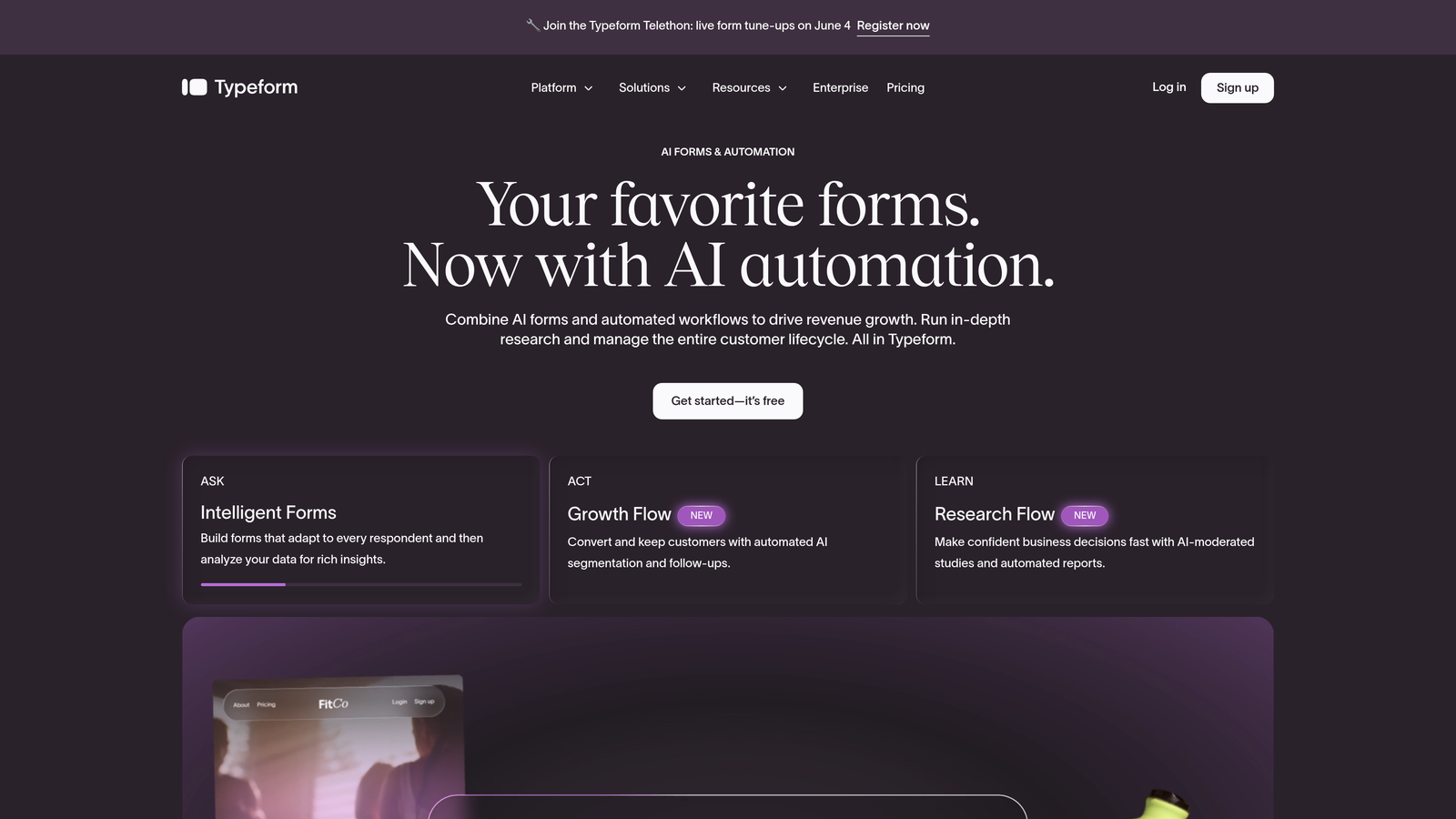
Typeform is a conversational form builder that reduces cognitive load by presenting one question at a time, keeping respondents engaged through longer form flows.
Where This Tool Shines
Typeform pioneered the conversational form format, and it remains one of the most visually polished tools in the category. When you need respondents to work through a longer sequence of questions, the one-at-a-time approach reduces the feeling of overwhelm that kills completion rates on traditional multi-field forms.
It's particularly effective for surveys, onboarding flows, and qualification questionnaires where the experience matters as much as the data collected. The design quality is consistently high, and brand customization options are strong relative to most competitors.
Key Features
Conversational UX Format: One question at a time reduces cognitive load and keeps respondents moving forward through longer flows.
Logic Jumps and Conditional Branching: Personalize the path each respondent takes based on their previous answers.
Visual Design and Brand Customization: Strong design controls with fonts, colors, and imagery that match your brand identity.
Native Integrations: Direct connections to HubSpot, Salesforce, Slack, and Zapier cover most marketing stack needs.
Video and Image Embedding: Enrich form questions with visual content to add context or personality.
Best For
Marketing teams that prioritize form experience and engagement, particularly for surveys, lead qualification questionnaires, or onboarding flows where respondent experience directly affects completion rates. Less ideal if you need deep analytics or built-in lead scoring.
Pricing
Free plan available. Paid plans start at approximately $25/month, with higher tiers unlocking advanced logic and integrations.
3. Hotjar
Best for: Diagnosing field-level drop-off and understanding exactly where users abandon your forms
Hotjar is a behavior analytics platform with dedicated form analytics that shows marketers which specific fields cause hesitation, drop-off, or repeated corrections.
Where This Tool Shines
Hotjar doesn't build forms. It watches what happens to your existing ones. The form analytics module reveals field-level data: how long users spend on each field, where they abandon, and which fields they return to and correct. That kind of granular visibility is invaluable when you're trying to diagnose why a form with a high traffic volume has a low completion rate.
Paired with session recordings, you can watch real user interactions with your forms, which often surfaces friction points that pure data wouldn't reveal on its own. It's a diagnostic tool first, and a strong one at that.
Key Features
Field-Level Form Analytics: See drop-off rates, time spent, and refill rates for each individual field in your form.
Session Recordings: Watch real users interact with your forms to identify friction that raw data misses.
Heatmaps: Understand scroll depth and click patterns on the pages where your forms live.
Feedback Widgets: Collect qualitative input from users alongside your quantitative analytics.
Funnel Analysis: Track the full conversion path leading to and from your form pages.
Best For
Marketing and CRO teams who need to diagnose why existing forms underperform. Hotjar works best as a diagnostic layer on top of your current form stack, not as a standalone form optimization solution. Particularly valuable for teams with moderate to high form traffic where behavioral patterns become statistically meaningful.
Pricing
Free plan available. Paid plans start at approximately $32/month, scaling with session volume and feature access.
4. VWO (Visual Website Optimizer)
Best for: Enterprise and mid-market teams running structured A/B and multivariate experiments on forms and landing pages
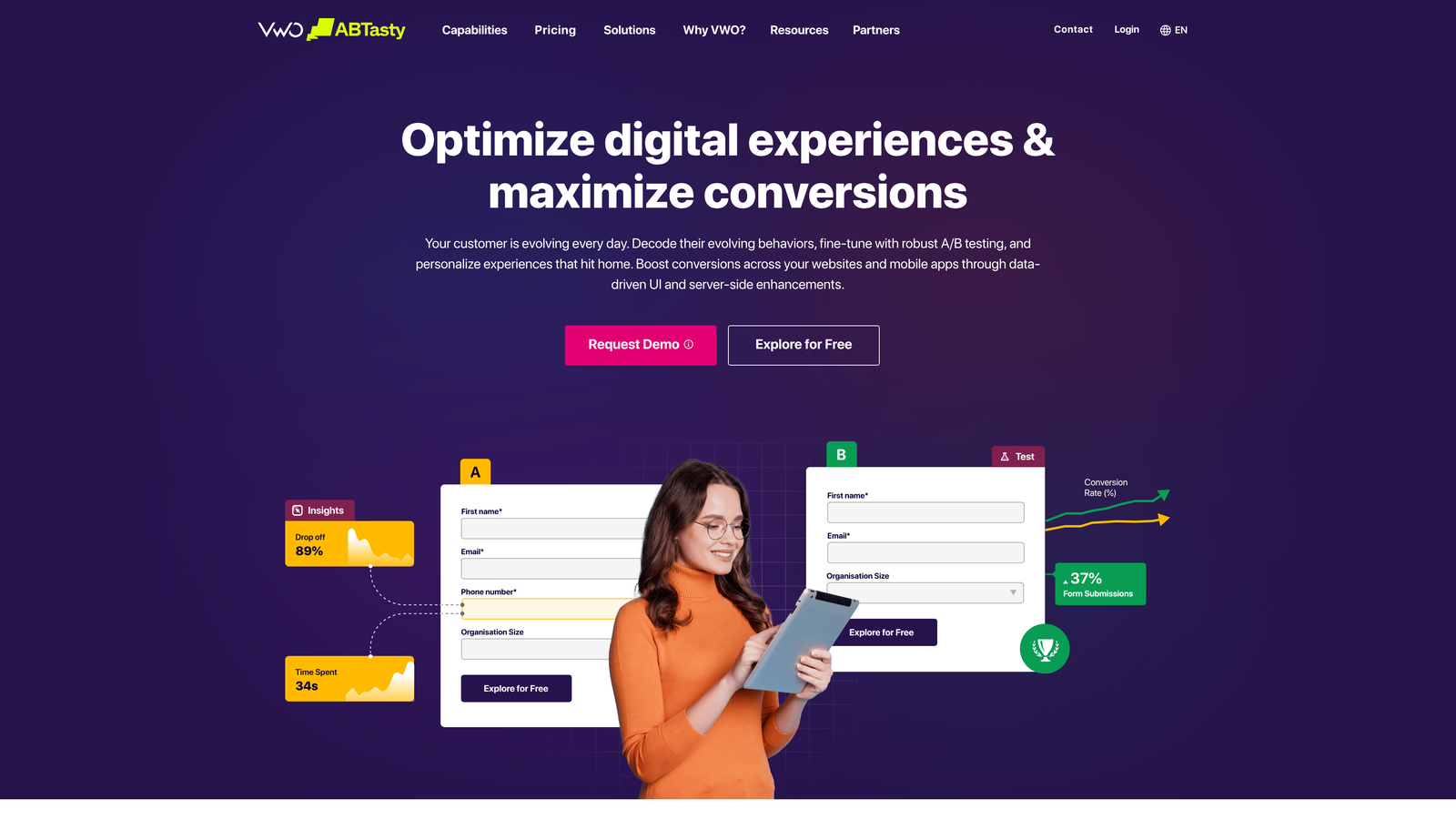
VWO is an enterprise-grade experimentation platform that enables marketers to A/B test and multivariate test form variations alongside full landing page experiments.
Where This Tool Shines
If you want to run rigorous, statistically grounded experiments on your forms, VWO is one of the most capable platforms in the category. You can test form layouts, field order, copy, and configurations without touching your codebase, using the visual editor to set up experiments directly on your existing pages.
What separates VWO from lighter testing tools is the combination of experimentation depth and qualitative context. Integrated heatmaps and session recordings let you understand not just which variant won, but why, giving your optimization work a stronger foundation for future iterations.
Key Features
A/B and Multivariate Testing: Test form layouts, copy, and field configurations with statistical rigor.
Visual Editor: Set up experiments on existing forms without writing code.
Integrated Heatmaps and Recordings: Add qualitative context to your quantitative test results.
Funnel Analysis: Measure how form changes affect downstream conversion metrics across the full funnel.
Personalization Engine: Serve different form variants to different audience segments based on behavior or attributes.
Best For
Mid-market and enterprise marketing teams with dedicated CRO resources who run ongoing experimentation programs. VWO's depth is a strength for teams that have the traffic volume and analytical bandwidth to run meaningful tests, but it may be more than smaller teams need.
Pricing
Pricing is available on request and typically reflects mid-market to enterprise positioning. Contact VWO directly for a quote based on your traffic and feature requirements.
5. HubSpot Forms
Best for: Teams already in the HubSpot ecosystem who want seamless CRM-native form management with progressive profiling
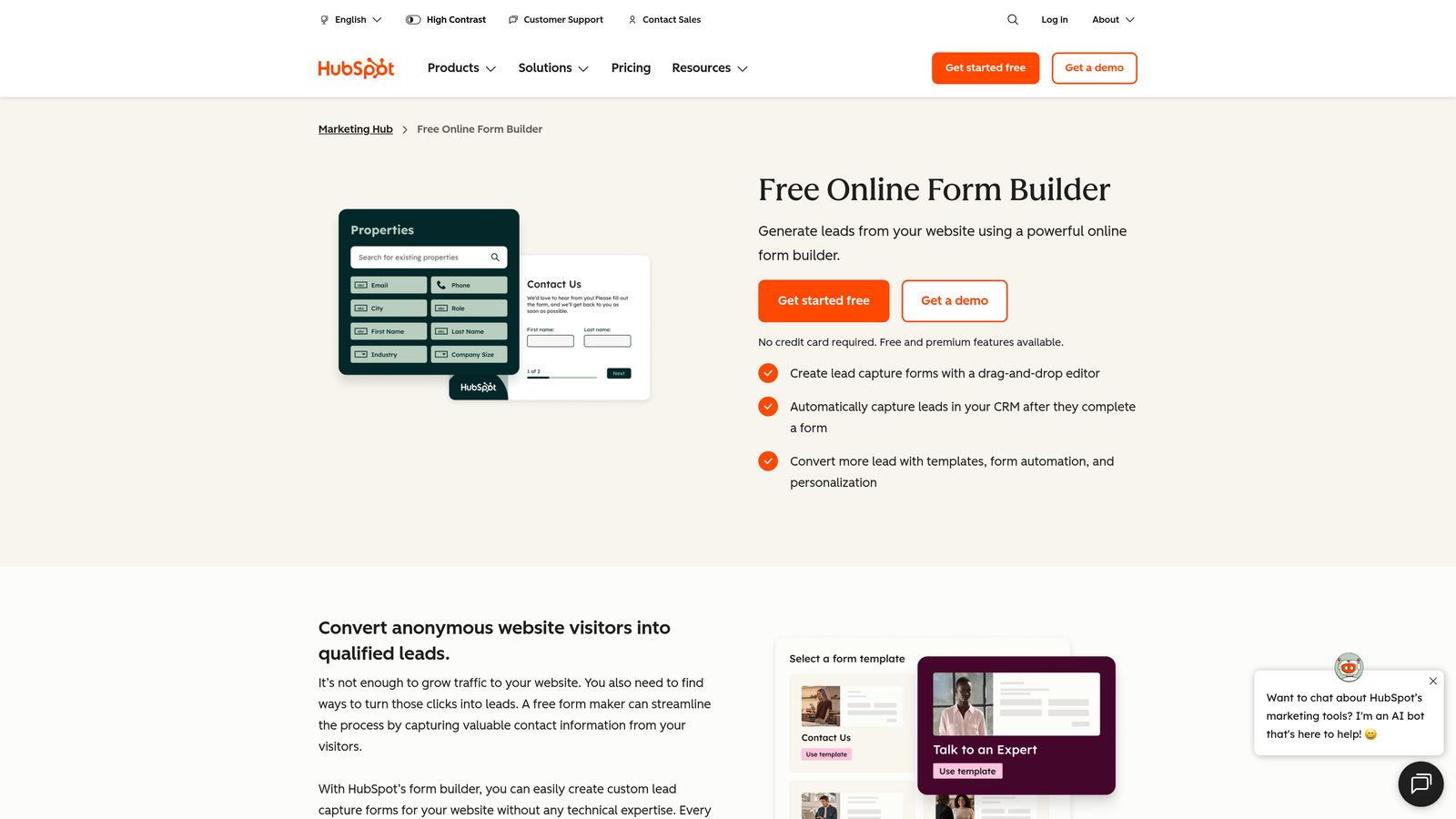
HubSpot Forms is a CRM-native form builder that connects submissions directly to HubSpot's marketing, sales, and CRM workflows, with progressive profiling to reduce form length for returning visitors.
Where This Tool Shines
The standout feature here is progressive profiling. Instead of asking returning contacts the same fields they've already filled out, HubSpot Forms automatically surfaces new questions to build out contact records over time. This reduces friction for returning visitors while gradually enriching your CRM data, which is a meaningful advantage for teams running content-gated lead gen at scale.
The zero-integration advantage is also real. For teams already using HubSpot, there's no data pipeline to manage. Submissions flow directly into CRM records, lists, and workflows the moment a form is submitted.
Key Features
Progressive Profiling: Shows different fields to returning contacts to avoid repetition and build richer profiles over time.
Direct CRM Sync: Submissions connect instantly to HubSpot CRM, lists, and automation workflows with no integration required.
Smart Forms: Forms adapt based on known contact properties stored in your CRM.
Embedded and Pop-Up Options: Flexible placement with A/B testing available on paid tiers.
Submission Analytics: View-to-submission rates and field performance within the HubSpot dashboard.
Best For
Marketing teams running on HubSpot who want their form data to flow seamlessly into CRM workflows without managing separate integrations. Less compelling for teams outside the HubSpot ecosystem, where the native advantage disappears.
Pricing
Free with HubSpot CRM. Advanced features are available on Marketing Hub paid tiers starting at approximately $15/month per seat.
6. Unbounce
Best for: Paid media teams who need landing page and form optimization managed in a single platform with AI traffic routing
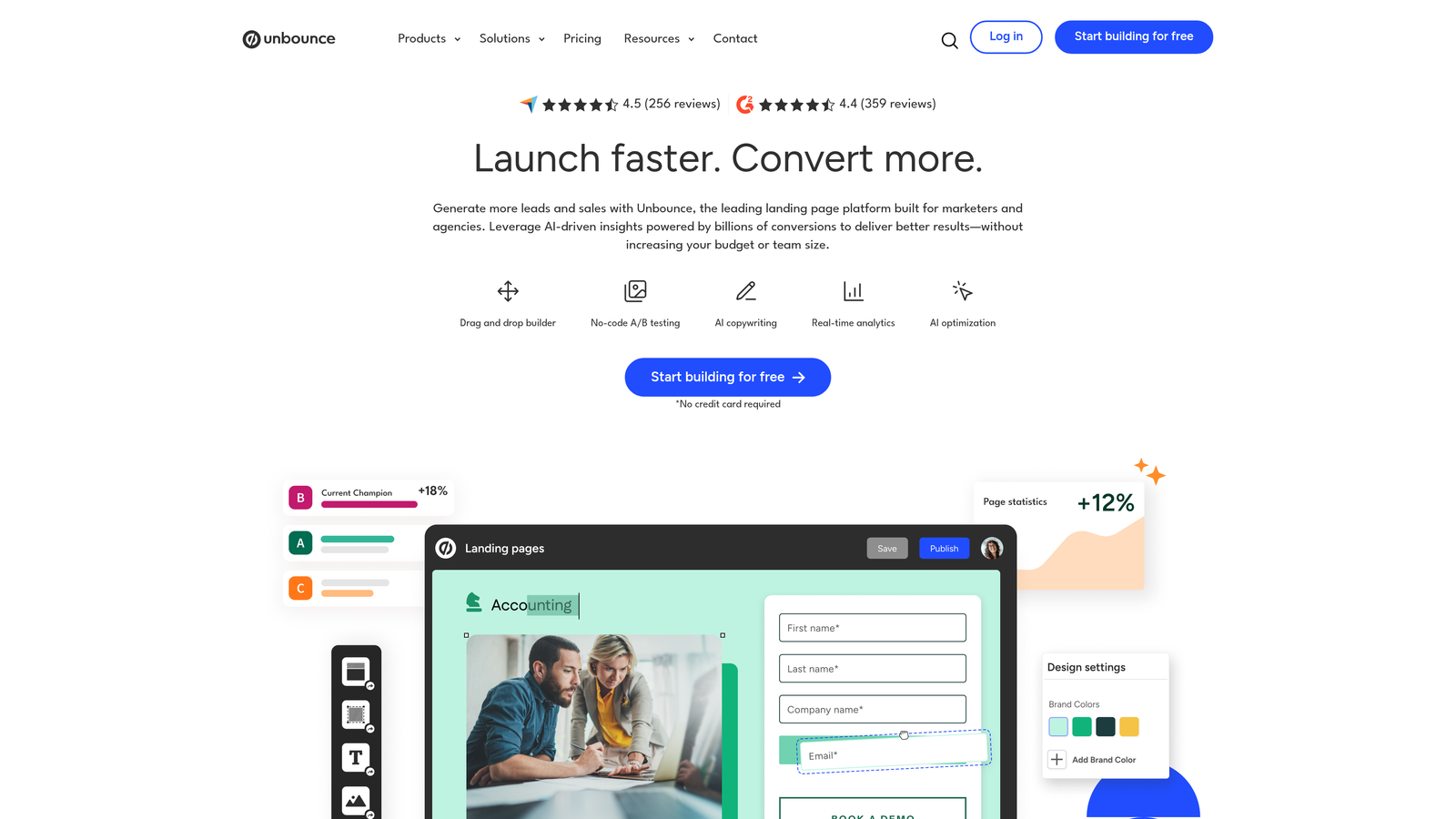
Unbounce is a landing page platform with deeply integrated form optimization, including AI-powered Smart Traffic that automatically routes visitors to the highest-converting page and form variant.
Where This Tool Shines
Unbounce's Smart Traffic feature is genuinely differentiated. Rather than waiting for a traditional A/B test to reach statistical significance, Smart Traffic uses machine learning to route visitors to the best-performing variant based on their attributes from the first session. For paid media campaigns where every click costs money, that kind of intelligent optimization has a direct impact on cost per lead.
The tight integration between landing page and form is also a practical advantage. You're building and testing both in the same environment, which eliminates the friction of managing separate tools for page design and form optimization.
Key Features
Smart Traffic AI: Automatically routes visitors to the best-performing form and page variant based on visitor attributes.
Drag-and-Drop Builder: Create landing pages with embedded forms without code, in a single workflow.
A/B Testing: Test both page layouts and form field configurations from within the same platform.
Dynamic Text Replacement: Match form copy to the keywords that drove each visitor to your page, improving relevance.
Conversion Intelligence: Surface optimization opportunities based on performance data across your campaigns.
Best For
Paid media and demand generation teams who manage high volumes of campaign-specific landing pages and need form and page optimization to work together. Less suited for teams who just need a standalone form tool without the landing page layer.
Pricing
Plans start at approximately $99/month, with higher tiers unlocking more published pages and advanced features.
7. Jotform
Best for: Teams that need broad template coverage and a wide integration ecosystem with fast deployment
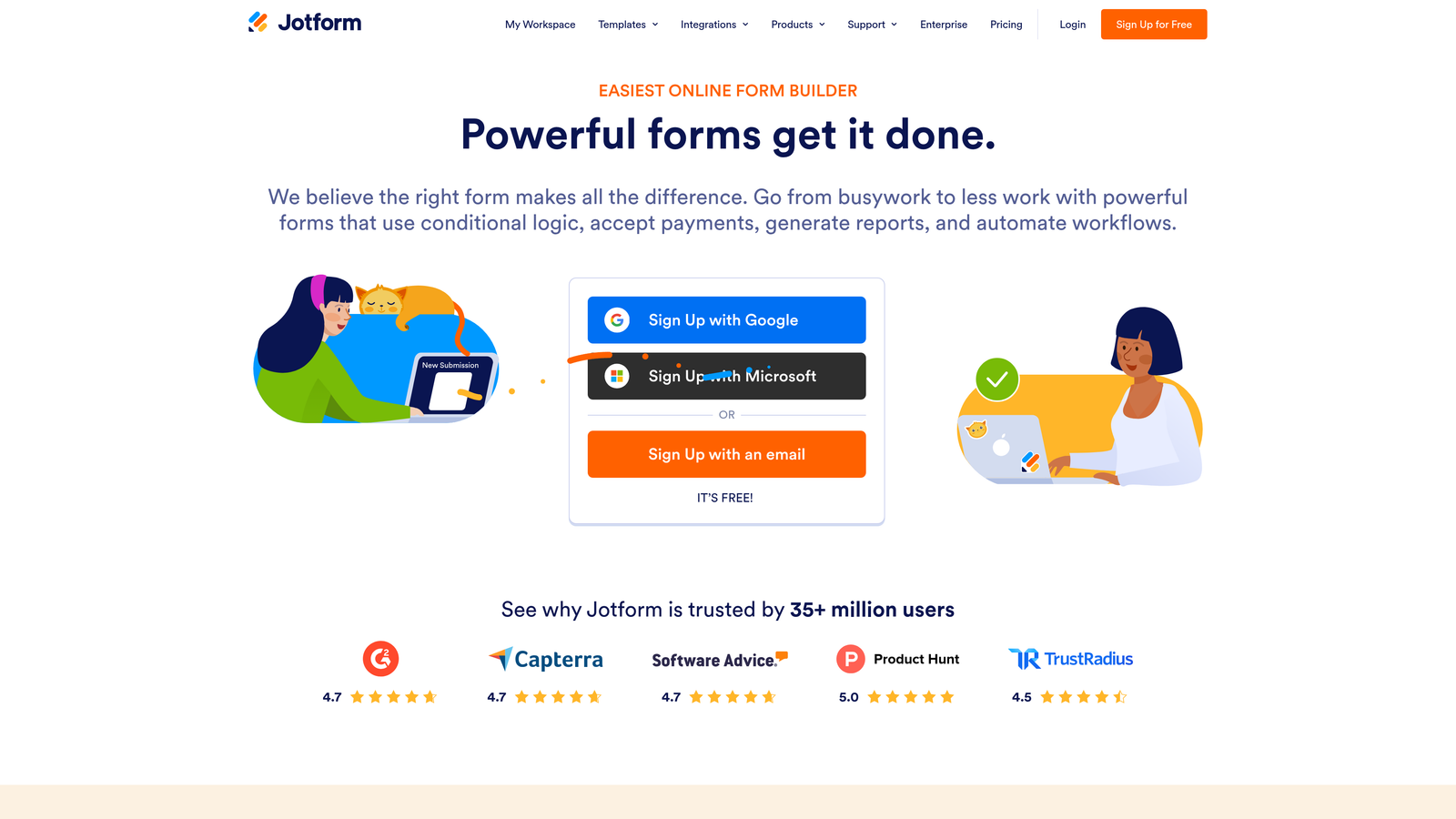
Jotform is a versatile form builder with one of the largest template libraries in the category and 200+ native integrations, making it a strong choice for teams that need flexibility fast.
Where This Tool Shines
Jotform's strength is breadth. With over 10,000 templates covering virtually every industry and use case, and native integrations spanning payment processors, CRMs, project management tools, and more, it's the go-to option when your team needs to ship a functional form quickly without extensive configuration.
It's also one of the few tools in this category with HIPAA-compliant form options on enterprise tiers, which opens the door for healthcare-adjacent marketing teams that other tools can't serve. The trade-off is depth: Jotform isn't optimized for advanced lead scoring or conversion experimentation the way more specialized tools are.
Key Features
10,000+ Templates: One of the largest template libraries in the category, spanning industries and use cases.
200+ Native Integrations: Covers payment processors, CRMs, email platforms, and project management tools.
Conditional Logic and Multi-Page Support: Build branching, multi-step form experiences without code.
Form Analytics: Track views, submissions, and conversion rates for each form.
HIPAA-Compliant Options: Available on enterprise tiers for teams in regulated industries.
Best For
Teams that prioritize speed of deployment and integration flexibility over deep optimization features. Also well-suited for organizations with diverse form needs across departments, where a single versatile tool is more practical than multiple specialized ones.
Pricing
Free plan available. Paid plans start at approximately $34/month, with enterprise pricing for compliance and advanced features.
8. Zuko (formerly Formisimo)
Best for: CRO specialists and analytics-focused teams who need the deepest possible field-level form behavior data
Zuko is a purpose-built form analytics platform that goes deeper than any general analytics tool, tracking field-level behavior to pinpoint exactly where and why users abandon forms.
Where This Tool Shines
Zuko is the most specialized tool on this list, and that specialization is its value. While tools like Hotjar include form analytics as one feature among many, Zuko is built entirely around understanding form behavior. The field-level data it surfaces, including time spent per field, drop-off rate, return rate, and abandonment patterns, is more granular than what you'll get from any general analytics platform.
Critically, it works with any existing form. You don't need to rebuild or migrate anything. Add a script tag, and Zuko starts collecting data on your current forms immediately. That low barrier to entry makes it an easy add to any existing form stack.
Key Features
Field-Level Analytics: Time spent, drop-off rate, and return rate tracked per individual field across your form.
Funnel Visualization: See abandonment at each stage of your form flow in a clear visual format.
Works With Any Form: No rebuild required — add a script to your existing forms and start collecting data immediately.
Segment Analysis: Compare form behavior across traffic sources, devices, or audience segments.
Actionable Recommendations: The platform surfaces specific suggestions based on field performance patterns.
Best For
CRO teams, UX researchers, and analytics-focused marketers who need to understand form behavior at a granular level. Particularly valuable for high-traffic forms where field-level optimization can have a meaningful impact on overall conversion volume. Works best as a diagnostic complement to your existing form builder, not a replacement.
Pricing
Plans start at approximately $79/month. A free trial is available to test the platform on your existing forms before committing.
9. Leadpages
Best for: Small to mid-size marketing teams who want landing page and form optimization with built-in conversion guidance
Leadpages is a landing page and lead generation platform with built-in form optimization features, including a real-time conversion rate indicator that gives feedback as you build.
Where This Tool Shines
Leadpages fills an interesting niche: it's more accessible than Unbounce but more conversion-focused than a general website builder. The real-time conversion rate indicator is a distinctive feature that provides immediate feedback on how your page and form design choices are likely to perform, which is genuinely useful for teams without a dedicated CRO specialist on hand.
The pop-up and alert bar form options are also worth noting. For teams that want to capture leads without disrupting the primary page experience, these non-intrusive formats can complement embedded forms and expand capture opportunities across a site.
Key Features
Real-Time Conversion Rate Indicator: Provides live feedback on how your form and page design choices are likely to convert as you build.
Drag-and-Drop Form Builder: Build and test forms with A/B split testing built in.
Pop-Up and Alert Bar Forms: Non-intrusive lead capture formats that complement page-embedded forms.
CRM and Email Integrations: Connects to major email marketing and CRM platforms for seamless lead handoff.
Lead Management Dashboard: Built-in lead notifications and management without requiring a separate CRM.
Best For
Small to mid-size marketing teams who want a combined landing page and form solution with accessible optimization guidance. A strong fit for teams that don't have a dedicated CRO function but still want data-informed form design built into their workflow.
Pricing
Plans start at approximately $49/month, with higher tiers unlocking additional sites and advanced features.
Which Tool Is Right for Your Stack?
The right form optimization tool depends on what's actually holding your conversion rate back. Here's a quick way to think through the decision.
If your core problem is lead quality, not just lead volume, Orbit AI is the clearest fit. It's the only tool on this list that embeds AI-powered qualification directly into the form flow, so your forms are doing scoring and routing work before a lead ever reaches your CRM. For B2B SaaS teams tired of handing sales a flat list of unqualified submissions, that's a meaningful shift.
If you need to diagnose why your current forms underperform, start with Hotjar for a broad behavioral picture or Zuko if you want the deepest possible field-level data. Both are diagnostic tools, and either can surface the specific friction points that generic analytics will miss.
For structured experimentation, VWO is the most capable A/B and multivariate testing platform in this group. If you have the traffic volume and CRO resources to run rigorous tests, it's worth the investment.
If you're fully in the HubSpot ecosystem, HubSpot Forms is the obvious choice. The progressive profiling feature alone makes it worth using if you're running content-gated lead gen at any real volume.
For conversational form experiences, Typeform remains the benchmark. For landing page and form optimization in a single workflow, Unbounce is the strongest option, especially for paid media teams. And if you need fast deployment across a wide range of use cases, Jotform's template and integration depth is hard to beat.
The best place to start is an honest audit of your current form stack: where are leads dropping off, where is quality suffering, and what visibility do you currently have into either? That audit will point you toward the right category of tool before you evaluate specific platforms.
For teams where lead qualification and conversion optimization are the priority, Start building free forms today and see how AI-powered form design can change what your pipeline looks like at the other end.


