

Startups move fast and budget carefully. When you're simultaneously scaling lead generation, onboarding flows, and customer feedback loops, form builder costs can sneak up on you quickly. The good news: most leading platforms offer startup programs, generous free tiers, or annual billing discounts that make professional-grade tools accessible from day one.
This guide covers the top form builders that offer genuine value for startups, whether you need AI-powered lead qualification, simple contact forms, or lightweight survey tooling. We evaluated each tool on pricing transparency, startup-specific offers, feature depth relative to cost, and how well it serves high-growth teams focused on conversion. If you're comparing options before committing to a plan, this list will help you cut through the noise fast.
1. Orbit AI
Best for: High-growth SaaS and B2B teams that need lead qualification built directly into their forms.
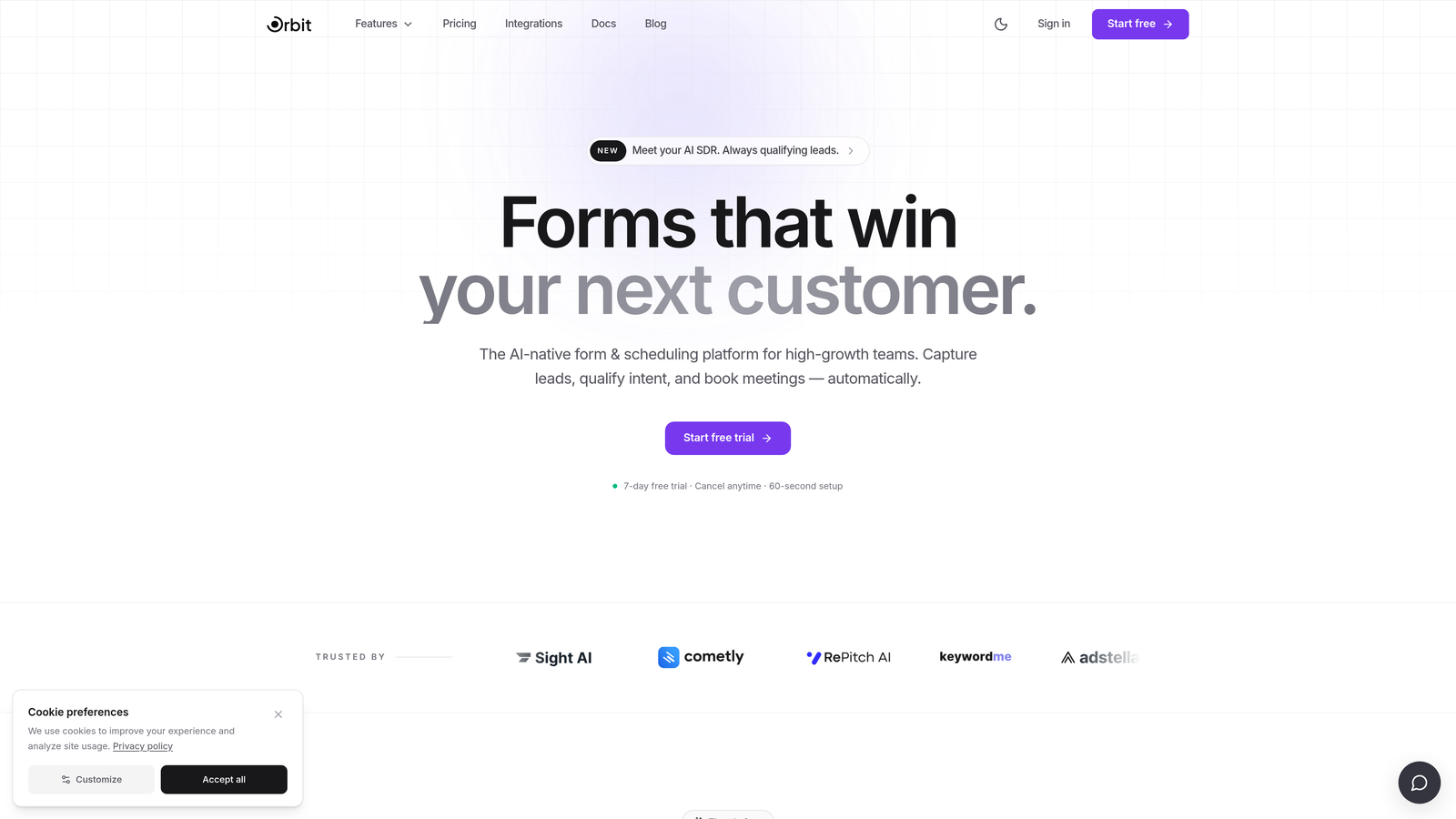
Orbit AI is an AI-powered form builder designed specifically for conversion-focused teams who want to qualify leads at the point of submission, not after.
Where This Tool Shines
Most form builders collect data and hand it off. Orbit AI goes a step further by scoring and qualifying leads the moment someone submits a form, so your sales team spends time on prospects that actually match your ICP. That's a meaningful operational advantage for B2B and SaaS teams dealing with high inbound volume.
Beyond lead qualification, the platform is built with conversion in mind from the ground up. Templates are designed for lead gen, demo requests, and onboarding flows rather than generic data collection, which means you're starting from a stronger baseline than most alternatives offer.
Key Features
AI Lead Scoring: Qualifies and scores leads automatically at the point of form submission, reducing manual triage for sales teams.
Conversion-Optimized Templates: Purpose-built templates for lead gen, demo requests, and onboarding flows that are designed to drive completions.
Conditional Logic and Dynamic Fields: Personalizes the form experience based on respondent inputs, keeping forms relevant and concise.
CRM and Marketing Integrations: Connects with the tools your team already uses to keep data flowing without manual exports.
Modern Form Design: Polished, professional aesthetics out of the box, so your forms match your brand without extra design work.
Best For
SaaS companies, B2B demand generation teams, and growth-focused startups that want their forms to do more than collect information. If lead quality matters as much as lead volume to your team, this is the tool built for that exact problem.
Pricing
Startup-friendly pricing is available. Check current plans at orbitforms.ai for the most up-to-date pricing and any active startup offers.
2. Typeform
Best for: Startups that prioritize form completion rates and a polished, conversational respondent experience.
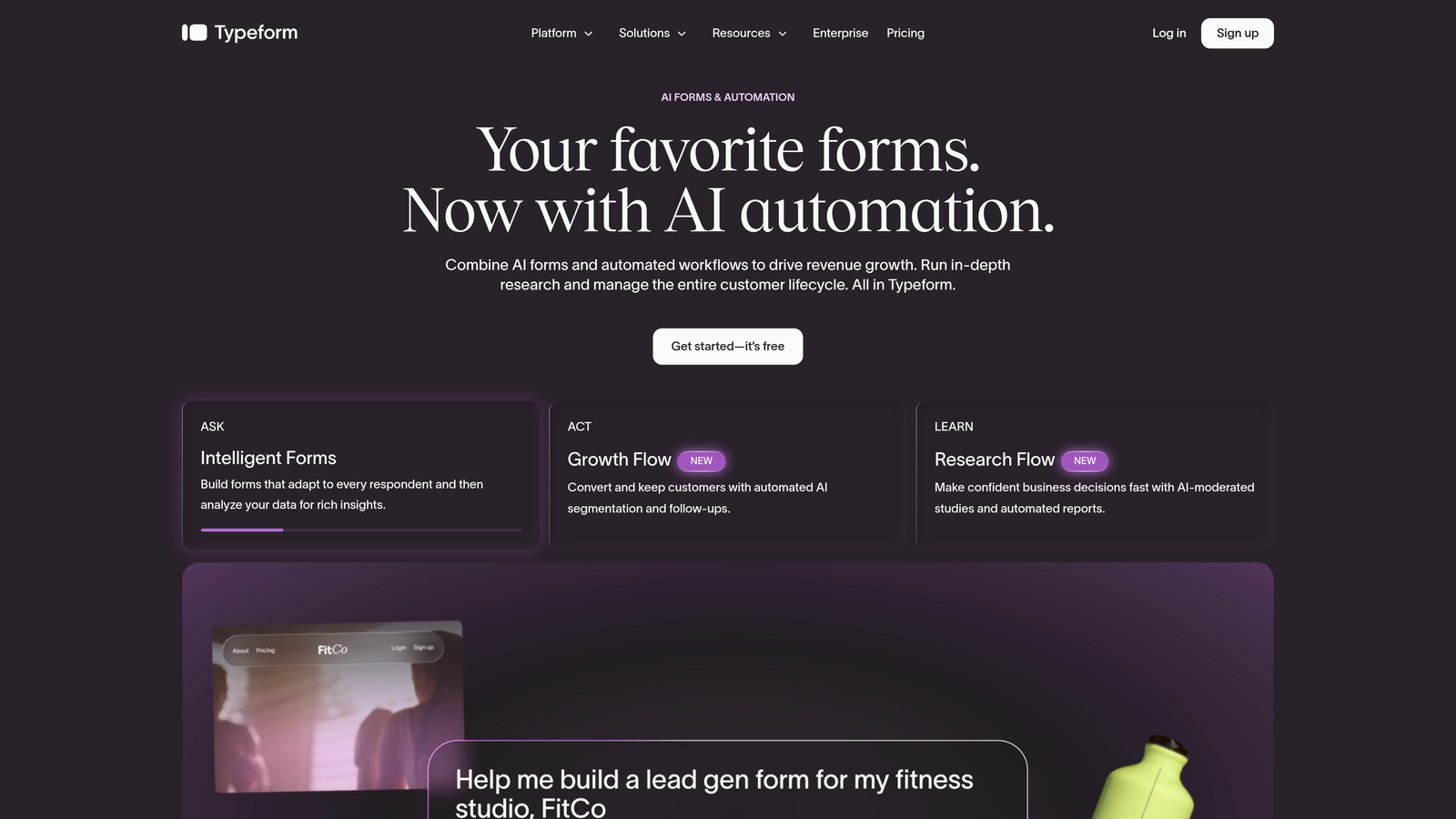
Typeform is a well-established conversational form builder that shows one question at a time, creating an experience closer to a dialogue than a data entry form.
Where This Tool Shines
The one-question-at-a-time format genuinely reduces drop-off, particularly for longer forms like lead qualification surveys or onboarding questionnaires. When a form feels less overwhelming, more people finish it, and that matters for startups optimizing their top-of-funnel conversion.
Typeform also has a broad ecosystem of integrations and a solid template library, making it relatively fast to deploy for common startup use cases like demo request forms, NPS surveys, and lead gen campaigns.
Key Features
Conversational Interface: Displays one question at a time to reduce friction and improve completion rates.
Logic Jumps: Routes respondents through different question paths based on their answers.
Template Library: Wide selection of pre-built forms for lead gen, surveys, quizzes, and more.
Startup Discount Access: Discounts available through select accelerator partnerships, including some Y Combinator and Stripe Atlas ecosystem offers. Verify current availability directly on their site.
Integrations: Connects with HubSpot, Salesforce, Slack, Zapier, and many other tools.
Best For
Startups running lead gen campaigns, customer research surveys, or onboarding flows where completion rate is a priority. Also a strong pick for teams with brand-conscious design standards who want forms that look as good as the rest of their product.
Pricing
Free plan available with limited responses. Paid plans start at approximately $25 per month billed annually. Verify current pricing and startup offers at typeform.com.
3. Tally
Best for: Bootstrapped startups and indie teams that need unlimited forms and responses without paying anything.
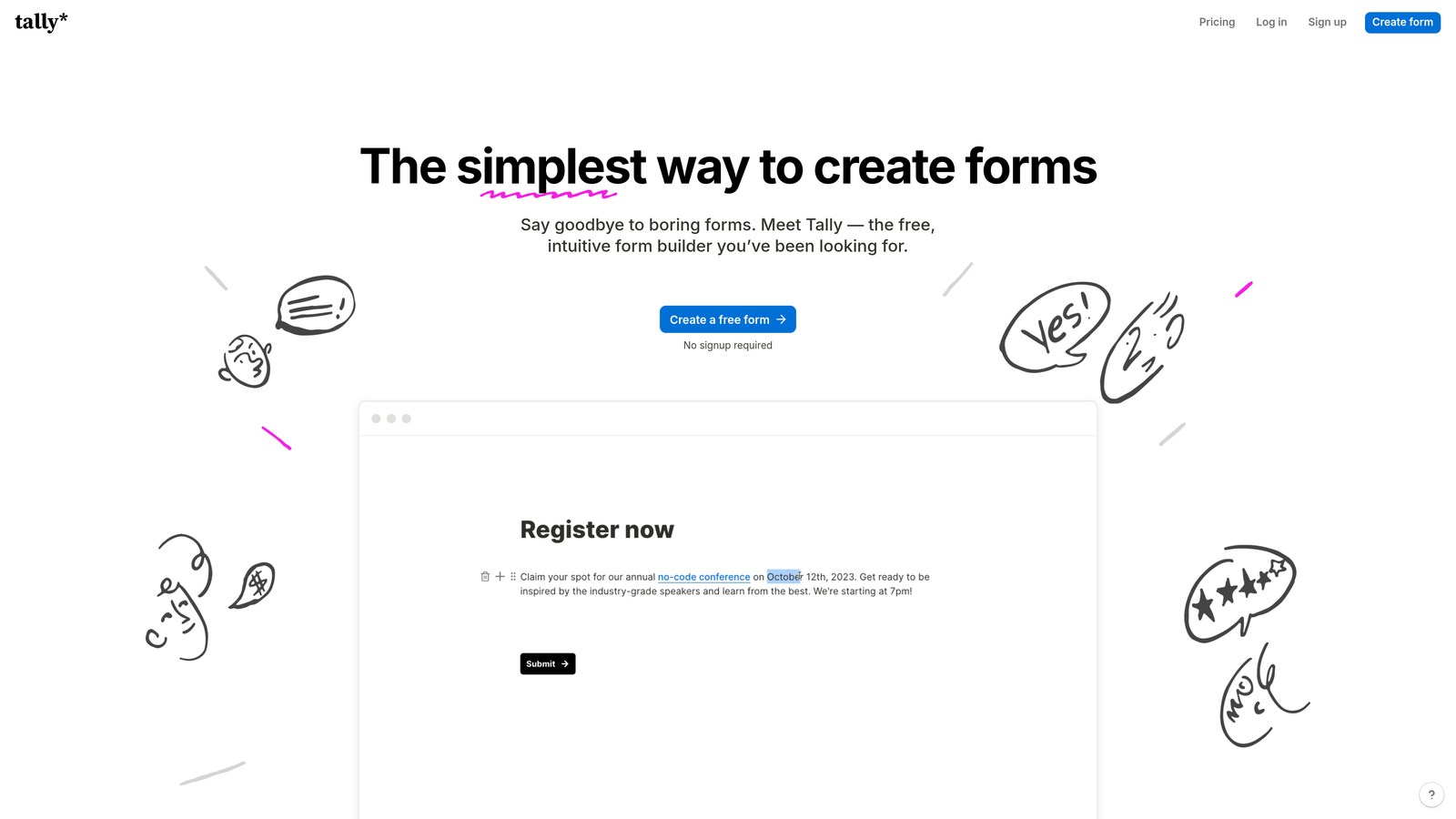
Tally is a Notion-inspired form builder with one of the most generous free tiers in the market, offering unlimited forms and unlimited responses at no cost.
Where This Tool Shines
For early-stage startups, Tally's free plan is effectively the startup discount. There are no submission limits, no form limits, and no forced branding on the free tier, which puts it ahead of many "free" competitors that quietly throttle usage once you start scaling.
The editor is clean and fast, with a block-based interface that feels familiar if your team already lives in Notion. It's not the most feature-rich option on this list, but for teams that need to ship forms quickly without a budget conversation, it's hard to beat.
Key Features
Unlimited Free Plan: No caps on forms or responses, making it genuinely usable at scale without upgrading.
Clean Block-Based Editor: Notion-style editing interface that's intuitive for modern startup teams.
Conditional Logic: Route respondents through different paths based on their inputs.
Calculated Fields: Useful for pricing estimators, lead scoring proxies, and quiz scoring.
Flexible Embedding: Embeds easily into websites, Notion pages, and other tools.
Best For
Bootstrapped startups, pre-seed teams, and product teams that want to move fast without budget approvals. Also a great fit for teams already using Notion as their primary workspace.
Pricing
Free forever plan with no usage limits. Pro plan available at an affordable monthly rate. Check current pricing at tally.so.
4. Jotform
Best for: Startups that need a feature-complete form builder with broad integration support from day one.
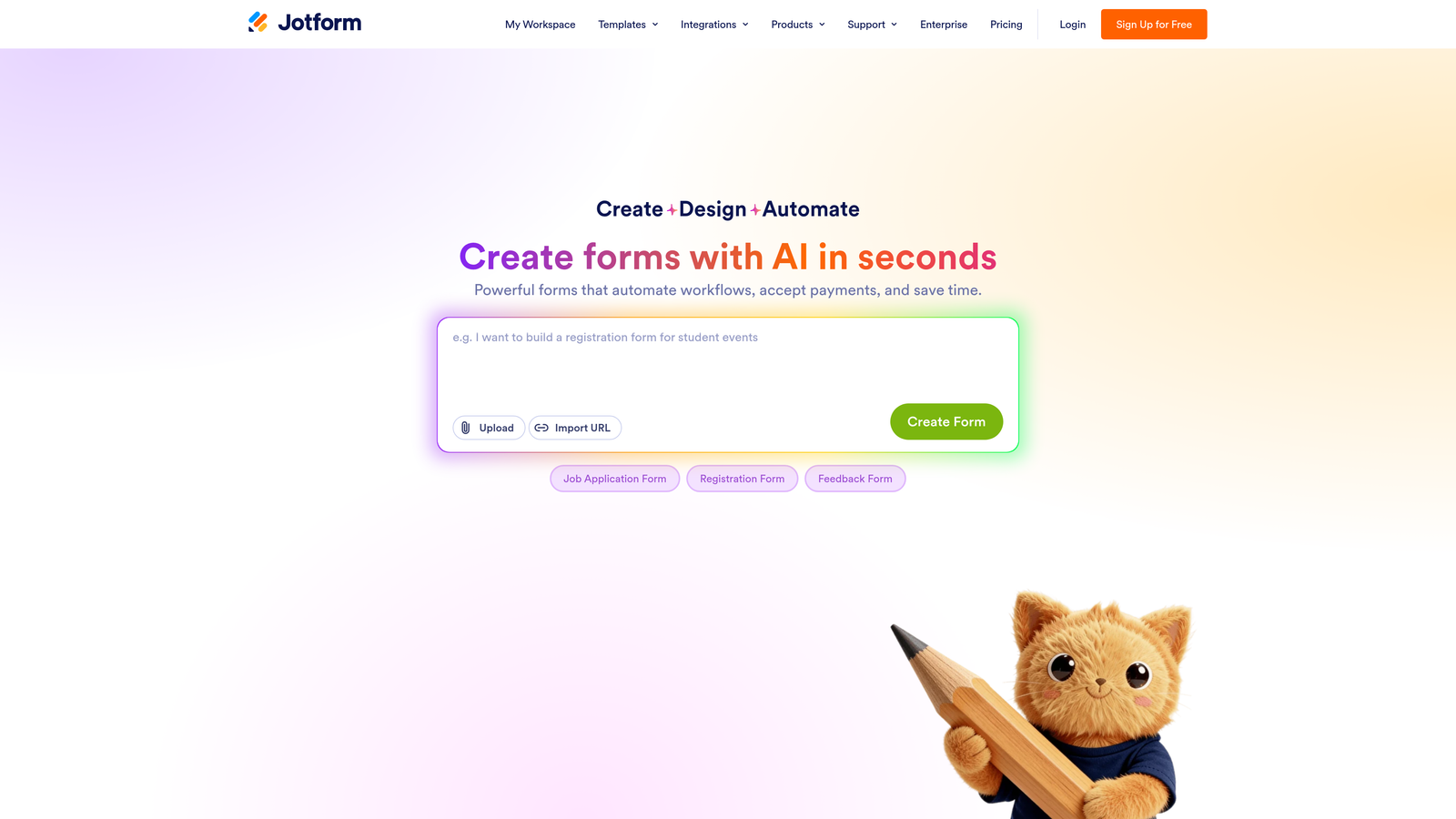
Jotform is one of the most established and feature-rich form builders available, with over 10,000 templates and 100-plus native integrations.
Where This Tool Shines
Jotform's depth is its defining characteristic. If you need payment collection, appointment scheduling, e-signature support, or complex conditional logic all in one tool, Jotform likely has it. For startups that want to consolidate multiple tools into one form platform, that breadth is genuinely valuable.
The platform also has a startup and nonprofit discount program, which can meaningfully reduce costs for qualifying teams. It's worth checking their pricing page directly to see current eligibility requirements and discount levels.
Key Features
10,000-Plus Templates: Covers virtually every use case from lead gen to HR onboarding to event registration.
100-Plus Native Integrations: Includes Salesforce, Slack, Stripe, HubSpot, Google Sheets, and many more.
Built-In Payment Collection: Accept payments via Stripe, PayPal, and Square without a third-party tool.
Startup Discount Program: Discounts available for qualifying startups. Verify current eligibility and terms at jotform.com/pricing.
Form Analytics: Track views, starts, and completions to identify where respondents drop off.
Best For
Startups that need a Swiss Army knife form platform with deep integration support. Particularly useful for teams managing multiple form types across sales, operations, and HR from a single account.
Pricing
Free plan includes 5 forms and 100 monthly submissions. Paid plans start at approximately $34 per month. Verify current pricing and startup program details at jotform.com.
5. Fillout
Best for: Product-led startup teams using Notion, Airtable, or Supabase as their operational backbone.
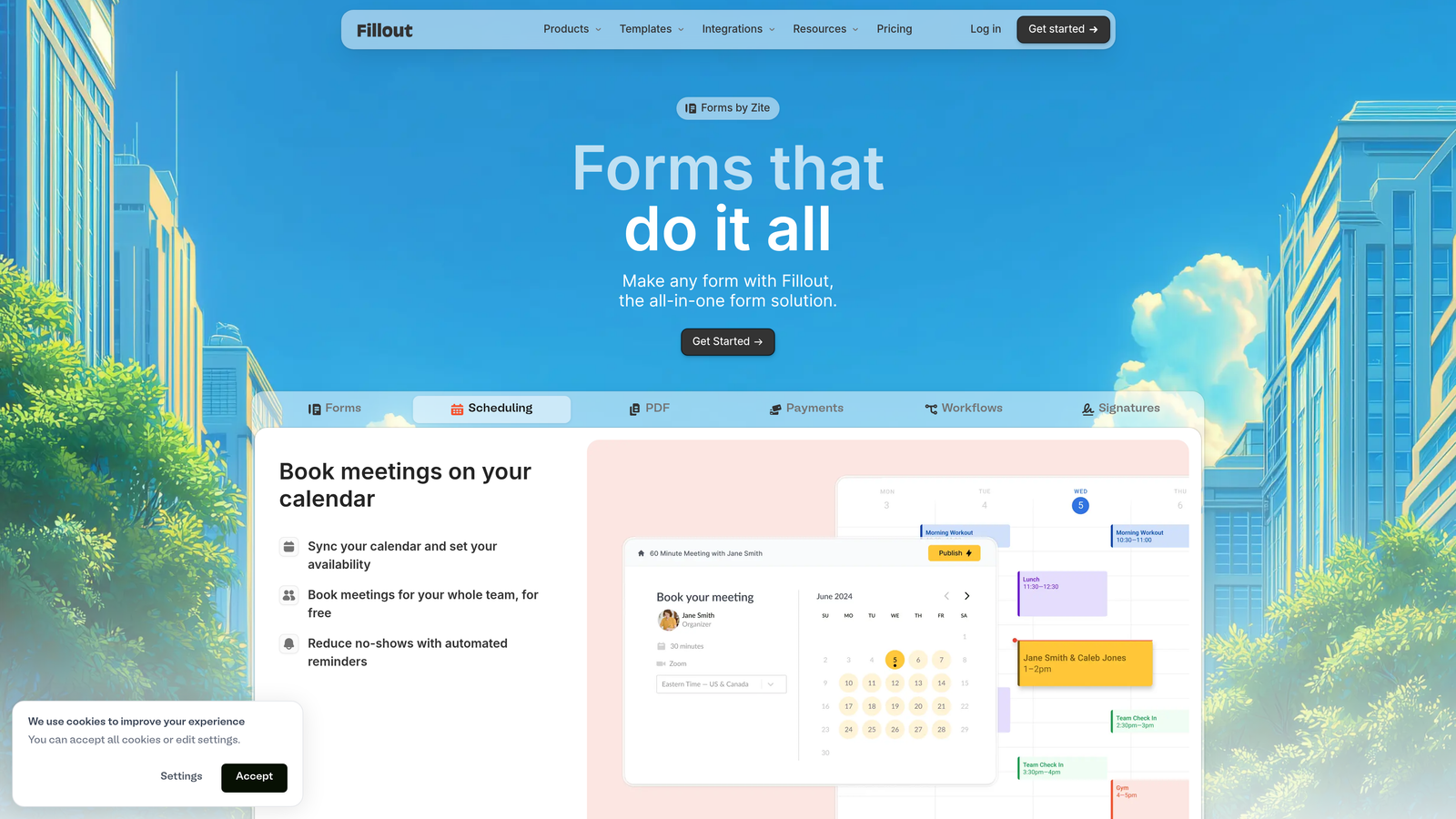
Fillout is a newer, fast-growing form builder that has built a strong following among no-code and product-led teams thanks to its deep native integrations.
Where This Tool Shines
Where most form builders treat integrations as an afterthought, Fillout treats them as a core feature. Native connections to Notion, Airtable, and Supabase mean that form submissions flow directly into your existing data layer without needing Zapier as a middleman. For teams already structured around these tools, that's a significant workflow improvement.
The free plan is also notably generous, with no branding restrictions, which is a meaningful differentiator for startups that want clean, professional forms without paying for the privilege.
Key Features
Native Notion, Airtable, and Supabase Integrations: Writes form data directly to your existing databases without middleware.
Generous Free Plan: No branding restrictions on the free tier, unlike many competitors.
Conditional Logic and Multi-Page Forms: Supports complex form flows without requiring a paid upgrade.
Scheduling and Payments: Available on paid plans for teams that need forms to handle more than data collection.
Clean, Modern UI: Fast to build with and easy for respondents to complete.
Best For
Product-led startups and no-code teams that use Notion, Airtable, or Supabase as their primary data layer. Also a strong choice for any team that wants a polished free plan without branding restrictions.
Pricing
Free plan available with competitive limits. Paid plans are reasonably priced. Check current pricing at fillout.com.
6. HubSpot Forms
Best for: Early-stage B2B startups building their first sales pipeline who want free CRM-connected forms.
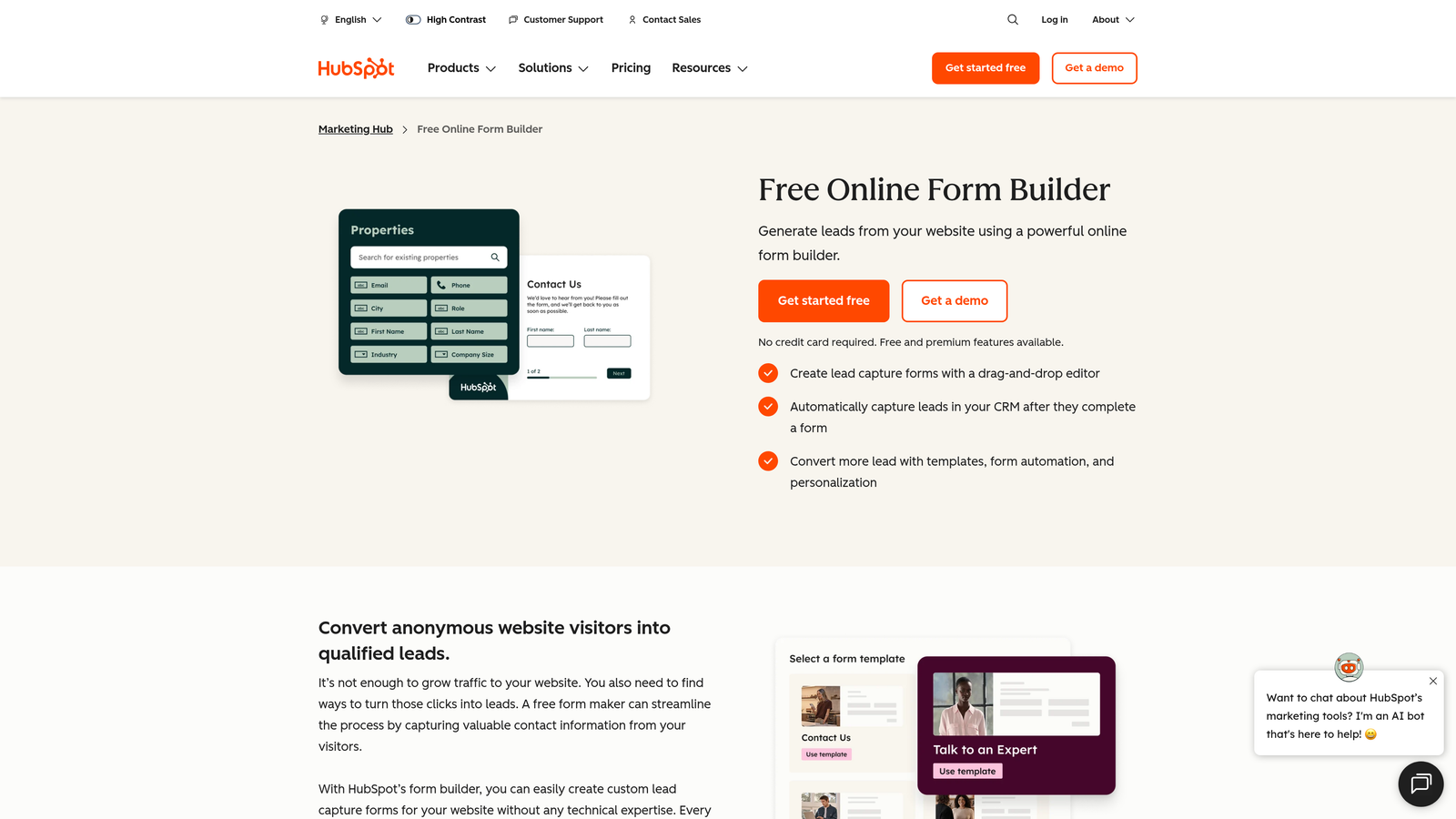
HubSpot Forms is a free form builder that feeds submissions directly into HubSpot's CRM, with no submission limits on the free tier.
Where This Tool Shines
The core value proposition here is simple: free forms that automatically populate a free CRM. For a B2B startup that's just starting to build a sales pipeline, that combination eliminates two tool costs at once. Every form submission becomes a contact record in HubSpot without any manual data transfer.
The HubSpot for Startups program is also one of the more substantial startup programs in the SaaS ecosystem, offering significant discounts for eligible companies. If your startup qualifies, the combined value of HubSpot's marketing, sales, and CRM tools at a reduced rate is hard to ignore.
Key Features
Free with No Submission Limits: No caps on responses, making it scalable even on the free tier.
Automatic CRM Integration: Every submission creates or updates a contact record in HubSpot's CRM automatically.
Basic Conditional Logic: Supports branching and field dependencies for more relevant form experiences.
HubSpot for Startups Program: Significant discounts available for qualifying startups. Verify current eligibility at hubspot.com/startups.
Email Follow-Up Workflows: Trigger automated email sequences based on form submissions within HubSpot.
Best For
Early-stage B2B startups that want CRM-connected lead capture without paying for separate tools. Especially valuable for teams that plan to grow into HubSpot's broader marketing and sales suite over time.
Pricing
Free as part of HubSpot's free CRM tier. HubSpot for Startups program offers meaningful discounts for qualifying companies. Verify current program details at hubspot.com/startups.
7. Paperform
Best for: Startups that need forms to function as mini landing pages with built-in payment and scheduling capabilities.
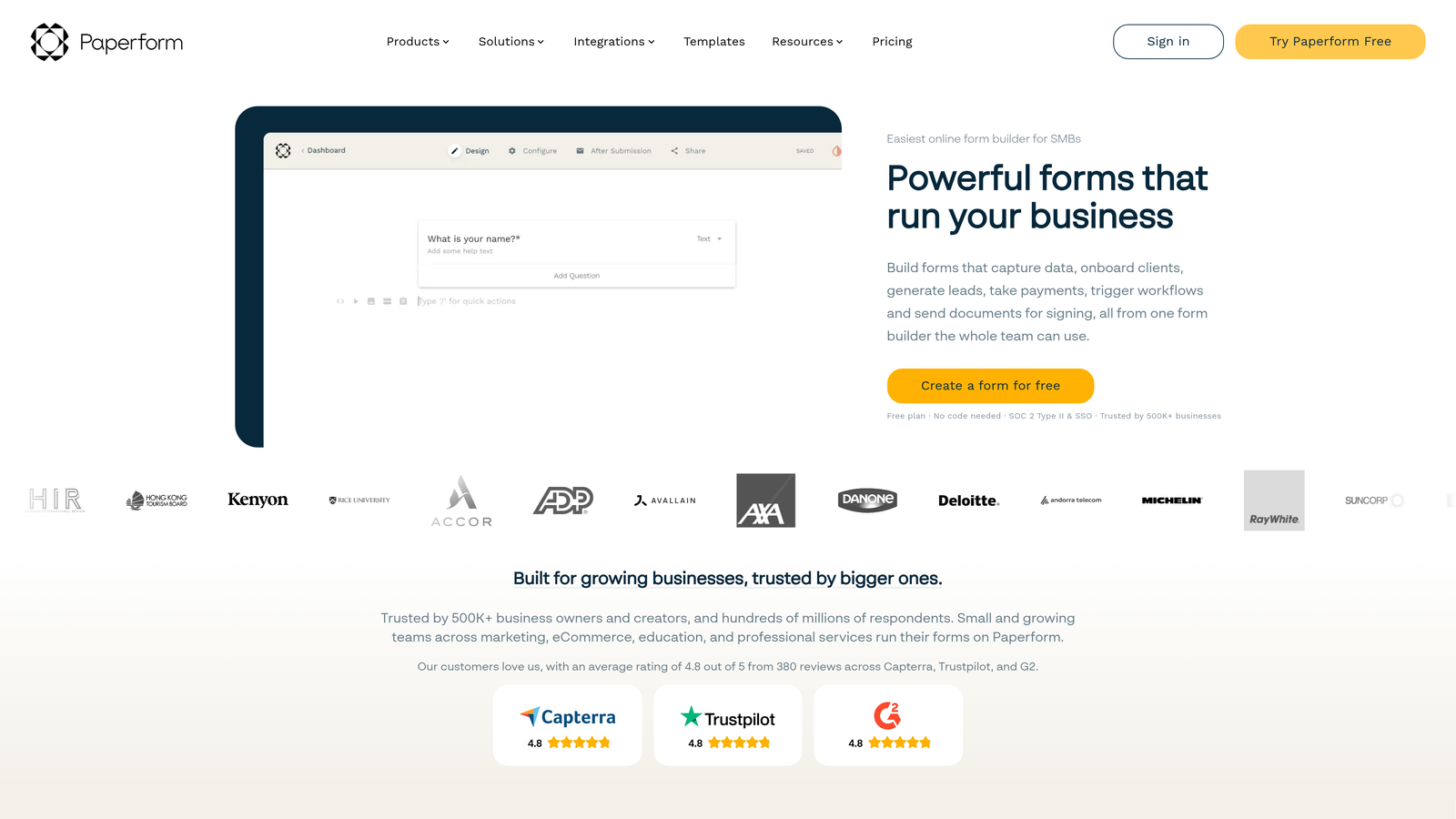
Paperform is a flexible form builder that blends form functionality with landing page design, payment collection, and appointment scheduling in a single tool.
Where This Tool Shines
Paperform occupies an interesting space between a form builder and a lightweight landing page tool. You can embed rich text, images, and video alongside form fields, which makes it possible to build forms that explain, sell, and collect information in one cohesive experience. That's useful for startups running lean who don't want to maintain a separate landing page tool for every campaign.
Annual billing provides meaningful cost savings, and the 14-day free trial gives you enough time to properly evaluate whether the platform fits your workflow before committing.
Key Features
Forms Plus Payments Plus Scheduling: Combines three tools into one, reducing your overall SaaS footprint.
Rich Media Embedding: Add text, images, and video directly into forms to create landing-page-style experiences.
Conditional Logic and Calculations: Supports complex form flows and dynamic pricing or scoring calculations.
Annual Billing Discount: Meaningful savings available when billed annually versus monthly.
14-Day Free Trial: Full access to evaluate the platform before committing to a paid plan.
Best For
Startups running campaigns that need a form and a landing page in one, or teams that want to collect payments and schedule calls without adding separate tools to their stack.
Pricing
14-day free trial available. Paid plans start at approximately $24 per month billed annually. Verify current pricing at paperform.co.
8. Google Forms
Best for: Pre-revenue or validation-stage startups with zero budget that need basic data collection immediately.
Google Forms is completely free, has no submission limits, and requires nothing beyond a Google account to get started.
Where This Tool Shines
There's no faster path from "we need a form" to "the form is live" than Google Forms. No sign-up friction, no pricing tiers to evaluate, no integration setup. For a startup in early validation mode that needs to collect customer feedback, run a quick survey, or capture interest in a new feature, it gets the job done in minutes.
Responses feed automatically into Google Sheets, which means your data is immediately accessible, filterable, and shareable without any additional setup. For teams already living in Google Workspace, that's a natural fit.
Key Features
Completely Free: No usage limits, no paid tiers, no submission caps of any kind.
Automatic Google Sheets Integration: Responses populate a linked spreadsheet in real time.
Basic Branching Logic: Simple conditional routing based on multiple-choice answers.
Google Workspace Integration: Works seamlessly with Drive, Docs, and Sheets for teams already in the Google ecosystem.
No Setup Required: Accessible immediately with any Google account, no onboarding needed.
Best For
Pre-revenue startups, teams in early validation mode, or any situation where speed and zero cost matter more than design quality or advanced features. Not recommended once you're actively optimizing for conversion or lead quality.
Pricing
Completely free. Included with any Google account at no cost.
9. Pabbly Form Builder
Best for: Budget-conscious startups that want to eliminate recurring SaaS fees entirely with a one-time lifetime deal.
Pabbly Form Builder is known for its lifetime deal availability, making it a genuinely different pricing model from the subscription-based alternatives on this list.
Where This Tool Shines
The lifetime deal model is the standout here. For startups that are watching every recurring line item on their P&L, paying once and owning access indefinitely is a compelling alternative to monthly or annual subscriptions. Pabbly has historically made lifetime deals available through platforms like AppSumo, though availability varies over time.
On the feature side, unlimited form submissions on paid plans removes one of the most common friction points for scaling startups. Built-in payment integrations and email autoresponders also reduce the number of additional tools needed for basic form-driven workflows.
Key Features
Lifetime Deal Availability: One-time payment options available periodically, often via AppSumo. Verify current availability at pabbly.com.
Unlimited Form Submissions: No per-submission fees or caps on paid plans.
Payment Integrations: Accepts payments via Stripe and PayPal directly through forms.
Email Notifications and Autoresponders: Built-in email automation triggered by form submissions without needing a separate tool.
Subscription and Lifetime Options: Flexibility to choose between recurring billing or a one-time purchase depending on what works for your budget.
Best For
Bootstrapped startups and budget-constrained teams that want to minimize recurring SaaS costs. Particularly appealing if a lifetime deal is currently available and your form requirements are straightforward.
Pricing
Subscription and lifetime deal options available. Check current offers at pabbly.com, and verify AppSumo availability for lifetime deal pricing.
Which Tool Is Right for Your Startup?
The right choice depends almost entirely on where your startup is right now and what you're optimizing for.
If you're in early validation mode with no budget, start with Google Forms or Tally. Both are free, fast to deploy, and require no commitment. Tally is the better pick if you care about design quality or need conditional logic without paying for it.
If you're an early-stage B2B startup building your first sales pipeline, HubSpot Forms is hard to argue against. Free CRM-connected lead capture is a strong foundation, and the HubSpot for Startups program can unlock the broader platform at a significant discount as you grow.
If your team is built around Notion or Airtable, Fillout deserves serious consideration. The native integrations remove meaningful workflow friction that other tools simply don't solve.
If you want to eliminate recurring costs entirely, Pabbly's lifetime deal model is worth checking when availability aligns with your timing.
And if lead quality matters as much as lead volume, which it almost always does for high-growth SaaS and B2B teams, Orbit AI is built for exactly that problem. Qualifying leads at the point of submission rather than after the fact changes how your sales team operates, and the conversion-optimized templates give you a stronger starting point than generic form builders offer.
Transform your lead generation with AI-powered forms that qualify prospects automatically while delivering the modern, conversion-optimized experience your high-growth team needs. Start building free forms today and see how intelligent form design can elevate your conversion strategy.


