

Static forms are quietly killing your conversion rates. When prospects hit a wall of fields, they bounce, and your pipeline suffers. Conversational forms flip the script: one question at a time, in a dialogue-style flow that feels less like a survey and more like a real exchange. The result is higher completion rates, better data quality, and leads that actually know what they signed up for.
But not all conversational form tools are built the same. Some are optimized for surveys. Others are built for enterprise workflows. A few are genuinely designed for lead generation and qualification, which is what high-growth teams actually need.
This comparison covers the best conversational form tools available in 2026, evaluated on UX, lead qualification capabilities, integrations, and pricing. Whether you're a SaaS team scaling outbound, an agency managing multiple clients, or a growth marketer optimizing top-of-funnel, there's a tool here for you.
1. Orbit AI
Best for: AI-powered lead qualification built directly into the conversational form flow
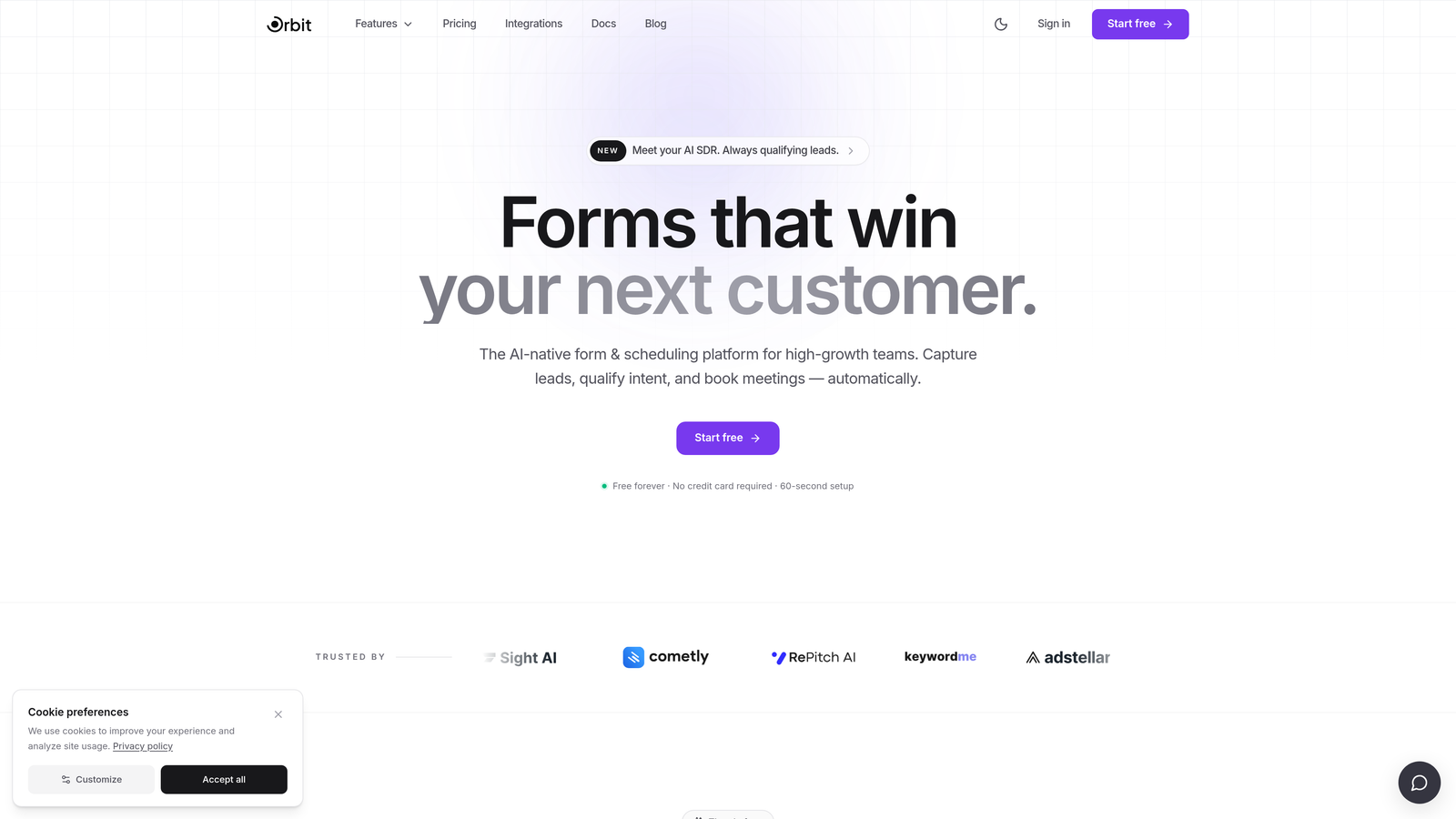
Orbit AI is an AI-powered conversational form builder with native lead qualification, designed specifically for high-growth B2B and SaaS teams focused on conversion optimization.
Where This Tool Shines
Most form tools collect data. Orbit AI qualifies it. The platform is built around the idea that your form shouldn't just capture a name and email, it should tell you whether that person is worth following up with before they ever reach your CRM. That distinction matters enormously for demand gen teams drowning in unqualified leads.
The form design is genuinely modern and conversion-optimized, not an afterthought. For teams where brand presentation and user experience are tied directly to pipeline quality, that combination of aesthetic polish and intelligent qualification logic is a meaningful differentiator from legacy form builders.
Key Features
AI-Powered Lead Qualification: Qualification logic runs natively inside the form flow, scoring and routing leads based on their answers in real time.
Smart Routing: Respondents are directed to different paths, outcomes, or follow-up experiences based on what they answer, without manual rule-building complexity.
Real-Time Lead Scoring: Qualification signals surface immediately, so your sales team knows which leads to prioritize before they even open their inbox.
Conversion-Optimized Design: Forms are built to look and feel modern, reducing friction and improving completion rates through thoughtful UX.
Demand Gen Workflow Integration: Built with high-growth team workflows in mind, including integrations that connect form data to the tools your team already uses.
Best For
SaaS and B2B teams that need more than a data collection tool. If lead quality is a bigger problem than lead volume, and you want qualification logic baked into the form rather than bolted on afterward, Orbit AI is purpose-built for that use case.
Pricing
Visit orbitforms.ai for current pricing details. Plans are designed for high-growth teams with varying form volume and qualification needs.
2. Typeform
Best for: Brand-forward surveys and polished one-question-at-a-time experiences
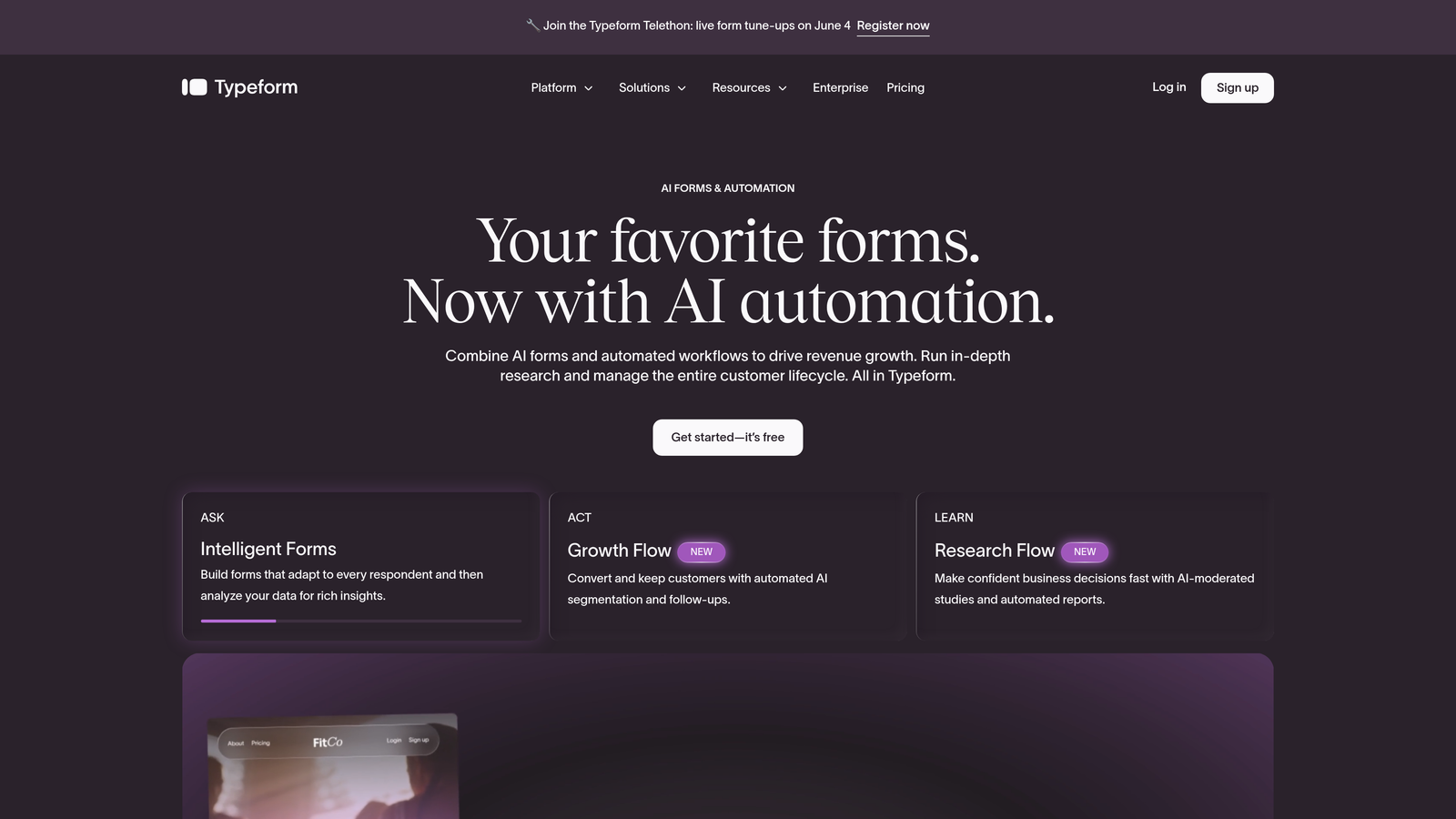
Typeform is the platform widely credited with popularizing the conversational, one-question-at-a-time format when it launched in 2012.
Where This Tool Shines
Typeform's core strength is design polish. The animations are smooth, the brand customization is deep, and the overall experience feels premium in a way that generic form tools simply don't. For teams where the form itself is part of the brand impression, that matters.
The platform also has a mature ecosystem of integrations and a well-developed logic system. Conditional branching, hidden fields, and logic jumps give you meaningful control over the respondent journey without requiring technical expertise.
Key Features
One-Question-at-a-Time UX: The original conversational format, refined over more than a decade of product iteration.
Brand Customization: Deep control over fonts, colors, backgrounds, and layout to match your visual identity.
Logic Jumps and Conditional Branching: Route respondents through different question paths based on previous answers.
Video Questions: Embed video alongside questions for richer, more engaging form experiences.
Marketing and CRM Integrations: Connects with HubSpot, Salesforce, Mailchimp, Slack, and many others via native integrations and Zapier.
Best For
Marketing teams running brand-aligned surveys, research projects, and lead gen campaigns where visual polish is a priority. Also well-suited for customer feedback and NPS programs where the form experience reflects on the brand.
Pricing
Free tier available with limited responses. Paid plans start at approximately $25/month. Verify current pricing at typeform.com, as plans and limits have evolved over time.
3. Tally
Best for: Free-tier users who need unlimited forms without the usual restrictions
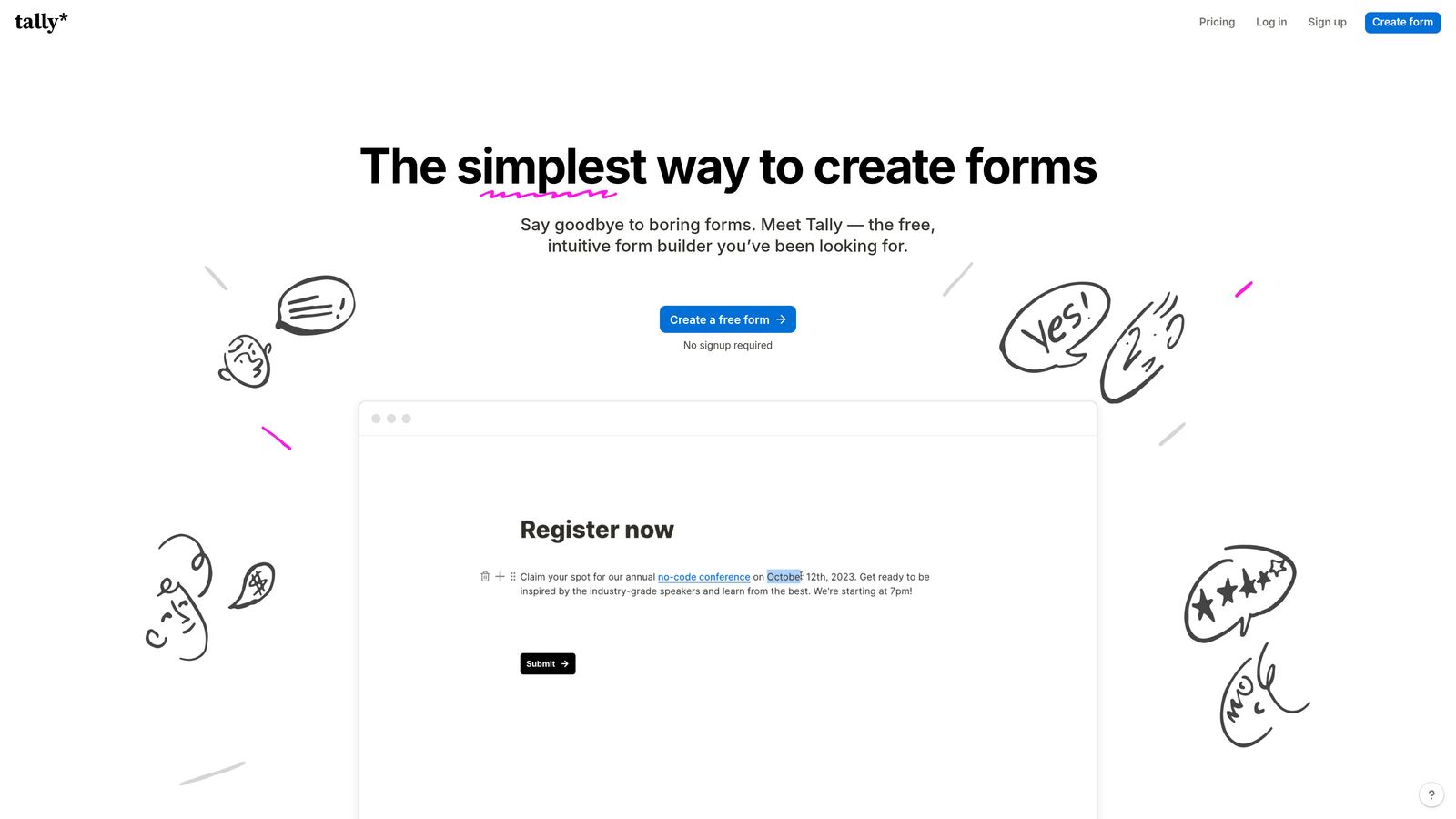
Tally is a Notion-inspired form builder with one of the most genuinely generous free plans in the category, including unlimited forms and unlimited responses at no cost.
Where This Tool Shines
Tally's free tier is legitimately useful, not a stripped-down teaser. Unlimited forms and responses on the free plan means startups, indie makers, and small teams can build real workflows without hitting a paywall every time they scale up. That's rare in this space.
The block-based editor feels immediately familiar to anyone who uses Notion, which lowers the learning curve significantly. The UI is minimal and distraction-free, which tends to produce cleaner form experiences than tools that overload you with options.
Key Features
Unlimited Free Forms and Responses: No response caps on the free plan, making it genuinely usable for teams at any stage.
Notion-Style Block Editor: Drag-and-drop block interface that's intuitive for teams already in the Notion ecosystem.
Conversational Mode: One-question-at-a-time display available alongside the standard layout.
Custom Domains and Branding: Available on the Pro plan for teams that need white-labeled form experiences.
Clean, Minimal UI: Less visual noise means faster building and a cleaner respondent experience.
Best For
Startups, indie hackers, and small teams that need a capable form tool without a recurring cost. Also a strong choice for Notion-heavy teams who want their form builder to feel native to their existing workflow.
Pricing
Free tier with unlimited forms and responses. Tally Pro is approximately $29/month. Verify current pricing at tally.so.
4. Jotform
Best for: Enterprise and operational teams needing forms as part of broader workflow automation
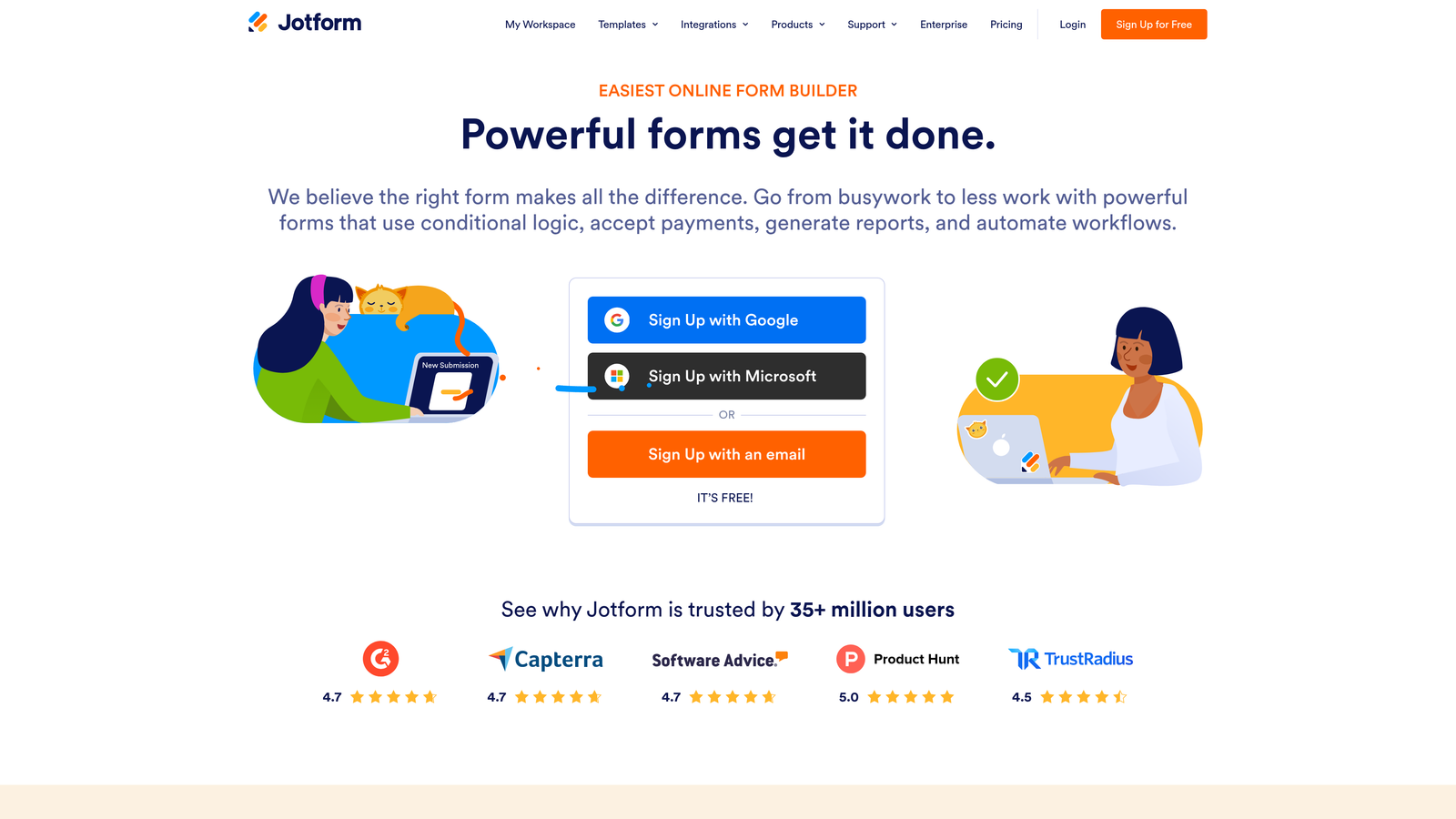
Jotform is one of the most established form platforms available, founded in 2006, with a feature set that goes well beyond data collection into full workflow automation.
Where This Tool Shines
Jotform's depth is its defining characteristic. With over 10,000 templates and support for payments, e-signatures, approval workflows, and HIPAA compliance, it covers use cases that most form tools simply can't. For organizations in healthcare, education, government, or enterprise operations, that breadth is genuinely valuable.
Conversational forms are included as a feature within the platform, meaning teams can use the dialogue-style format when it fits while falling back to standard layouts for more complex operational forms. The flexibility here is unmatched in the category.
Key Features
10,000+ Templates: Covers virtually every industry and use case, dramatically reducing setup time.
Approval Workflows and E-Signatures: Forms can trigger multi-step approval processes and collect legally binding signatures.
Payment Collection: Native integrations with Stripe, PayPal, and other processors for order forms and registration.
HIPAA Compliance: Available on higher-tier plans for healthcare organizations handling sensitive data.
Team Collaboration Controls: Role-based access and team workspaces for managing forms across large organizations.
Best For
Mid-market and enterprise organizations that need forms embedded in operational workflows. Particularly strong for healthcare, legal, education, and any team that needs compliance-ready data collection alongside conversational UX.
Pricing
Free tier available. Paid plans start at approximately $34/month. Verify current pricing and plan limits at jotform.com.
5. Landbot
Best for: Chat-style lead capture experiences on web, WhatsApp, and Messenger
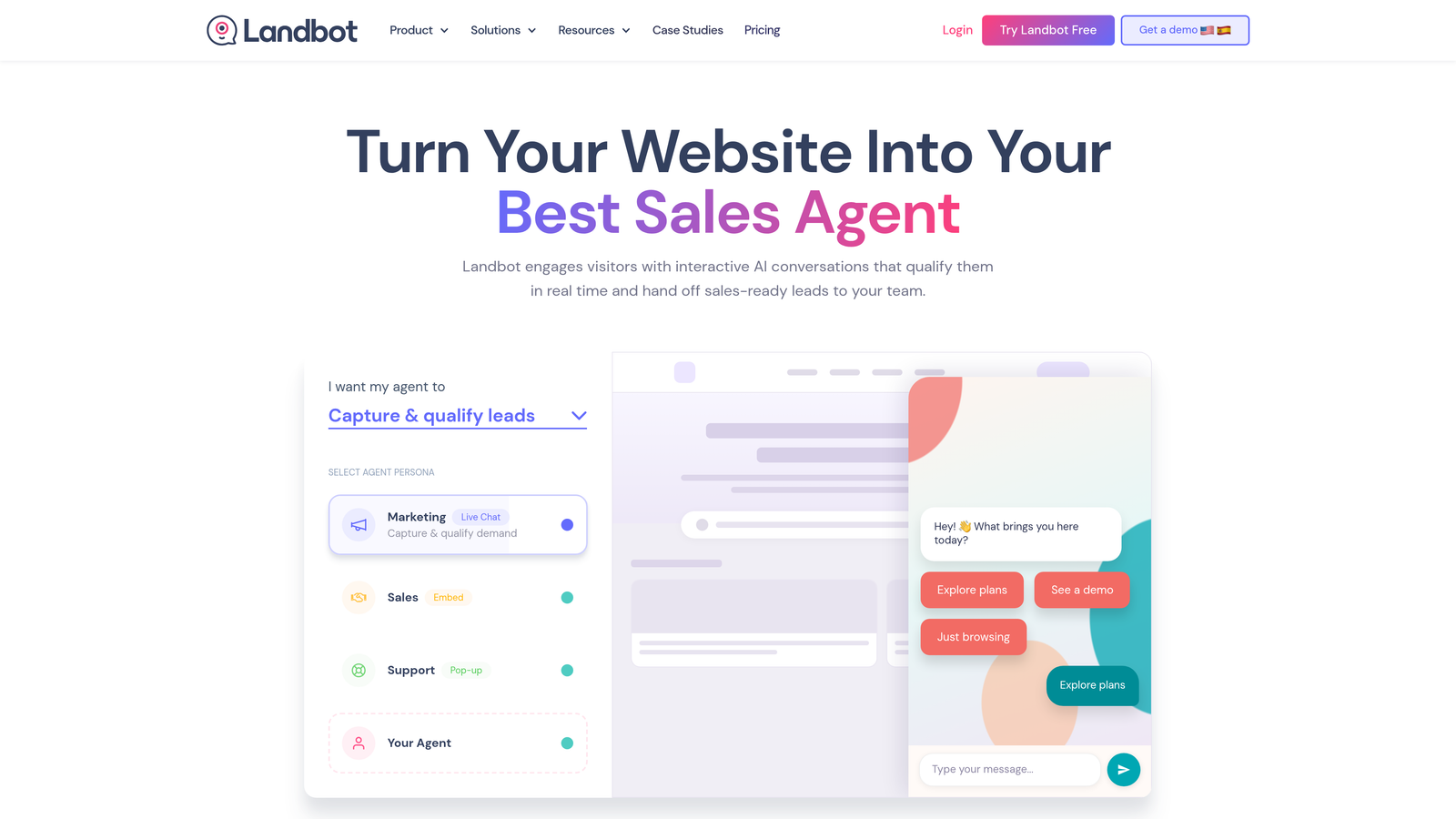
Landbot is a no-code chatbot builder that delivers form experiences through a true chat interface, deployable across web, WhatsApp, and Facebook Messenger.
Where This Tool Shines
Landbot occupies a distinct position in this comparison: it's less a form tool and more a conversational bot platform. The experience for respondents genuinely feels like a chat conversation rather than a form with a makeover. For sales teams that want a bot-like presence on landing pages without hiring developers, that's a meaningful capability.
The WhatsApp and Messenger deployment options also set Landbot apart. If your audience lives in messaging apps rather than email inboxes, the ability to run your lead capture flow natively in those channels is a real advantage over web-only tools.
Key Features
Chat-Style Interface: Respondents interact through a messaging UI that mimics real conversations rather than traditional form layouts.
WhatsApp and Messenger Deployment: Run conversational flows natively inside messaging platforms, not just on web.
Visual Flow Builder: Drag-and-drop canvas for building branching conversation paths without code.
Conditional Branching Logic: Route conversations based on user responses with visual logic mapping.
CRM and Webhook Integrations: Connect conversation data to your CRM, email tools, or custom endpoints.
Best For
Sales and marketing teams that want a chatbot-style lead capture experience on landing pages or in messaging apps. Particularly effective for brands with audiences active on WhatsApp or teams running conversational sales campaigns.
Pricing
Free tier available. Paid plans start at approximately $45/month. Verify current pricing and channel availability at landbot.io.
6. HubSpot Forms
Best for: Teams already inside the HubSpot ecosystem who want seamless CRM data sync
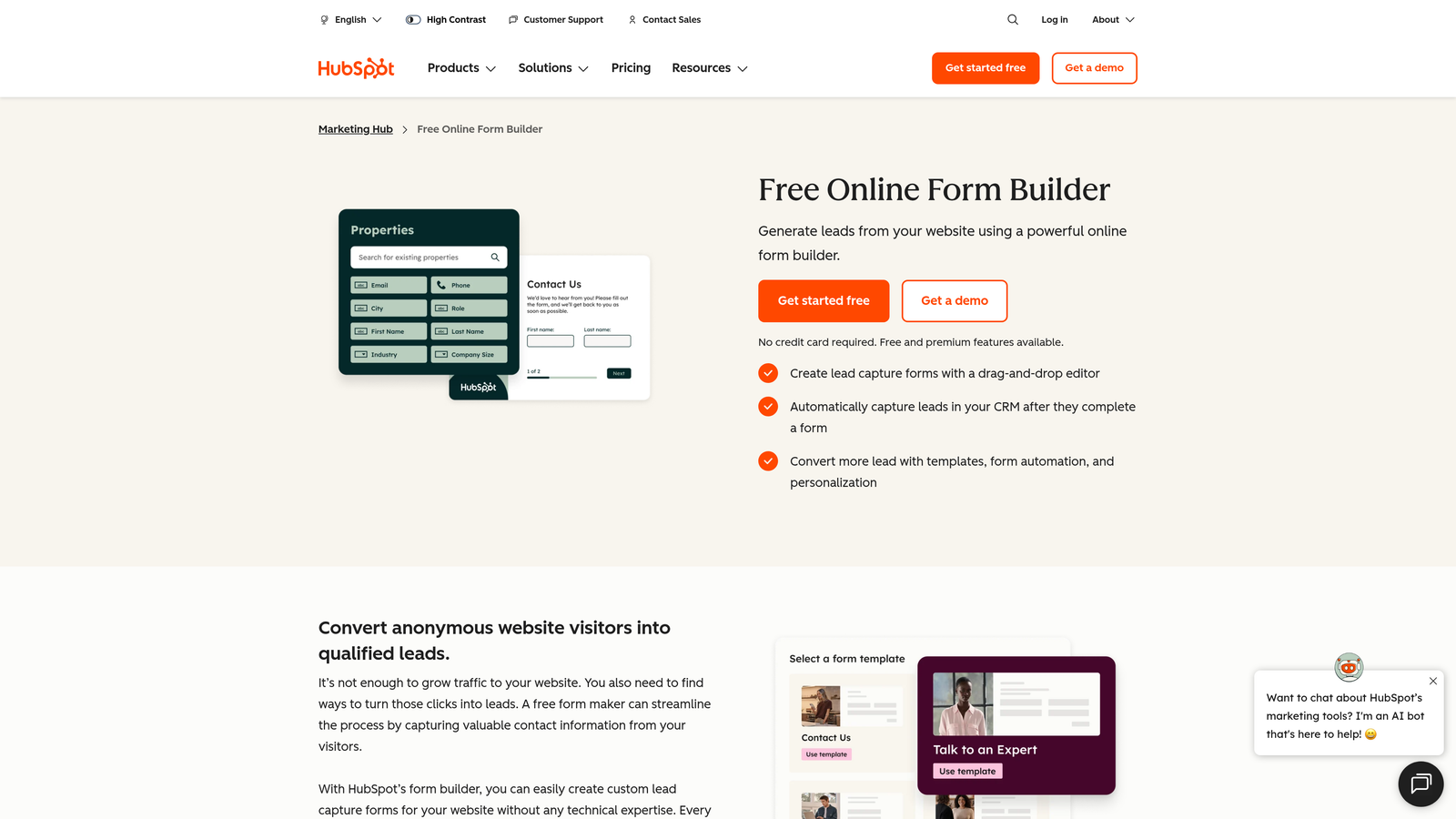
HubSpot Forms is the native form builder within HubSpot's Marketing Hub, with progressive profiling and direct CRM integration as its standout capabilities.
Where This Tool Shines
If your team runs on HubSpot, the forms tool becomes significantly more valuable than it would be as a standalone product. Progressive profiling is the headline feature: returning visitors see different fields based on what HubSpot already knows about them, gradually building out contact records without ever asking the same question twice. For teams running long nurture cycles, that's a genuinely useful capability.
The seamless sync to smart lists, workflows, and lead scoring within HubSpot means form submissions can trigger automated sequences immediately, without middleware or manual exports. The tight integration is the whole value proposition here.
Key Features
Progressive Profiling: Returning visitors see new fields rather than repeating ones, building richer contact records over time.
Direct CRM Sync: Form submissions flow instantly into HubSpot contact records, smart lists, and workflows.
Smart Forms: Forms adapt based on known contact data, showing only relevant fields to each visitor.
Built-in A/B Testing: Available on paid Marketing Hub plans for optimizing form performance.
Marketing Automation Integration: Form submissions can trigger email sequences, lead scoring updates, and sales notifications natively.
Best For
Teams already committed to the HubSpot platform who want their form data to flow directly into their CRM and marketing automation without any additional setup. Limited value as a standalone tool outside the HubSpot ecosystem.
Pricing
Free with HubSpot's free CRM. Advanced features require Marketing Hub paid plans. Verify current plan tiers at hubspot.com.
7. Paperform
Best for: Teams that want forms to function as standalone content pages with rich media
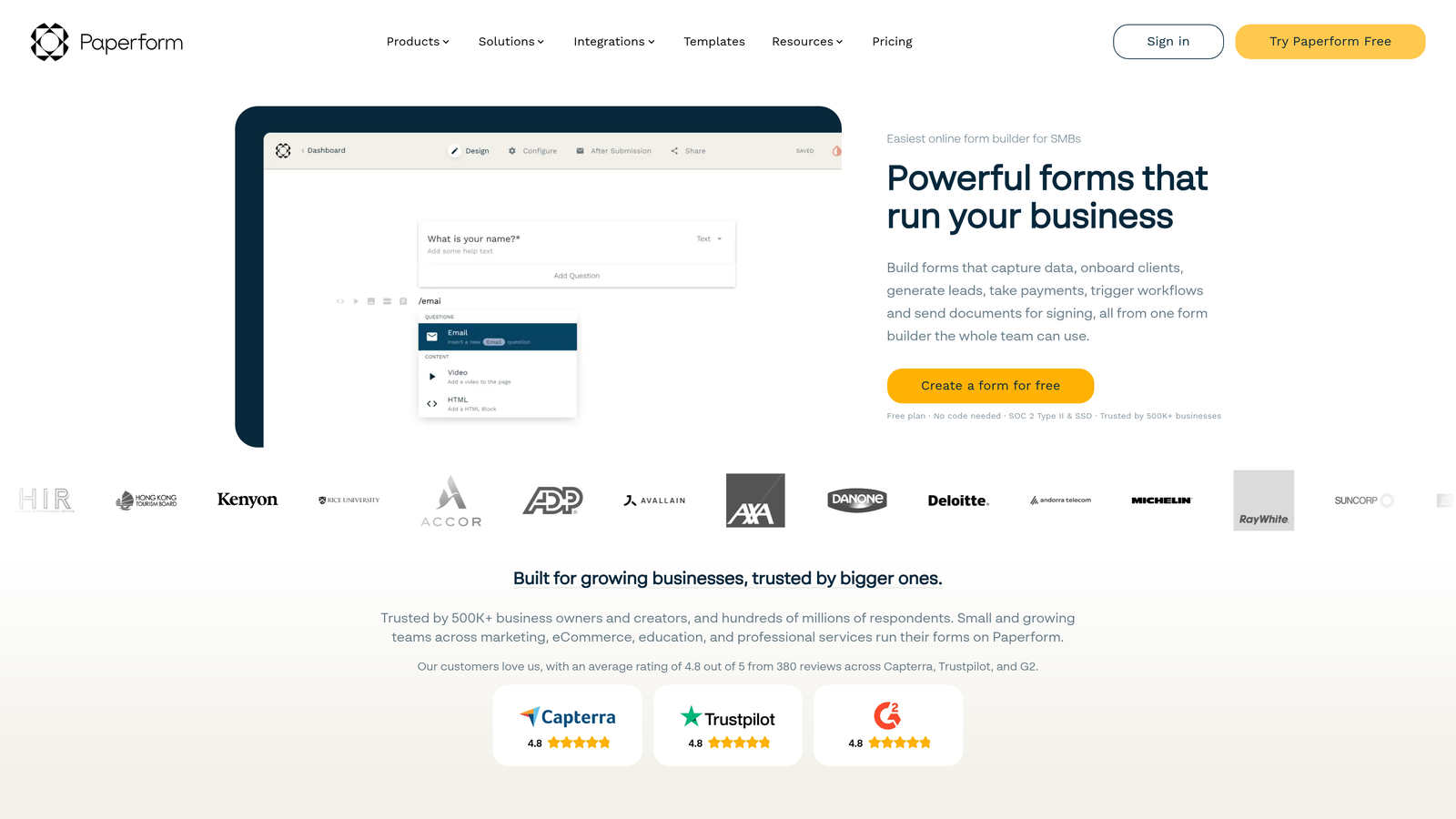
Paperform is a hybrid form and page builder that lets teams embed text, images, and video directly alongside form questions, creating experiences that feel more like landing pages than data collection tools.
Where This Tool Shines
Paperform's hybrid nature is genuinely useful for use cases where context matters. Coaches, consultants, course creators, and event organizers often need forms that explain something before asking for it. Embedding rich content directly in the form flow removes the need to build a separate landing page and then redirect to a form.
The payments and booking capabilities add further versatility. For small teams running registrations, appointments, or product sales, having all of that in one tool reduces the number of platforms to manage.
Key Features
Rich Content Embedding: Add text blocks, images, and video directly alongside form fields within the same flow.
Payments and E-Commerce: Accept payments via Stripe and other processors directly through the form.
Booking and Scheduling: Built-in appointment booking capabilities for service-based businesses.
Zapier and Make Integrations: Strong automation ecosystem for connecting form data to external tools and workflows.
Best For
Coaches, consultants, event organizers, and small business owners who need a form that doubles as a content experience. Also well-suited for teams that want to consolidate payments, bookings, and data collection into a single tool.
Pricing
Starts at approximately $24/month. No free tier available. Verify current plan pricing at paperform.co.
8. involve.me
Best for: Quiz funnels, scored assessments, and personalized outcome-based lead segmentation
involve.me is an interactive content platform specializing in quizzes, assessments, calculators, and surveys with built-in outcome scoring and personalized result pages.
Where This Tool Shines
involve.me sits at the intersection of lead generation and interactive content. The platform's scoring engine lets you assign values to answers and generate personalized outcome pages based on total scores, which creates a genuinely engaging experience for respondents while producing segmented, scored lead data for your team.
Quiz funnels are the standout use case. Respondents feel like they're getting something valuable, a personalized recommendation, assessment result, or score, while your team receives leads that are already segmented by interest, intent, or fit. That dual value exchange tends to drive higher completion rates than standard lead capture forms.
Key Features
Outcome Scoring and Segmentation: Assign point values to answers and route leads to different outcomes or CRM segments based on total scores.
Personalized Result Pages: Respondents receive customized outcome pages based on their answers, increasing perceived value.
Quiz, Calculator, and Assessment Templates: Pre-built templates for common interactive content formats across multiple industries.
Lead Scoring Output to CRM: Score data flows to your CRM alongside contact information for immediate sales prioritization.
Embedding and Popup Deployment: Flexible placement options including inline embeds, popups, and standalone pages.
Best For
Content marketers and demand gen teams running quiz funnels or scored assessments as top-of-funnel lead magnets. Particularly effective for SaaS and professional services teams that want to segment leads by need or fit before they reach sales.
Pricing
Free tier available. Paid plans start at approximately $29/month. Verify current pricing and response limits at involve.me.
9. Fillout
Best for: Notion and Airtable power users who need forms that write directly to their databases
Fillout is a modern form builder with deep native integrations for Notion and Airtable, advanced conditional logic, and a clean UI designed for non-technical users.
Where This Tool Shines
Fillout's native Notion and Airtable integrations are the reason most teams choose it. Form submissions write directly to your databases without Zapier middleware, which means cleaner data, fewer failure points, and a dramatically simpler setup for ops-heavy teams already living in those tools.
The conditional logic is also notably accessible. Many form builders offer branching logic but bury it in complex interfaces. Fillout makes it approachable for non-technical users, which matters for small teams where the person building forms isn't a developer.
Key Features
Native Notion Integration: Form submissions write directly to Notion databases without third-party automation tools.
Native Airtable Integration: Direct connection to Airtable bases for teams using it as their operational database.
Advanced Conditional Logic: Powerful branching and display rules with an interface accessible to non-technical builders.
Multi-Step and Conversational Forms: Supports both sequential multi-step and fully conversational one-question-at-a-time formats.
Scheduling and Booking: Built-in scheduling form capabilities for appointment and meeting request workflows.
Best For
Operations teams, no-code builders, and startups running their workflows in Notion or Airtable who want form submissions to land directly in their existing databases. Also a strong choice for teams that find other form builders' logic systems too complex.
Pricing
Free tier available. Paid plans start at approximately $19/month, making it one of the more accessible paid options in this comparison. Verify current pricing at fillout.com.
Which Tool Is Right for Your Team?
Every tool in this list solves the core problem of conversational data collection, but they diverge significantly on what they optimize for. The right choice depends on where your biggest friction point actually is.
AI-powered lead qualification: Orbit AI is the purpose-built choice. If lead quality is your bottleneck and you want qualification logic running inside the form itself rather than patched together downstream, this is where to start.
Brand-forward surveys and polished experiences: Typeform remains the benchmark for design quality and conversational UX polish, particularly for research, NPS, and brand-aligned lead gen.
Best free tier in the category: Tally offers unlimited forms and responses at no cost, which is genuinely rare and makes it the default recommendation for early-stage teams watching spend.
Enterprise workflows and compliance: Jotform's depth, template library, and compliance features make it the natural fit for healthcare, legal, and enterprise operations teams.
Chat-style and messaging app deployment: Landbot is the only tool here that truly feels like a chatbot and deploys natively to WhatsApp and Messenger.
HubSpot-native teams: HubSpot Forms' progressive profiling and seamless CRM sync make it the obvious choice if your team is already committed to the HubSpot ecosystem.
Forms as landing pages: Paperform's rich content embedding makes it the right pick when context and explanation need to live alongside your questions.
Quiz funnels and scored assessments: involve.me's outcome scoring and personalized result pages are built specifically for interactive lead magnets that segment as they convert.
Notion and Airtable power users: Fillout's native database integrations make it the cleanest option for ops teams already running their workflows in those tools.
For high-growth SaaS and B2B teams where lead quality directly impacts revenue, the conversation usually starts and ends with qualification. Forms that collect data are everywhere. Forms that tell you which leads are worth pursuing, in real time, before they hit your CRM, are a different category entirely.
Transform your lead generation with AI-powered forms that qualify prospects automatically while delivering the modern, conversion-optimized experience your high-growth team needs. Start building free forms today and see how intelligent form design can elevate your conversion strategy.


