

Not all leads are created equal, and treating them the same is one of the fastest ways to burn your sales team's time and tank your conversion rates. Lead segmentation software helps you automatically sort, score, and route incoming leads based on firmographics, behavior, and qualification signals, so your team focuses energy where it actually converts.
This list covers nine tools purpose-built (or well-suited) for lead segmentation across the funnel, from form-based qualification at the top to CRM-level scoring deeper down. Whether you're running a lean growth team or scaling a demand gen operation, there's a fit here.
Selection criteria: native segmentation or scoring capabilities, integration depth, ease of use for non-technical teams, and suitability for B2B SaaS and high-growth contexts.
1. Orbit AI
Best for: Qualifying and segmenting leads at the point of capture, before they hit your CRM
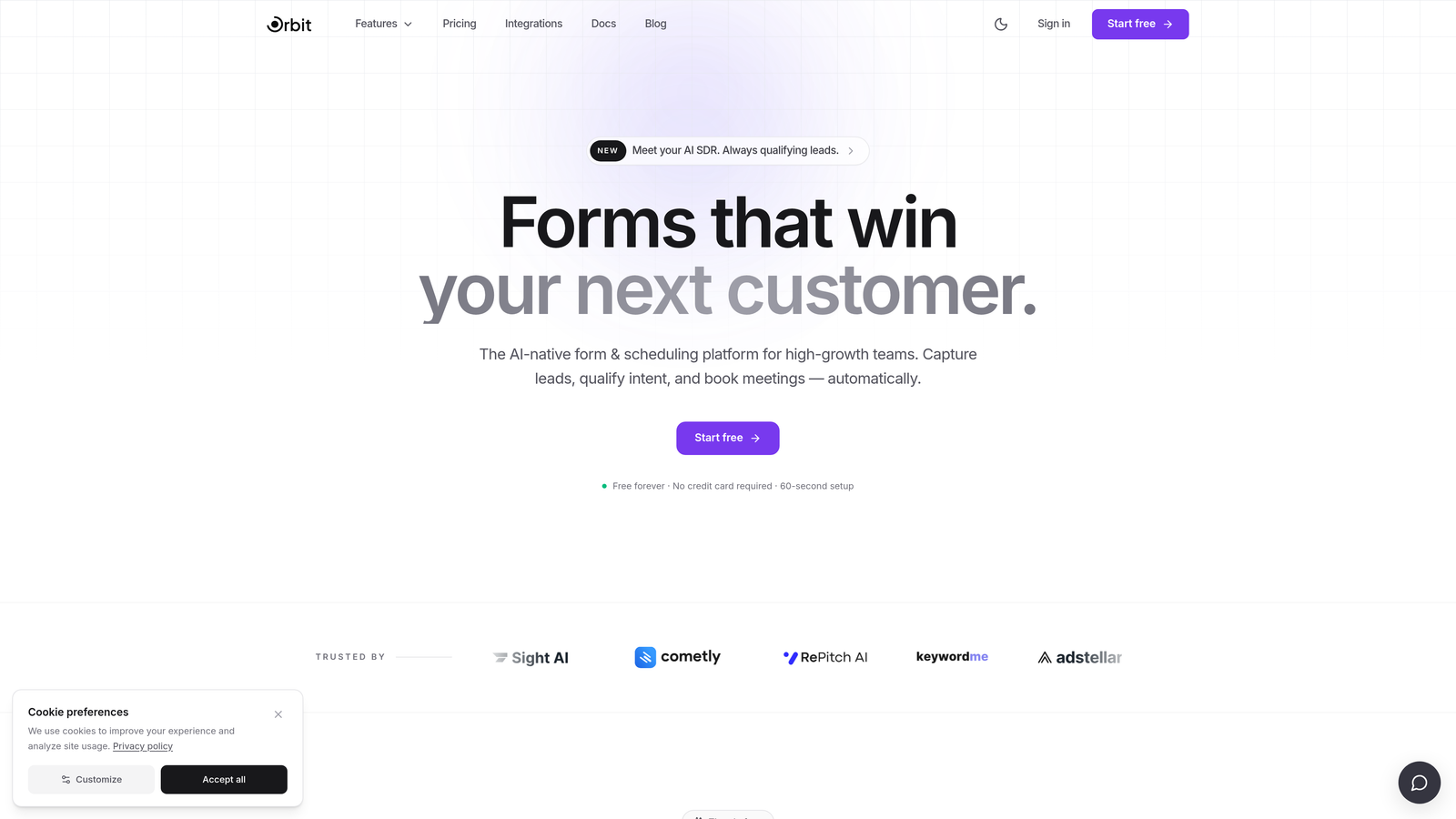
Orbit AI is an AI-powered form builder that qualifies and segments leads through adaptive, conversational forms at the very top of your funnel.
Where This Tool Shines
Most segmentation tools operate after a lead enters your system. Orbit AI flips that model entirely. By embedding qualification logic directly into the form experience, it captures richer data upfront and tags or routes leads before they ever reach a CRM or sales queue. That means cleaner pipelines and less noise for your team.
The conversational, adaptive format also tends to feel less like a form and more like a dialogue, which keeps completion rates healthy. For B2B SaaS teams running paid acquisition or inbound demand gen, this upstream segmentation can meaningfully reduce the volume of unqualified leads your sales team has to triage.
Key Features
Adaptive Conditional Logic: Questions change dynamically based on prior answers, surfacing deeper qualification signals without overwhelming respondents with irrelevant fields.
AI-Powered Lead Qualification: Qualification signals are embedded directly in the form flow, helping surface high-fit leads automatically.
Automatic Lead Tagging and Routing: Leads are tagged and routed based on their responses, so the right rep or nurture sequence gets the right lead every time.
Conversion-Optimized Design: Built specifically for high-growth SaaS teams, with modern form design that prioritizes both aesthetics and performance.
CRM and Marketing Tool Integrations: Passes pre-segmented lead data downstream to your existing stack, so enrichment happens before leads land in your CRM rather than after.
Best For
B2B SaaS teams who want to reduce CRM noise, improve lead quality at the source, and give sales reps pre-qualified, pre-tagged leads to work with. Particularly strong for growth teams running high-volume inbound or paid channels where manual qualification doesn't scale.
Pricing
Check orbitforms.ai for current pricing plans and available tiers.
2. HubSpot Marketing Hub
Best for: CRM-native segmentation with dynamic lists and lifecycle stage management
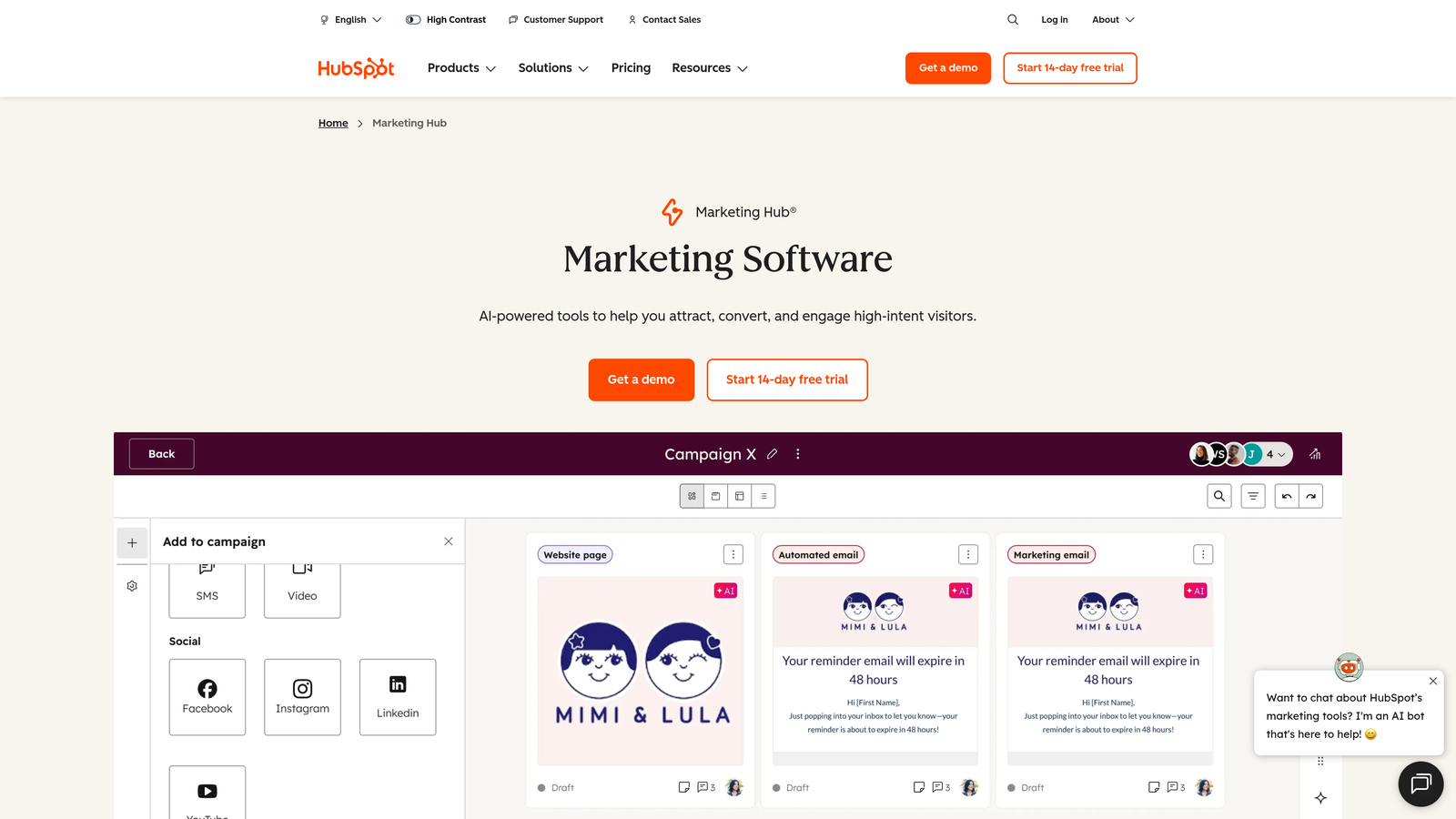
HubSpot Marketing Hub is a full-featured marketing platform with built-in lead scoring, smart list segmentation, and deep CRM integration for teams already operating in the HubSpot ecosystem.
Where This Tool Shines
HubSpot's segmentation strength comes from its tight CRM integration. Because contact properties, lifecycle stages, and behavioral data all live in the same platform, your smart lists stay current automatically. There's no syncing headache, no lag between a lead taking an action and that action triggering a segment update.
For teams that want a single platform to handle marketing, CRM, and basic sales automation without stitching together multiple tools, HubSpot remains one of the most practical choices in the mid-market.
Key Features
Dynamic Smart Lists: Contact lists that update automatically as properties change, keeping your segments accurate without manual intervention.
Lead Scoring: Score leads based on both demographic fit and behavioral engagement, available on Professional and Enterprise tiers.
Lifecycle Stage Segmentation: Segment contacts by their position in the buyer journey, tied directly to the CRM pipeline.
Native Suite Integration: Works seamlessly with HubSpot CRM, Sales Hub, and Service Hub for unified contact management.
Workflow Automation: Trigger automated actions, emails, and notifications based on segment membership changes.
Best For
SMB to mid-market B2B teams already using or planning to adopt HubSpot as their CRM. Especially strong for teams that want segmentation, email marketing, and pipeline management under one roof without heavy technical overhead.
Pricing
Free tier available. Marketing Hub Professional starts at $800/month. Verify current pricing at hubspot.com as plans change regularly.
3. Breeze Intelligence (formerly Clearbit)
Best for: Real-time data enrichment that enables instant segmentation without long forms
Breeze Intelligence is a data enrichment tool that appends firmographic and technographic data to inbound leads the moment they submit a form, enabling segmentation depth without requiring extra form fields.
Where This Tool Shines
The core value proposition here is simple: you can shorten your forms dramatically while actually knowing more about the leads who submit them. Breeze Intelligence fills in the gaps, company size, industry, tech stack, revenue range, automatically, so your segmentation logic has rich data to work with from the very first touch.
Following HubSpot's acquisition of Clearbit, this capability is now woven into the HubSpot platform, making it a natural complement for teams already running Marketing Hub. For account-based strategies in particular, the technographic data is genuinely useful for identifying high-fit prospects based on the tools they already use.
Key Features
Real-Time Form Enrichment: Appends company size, industry, and tech stack data to form submissions instantly, without requiring the lead to provide it.
Shorter Forms, Deeper Data: Reduces required fields while increasing the segmentation signals available to your marketing and sales teams.
Account-Based Segmentation: Enables ABM-style segmentation from the first lead interaction, not just after enrichment runs in the background.
HubSpot Platform Integration: Now natively embedded within HubSpot's ecosystem following the acquisition.
Technographic Signals: Identifies high-fit accounts based on existing tool usage, useful for competitive displacement or ecosystem targeting.
Best For
B2B SaaS teams running account-based marketing programs or any team looking to improve segmentation quality without increasing form friction. Works best when paired with HubSpot Marketing Hub.
Pricing
Now bundled within HubSpot tiers. Verify the current structure and what's included at hubspot.com.
4. Marketo Engage
Best for: Enterprise-grade multi-dimensional lead scoring and complex segmentation logic
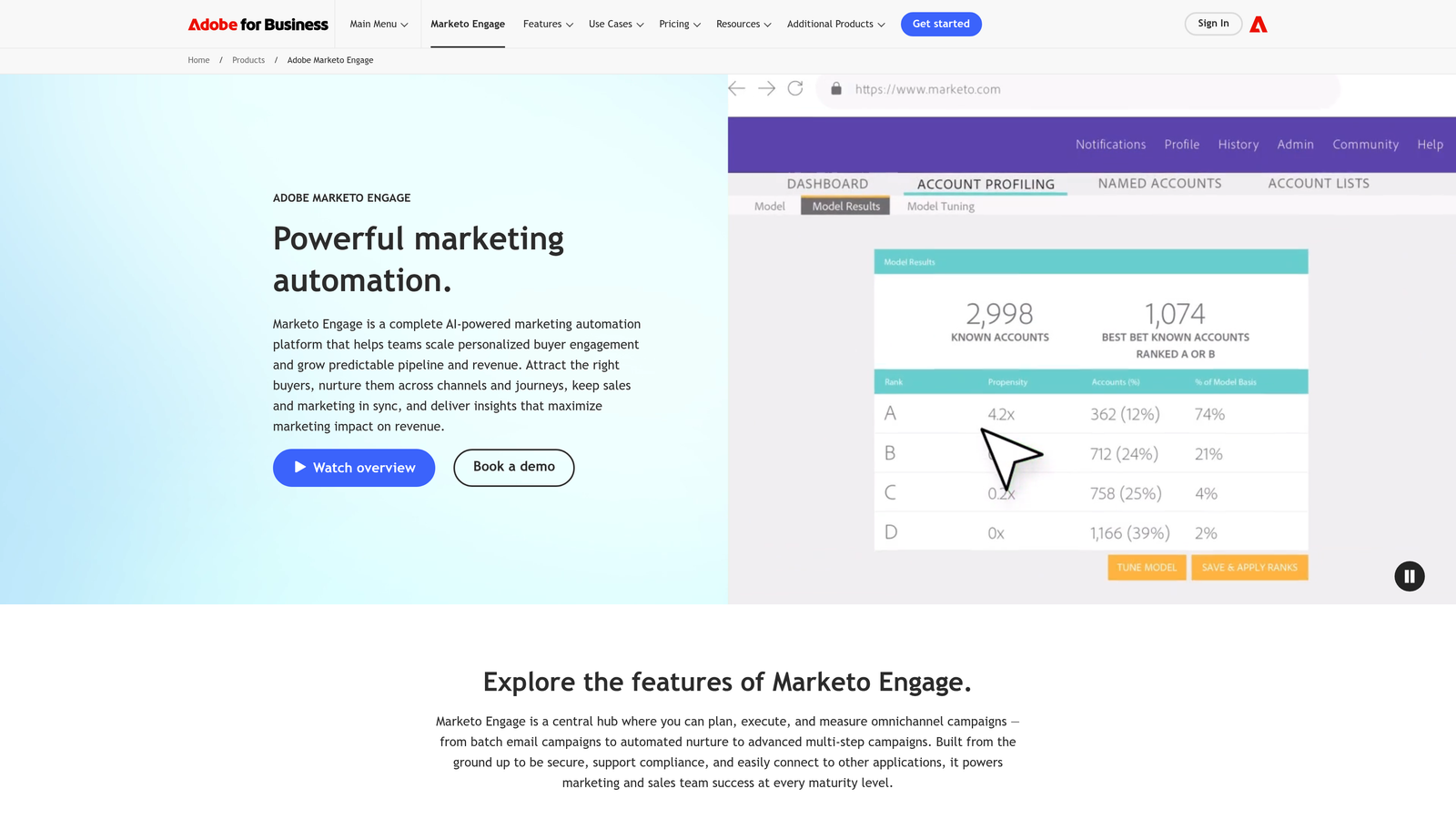
Marketo Engage is Adobe's enterprise marketing automation platform, built for large marketing organizations that need sophisticated scoring models and granular segmentation across complex funnel architectures.
Where This Tool Shines
Marketo's lead scoring capabilities go well beyond simple point thresholds. You can layer behavioral signals, demographic fit, and firmographic data into multi-dimensional scoring models that reflect how your actual buyers behave, not just how often they open emails. For organizations with dedicated marketing ops resources, this depth is genuinely powerful.
The Smart List and Smart Campaign system gives marketers fine-grained control over who enters which segment and what happens when they do. That said, Marketo has a steep learning curve and typically requires experienced marketing operations staff to run effectively. It's a professional-grade tool, not a plug-and-play solution.
Key Features
Multi-Dimensional Lead Scoring: Combines behavioral, demographic, and firmographic signals into composite scores that reflect real buyer fit and intent.
Smart Lists: Rule-based audience segmentation with granular filter logic for precise targeting.
Smart Campaigns: Automated nurture triggered by segment changes or scoring thresholds.
Revenue Cycle Modeling: Maps leads through defined funnel stages for pipeline-aligned segmentation.
CRM Integration: Deep integration with Salesforce and Microsoft Dynamics for sales-marketing alignment.
Best For
Enterprise marketing teams or well-resourced mid-market organizations with dedicated marketing ops staff. Best suited to companies with complex buyer journeys and a need for sophisticated, multi-touch attribution alongside segmentation.
Pricing
Custom enterprise pricing. Contact Adobe directly for a quote at business.adobe.com.
5. ActiveCampaign
Best for: Accessible behavioral segmentation and lead scoring for growing SaaS teams
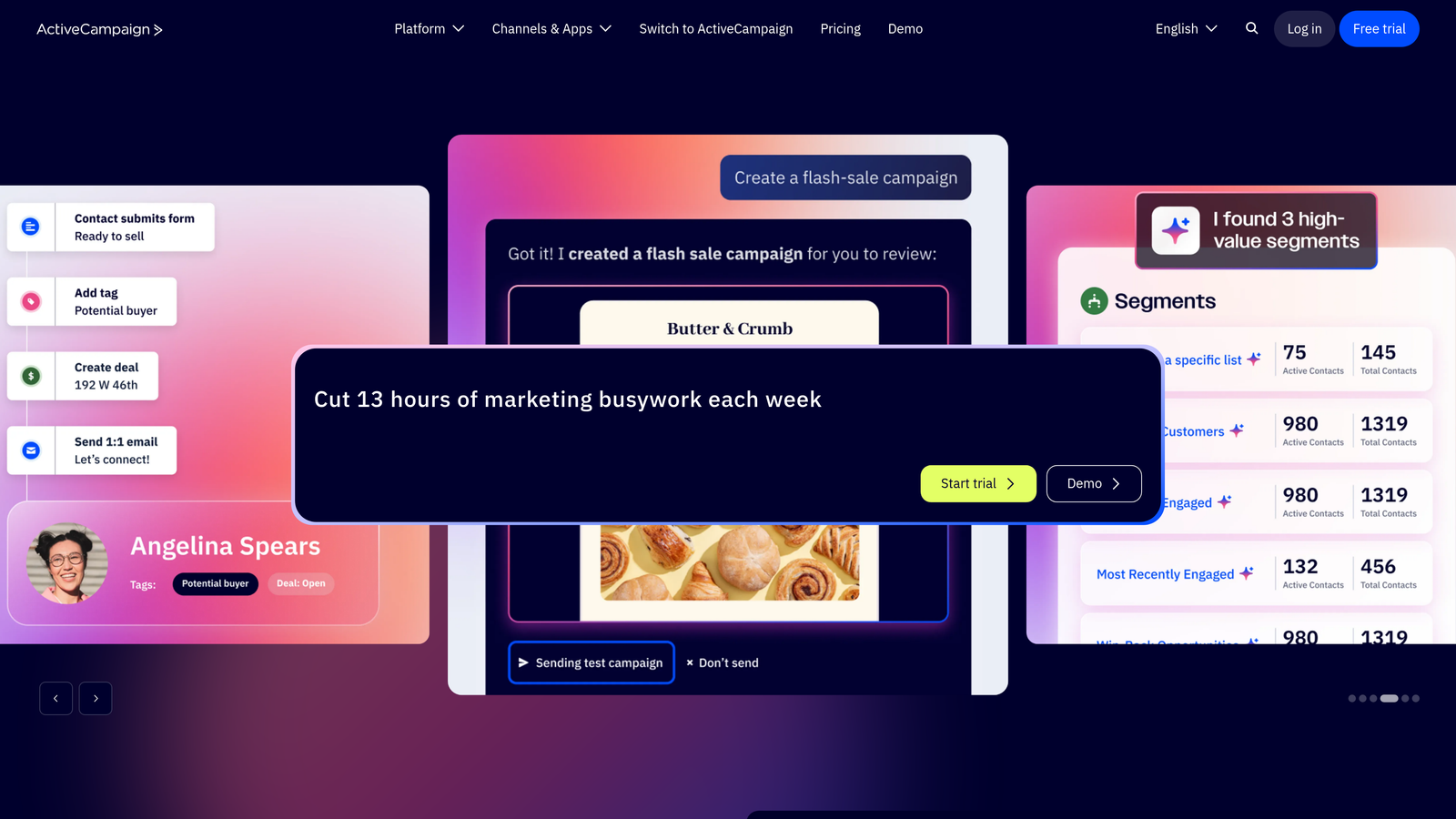
ActiveCampaign is an all-in-one CRM, email marketing, and automation platform that makes behavioral segmentation and lead scoring accessible without enterprise-level complexity or pricing.
Where This Tool Shines
ActiveCampaign hits a sweet spot that many growing SaaS teams need: meaningful segmentation capabilities without the overhead of a Marketo implementation. The tag-based segmentation system is flexible enough to handle nuanced audience logic, while the site tracking script extends behavioral signals beyond email into actual website behavior.
The built-in CRM means you're not managing a separate integration just to connect marketing segments to your sales pipeline. For teams that need a capable, unified platform without a dedicated marketing ops hire, ActiveCampaign is one of the more practical choices at this tier.
Key Features
Lead Scoring: Score contacts based on email engagement, site visits, and custom events, with scores that update dynamically.
Tag-Based Segmentation: Flexible tagging system that updates automatically as contact behavior changes.
Site Tracking: Behavioral segmentation based on pages visited and actions taken across your website.
Automation Recipes: Pre-built automation templates for segment-triggered nurture sequences.
Built-In CRM: Deal pipeline and contact scoring in one platform, reducing integration complexity.
Best For
SMB and growing SaaS businesses that need solid behavioral segmentation and lead scoring without the cost or complexity of enterprise platforms. Strong fit for teams managing both email marketing and basic CRM in one place.
Pricing
Multiple tiers available at accessible price points relative to enterprise alternatives. Check activecampaign.com for current plan details.
6. Segment (Twilio)
Best for: Product-led growth teams segmenting trial users by actual product behavior
Segment is a Customer Data Platform that collects and unifies event-level data across your entire stack, enabling precise audience segmentation based on what users actually do inside your product.
Where This Tool Shines
If you're running a product-led growth motion, Segment is in a different category from the other tools on this list. Rather than segmenting by form responses or email engagement, Segment segments by product behavior: who activated, who hit a key feature milestone, who's approaching a usage limit. That's a fundamentally more accurate signal of intent and fit.
The tradeoff is implementation complexity. Segment requires technical resources to instrument properly, and building meaningful computed traits or audiences requires thoughtful event naming and data governance upfront. For teams with engineering support and a PLG motion, the payoff is substantial. For teams without that infrastructure, it's likely overkill.
Key Features
Unified Event Collection: Collects behavioral data from web, mobile, server, and third-party sources into a single customer profile.
Computed Traits and Audiences: Build segments from product usage milestones, feature adoption, and custom event combinations.
400+ Downstream Integrations: Syncs segments to CRMs, ad platforms, email tools, and more for activation across your full stack.
Trial User Segmentation: Ideal for segmenting free or trial users by activation events to trigger timely sales or nurture outreach.
Protocols: Data governance feature that enforces consistent event naming and quality across your tracking implementation.
Best For
Product-led SaaS companies with engineering resources who need segmentation based on in-product behavior. Particularly valuable for teams running trial-to-paid conversion programs or usage-based expansion motions.
Pricing
Free tier available for low volumes. Paid plans scale with Monthly Tracked Users. See segment.com for current plan details.
7. Salesforce Marketing Cloud Account Engagement
Best for: Salesforce-native B2B teams needing dual scoring and tight pipeline alignment
Salesforce Marketing Cloud Account Engagement (formerly Pardot) is Salesforce's B2B marketing automation platform, built around a dual scoring and grading model designed for tight alignment with the Salesforce CRM pipeline.
Where This Tool Shines
The scoring-plus-grading model is what distinguishes this platform from most alternatives. Scoring measures engagement level, how active a lead has been with your content and emails. Grading measures firmographic fit, how closely the lead matches your ideal customer profile. Together, they give sales a much clearer picture than a single composite score typically provides.
Because it's built for Salesforce-native organizations, the bidirectional sync is genuinely seamless. Marketing segments stay aligned with sales pipeline stages without manual reconciliation, which is a common pain point when marketing automation and CRM live in separate platforms.
Key Features
Dual Scoring and Grading: Separate scores for engagement level and firmographic fit, giving sales richer context on each lead.
Bidirectional Salesforce Sync: Marketing segments stay aligned with Salesforce CRM pipeline stages in real time.
Dynamic Lists: Segment based on Salesforce field values and marketing activity simultaneously.
Engagement Studio: Visual builder for multi-step, segment-based nurture programs.
ABM Features: Account-based marketing capabilities for enterprise teams running named account programs.
Best For
Mid-market to enterprise B2B organizations already running Salesforce CRM who need marketing automation that integrates deeply with their existing pipeline and reporting infrastructure.
Pricing
Growth tier starts at $1,250/month. Verify current pricing and tier structure at salesforce.com.
8. Dealfront (formerly Leadfeeder)
Best for: SDR teams prioritizing outreach based on anonymous website visitor behavior
Dealfront is a B2B intent and visitor identification platform that segments anonymous website visitors by company, giving sales teams a way to prioritize outreach based on who is actually showing up on your site.
Where This Tool Shines
Most segmentation tools only work with leads who have already identified themselves. Dealfront addresses the gap before that conversion happens. By resolving anonymous traffic to company-level identities using IP data and other signals, it surfaces buying intent from accounts that haven't raised their hand yet.
The segmentation layer on top of visitor identification is what makes it actionable. You can filter visiting companies by industry, company size, location, and specific pages viewed, then push the most relevant accounts directly into your CRM or sales engagement tool for SDR follow-up. It's a practical fit for outbound-oriented teams who want to prioritize their prospecting based on real signals rather than cold lists.
Key Features
Company-Level Visitor Identification: Identifies the companies visiting your site using IP resolution and additional data signals.
Behavioral Segmentation: Filters visiting companies by industry, size, location, and specific pages or content viewed.
Intent Scoring: Scores accounts based on visit frequency, depth, and the specific pages they engage with.
CRM and Sales Tool Push: Sends identified and segmented accounts directly into your CRM or outreach tools for SDR action.
Traffic Quality Filtering: Removes bots, ISPs, and irrelevant traffic to improve the signal-to-noise ratio of your visitor data.
Best For
B2B sales and SDR teams that want to prioritize outbound outreach based on inbound intent signals. Particularly useful for teams with a named account or ABM strategy who want to know when target accounts are actively researching.
Pricing
Free plan available with limited data. Paid plans vary based on features and volume. See dealfront.com for current options.
9. Intercom
Best for: SaaS teams qualifying and segmenting leads through conversational chat and product interactions
Intercom is a conversational customer platform that qualifies and segments leads through chat, bots, and product interactions, making it a strong fit for SaaS teams with active trial or freemium funnels.
Where This Tool Shines
Intercom's segmentation happens in context, inside the product, on your pricing page, during a trial. Custom bots can ask qualification questions, route high-value leads to sales, and trigger different experiences based on who the visitor is and what they've done. That real-time, in-context segmentation is difficult to replicate with form-based tools alone.
The platform also pulls segmentation signals from multiple sources simultaneously: CRM attributes, product usage events, and conversation history. That combination gives you a rich, multi-dimensional view of each lead without requiring them to fill out a separate form or complete a standalone qualification flow.
Key Features
Custom Qualification Bots: Bots that ask qualifying questions and route conversations to the right team or sequence based on responses.
Multi-Source Segments: Build segments from CRM attributes, product events, and conversation history in combination.
Behavioral Chat Triggers: Trigger chat proactively based on page, user properties, or specific actions taken.
Series Automation: Segment-based onboarding and nurture automation for trial and freemium users.
Product Tours and Checklists: Activation-based experiences tied to segment membership, useful for driving trial-to-paid conversion.
Best For
SaaS companies with freemium or trial funnels where in-product conversations are a natural part of the user journey. Strong fit for teams that want to qualify and segment leads through conversational experiences rather than static forms.
Pricing
Multiple tiers available. Pricing has evolved significantly in recent years, so check intercom.com for current plans before budgeting.
Which Tool Is Right for Your Team
The right lead segmentation tool depends heavily on where your biggest qualification gap actually lives. Before investing in mid-funnel or downstream tools, it's worth asking whether you're capturing enough signal at the point of capture in the first place.
Here's a quick breakdown by team type to help you orient:
Early-stage or lean growth teams: Start with Orbit AI to qualify leads at the form level, then pair with ActiveCampaign for lightweight CRM and nurture. You'll get meaningful segmentation without enterprise overhead.
HubSpot-native teams: HubSpot Marketing Hub combined with Breeze Intelligence gives you CRM-native segmentation plus real-time enrichment, a strong combination for teams already in that ecosystem.
Product-led growth companies: Segment is the natural choice for segmenting trial users by in-product behavior. Pair it with Intercom for in-context qualification and onboarding.
Enterprise or Salesforce-native organizations: Marketo Engage or Salesforce Marketing Cloud Account Engagement, depending on your CRM. Both require investment in marketing ops but deliver sophisticated scoring at scale.
Outbound-heavy SDR teams: Dealfront surfaces intent from anonymous visitors, giving your reps a prioritized list of accounts to work rather than starting from cold.
One consistent pattern across high-performing growth teams: fixing segmentation at the point of capture tends to deliver the highest return before layering in more complex downstream tools. If your CRM is full of unqualified noise, the problem often starts at the form, not inside the CRM itself.
Transform your lead generation with AI-powered forms that qualify prospects automatically while delivering the modern, conversion-optimized experience your high-growth team needs. Start building free forms today and see how intelligent form design can elevate your conversion strategy.


