

Typeform built its reputation on beautiful, conversational forms, and for good reason. But for SaaS teams focused on lead qualification and conversion optimization, it increasingly falls short. Pricing scales steeply with response volume, native AI-powered lead scoring is absent, and CRM integrations often require middleware rather than direct connections.
The good news: the form builder market has matured significantly. In 2026, there are genuinely excellent alternatives designed with SaaS growth teams in mind, whether you're capturing inbound leads, qualifying prospects in real time, running structured NPS programs, or building onboarding flows.
Each tool in this list was evaluated on conversion-focused features, SaaS-relevant integrations, pricing transparency, and how well it supports teams moving fast. For deeper context on getting more from your forms, our guides on how to improve lead quality and how to qualify leads with forms are worth reading alongside this comparison.
1. Orbit AI
Best for: B2B SaaS teams that need AI-powered lead qualification built directly into their forms.
Orbit AI is an AI-native form builder designed specifically for high-growth SaaS teams who need more than a pretty form.
Where This Tool Shines
Most form builders collect data and hand it off. Orbit AI qualifies that data in real time, scoring leads and routing them based on quality signals without requiring manual rules setup or a separate scoring layer in your CRM. That's a meaningful difference when your sales team is triaging dozens of inbound submissions daily.
The platform is also built with brand-forward SaaS products in mind. The templates are conversion-optimized out of the box, the UI is genuinely modern, and conditional logic adapts the form experience based on how a prospect responds, keeping high-intent leads engaged and filtering out poor fits early.
Key Features
AI-Powered Lead Qualification and Scoring: Automatically scores incoming leads in real time based on their responses, reducing manual triage for sales teams.
Conversion-Optimized Templates: Multi-step form templates designed specifically for lead capture, demo requests, and SaaS onboarding flows.
Conditional Logic and Smart Routing: Routes leads to different follow-up paths based on their qualification score, ensuring high-value prospects get immediate attention.
CRM and Sales Tool Integrations: Direct integrations with popular CRM and sales tools for clean, friction-free lead handoff without middleware dependency.
Modern Form Design: Beautiful, brand-consistent form experiences built to match the quality expectations of modern SaaS products.
Best For
B2B SaaS companies running high-volume inbound lead generation who want qualification logic built into the form layer itself. Particularly valuable for growth teams that want to reduce the gap between form submission and sales follow-up without adding manual scoring steps.
Pricing
Visit orbitforms.ai for current pricing plans. A free tier is available to get started.
2. Tally
Best for: Lean SaaS teams that need fast, clean form deployment with a generous free tier.
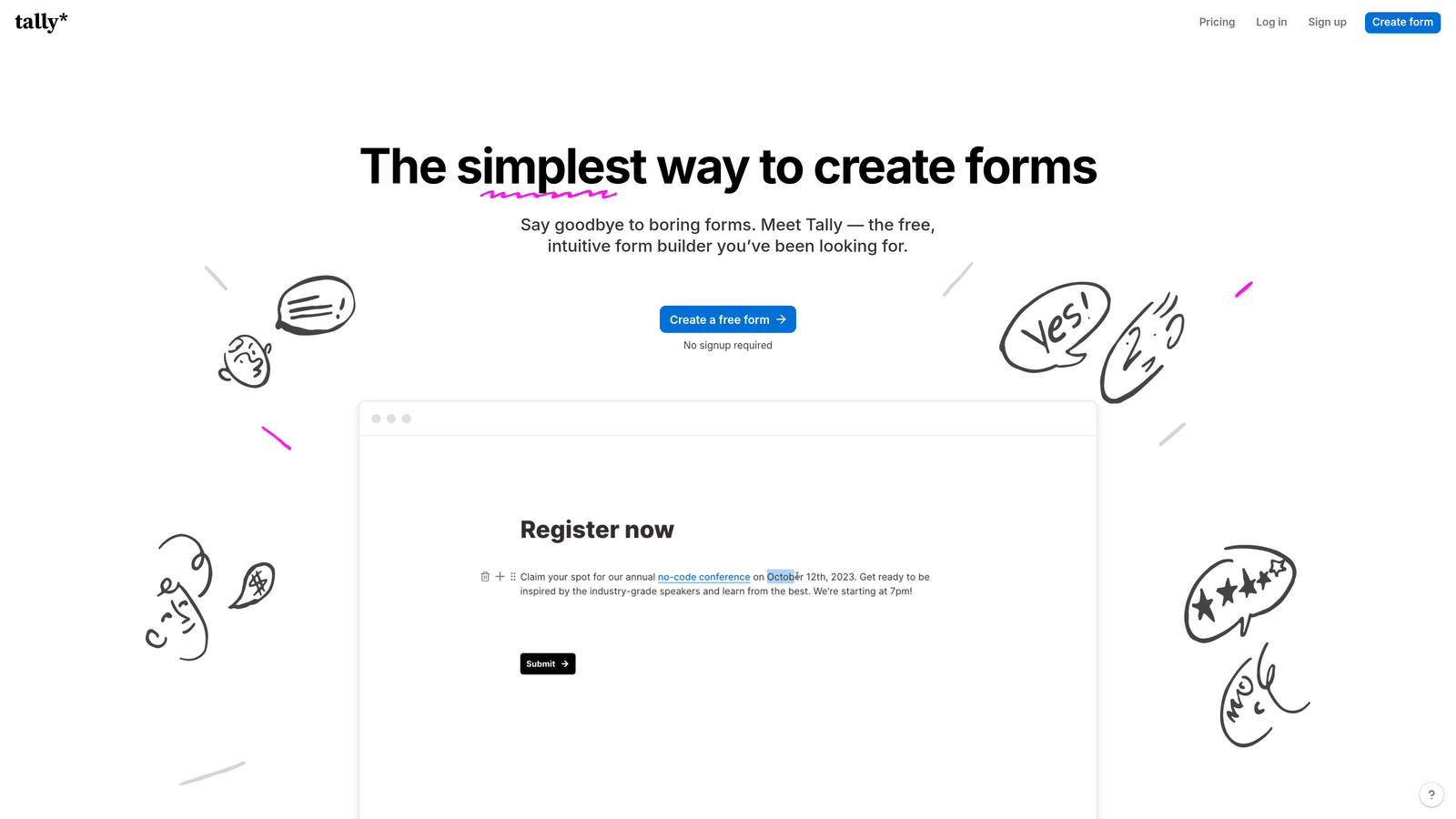
Tally is a Notion-inspired form builder with unlimited forms and responses on its free plan, making it a favorite in the startup community.
Where This Tool Shines
Tally's block-based editor feels immediately familiar to anyone who uses Notion, which dramatically reduces the learning curve. You can build a multi-step form with conditional logic in minutes, not hours. For lean teams without dedicated ops resources, that speed matters.
The free tier is genuinely generous, not a stripped-down teaser. Unlimited forms, unlimited responses, and core conditional logic are all available without paying a dollar. For early-stage SaaS products or internal tooling, it's hard to beat.
Key Features
Unlimited Free Forms and Responses: No submission caps on the free plan, which is rare in this category and genuinely useful for growing teams.
Notion-Like Block Editor: Drag-and-drop block interface that makes form building feel intuitive for teams already in the Notion ecosystem.
Conditional Logic and Multi-Page Forms: Show or hide fields based on previous answers, and break longer forms into multi-step flows to reduce abandonment.
Zapier and Native Integrations: Connect to popular SaaS tools via Zapier or Tally's growing library of native integrations.
Custom Domain Support: Available on paid plans for teams that want branded form URLs.
Best For
Early-stage SaaS teams, bootstrapped products, and lean growth teams that need reliable forms quickly without budget pressure. Less suited for teams that need advanced lead qualification or deep CRM logic baked in.
Pricing
Free tier available with no submission limits. Pro plan starts at $29/month for advanced features including custom domains and priority support.
3. HubSpot Forms
Best for: SaaS teams already running HubSpot as their CRM and marketing platform.
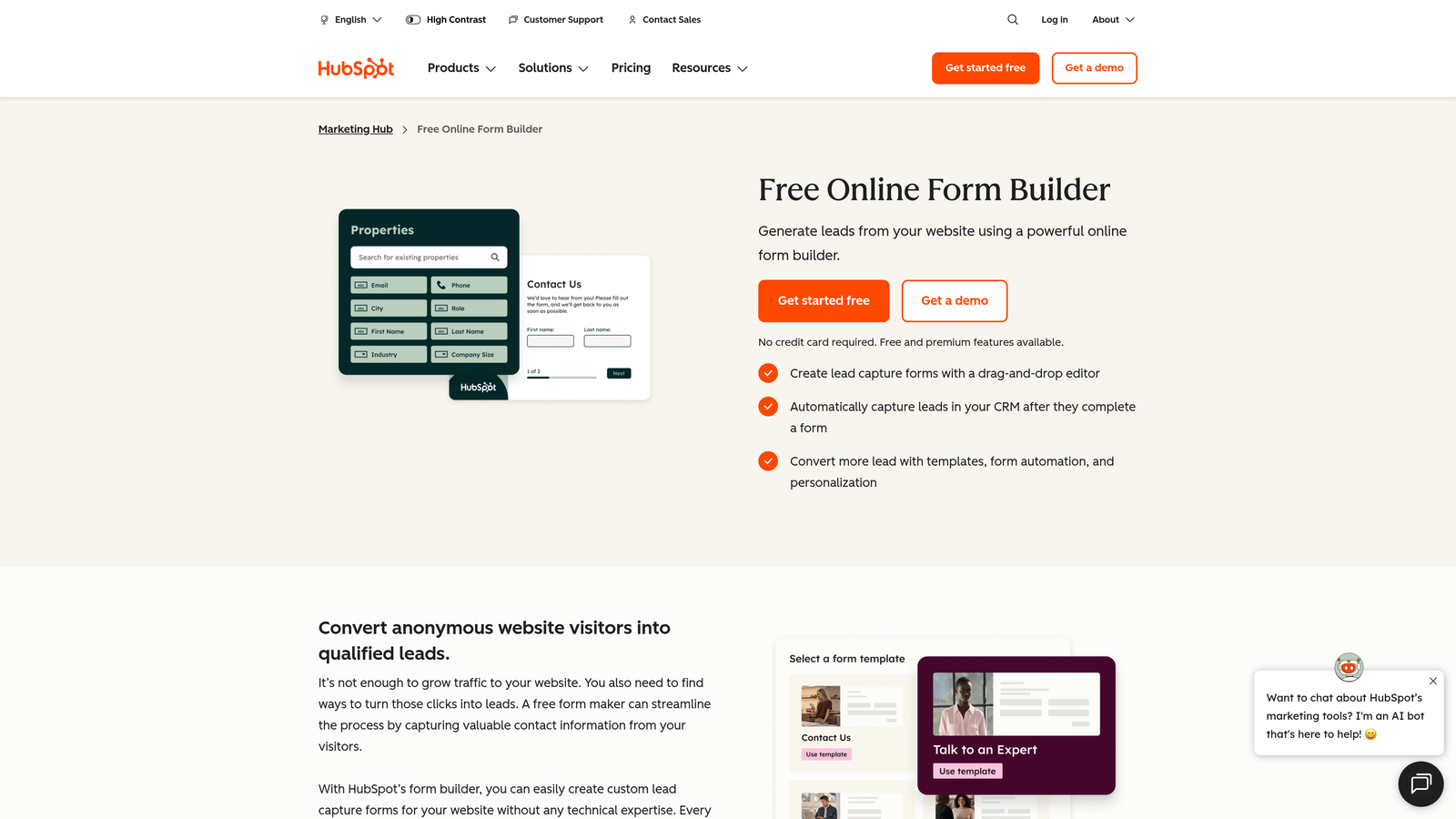
HubSpot Forms is a native form builder embedded directly in the HubSpot platform, offering seamless CRM sync with zero configuration.
Where This Tool Shines
If your team lives in HubSpot, this is the path of least resistance. Form submissions automatically populate contact records, trigger workflows, and feed lead nurturing sequences without any middleware. The integration isn't bolted on because it's the same system.
Progressive profiling is a standout feature for SaaS teams running multiple touchpoints. Rather than asking the same questions repeatedly, HubSpot Forms recognizes returning contacts and surfaces only fields where data is missing, keeping forms short while building a richer contact profile over time.
Key Features
Zero-Friction CRM Sync: Every submission instantly updates HubSpot contact records, no Zapier required and no data mapping to configure.
Progressive Profiling: Automatically replaces already-known fields with new questions for returning contacts, reducing form friction across the funnel.
Smart Form Fields: Pre-fills known contact data to shorten forms for prospects already in your database.
Embedded and Standalone Options: Deploy forms inline on your site, as pop-ups, or as standalone pages.
Built-In Workflow Triggers: Submissions automatically fire lead nurturing sequences, task assignments, and internal notifications.
Best For
SaaS companies already invested in the HubSpot ecosystem. If you're not a HubSpot customer, the standalone value of HubSpot Forms is limited and the pricing jumps significantly once you need advanced features.
Pricing
Free with HubSpot's free CRM tier. Advanced features require Marketing Hub, which starts at $800/month, making it a meaningful commitment for smaller teams.
4. Jotform
Best for: Teams that need a versatile, template-rich form builder covering lead gen, payments, and approvals in one platform.
Jotform is one of the most established form builders available, with over 10,000 templates and a broad ecosystem of widgets and integrations.
Where This Tool Shines
Jotform's depth is its defining characteristic. Whatever use case you're building for, there's almost certainly a template that covers it. Payment processing, approval workflows, HIPAA-compliant data collection, and standard lead gen are all handled within the same platform, which reduces tool sprawl for teams managing multiple form types.
The trade-off is that Jotform can feel overwhelming. The interface carries years of feature additions, and finding the right configuration for a specific use case sometimes requires more exploration than leaner tools. For teams that need breadth, though, that depth is a genuine asset.
Key Features
10,000+ Form Templates: One of the largest template libraries available, spanning lead gen, payments, HR, healthcare, and more.
Native Payment Processing: Accept payments directly through forms via Stripe, PayPal, and Square without third-party workarounds.
Approval Workflow Builder: Route form submissions through multi-step approval chains, useful for internal ops and procurement workflows.
HIPAA-Compliant Plans: Available for regulated industries that need compliant data handling, a differentiator few competitors offer at this price point.
Extensive Integration Ecosystem: Hundreds of native integrations plus Zapier support for connecting to virtually any SaaS stack.
Best For
Mid-market SaaS companies and operations teams that need a single form platform covering multiple use cases. Also well-suited for teams in regulated industries that need compliance features without enterprise pricing.
Pricing
Free tier available. Paid plans start at $34/month, with higher tiers unlocking more submissions, storage, and team features.
5. Paperform
Best for: SaaS teams building rich, media-embedded conversion experiences that function as standalone landing pages.
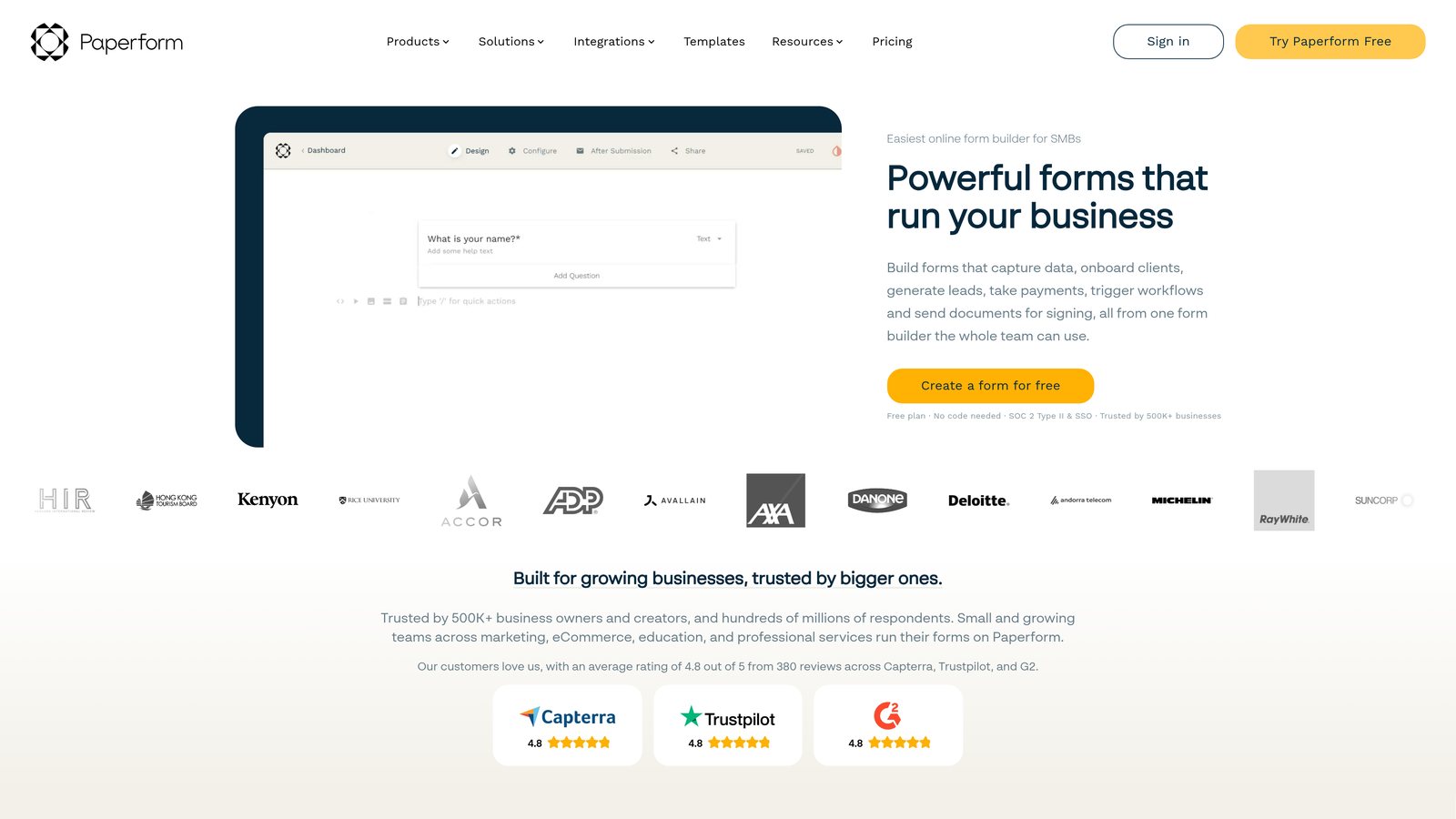
Paperform is a hybrid form and landing page builder that treats every form as a full content experience, not just a data collection interface.
Where This Tool Shines
Paperform sits in an interesting position: it's more than a form builder but less opinionated than a full landing page tool. You can embed images, video, and rich text directly alongside form fields, which makes it particularly effective for product-led growth sign-up flows where context and persuasion matter as much as the form itself.
The built-in payment and scheduling capabilities are also worth noting. For SaaS teams running demos, trials, or product sales directly through their forms, having those flows handled natively removes friction that typically requires stitching together multiple tools.
Key Features
Rich Media Embedding: Add images, video, and formatted text directly within forms to create persuasive, context-rich conversion experiences.
Built-In Payment Flows: Accept payments and sell products directly through form submissions without a separate checkout tool.
Scheduling and Booking Integrations: Connect calendar tools to let prospects book demos or calls directly from within the form.
Conditional Logic and Calculation Fields: Show or hide fields dynamically, and use calculation logic for pricing estimators or qualification scoring.
Custom Domain and Branding: Full white-label control over form URLs and visual design.
Best For
SaaS teams running product-led growth flows, demo request pages, or trial sign-up experiences where the form needs to do persuasive work alongside data collection. Less suited for high-volume, lightweight lead capture where speed of deployment matters most.
Pricing
Essentials plan starts at $29/month. Grow plan at $59/month unlocks additional submissions, team seats, and advanced features.
6. SurveyMonkey
Best for: Enterprise SaaS teams running structured NPS programs, customer research, and compliance-sensitive data collection.
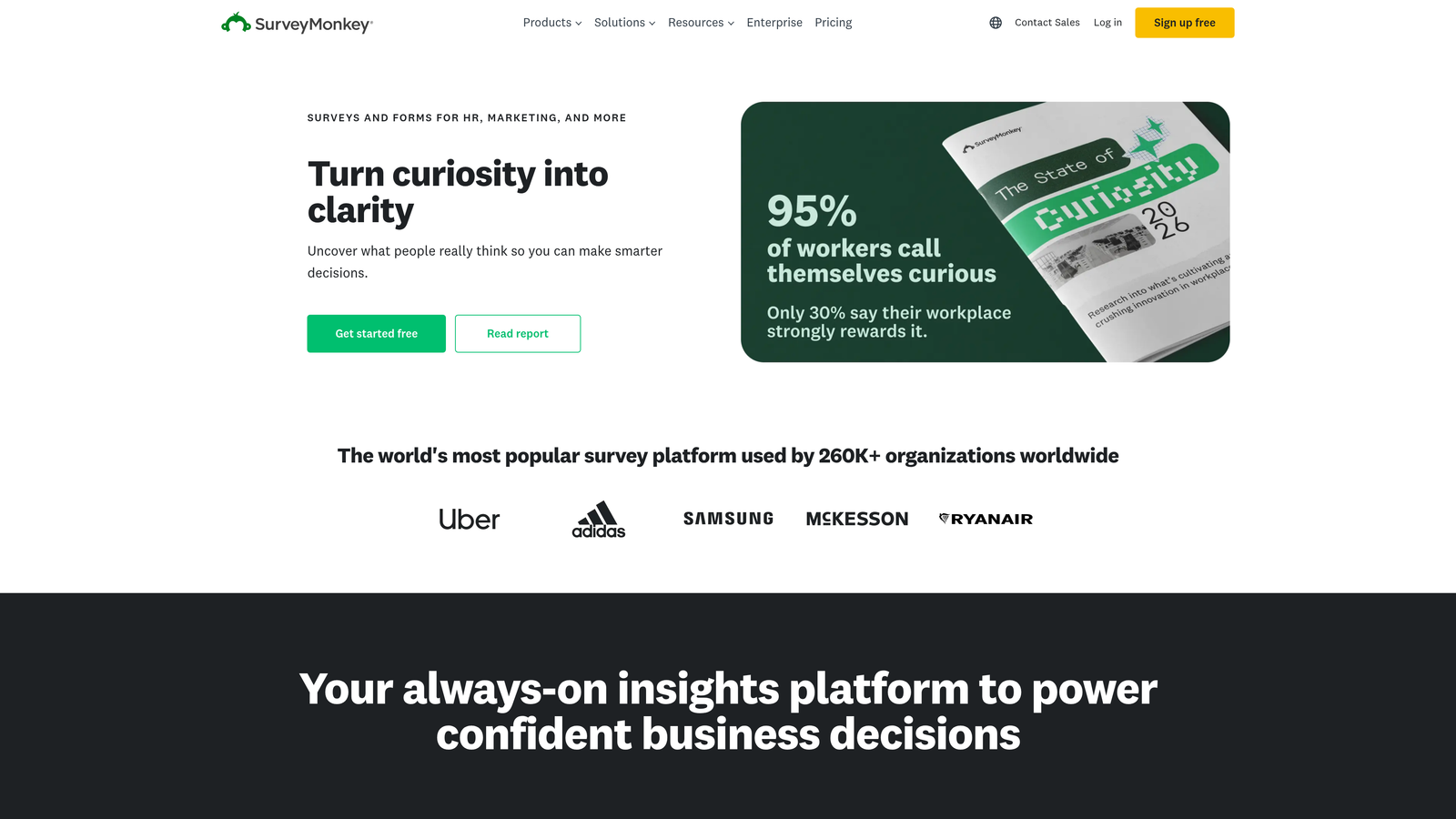
SurveyMonkey is a mature enterprise survey platform with deep analytics, benchmarking data, and compliance infrastructure that goes well beyond typical form builders.
Where This Tool Shines
SurveyMonkey's strength is structured research at scale. The platform includes industry benchmarking data for NPS, CSAT, and CES scores, which means you're not just collecting numbers but contextualizing them against your industry. For SaaS companies running formal voice-of-customer programs, that context is genuinely valuable.
The enterprise security and compliance features, including GDPR and HIPAA support, make it one of the few options suitable for regulated industries or companies with strict data governance requirements. It's overkill for simple lead capture, but that's not what it's designed for.
Key Features
Industry Benchmarking Data: Compare your NPS, CSAT, and CES scores against industry averages to contextualize performance.
NPS, CSAT, and CES Templates: Pre-built survey templates for the most common customer success metrics in SaaS.
Enterprise Security and Compliance: GDPR and HIPAA-compliant data handling for regulated industries and enterprise procurement requirements.
Panel Access for Market Research: Access to survey panels for primary market research without recruiting your own respondents.
Team Collaboration and Permissions: Role-based access control and team collaboration features for larger organizations.
Best For
Enterprise SaaS companies with formal customer research programs, compliance requirements, or dedicated customer success teams running structured feedback loops. Not the right fit for teams primarily focused on lead generation or conversion optimization.
Pricing
Individual plans start at $25/month. Team plans vary by seat count and feature tier, with enterprise pricing available on request.
7. Fillout
Best for: Data-driven SaaS teams that use Airtable, Notion, or Supabase as their operational backbone.
Fillout is a modern form builder with native database integrations that reduce middleware dependency for teams with data-heavy workflows.

Where This Tool Shines
What sets Fillout apart is its native connection to databases that SaaS teams increasingly use as lightweight operational systems. Connecting a form directly to Airtable, Notion, or Supabase without routing through Zapier means fewer failure points, faster sync, and less maintenance overhead. For ops-heavy teams, that's a meaningful quality-of-life improvement.
The pricing is also notably competitive. A generous free tier and paid plans starting at $19/month make Fillout accessible for teams that don't want to pay Typeform prices for database-connected forms.
Key Features
Native Database Connections: Direct integrations with Airtable, Notion, and Supabase for clean data flow without middleware.
Multi-Step Forms with Conditional Logic: Build branching, multi-step form experiences that adapt based on respondent answers.
Scheduling and Calendar Integrations: Built-in scheduling capabilities for booking flows directly within forms.
Custom Branding and White-Label Options: Full control over form appearance and custom domain support.
Competitive Free Tier: Generous response limits on the free plan, making it practical for early-stage teams.
Best For
SaaS teams using Airtable, Notion, or Supabase as their primary data layer, and anyone looking to reduce Zapier dependency in their form-to-database workflows. Also a strong value option for teams on a tight budget.
Pricing
Free tier available with generous response limits. Paid plans start at $19/month, making it one of the more affordable options in this category.
8. Feathery
Best for: Product and engineering-led SaaS teams that need pixel-perfect custom form experiences with developer-level control.
Feathery is a developer-first form platform with a React SDK for full customization alongside a visual builder for non-technical teammates.
Where This Tool Shines
Feathery solves a specific problem that engineering-led SaaS teams know well: off-the-shelf form tools never quite match your product's design system, and building forms from scratch in React is tedious. Feathery's SDK gives developers the control they need while the visual builder lets product managers and marketers make changes without engineering tickets.
The platform is particularly strong for complex onboarding flows where the form experience needs to feel like part of the product itself, not a third-party widget dropped in. A/B testing and form analytics add another layer of optimization capability that most developer-first tools skip.
Key Features
React SDK: Full programmatic control over form rendering, styling, and behavior for engineering teams that need pixel-perfect implementation.
No-Code Visual Builder: Non-developer teammates can build and edit forms without touching code, reducing engineering bottlenecks.
Advanced Onboarding Flow Logic: Multi-step, branching form logic designed for complex product onboarding and user activation flows.
A/B Testing and Form Analytics: Built-in experimentation and performance tracking to optimize form conversion over time.
CRM and Data Warehouse Integrations: Connects to major CRMs and data warehouses for enterprise-grade data routing.
Best For
Product-led SaaS companies with engineering resources who want forms that feel native to their product experience. Also strong for teams running complex onboarding flows where the form is a core part of user activation, not just a lead capture mechanism.
Pricing
Free tier available. Growth plan starts at $49/month, with enterprise pricing for larger teams and higher volume requirements.
9. Google Forms
Best for: Internal surveys and low-stakes data collection where design and conversion optimization are not priorities.
Google Forms is Google's free, no-frills form tool, reliable and familiar but limited in almost every way that matters for SaaS growth teams.
Where This Tool Shines
Google Forms earns its place on this list for one reason: it's completely free, requires no setup, and works instantly for anyone with a Google account. For internal team surveys, quick employee feedback, or low-stakes data collection, that zero-friction access is genuinely useful.
The native Google Sheets integration means responses flow directly into a spreadsheet without any configuration, which is convenient for teams that already live in Google Workspace. That's about where the SaaS-relevant strengths end.
Key Features
Completely Free: No submission limits, no paid tiers, and no credit card required for any feature.
Native Google Sheets Integration: Responses automatically populate a connected spreadsheet in real time.
Basic Conditional Logic: Show or hide sections based on previous answers, though logic is limited compared to dedicated form tools.
Google Workspace Integration: Works seamlessly with Gmail, Drive, and other Workspace tools your team already uses.
Quiz and Grading Functionality: Built-in quiz mode with automatic grading, useful for internal training or assessments.
Best For
Internal surveys, team polls, event RSVPs, and any situation where speed and zero cost matter more than design, branding, or conversion performance. Not suitable for customer-facing lead generation or any context where form quality reflects on your product.
Pricing
Completely free with any Google account. No paid tiers exist.
Which Tool Is Right for Your SaaS Team?
The right choice depends on what you're actually trying to accomplish. Here's a quick breakdown by use case to help you decide.
If lead generation and qualification are your primary goal, Orbit AI is built for exactly that. The combination of AI-powered lead scoring, conversion-optimized templates, and smart routing makes it the most purpose-built option for B2B SaaS teams focused on turning form submissions into qualified pipeline.
If you're a lean or early-stage team with budget constraints, Tally delivers impressive capability on its free tier and deploys quickly without a learning curve.
If your team is already running HubSpot, HubSpot Forms is the obvious choice. The native CRM sync and progressive profiling features are genuinely valuable, and you're already paying for the platform.
For structured NPS programs and enterprise-grade customer research, SurveyMonkey offers depth that no other tool on this list can match, including benchmarking data and compliance infrastructure.
If your team is engineering-led and needs forms that feel native to your product, Feathery's React SDK gives you control that no visual builder can replicate.
And if your operational data lives in Airtable, Notion, or Supabase, Fillout removes the middleware friction that makes most other form tools feel clunky in database-driven workflows.
The broader trend worth noting: AI-native form tools are becoming the default for high-growth SaaS teams, not a premium add-on. As lead qualification moves earlier in the funnel, the form layer is where that intelligence increasingly needs to live.
If you're ready to see what that looks like in practice, Start building free forms today with Orbit AI and experience how intelligent form design can transform your conversion strategy.


