
The popular advice is simple: get more email signups. That advice is incomplete in 2026. A larger list can still produce weaker results if subscribers never reach the inbox, don't match your offer, or disengage immediately after opting in.
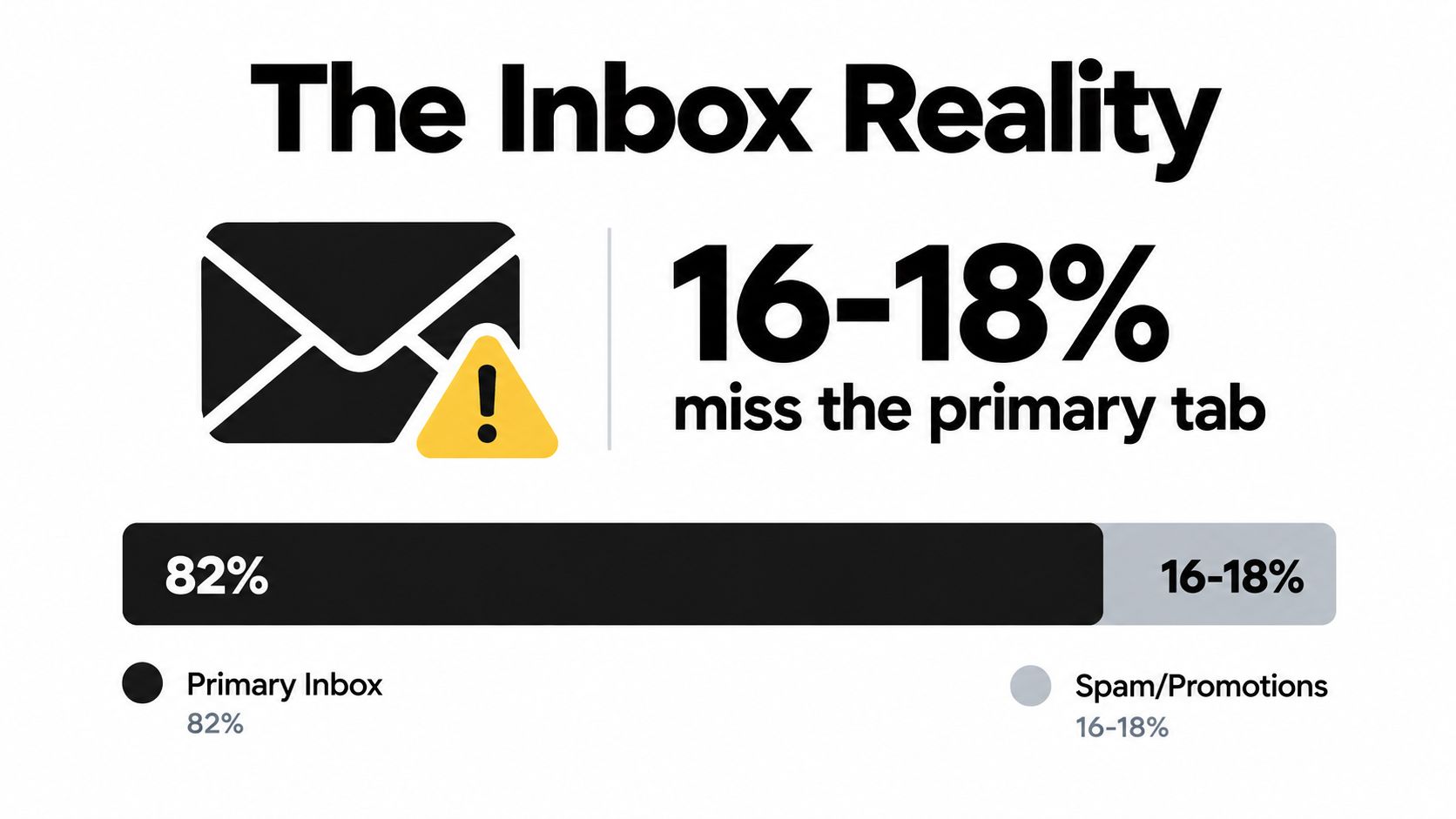
One 2025 benchmark found that one in six legitimate marketing emails fails to reach the inbox globally. The same research reports that 64.6% of businesses have seen deliverability problems affect revenue or retention. Validity's 2025 Email Benchmark Report makes the operational lesson clear: list growth without qualification and inbox monitoring can create an expensive database of unreachable contacts.
A good list isn't a pile of addresses. It's a permissioned audience of qualified, reachable, and engaged subscribers. This guide shows how to build email list infrastructure around that standard, from ICP definition and lead magnets to forms, acquisition channels, hygiene, segmentation, and automation.
Why Most Email Lists Underperform Before They Start
More signups can reduce revenue when they attract people who want a freebie but have no interest in your product. Low-fit contacts weaken engagement, increase bounces and complaints, and can damage sender reputation. The list-building problem in 2026 is therefore quality and inbox placement, not volume.
Inbox access deserves attention before traffic spend. As noted in the Validity benchmark cited earlier, one in six legitimate marketing emails fails to reach the inbox globally. Permission does not guarantee visibility. A missed message cannot produce an open, click, reply, or pipeline opportunity, so every new contact needs a path to engagement, not just a place in the database.
The three failures that start early
Unclear targeting pulls the wrong people into the database. A generic “marketing newsletter” invites curiosity. A role-based workflow checklist gives the right prospect a specific reason to subscribe and makes qualification happen before the first email.
Weak capture mechanics turn qualified interest into abandonment. Slow forms, vague button copy, thumb-hostile mobile layouts, and fields unrelated to the offer all reduce completion. Use the fewest fields that support the promise, then test the form on a phone before sending paid traffic.
Ignored deliverability signals conceal acquisition costs. B2B marketing teams often celebrate gross subscriber growth while overlooking unsubscribes, bounces, spam complaints, and inbox placement. A dashboard can show a larger list while actual sends reach fewer engaged people.
Practical rule: Measure the subscriber you can reach and activate, not the contact you managed to collect.
Treat the form as a qualification layer, not a top-of-funnel megaphone. Define the subscriber you want, offer a useful solution to a real problem, and route qualified traffic to a focused form. Validate consent, capture source and behavior, monitor delivery, and remove contacts that stop engaging. The quality-over-quantity approach to lead capture supports this operating model.
A strong build program makes six decisions: who belongs on the list, what value earns the opt-in, how much friction improves qualification, which channels bring suitable traffic, how hygiene protects reach, and which automations turn a new subscriber into a useful marketing or sales signal. Bigger lists are easy to report. Reachable, responsive lists are what create results.
Defining the Subscriber You Actually Want
Start with revenue, not the form builder. Your ideal subscriber should resemble the people who buy, renew, expand, or refer, not merely the people most willing to download a file.
Mine three sources of truth
Review customers who already create durable value. Look for shared roles, company situations, buying triggers, product use cases, and outcomes. Separate a contact who downloaded something from a customer who adopted the product and stayed.
Next, collect the language prospects use. Sales-call notes, support conversations, customer reviews, survey responses, and objections reveal the phrases people use when they describe the problem. Use that language in the lead magnet title and form promise. “Improve demand generation” is abstract. “Find the conversion leaks between MQL and SQL” is concrete.
Finally, document disqualifiers. Some people may never become customers, may submit fake details, or may repeatedly engage only with prize-oriented offers. Excluding poor-fit contacts protects nurture relevance and reduces the chance that acquisition volume damages list quality.
Write the result as one paragraph:
Subscriber definition: “A [role] at a [company profile] who has experienced [trigger event] and wants [specific outcome]. They care about [pain language], while [disqualifier] makes them a poor fit.”
That statement should guide every asset and channel decision. The zero-party data framework from Orbit AI can help you think about information subscribers intentionally provide during the capture experience.
Match the promise to the persona
A SaaS growth lead might want a SQL-to-MQL playbook. An ecommerce founder might want a post-iOS conversion benchmark or a retention checklist. A creator may prefer a preview of a paid tier, a mini-course, or access to a community waitlist.
The form should reflect intent. A high-intent diagnostic or calculator can justify a role, company, and business challenge field. A low-intent educational download should usually ask for an email and one useful qualifier. Don't demand a full sales qualification interview from someone requesting a short guide.

Finish the exercise by documenting four items: the target role, the trigger event, the promised outcome, and the disqualifying signal. If your team can't agree on those items, it's too early to build a magnet or buy traffic.
Lead Magnet Formats That Convert in 2026
The right lead magnet isn't the most elaborate asset. It's the one that helps a qualified prospect take the next decision with minimal delay. A calculator can outperform a polished PDF when the buyer needs a business case. A checklist can beat a webinar when the problem is operational and immediate.
The table below uses qualitative effort and launch estimates. No universal average conversion rate exists across all audiences and offers, so the rate column should be treated as a testing benchmark rather than a guaranteed outcome. A standard newsletter signup form averages 3.67% conversion, according to Claspo's newsletter signup benchmarks, while another benchmark places average email opt-in performance at 2.1%, with under 1.5% below average, 1.5% to 3% average, 3% to 8% well optimized, and 8%+ in top-performer territory, as reported by Stripo's opt-in statistics guide.
Lead Magnet Formats Compared by Effort and Conversion
| Format | Production Effort | Time to Launch | Avg. Conversion Rate | Best Fit |
|---|---|---|---|---|
| Short PDF guide | Low to medium | Fast | Benchmark against page traffic and offer relevance | Early education and search-driven audiences |
| Interactive calculator or quiz | Medium to high | Moderate | Benchmark against static forms and completion quality | Buyers making a financial or product decision |
| Template or swipe file | Low to medium | Fast | Benchmark against practical downloads | Operators who need an immediate starting point |
| Mini-course or video training | Medium | Moderate | Benchmark against completion and qualified replies | Audiences that need explanation and trust |
| Private podcast or community access | Medium | Moderate | Benchmark against participation and retention | Relationship-led brands and creators |
| Gated tool or AI prompt pack | Medium to high | Moderate to long | Benchmark against usage and downstream intent | Technical, growth, and productivity audiences |
For B2B SaaS, start with an ROI calculator or a templated outreach pack. Those formats connect directly to a buyer's next internal conversation. For ecommerce, test a quiz-based product finder or post-purchase checklist before defaulting to a discount capture. Discounts can attract shoppers, but they don't necessarily identify people who care about the broader customer experience.
Creators and educators should consider paid-tier previews, mini-courses, and community waitlists. These offers reveal commitment more effectively than a generic newsletter promise because the subscriber can see the experience they're considering.
Keep production capacity in the decision. An interactive asset that takes months to maintain may be a poor choice if a focused template can launch this week and generate useful learning. Put a lightweight secondary offer on the thank-you page, such as a related checklist or preference question, but don't bury the primary delivery experience beneath another aggressive request. Lead magnet form strategies from Orbit AI offers another perspective on aligning the offer and capture experience.
High-Converting Forms and Landing Pages
Forms turn attention into an address, but they also determine what your team learns about the subscriber. Treat the form as a qualification layer, not a decorative box placed beneath a headline.
Five rules cover most of the mechanical work:
- Use one email field by default. Add fields only when the answer changes routing, personalization, or sales action.
- Match friction to value. A high-intent assessment can support more questions than a short checklist.
- Design mobile first. Large tap targets, readable labels, and short screens matter more than ornamental layouts.
- Validate on the server. Client-side checks improve usability, but server-side validation protects the data flow.
- Use progressive profiling. Ask for a new detail later instead of forcing every question at the first interaction.
Build the page above the fold
The first screen needs four elements: a clear promise, credible proof, one primary CTA, and one disqualifying question when fit matters. The promise should state what the visitor receives and who it's for. Proof can be a relevant result, customer type, expert review, or transparent explanation of what's inside. Don't add multiple competing buttons.
Field labels should describe the answer, not force the visitor to decode your intent. “Company size” is clearer than “Tell us about your business.” Button copy should complete the action, such as “Send the calculator” or “Get the playbook,” rather than relying on an empty “Submit.”
Exit-intent prompts can work when they offer a relevant alternative, such as saving a guide or subscribing to a focused update. They shouldn't block navigation, hide the close control, or imply a false deadline. Consent must remain explicit. Under GDPR, valid marketing consent must be freely given, specific, informed, and unambiguous, with a clear affirmative action such as an unticked checkbox. Warmy's GDPR consent guide explains why pre-ticked boxes, bundled consent, and opt-out mechanisms don't meet that standard.
Choose the tool for the learning loop
Orbit AI is one practical option for SMB teams that want Smart Fields, conditional logic, and built-in A/B testing in the same capture workflow. OptinMonster suits teams focused on onsite campaigns and exit-intent experiences. ConvertFlow fits marketers building targeted conversion paths, while Klaviyo forms work naturally for ecommerce lifecycle programs. HubSpot makes sense when CRM ownership and broader marketing operations drive the decision.
| Tool | Best For | Forms Builder | A/B Testing | CRM Sync | Starting Price |
|---|---|---|---|---|---|
| Orbit AI | SMB lead capture and qualification | Smart Fields and conditional logic | Built in | Connects with CRM and automation tools | Check current pricing |
| OptinMonster | Onsite campaigns | Popup and campaign builder | Available by plan | Integrations available | Check current pricing |
| ConvertFlow | Conversion paths | Form and funnel builder | Available by plan | Integrations available | Check current pricing |
| Klaviyo forms | Ecommerce lifecycle | Signup and popup forms | Available by plan | Native ecommerce and marketing sync | Check current pricing |
| HubSpot | CRM-heavy teams | Forms tied to CRM records | Available by plan | Native HubSpot CRM | Check current pricing |
Optimize in the right order. First fix offer-market fit. Then fix page speed and mobile usability. Next improve the conversion rate with copy, proof, and placement. Only after that should you debate field count or button color. Landing page form design guidance from Orbit AI supports the same principle: remove friction where it blocks intent, not where it merely makes the form look less busy.
Multi-Channel Acquisition Beyond Your Website
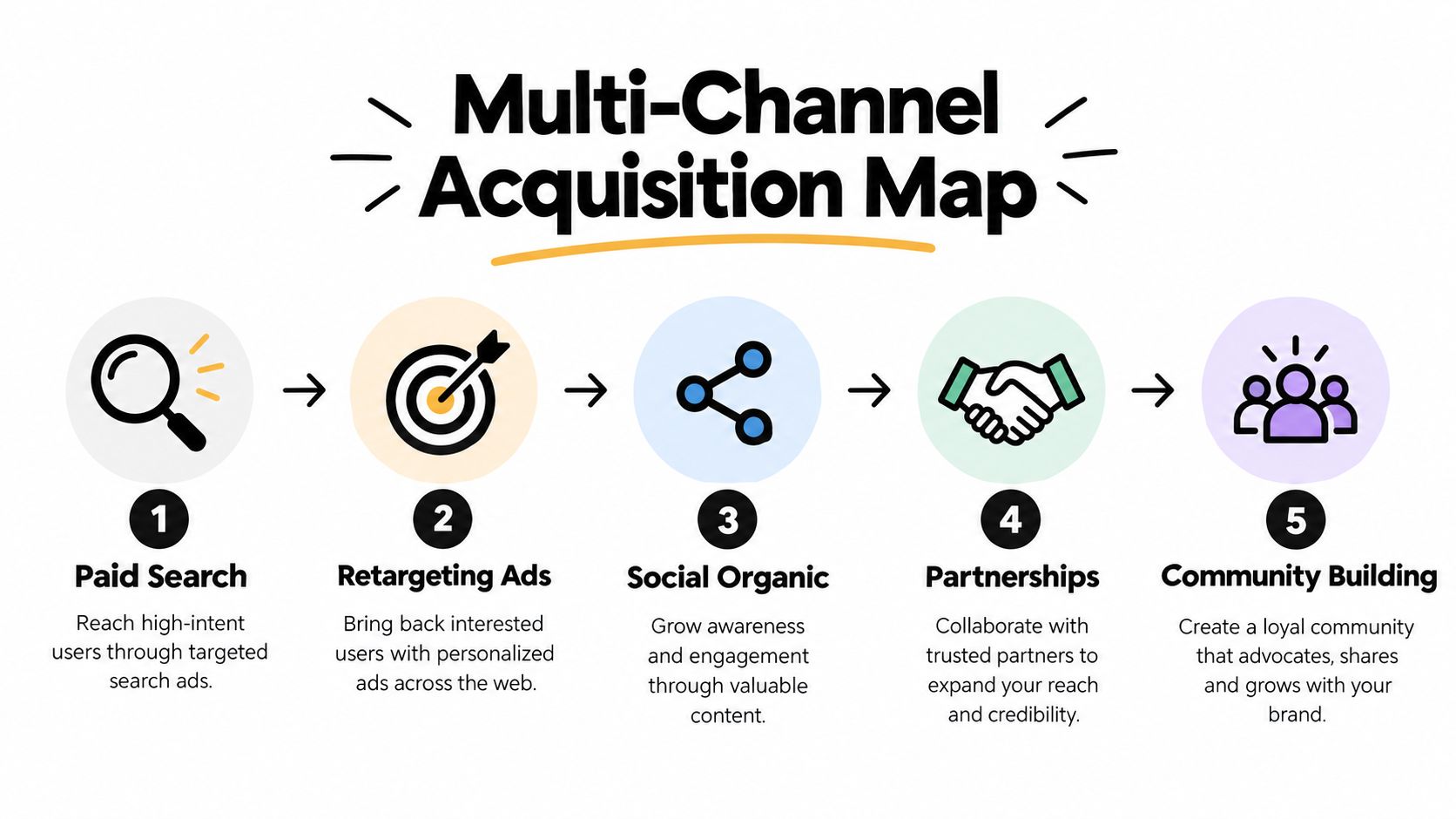
Your website is one acquisition surface, not the whole program. Qualified subscribers can come from paid search, retargeting, social conversations, partnerships, events, and referrals, but each source needs its own promise and tracking logic.
Give every channel a dedicated path
Paid search: Build a Google landing page around the exact query and offer. Use a headline that mirrors search intent, one proof element, and a form that asks for the minimum qualifying detail. For Meta, lead with a problem-focused hook, show the asset in use, state the audience, and send clicks to a matching page instead of the homepage. Retarget visitors who viewed the page but didn't complete the form with a different proof angle, not the same creative repeated endlessly.
Organic social: On LinkedIn and Instagram, publish a useful post, invite a keyword-based DM, and respond with a permission-based sequence. The first message should deliver context or the resource. The next should ask a single preference question. Only then should you invite the person to subscribe, and the consent language must explain what they'll receive.
Partnerships: Co-create a checklist, webinar, or diagnostic with a complementary brand. Agree in advance on lead ownership, consent wording, source tags, and any revenue-share arrangement. Both partners should promote the asset independently rather than exchanging lists.
Events: Use a scan-to-join flow tied to the event and session. Tag contacts by event, session, role, and consent source so the follow-up reflects the context in which they subscribed. Don't drop every attendee into a generic newsletter without acknowledging why they joined.
Referrals: Give current subscribers a reason to invite a colleague who fits the ICP. Track invitation source, cap suspicious bursts, and suppress contacts that show obvious duplicate or automated behavior. The reward should reinforce relevance, not attract people who only want a prize.
Every lane should send traffic to a dedicated landing page matched to the channel promise. A homepage makes the visitor reconstruct the offer, and that mismatch often costs more than a headline or layout mistake.
Deliverability, Hygiene, and Segmentation
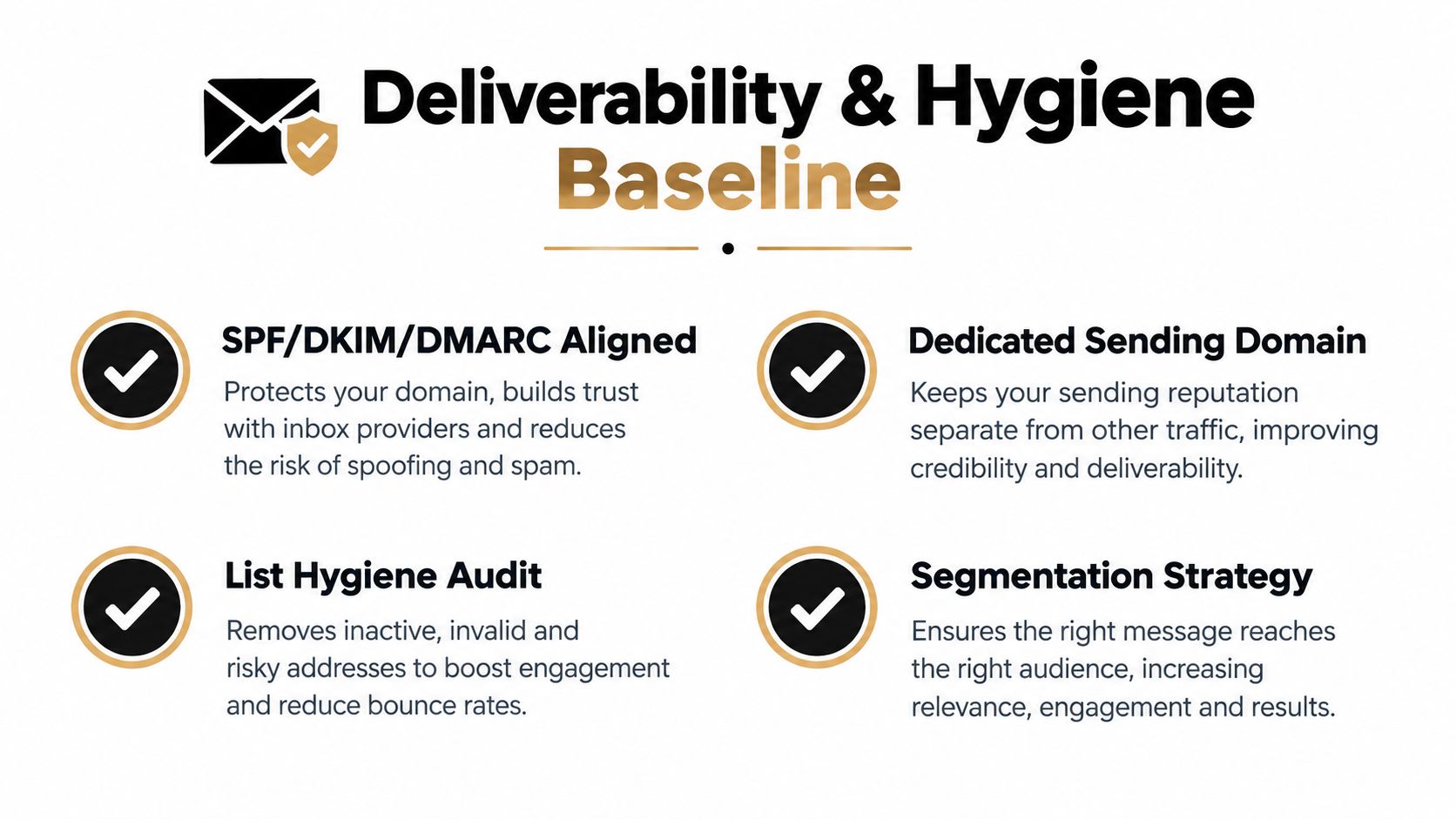
A large list with poor inbox placement is an expensive liability. Configure SPF, DKIM, and DMARC alignment first. Use a dedicated sending domain when your volume and operational needs justify separating it from other mail, then warm that domain gradually before a major campaign.
Keep the database defensible
Double opt-in is a strong choice when list quality matters. It confirms that the subscriber controls the address, limits accidental or automated signups, and creates a clearer consent record. In the EEA and UK, B2B status does not automatically remove consent obligations. The legal basis depends on the communication, jurisdiction, recipient, and documentation, so involve privacy counsel when the use case is unclear.
Run hygiene as a recurring operating process:
- Re-engage inactive contacts: Use flows at 90 and 180 days to ask whether the subscriber still wants the content.
- Apply a sunset policy: Suppress chronic non-openers when your engagement rules show that continued sending creates more risk than value.
- Review hard bounces and complaints: Remove undeliverable addresses and investigate complaint patterns before increasing acquisition.
- Audit consent records: Keep the source, timestamp, form version, and consent language available for review.
A 2025 deliverability benchmark found that only 23.6% of businesses verify lists before every campaign and just 13% use inbox placement tests. Treat those figures as an operating warning, not a reason to chase more signups. Add pre-send verification to the campaign checklist, and block the send when verification is skipped. Use inbox placement testing for priority campaigns, new domains, and major changes to sending volume.
Segment before you automate
Tag each subscriber by acquisition source, magnet, page or campaign, stated role, and behavior. Use visits, clicks, replies, purchases, and engagement scores to route contacts into relevant nurture branches. Someone who requested a pricing calculator should not receive the same sequence as someone who downloaded an introductory guide.
If you are researching the market or planning a company, the Gritt.io investor search tool can help identify relevant investor categories while you assess audience and funding context. Keep that research separate from subscriber consent. Never add contacts to a marketing list without explicit permission.
Healthy net growth is new subscribers minus unsubscribes minus bounces, divided by total list size, multiplied by 100. Use The Stacc's email list-building guide to compare website opt-in benchmarks, and review Email Marketing for Business for broader list-growth context. Growth only matters when contacts remain reachable and relevant. The list hygiene guidance from Orbit AI offers a practical reference for keeping the database usable after capture.
Automation, Analytics, and Your 30-Day Build Plan
A list-building program needs one operating loop: capture the subscriber, deliver the promised value, learn intent, route the contact, and measure the resulting business activity. Don't treat the form, email platform, and CRM as separate projects. Connect them with native sync or a webhook, preserve the source and consent fields, and make the handoff observable.
Start with a five-email welcome sequence. Email one delivers the magnet immediately. Email two helps the subscriber use it. Email three addresses a common obstacle. Email four introduces a relevant product or next step. Email five asks a useful qualification question or directs the subscriber to the appropriate conversion path.
Build the dashboard around decisions
Track opt-in rate by page, source, offer, device, and audience segment. Add confirmed opens, click-through rate, replies, unsubscribes, bounces, and pipeline assisted. Treat open data cautiously because privacy features can distort it, and use clicks, replies, downstream actions, and CRM outcomes as stronger intent signals.
Ignore two vanity metrics: gross subscriber count and total form submissions without source or quality context. Neither tells you whether the list is reachable, relevant, or contributing to revenue.
For teams that need a broader operating reference, email marketing tactics for agencies can help connect campaign execution with client reporting and workflow management.
Ship the first version in 30 days
Days 1 to 3, owner: growth lead. Interview sales and customer teams, review renewals and objections, and approve the ICP paragraph. Acceptance means the role, trigger, outcome, and disqualifiers are documented.
Days 4 to 7, owner: content lead. Choose one magnet, write the promise, and define the thank-you-page action. Acceptance means the asset solves one specific problem and has a named audience.
Days 8 to 10, owner: demand generation lead. Build the landing page, form, consent language, source tags, and thank-you flow. Acceptance means the form works on mobile, validates submissions, records consent, and sends test data to the correct system.
Days 11 to 14, owner: operations lead. Configure SPF, DKIM, DMARC alignment, suppression rules, double opt-in where appropriate, and the welcome sequence. Acceptance means test contacts receive the right messages and unsubscribes remove them from future marketing sends.
Days 15 to 21, owner: channel owners. Launch one paid, one organic, and one partner or event pilot. Acceptance means each channel uses a dedicated page and unique source tracking.
Days 22 to 26, owner: lifecycle marketer. Review form drop-off, clicks, replies, bounces, complaints, and segment behavior. Acceptance means the team identifies one offer change and one routing change based on observed data.
Days 27 to 30, owner: growth lead. Publish the dashboard, review net list growth, and decide whether to scale, revise, or pause each channel. Acceptance means every new subscriber has a source, consent record, segment, and next action.
The fastest path to a better list isn't adding more popups. It's aligning the promise, qualification, consent, delivery, and follow-up so every new address has a credible chance to become a useful relationship.
Orbit AI helps growth teams build lightweight forms, apply conditional qualification, score new submissions, and sync subscribers into the tools that run their follow-up. Use Orbit AI to turn your next list-building campaign into a measurable capture and qualification workflow, then start building with its free option.


