

Picking the right conversion rate optimization platform feels a lot like shopping for a car when every dealership claims theirs is the fastest. Dozens of tools promise to boost your conversions, but they serve very different needs: some are built for large-scale A/B experimentation, others focus on behavioral analytics, and a few specialize in the forms and landing pages where leads are actually captured.
This comparison cuts through the noise by evaluating nine platforms across the criteria that matter most: ease of use, testing capabilities, analytics depth, AI features, integrations, and pricing. Whether you're optimizing landing pages, improving form conversion rates, checkout flows, or entire user journeys, you'll find the right fit here. The list spans AI-powered form optimization tools, full-suite experimentation platforms, behavioral analytics solutions, and B2B personalization engines, so there's something for every team size and growth stage.
1. Orbit AI
Best for: High-growth teams focused on lead generation through conversion-optimized, AI-qualified forms
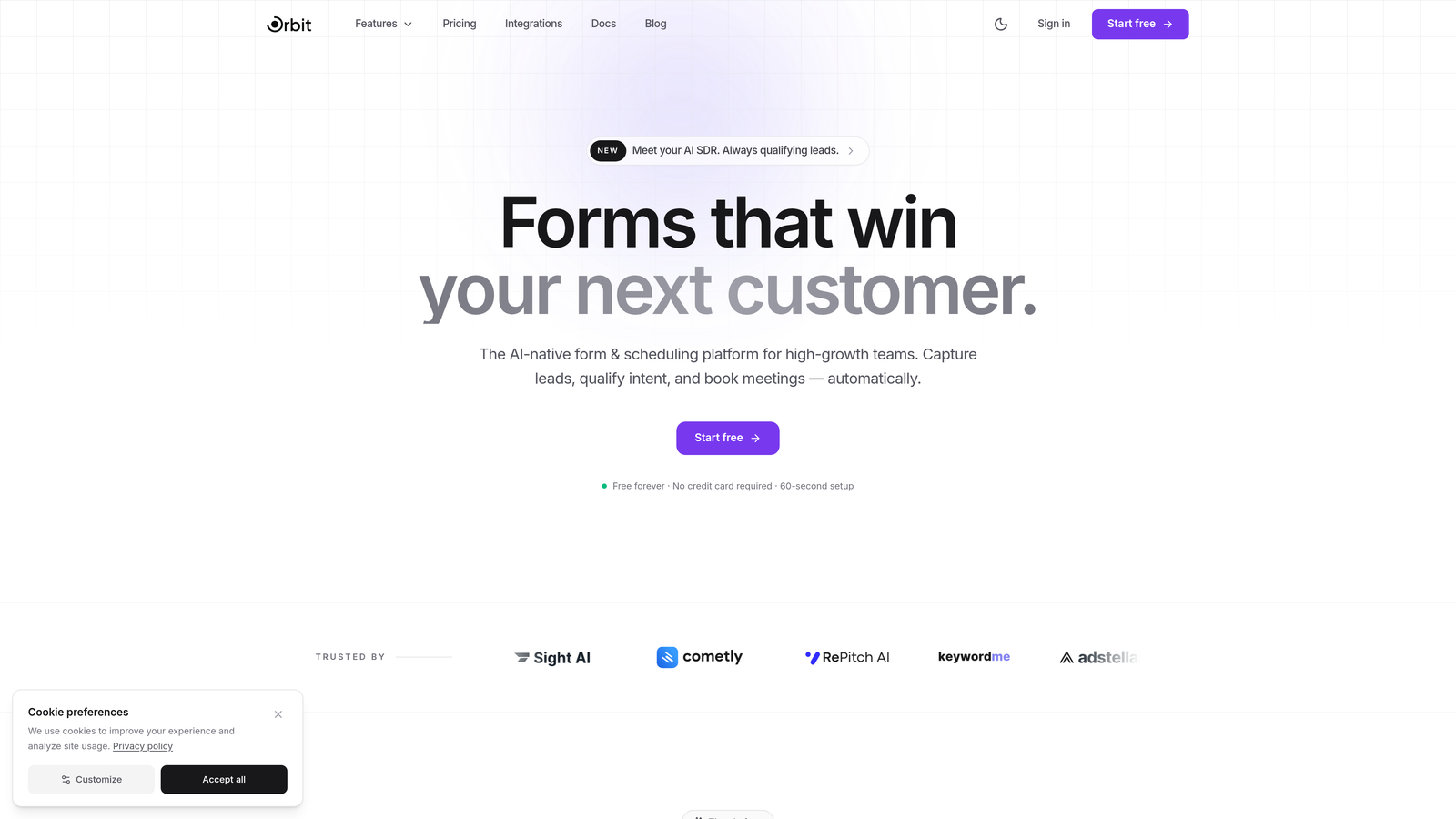
Orbit AI is an AI-powered form builder platform that combines intelligent lead qualification with conversion-optimized design, purpose-built for teams where form submissions are the primary growth metric.
Where This Tool Shines
Most CRO platforms treat forms as an afterthought: a widget you embed after you've finished optimizing the page. Orbit AI flips that model entirely. The platform is built around the idea that the form itself is a conversion experience, not just a data-capture endpoint. Every design decision, from field order to conditional logic, is oriented toward maximizing submission rates.
What sets Orbit AI apart from generic form builders is the built-in AI lead qualification layer. Instead of passing every submission to your CRM and letting sales sort through the noise, Orbit AI scores and qualifies leads within the form experience itself. That means your pipeline stays cleaner, your team focuses on the right prospects, and your conversion data reflects genuine quality, not just volume.
Key Features
AI-Powered Lead Qualification and Scoring: Automatically scores leads based on their responses, routing high-value prospects to the right follow-up flow without manual review.
Conversion-Optimized Templates: A library of form templates designed specifically to maximize submission rates, not just look good on the page.
Dynamic Form Fields: Fields that adapt based on user input, reducing form length for qualified leads and gathering richer data when it matters.
CRM Integrations: Seamless connections to major CRM platforms ensure leads are routed, tagged, and actioned the moment they submit.
Form Analytics with Drop-Off Insights: Built-in form analytics and tracking show exactly where users abandon, so you can iterate with precision rather than guesswork.
Best For
SaaS companies, B2B lead generation teams, and growth marketers who want to optimize the lead capture experience specifically, rather than running broad page-level experiments. Ideal for teams that care about lead quality as much as lead volume.
Pricing
Visit orbitforms.ai for current pricing plans. A free starting option is available for teams ready to explore the platform.
2. VWO (Visual Website Optimizer)
Best for: Teams wanting a unified A/B testing, heatmapping, and behavioral analytics suite in one platform
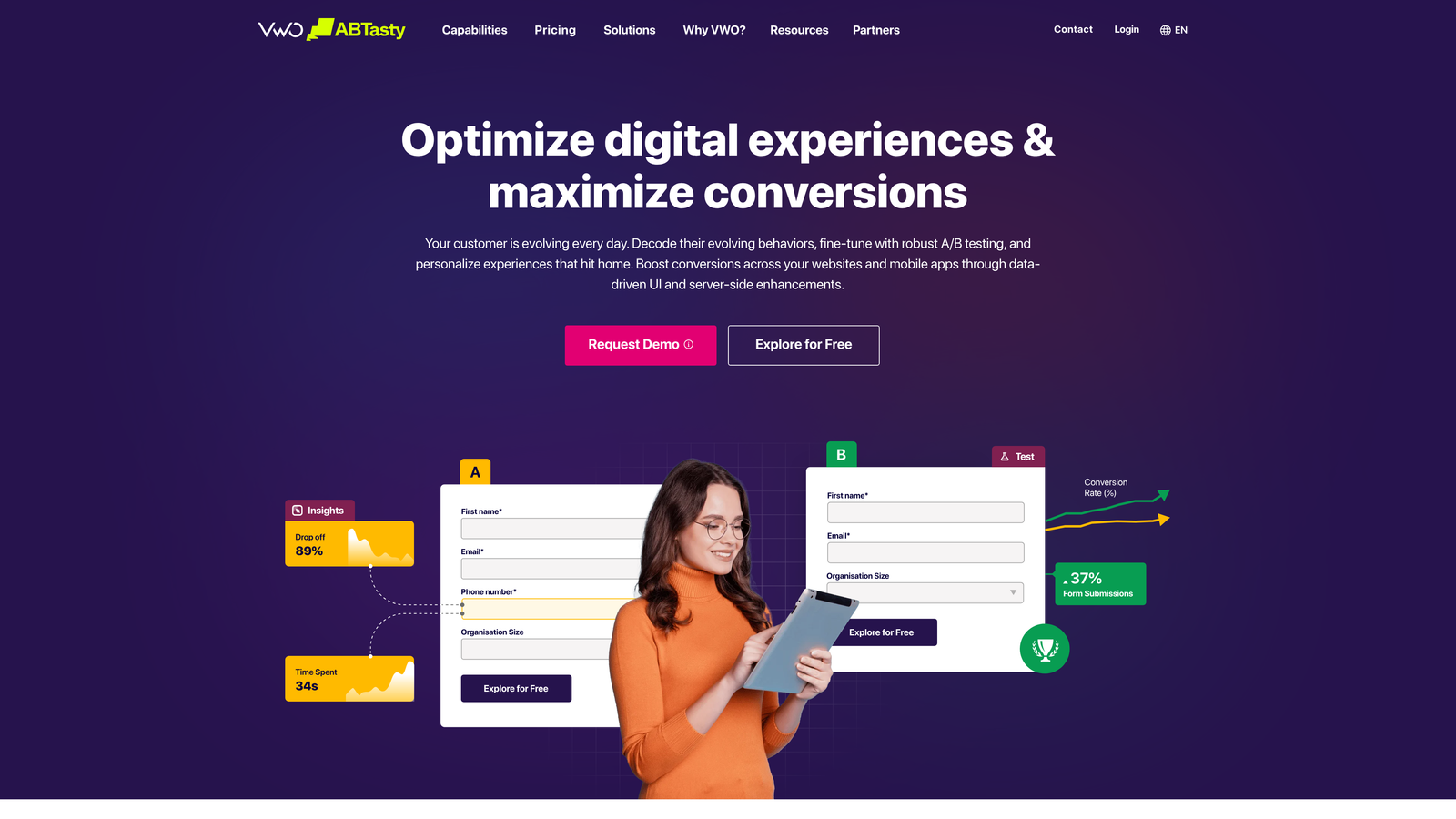
VWO is a full-stack experimentation platform that brings A/B testing, multivariate testing, heatmaps, session recordings, and on-page surveys into a single, cohesive dashboard.
Where This Tool Shines
VWO's biggest strength is breadth without fragmentation. Many teams cobble together separate tools for testing, heatmaps, and surveys, then spend time reconciling data across platforms. VWO keeps everything in one place, which makes it easier to connect behavioral observations directly to experiment hypotheses and outcomes.
The platform's Bayesian statistical engine is worth highlighting for teams tired of waiting weeks for test significance. It draws conclusions faster than traditional frequentist approaches, which matters when you're running multiple experiments simultaneously and need to move quickly.
Key Features
A/B, Multivariate, and Split URL Testing: A visual editor lets non-developers create test variations without touching code, while split URL testing handles more complex page-level experiments.
Heatmaps and Session Recordings: Behavioral analysis tools that reveal how users actually interact with your pages, helping you form stronger test hypotheses.
Server-Side Testing: Enables complex experiments that go beyond the front end, useful for product and engineering teams running deeper feature tests.
Bayesian Statistical Engine: Reaches statistically significant conclusions faster, reducing the time each experiment needs to run.
Integrated On-Page Surveys and Form Analytics: Collect qualitative feedback alongside quantitative test data for a more complete picture of user intent.
Best For
Growth teams and CRO specialists who want a single platform covering the full experimentation workflow, from behavioral research through testing to analysis. Works well for mid-market companies scaling their optimization programs.
Pricing
A free starter plan is available. Paid plans begin around $357/month at the Growth tier, with higher tiers for larger traffic volumes and advanced features.
3. Optimizely
Best for: Enterprise teams running high-volume, complex experiments across web, product, and content channels
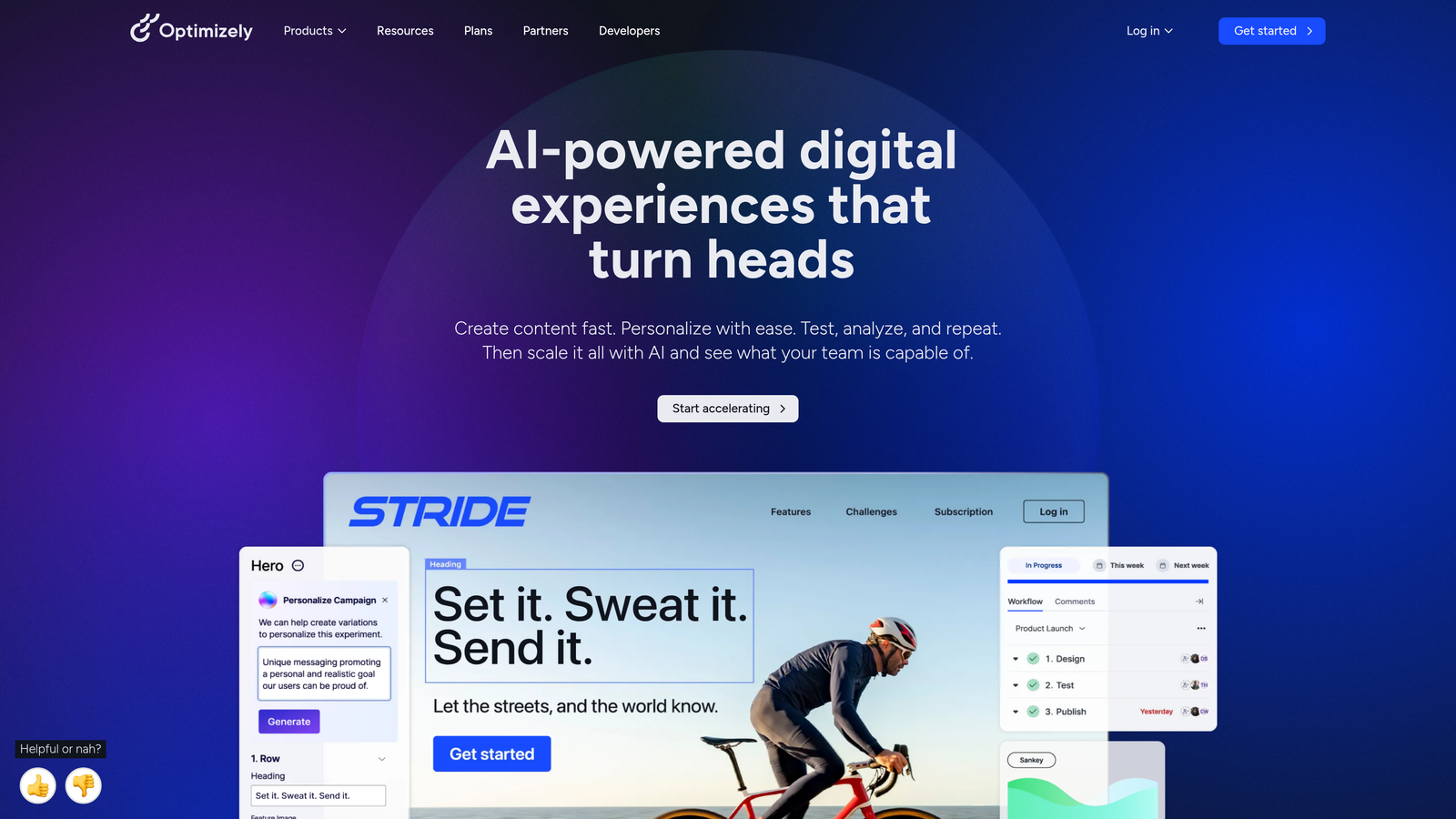
Optimizely is an enterprise-grade experimentation and digital experience platform with feature flagging, progressive delivery, and a robust statistical engine built for organizations running experiments at serious scale.
Where This Tool Shines
Optimizely is the platform that large engineering and product teams reach for when they need experimentation infrastructure that can handle millions of visitors, complex targeting rules, and cross-functional collaboration. Its Stats Accelerator feature intelligently reallocates traffic toward winning variants mid-experiment, which can meaningfully shorten test cycles.
Beyond testing, Optimizely has evolved into a broader digital experience platform with content management and personalization modules. For enterprises managing multiple product lines or digital properties, that consolidation can reduce tool sprawl significantly.
Key Features
Web and Feature Experimentation: Advanced targeting capabilities let teams run experiments on specific audience segments, devices, or behavioral triggers.
Feature Flags and Progressive Delivery: Controlled rollouts that let engineering teams test new features with a subset of users before full release.
Stats Accelerator: Intelligent traffic allocation that shifts visitors toward better-performing variants automatically, speeding up conclusions.
Content Management and Personalization: Modules for managing and personalizing digital content across channels, extending the platform beyond pure experimentation.
Extensive Integrations and APIs: Deep connections to analytics platforms, CDPs, and marketing stacks make Optimizely a natural fit for complex enterprise tech ecosystems.
Best For
Large enterprises and technically sophisticated teams that need scalable experimentation infrastructure, feature management, and personalization under one roof. Less suited for small teams or those with limited developer resources.
Pricing
Custom enterprise pricing; contact the Optimizely sales team for a quote. Expect pricing to reflect enterprise-scale usage and implementation support.
4. AB Tasty
Best for: Marketing teams who need to run tests and personalization campaigns without heavy developer involvement
AB Tasty is a marketer-friendly CRO platform that combines A/B testing, AI-powered personalization, and a pre-built widget library for deploying conversion-boosting elements with minimal technical overhead.
Where This Tool Shines
AB Tasty is designed for speed. Its low-code visual editor means marketing teams can create test variations, launch personalization campaigns, and deploy on-page widgets like countdown timers, social proof banners, and pop-ups without waiting on engineering. For teams where developer bandwidth is a constant bottleneck, that independence is genuinely valuable.
The platform's ROI dashboard connects experiment results to revenue impact, which makes it easier to justify CRO investment internally and prioritize which tests to run next based on potential business value.
Key Features
Low-Code Visual Editor: Create and launch test variations or personalization campaigns without writing code, keeping marketers in the driver's seat.
AI-Powered Personalization: Audience segmentation and personalization driven by behavioral signals, helping deliver relevant experiences to different visitor cohorts.
Pre-Built Widget Library: Ready-to-deploy conversion elements including countdown timers, pop-ups, and social proof notifications that can be added to any page.
Server-Side and Feature Flag Testing: For teams that need to go beyond front-end experiments without switching platforms.
ROI Dashboard: Connects test results to revenue metrics so teams can quantify the business impact of their optimization program.
Best For
E-commerce brands, digital marketing teams, and growth marketers who want to run sophisticated personalization and testing programs without depending on developer resources for every change.
Pricing
Custom pricing based on traffic volume. Contact the AB Tasty sales team for a quote tailored to your site's scale and feature requirements.
5. Hotjar
Best for: Teams that need to understand why users aren't converting before they start testing solutions
Hotjar is a behavioral analytics platform that helps teams identify conversion bottlenecks through heatmaps, session recordings, feedback polls, and on-site surveys.
Where This Tool Shines
Hotjar occupies a specific and important role in the CRO stack: it's the diagnostic layer. Before you can run effective A/B tests, you need to understand what's actually broken. Hotjar's heatmaps and session recordings surface the friction points, confusing elements, and unexpected user behaviors that quantitative analytics alone can't explain.
Its funnel and form analysis features are particularly useful for lead generation teams. Seeing exactly where users drop off within a multi-step form, or which form fields cause the most hesitation, gives you actionable hypotheses to test rather than educated guesses.
Key Features
Heatmaps: Visual representations of where users click, scroll, and move their mouse, revealing which page elements attract attention and which are ignored.
Session Recordings: Watch real user sessions with filtering and tagging to quickly find examples of specific behaviors or friction points.
On-Site Feedback Widgets and Surveys: Collect qualitative user sentiment at key moments in the journey without requiring users to leave the page.
Funnel and Form Analysis: Identify exactly where users abandon multi-step flows, giving you precise drop-off data to act on.
Integrations with Testing Tools: Connects with A/B testing platforms so behavioral insights can directly inform your experimentation roadmap.
Best For
Product teams, UX researchers, and CRO specialists who want to build a research-driven optimization program. Also valuable for smaller teams that need to prioritize which problems to solve before investing in testing infrastructure.
Pricing
A free Basic plan is available with limited sessions. Paid plans start at $32/month for the Plus tier, scaling with session volume and feature access.
6. Unbounce
Best for: PPC and paid media teams who need to build, test, and optimize landing pages quickly
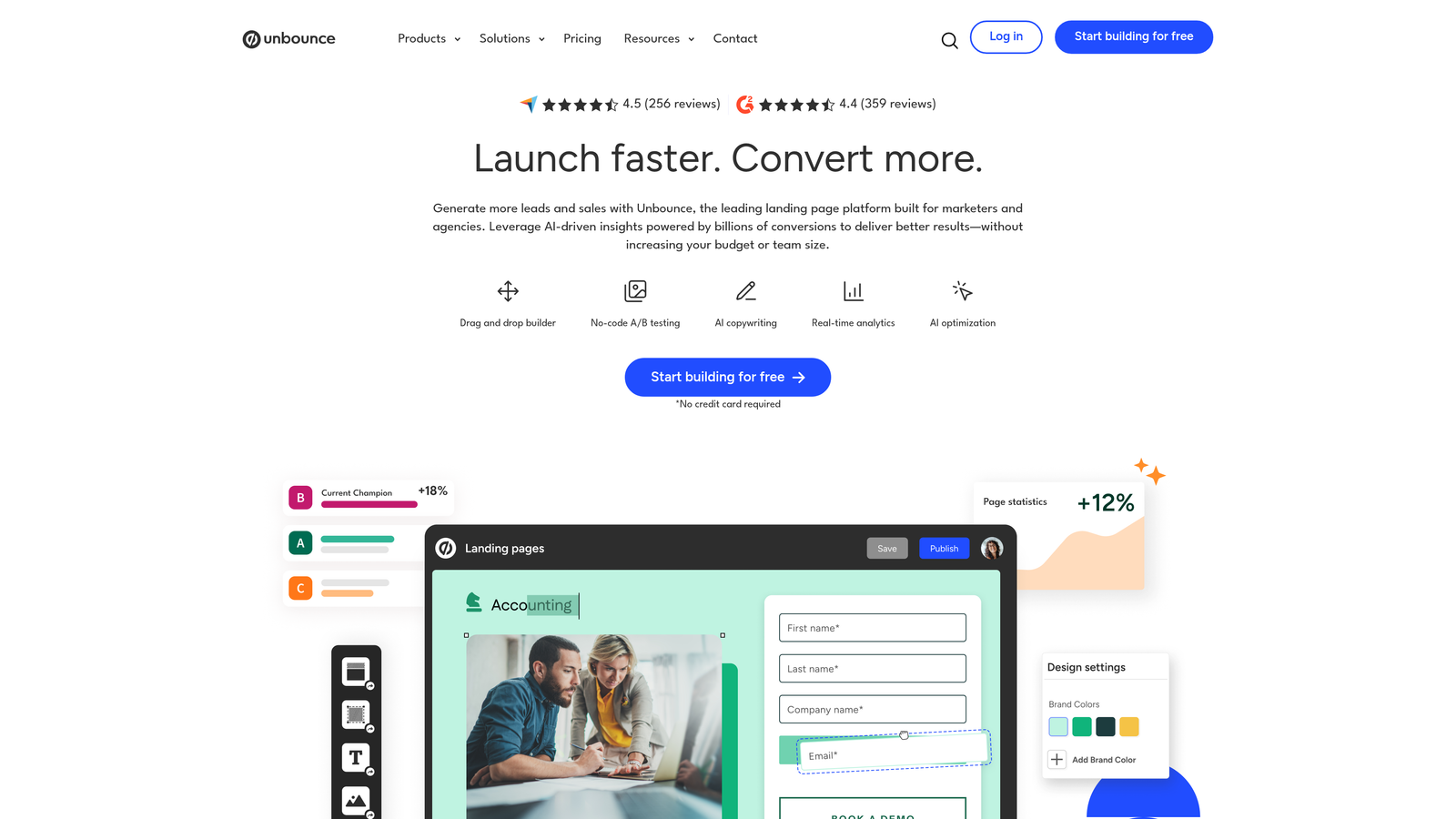
Unbounce is a landing page platform with built-in A/B testing and an AI-powered Smart Traffic feature that automatically routes visitors to the page variant most likely to convert them.
Where This Tool Shines
Unbounce is built for speed-to-launch. Its drag-and-drop builder and 100-plus templates let teams create high-quality landing pages without a design team or developer, which is especially valuable for running multiple paid campaigns simultaneously. The dynamic text replacement feature is a particular standout for PPC teams: it automatically matches landing page copy to the search terms visitors used, improving relevance and conversion rates across campaigns.
Smart Traffic is Unbounce's AI differentiator. Rather than waiting for traditional A/B test significance, Smart Traffic learns visitor patterns and routes each person to the variant they're most likely to convert on, which can accelerate results compared to standard split testing.
Key Features
Drag-and-Drop Landing Page Builder: Over 100 templates and a flexible visual editor make it fast to build and iterate on landing pages without code.
Smart Traffic AI: Automatically routes visitors to the variant most likely to convert based on their attributes and behavior patterns.
A/B Testing for Pages, Popups, and Sticky Bars: Test variations across multiple page elements, not just the main landing page layout.
Dynamic Text Replacement: Automatically swaps landing page copy to match the visitor's search query, improving PPC campaign relevance.
CRM and Marketing Tool Integrations: Connects to major platforms to ensure leads captured on landing pages flow directly into your existing workflows.
Best For
Paid media teams, performance marketers, and agencies managing multiple campaigns who need to launch and iterate on landing pages rapidly without engineering support.
Pricing
Plans start at $74/month for the Build tier. Smart Traffic AI is available on higher-tier plans. A 14-day free trial is offered.
7. Convert
Best for: Privacy-conscious teams and agencies that need flicker-free testing with strong GDPR and CCPA compliance
Convert is a privacy-first A/B testing platform built for agencies and teams that require rigorous data compliance alongside powerful experimentation capabilities.
Where This Tool Shines
Convert's privacy-by-design architecture is its defining characteristic. The platform stores no personal data by default, which simplifies GDPR and CCPA compliance considerably and removes the legal overhead that can slow down testing programs in regulated industries or European markets. For agencies managing experiments across multiple client sites, that compliance posture is a meaningful risk reducer.
The flicker-free implementation is another technical differentiator. Many A/B testing tools cause a brief visual flash when loading test variants, which can affect user experience and data quality. Convert's approach minimizes this issue, resulting in cleaner experiments and a better experience for test participants.
Key Features
Flicker-Free A/B and Multivariate Testing: Smooth variant loading that avoids the visual flash common in other testing tools, protecting both UX and data integrity.
Privacy by Design: No personal data storage by default, making compliance with GDPR and CCPA straightforward rather than an afterthought.
Advanced Targeting with 40-Plus Audience Conditions: Granular audience segmentation for precise experiment targeting across complex visitor cohorts.
Multi-Domain and Multi-Project Support: Designed for agencies managing experiments across multiple client websites from a single account.
Post-Segmentation Analysis: Slice experiment results by audience segment after the test concludes, revealing insights that aggregate data can obscure.
Best For
CRO agencies, in-house teams in regulated industries, and any organization where data privacy compliance is a non-negotiable requirement alongside rigorous experimentation.
Pricing
Plans start at around $299/month, with volume-based pricing available for higher traffic levels. No free plan, but a free trial is offered.
8. Crazy Egg
Best for: Small teams and growing businesses that want visual CRO insights and simple A/B testing without complexity
Crazy Egg is a visual analytics and lightweight A/B testing tool that makes CRO accessible for smaller teams through heatmaps, scroll maps, confetti reports, and a straightforward test editor.
Where This Tool Shines
Crazy Egg's strength is approachability. It delivers the core behavioral analytics that teams need to identify conversion problems, presented in visual formats that are easy to interpret without a data science background. Confetti reports, which show individual clicks color-coded by traffic source, are particularly useful for understanding how different audience segments interact with the same page.
The lightweight script is worth noting for performance-conscious teams. Crazy Egg is designed to have minimal impact on page load speed, which matters both for user experience and for keeping your test environment as close to real-world conditions as possible.
Key Features
Heatmaps, Scroll Maps, and Confetti Reports: Visual representations of user behavior that make it easy to spot friction points and engagement patterns at a glance.
Simple A/B Testing: A visual editor that lets non-technical users create and launch test variations without writing code.
Traffic Analysis and Referral Source Tracking: Understand how different traffic sources behave on your pages, informing both CRO and acquisition strategy.
Snapshot Reports: Quick visual audits of any page that surface behavioral data without requiring ongoing session recording setup.
Lightweight Script: Minimal performance impact on page load, preserving site speed while collecting behavioral data.
Best For
Small businesses, early-stage startups, and lean marketing teams that want to get started with CRO without a steep learning curve or a large budget. Also useful as a complementary tool for teams that need visual analytics alongside a more robust testing platform.
Pricing
Plans start at $29/month for the Basic tier. A 30-day free trial is available, making it easy to evaluate before committing.
9. Mutiny
Best for: B2B revenue teams running account-based marketing who want to personalize web experiences at the account level
Mutiny is a B2B website personalization platform that uses firmographic data, intent signals, and account lists to deliver tailored web experiences for target accounts and drive pipeline conversion.
Where This Tool Shines
Mutiny operates in a distinct niche within the CRO landscape: it's not primarily about testing page variants for broad traffic segments. Instead, it's about delivering the right message to the right company when a target account visits your site. For B2B teams running account-based marketing programs, that specificity can meaningfully improve pipeline conversion rates by ensuring that high-value prospects see content and messaging tailored to their industry, company size, or stage in the buying journey.
The no-code visual editor means that marketing and demand generation teams can personalize page elements, headlines, and CTAs for specific account segments without engineering support. Combined with built-in revenue attribution, Mutiny makes it possible to connect personalization activity directly to pipeline impact.
Key Features
Firmographic and Intent-Based Segmentation: Target visitors by company size, industry, intent signals, or named account lists for highly relevant personalization.
No-Code Visual Editor: Personalize any page element for specific audience segments without writing code, keeping execution in the hands of marketing teams.
ABM Playbooks with Account-Level Targeting: Pre-built frameworks for running account-based marketing campaigns through web personalization.
Built-In A/B Testing for Personalized Experiences: Test different personalization approaches against each other to optimize which messaging resonates most with target segments.
Revenue Attribution and Pipeline Reporting: Connect personalization activity to pipeline and revenue outcomes, making it easier to demonstrate ROI to leadership.
Best For
Mid-market and enterprise B2B companies with established ABM programs, typically with dedicated demand generation or revenue marketing teams. Less suited for B2C teams or companies without a defined account-based strategy.
Pricing
Custom pricing; Mutiny is typically positioned for mid-market and enterprise B2B organizations. Contact the sales team for a quote aligned to your account volume and traffic.
Which Platform Is Right for Your Team?
The right CRO platform depends on where your biggest conversion opportunity actually lives. Here's a quick-reference guide organized by primary use case to help you cut to the right choice.
Form-Focused CRO: If lead generation forms are your primary conversion point, Orbit AI is purpose-built for this. No other platform on this list combines form building, AI lead qualification, and conversion analytics in a single product designed specifically for lead-gen teams.
Full-Stack Experimentation: VWO is the strongest choice for mid-market teams that want testing, behavioral analytics, and surveys unified in one platform. Optimizely is the enterprise option when you need feature flagging, progressive delivery, and the infrastructure to run hundreds of concurrent experiments.
Marketer-Friendly Testing: AB Tasty and Convert both serve teams that need to run experiments without heavy developer involvement, though Convert is the better fit when privacy compliance is a hard requirement.
Behavioral Diagnostics: Hotjar and Crazy Egg are complementary rather than competitive. Hotjar offers more depth for research-driven teams; Crazy Egg is the faster, more affordable entry point for smaller teams just getting started with visual analytics.
Landing Page Optimization: Unbounce is the clear choice for paid media and PPC teams who need to build, test, and iterate on landing pages rapidly without engineering support.
B2B Website Personalization: Mutiny stands alone in this list for account-based personalization. If your go-to-market motion is ABM-led, it's worth the investment.
For teams focused on increasing form submissions and improving form field optimization, the conversation starts with the form itself, not the page around it. Start your free trial today with Orbit AI and see how intelligent form design, built-in lead qualification, and conversion-focused analytics can transform your lead generation results. When your forms work harder, your entire CRO program performs better.


