

Finance teams have unique form requirements that generic tools often fail to meet. Compliance considerations, secure data handling, conditional logic for complex financial products, and seamless CRM integrations are all table stakes for serious financial services operations. Whether you're collecting loan applications, onboarding new clients, running KYC checks, or qualifying leads for wealth management services, the right form builder can meaningfully improve conversion rates and reduce manual work.
This guide covers the top form builders built or well-suited for finance use cases in 2026. We evaluated each tool on security features, conditional logic capabilities, integration depth, compliance support, and overall ease of use for non-technical finance teams. Whether you're a high-growth fintech, an independent financial advisor, or a traditional institution modernizing your intake process, there's a solution here for you.
1. Orbit AI
Best for: High-growth financial services teams focused on lead qualification and conversion optimization.
Orbit AI is an AI-powered form builder with built-in lead qualification agents, designed specifically for financial services teams who care about converting the right prospects faster.

Where This Tool Shines
What sets Orbit AI apart from every other tool on this list is the intelligence layer. Rather than just collecting form submissions and dumping them into a spreadsheet, Orbit AI's AI agents qualify leads in real time as forms are completed. For finance teams managing high volumes of loan inquiries, investment leads, or insurance applications, this means your team spends time on prospects who actually meet your criteria.
The platform pairs that qualification engine with genuinely conversion-optimized design. Multi-step form flows, conditional logic, and beautifully designed templates reduce abandonment on complex financial intake forms. The built-in analytics dashboard gives you visibility into where leads drop off and which form variations perform best.
Key Features
AI Lead Qualification Agents: Automatically score and qualify leads in real time as forms are submitted, so your team focuses on the highest-value prospects.
Conditional Logic and Multi-Step Flows: Build complex, branching form experiences for financial products like mortgage applications, investment onboarding, or insurance quotes without writing code.
Conversion-Optimized Templates: Modern, professionally designed templates built specifically to reduce abandonment on longer financial intake forms.
Workflow Automation and CRM Sequences: Trigger automated follow-up sequences and push qualified lead data directly to your CRM through built-in integrations.
Analytics Dashboard: Track form performance, monitor lead quality trends, and identify drop-off points to continuously improve conversion rates.
Best For
Orbit AI is the right choice for fintech companies, financial advisors, and financial services teams running active lead generation campaigns. If your primary goal is qualifying more leads with less manual effort while maintaining a polished, modern client experience, this platform was purpose-built for exactly that.
Pricing
Visit orbitforms.ai/pricing for current plan details. Free plan available to get started.
2. Typeform
Best for: Client onboarding and financial intake forms where user experience and completion rates are a priority.
Typeform is a conversational form builder known for its polished, one-question-at-a-time UX that reduces abandonment on long client intake forms.

Where This Tool Shines
Typeform's signature format works particularly well for financial services because it makes complex forms feel approachable. When you're asking a prospect to share sensitive financial information, the conversational flow reduces the psychological friction of staring at a wall of fields. This is especially valuable for wealth management intake, client onboarding questionnaires, and financial needs assessments.
The native integrations with HubSpot and Salesforce mean that completed forms flow directly into your existing CRM without manual data entry. Logic jumps allow you to build personalized paths based on prior answers, so a high-net-worth individual and a first-time investor see different questions relevant to their situation.
Key Features
Conversational One-Question Format: Presents questions one at a time to reduce cognitive load and improve completion rates on longer forms.
Logic Jumps: Route respondents through different question paths based on prior answers for personalized financial intake experiences.
Native CRM Integrations: Direct connections to HubSpot, Salesforce, and Zapier for seamless lead data handoff.
Mobile-Optimized Design: All forms render beautifully on mobile out of the box, important for client-facing financial applications.
Video and Image Embedding: Add explainer content or branding directly into forms for richer client experiences.
Best For
Typeform suits financial advisors, wealth management firms, and fintech companies prioritizing a premium client experience. It's not purpose-built for compliance-heavy workflows, but it excels where first impressions and completion rates matter most.
Pricing
Free plan available with limited responses. Paid plans start at $25/month, with pricing scaling based on response volume.
3. JotForm
Best for: Regulated financial workflows requiring compliance certifications, e-signatures, and payment collection.
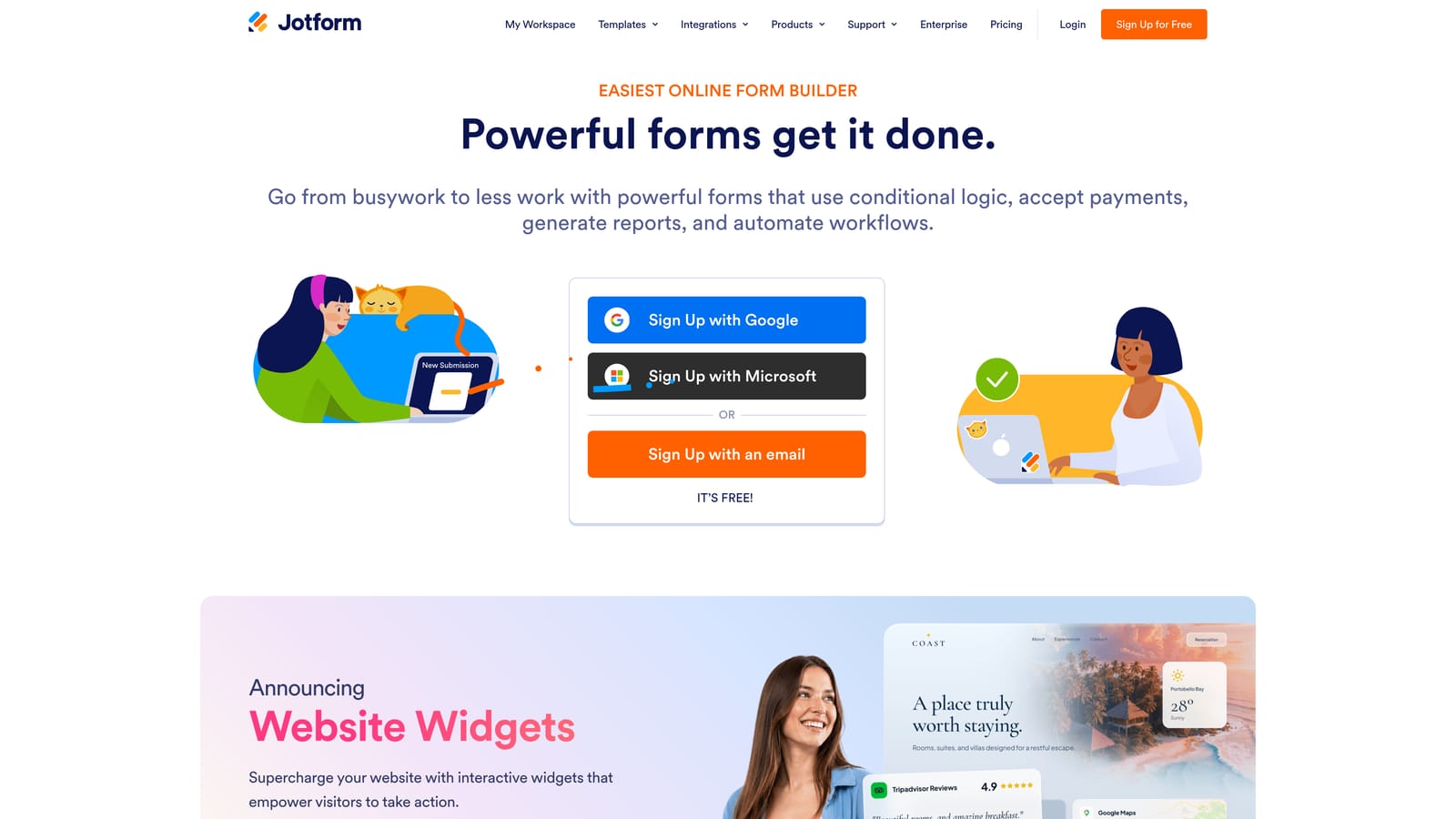
JotForm is a feature-rich form builder with strong compliance credentials, e-signature support, and a large library of finance-specific templates.
Where This Tool Shines
JotForm is arguably the strongest all-around choice for compliance-conscious finance teams. The combination of HIPAA compliance and SOC 2 certification covers most regulatory bases for financial services operations, and the built-in e-signature tool (JotSign) means clients can sign loan agreements, advisory contracts, or account opening documents without leaving the form flow.
The template library is genuinely useful here. With over 5,000 templates including mortgage applications, insurance claim forms, and banking intake forms, you can launch a production-ready form quickly rather than building from scratch. Payment collection via Stripe, PayPal, and Square adds further utility for teams collecting application fees or deposits.
Key Features
HIPAA and SOC 2 Compliance: Meets key regulatory requirements for financial and healthcare-adjacent data handling.
JotSign E-Signatures: Collect legally binding signatures directly within forms, no third-party tool required.
Payment Collection: Accept payments via Stripe, PayPal, and Square for application fees, deposits, or service charges.
5,000+ Finance Templates: Pre-built templates for mortgage, insurance, banking, and accounting use cases.
Conditional Logic and Multi-Page Forms: Build complex, branching form experiences for financial product applications.
Best For
JotForm is ideal for mortgage brokers, insurance agencies, accounting firms, and any financial services team that needs compliance certifications and e-signature capability in a single platform. It handles regulated data collection better than most tools at its price point.
Pricing
Free plan available with limited submissions. Paid plans start at $34/month, scaling with submission volume and storage.
4. Gravity Forms
Best for: Financial services teams running WordPress websites who need deep integration and a mature add-on ecosystem.
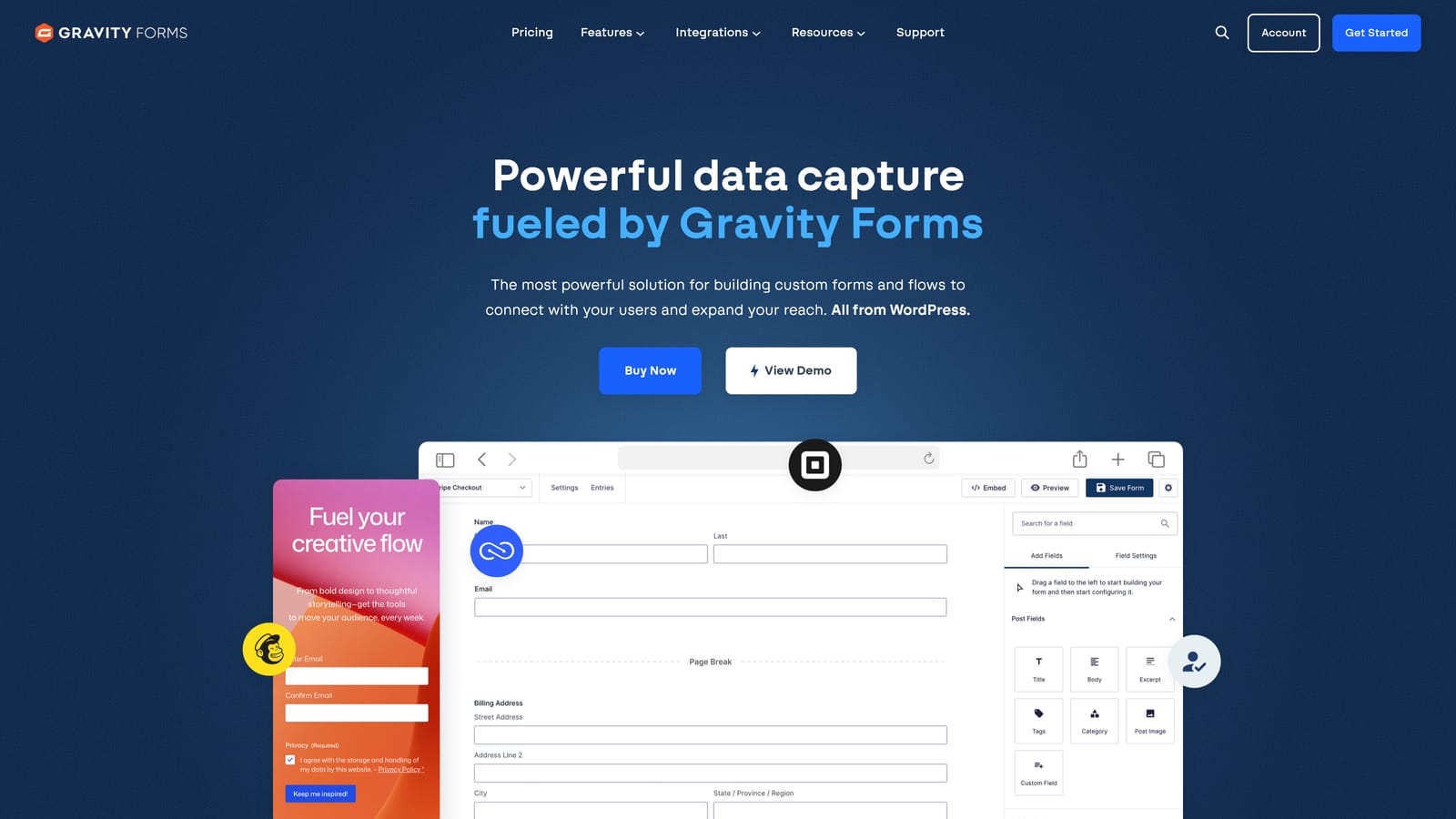
Gravity Forms is the leading WordPress-native form builder with a mature add-on ecosystem for payment processing, conditional logic, and CRM integrations.
Where This Tool Shines
If your financial services website runs on WordPress, Gravity Forms is the natural choice. It integrates at the theme and plugin level in ways that SaaS form builders simply cannot match, giving you full control over styling, data handling, and workflow automation within your existing tech stack. The add-on library covers virtually every integration a finance team might need.
The annual license model is worth highlighting: unlike most SaaS form builders that charge per response, Gravity Forms charges a flat annual fee per site. For high-volume financial services operations collecting thousands of applications per month, this pricing structure can represent meaningful savings over time.
Key Features
Deep WordPress Integration: Full theme compatibility and native WordPress data handling for teams already on that stack.
Payment Gateway Add-Ons: Supports Stripe, PayPal, and Authorize.net through official add-ons.
Advanced Conditional Logic: Build complex multi-page forms with sophisticated branching logic for financial product eligibility.
Large Add-On Library: Hundreds of official and community add-ons for CRM, email marketing, and workflow automation.
Flat Annual Licensing: No per-response pricing, making it cost-effective for high-volume financial intake operations.
Best For
Gravity Forms is the right tool for financial advisors, mortgage brokers, and fintech companies whose primary web presence runs on WordPress. Teams not on WordPress should look elsewhere, as this tool's strengths are entirely tied to that platform.
Pricing
Starts at $59/year for a single site license. Higher tiers unlock additional add-ons and multi-site support.
5. Formstack
Best for: Large financial institutions with complex Salesforce workflows and document automation requirements.
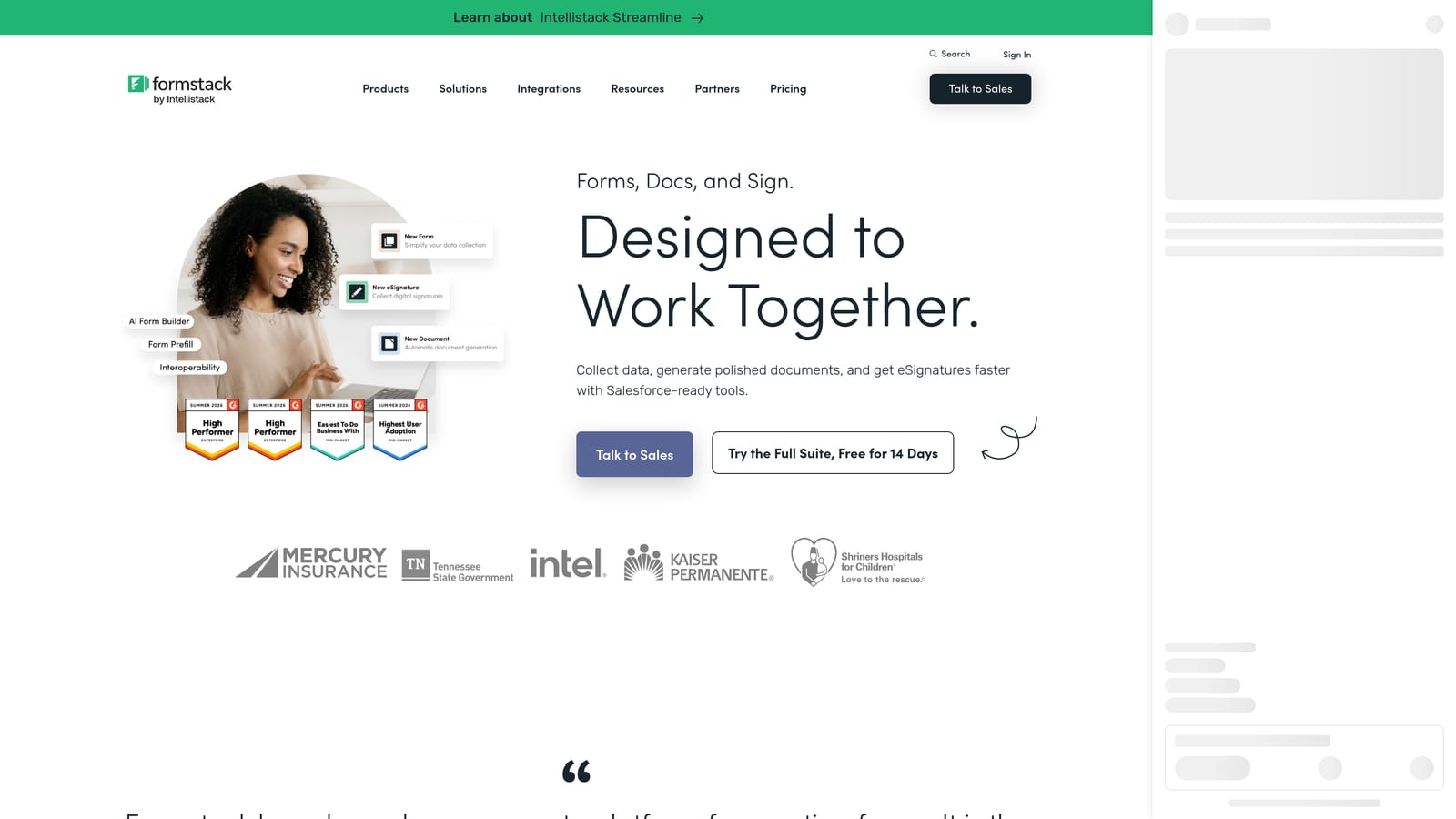
Formstack is an enterprise form and document automation platform with deep Salesforce integration, built for large financial institutions with complex internal workflows.
Where This Tool Shines
Formstack goes beyond form building into full document automation territory. Through Formstack Documents, a completed form can automatically populate a contract, disclosure document, or account opening agreement, which then routes through an approval chain and collects e-signatures via Formstack Sign. For large financial institutions managing high volumes of paperwork, this end-to-end automation is genuinely transformative.
The Salesforce integration is among the deepest available in this category. Formstack can read from and write to Salesforce objects in real time, enabling sophisticated workflows where form data updates existing records, triggers automated processes, and feeds into reporting dashboards without manual intervention.
Key Features
Form-to-Document Automation: Automatically populate contracts, agreements, and disclosure documents from form submissions via Formstack Documents.
E-Signature Collection: Collect legally binding signatures through Formstack Sign without leaving the platform.
Deep Salesforce Integration: Bidirectional Salesforce sync with support for complex object relationships and workflow triggers.
HIPAA and SOC 2 Compliance: Enterprise-grade compliance options for regulated financial data handling.
Workflow Routing and Approvals: Build multi-step approval chains for financial documents requiring multiple sign-offs.
Best For
Formstack is built for enterprise financial institutions: banks, insurance companies, investment firms, and large advisory practices with complex internal workflows and heavy Salesforce dependencies. The price point reflects that positioning.
Pricing
Starts at $83/month. Enterprise pricing available for larger teams and more complex workflow requirements.
6. Cognito Forms
Best for: Finance teams needing native calculation fields for loan calculators, fee estimators, and quote forms.
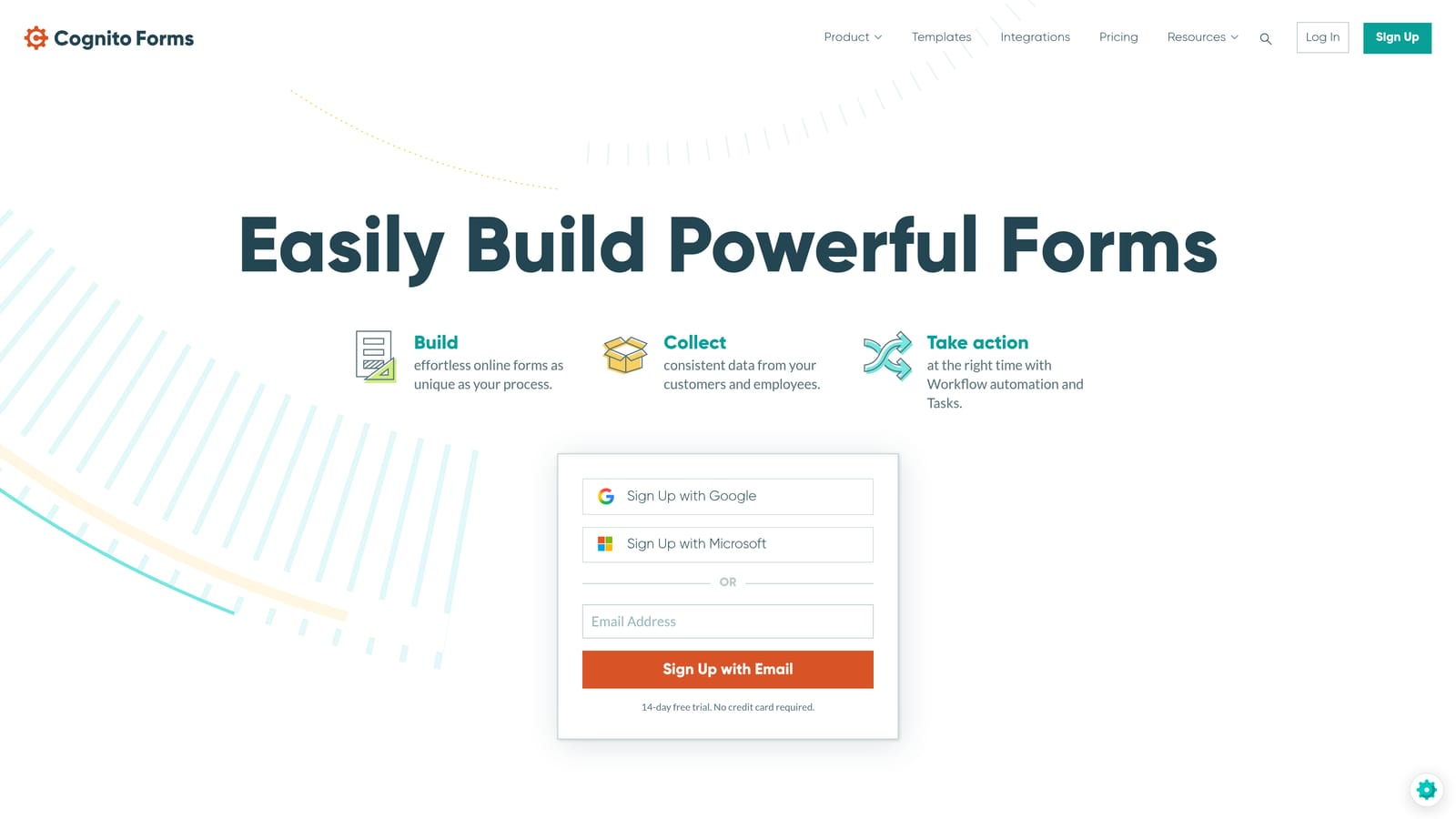
Cognito Forms is a form builder with standout native calculation fields, ideal for building math-heavy financial forms without writing code.
Where This Tool Shines
Cognito Forms occupies a genuinely unique niche in this list: it handles calculations better than almost any other form builder at its price point. You can build a loan payment estimator, a fee calculator, or a quote generator using formula-based fields that update dynamically as users fill out the form. For financial services teams that typically rely on developers or spreadsheets for this kind of functionality, this is a meaningful capability.
Repeating sections are another standout feature. If you need clients to list multiple assets, liabilities, or income sources, repeating sections let users add rows dynamically, and the calculation fields can aggregate those values automatically. This is exactly the kind of functionality that complex financial intake forms require.
Key Features
Native Calculation Fields: Build loan calculators, fee estimators, and quote tools using formula-based fields with no code required.
Repeating Sections: Allow users to add multiple entries for assets, liabilities, or income sources with automatic aggregation.
Payment Collection: Accept payments via Stripe directly within forms.
Conditional Logic: Show or hide fields and sections based on prior answers for personalized financial intake flows.
Generous Free Plan: Unlimited forms with a functional free tier, making it accessible for smaller teams.
Best For
Cognito Forms is ideal for mortgage brokers, financial advisors, and insurance agents who need to embed calculators and estimators in their client intake process without developer resources. The UI is less polished than some competitors, but the functional depth is hard to match at this price.
Pricing
Free plan available with unlimited forms. Paid plans start at $15/month for additional features and submission volume.
7. Wufoo
Best for: Simple, reliable financial data collection with built-in payment integrations and reporting dashboards.
Wufoo is one of the original SaaS form builders, offering reliable basic financial data collection with payment integrations and built-in reporting.
Where This Tool Shines
Wufoo earns its place on this list through reliability and simplicity. For finance teams that need a quick, no-fuss form for event registration, basic client intake, or internal data collection, Wufoo delivers without a steep learning curve. Its built-in report and dashboard builder lets non-technical team members visualize submission data without exporting to a spreadsheet.
It's worth being transparent: Wufoo's feature development has slowed considerably compared to newer competitors. Teams with growing complexity in their form requirements often find themselves looking for alternatives. But for straightforward, low-volume use cases, it remains a dependable option with a low barrier to entry.
Key Features
Payment Integrations: Accepts payments via Stripe, PayPal, and Authorize.net for application fees or service charges.
Built-In Reporting Dashboard: Visualize form submission data without exporting, useful for non-technical finance team members.
Branching Logic: Basic conditional logic for routing respondents through different question paths.
Simple Drag-and-Drop Editor: Accessible form building for teams without technical resources.
API Access: Connect to custom integrations for teams with development resources.
Best For
Wufoo suits small financial services firms, independent advisors, or internal finance teams with simple, low-volume data collection needs. Teams expecting significant growth or increasing workflow complexity will likely outgrow it.
Pricing
Free plan available with limited entries. Paid plans start at $14.08/month, making it one of the more affordable options on this list.
8. Tally
Best for: Quickly prototyping financial intake forms or handling low-stakes internal data collection on a tight budget.
Tally is a Notion-inspired form builder with a generous free plan, great for teams that need clean, functional forms without a significant time or financial investment.
Where This Tool Shines
Tally's block-based editor will feel immediately familiar to anyone who uses Notion, which makes onboarding essentially instant. The free plan is genuinely generous: unlimited forms and unlimited responses with no submission caps. For finance teams that need to spin up an internal expense request form, a client feedback survey, or a preliminary intake questionnaire, Tally removes every barrier to getting started.
The clean, minimal design also means forms look professional without any styling effort. Conditional logic and hidden fields cover the basics for personalized form paths, and Zapier and Make integrations connect Tally to most downstream tools your team already uses.
Key Features
Unlimited Free Plan: Unlimited forms and responses on the free tier, no submission caps or time limits.
Block-Based Editor: Notion-style editing interface with a minimal learning curve for non-technical users.
Conditional Logic and Hidden Fields: Basic personalization and routing capabilities for financial intake flows.
Zapier and Make Integrations: Connect to CRM, email, and workflow tools through popular automation platforms.
Clean Embed Support: Embeds neatly into websites and client portals without styling conflicts.
Best For
Tally is ideal for internal finance team workflows, early-stage fintech teams prototyping their intake process, or any scenario where budget is the primary constraint. It is not compliance-certified for regulated financial data, so it should not be used for sensitive client-facing collection in regulated environments.
Pricing
Free plan available with unlimited forms and responses. Tally Pro is $29/month for additional customization and branding options.
9. Google Forms
Best for: Internal finance team data collection within Google Workspace environments.
Google Forms is a free, no-frills form builder deeply integrated with Google Sheets, best suited for internal data collection rather than client-facing financial workflows.
Where This Tool Shines
Google Forms earns its place on this list through one undeniable strength: it costs nothing and requires no setup for teams already in Google Workspace. For internal use cases like expense tracking, team availability surveys, internal audit checklists, or budget request forms, it gets the job done with zero friction. Response data flows directly into Google Sheets in real time, making it easy for finance teams to analyze submissions without any export steps.
The honest caveat is that Google Forms is not appropriate for client-facing financial data collection. It lacks the security controls, compliance certifications, and design flexibility that finance clients expect. Think of it as a reliable internal tool rather than a client experience platform.
Key Features
Completely Free: No cost with any Google account, and included in all Google Workspace plans.
Real-Time Google Sheets Sync: All responses populate a connected spreadsheet automatically for easy analysis.
Basic Conditional Logic: Section branching allows simple routing based on respondent answers.
Google Workspace Integration: Seamless sharing and collaboration within existing Google organizational accounts.
Simple Survey and Quiz Functionality: Handles basic internal data collection, polls, and knowledge checks.
Best For
Google Forms is the right tool for internal finance team workflows within Google Workspace organizations. It should not be used for collecting sensitive client financial data, running KYC processes, or any client-facing intake where security and design matter.
Pricing
Free with any Google account. Google Workspace plans start at $6/user/month for business features and admin controls.
Which Form Builder Is Right for Your Finance Team?
The right tool depends almost entirely on what you're trying to accomplish. Here's a quick breakdown to help you decide.
If lead qualification and conversion optimization are your primary goals, Orbit AI is the clear choice. It's the only platform on this list purpose-built for financial services teams focused on qualifying the right leads faster, with AI agents that do the heavy lifting automatically.
For compliance-heavy workflows that require e-signatures and certified data handling, JotForm leads the pack. Its HIPAA and SOC 2 certifications, combined with JotSign and payment collection, make it the most capable all-in-one option for regulated financial intake.
Enterprise teams with deep Salesforce dependencies and document automation needs will find Formstack the most capable platform. The price reflects the sophistication, but for large institutions, the ROI on workflow automation is substantial.
If your financial services website runs on WordPress, Gravity Forms is hard to beat. The flat annual licensing model also makes it cost-effective for high-volume operations. Teams that need embedded calculators and estimators without developer resources should look seriously at Cognito Forms, which handles math-heavy forms better than anyone else at its price point.
For teams on a tight budget or just getting started, Tally's free plan is genuinely impressive for internal workflows and prototyping. Google Forms covers the basics for internal Google Workspace teams at no cost. Typeform and Wufoo round out the list for teams prioritizing user experience and simplicity, respectively.
The right form builder for finance isn't just about collecting data. It's about qualifying the right leads faster, staying compliant, and reducing friction for clients. Most tools on this list offer free plans or trials, so the best move is to test two or three against your actual use case before committing.
If you're a high-growth financial services team focused on lead generation, start with Orbit AI. Transform your lead generation with AI-powered forms that qualify prospects automatically while delivering the modern, conversion-optimized experience your team needs. Start building free forms today and see how intelligent form design can elevate your conversion strategy.


